Enescu: Octet
Mendelssohn: Octet
Quatuor Ébène, Belcea Quartet
Erato 5021732997296 (CD). 2026. Fabrice Planchat, prod., eng.
Performance ***
Sonics **** The popular Mendelssohn begins forthrightly but uneasily: The main lines ought to stand in sharper relief. As the harmonies become more conflicted, the sonority has nowhere to go. After a minute or so, everyone settles in, though the dry, unalluring tone remains a problem throughout. The players shift moods on a dime, with unmarked Luftpausen effectively separating the sections. The agitated development, wandering into uncharted harmonies, becomes almost morbid. The players almost neglect to signal the recap. Dry lower strings compromise the Andante's gloomy start: The higher voices improve the sound and the mood. The contrapuntal overlaps are gently nudged along until the music turns unexpectedly stark. The Scherzo, light and bustling, gets just the right sort of forward motion. The lower strings are a scrambled muddle at the Presto's start, but this lively moto perpetuo rides along on sheer energy and thrust.
Despite the tempo indications in French, Enescu's Octet is about as un-French as you can get. After an imposing start, the first movement's theme tosses back and forth with folklike stresses. In the development, a pulsing accompaniment turns edgy. A broadly lyrical, almost glamorous episode highlights a problem: The sequence of episodes feels logical, but the formal logic isn't clear. So, too, with a similarly lyrical episode in the busy, angular Très fougueux. The solemn chorale of the Lentement, intense and inward, opens into a passionate yearning that finally caught my attention; the movement heads without pause into the finale. The astringent counterpoint is no more "difficult" than in late Strauss, and the "mouvement de valse" manages to cut through the busywork. The players' lack of tonal beauty is less of a demerit here, and they project their compatriot's score with enthusiasm.—Stephen Francis Vasta
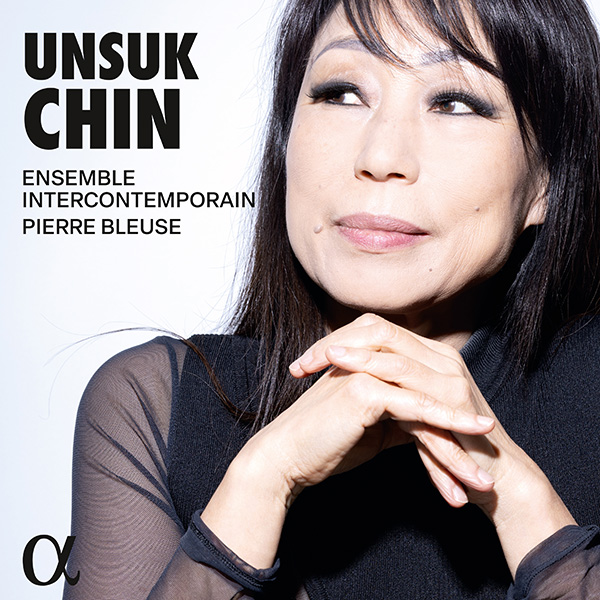 Unsuk Chin: Unsuk Chin
Ensemble Intercontemporain, Pierre Bleuse, cond.
Alpha 12000 (CD; reviewed as 24/96). 2025. Preben Iwan, prod., eng.
Performance ****
Sonics ***½ The music of Korean expatriate Unsuk Chin, who has lived in Germany since she began studying with György Ligeti 41 years ago, is certain to divide opinion. Some will embrace its unapologetically brash, sometimes violent explosions of color and timbre. Others will flee.
This extremely airy and dynamic recording offers three works, performed by Ensemble Intercontemporain. Founded by Pierre Boulez in 1976, the resident chamber ensemble of the Philharmonie de Paris is one of France's contemporary music equivalents to Germany's Akademie für Alte Musik Berlin.
The recording opens with the Gougalõn, Street Theatre Scenes for Ensemble. Even though the six "episodes" of this startling 19-minute work seem to reflect the sounds of the Korean amateur street ensembles that Chin heard in her childhood, she insists that the music is "imaginary folk music that is stylized, fractured and only appears to be primitive."
The influence of Ligeti, which I sense in Chin's penchant for constant surprises that can oscillate between extreme flashes of brilliance, haunting nightmares, drug-induced fantasies, and the cartoonish, can variously induce states of wonder and endless questions about what is going on. Chin claims that Graffiti, her 2013 work for large ensemble, is "neither illustrative nor programmatic" but rather based in "the dialectic between primitivism and refinement that caught my eye in some remarkable examples of street art." As I listened, I imagined, variously, graffiti artists dashing about, scaling structures to leave their mark, and stealing hither and thither in the mists of night. I'll leave it to you to discover the wonders in her Double Concerto for Piano, Percussion, and Ensemble. Percussionist Samuel Favre is astounding.—Jason Victor Serinus
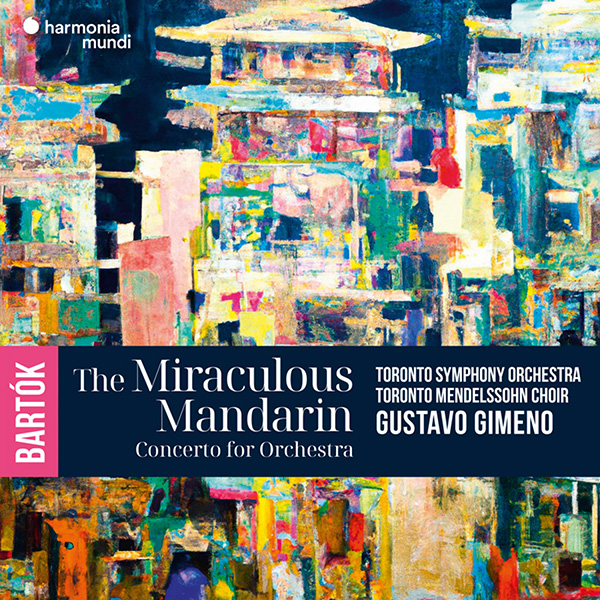 Bartók: The Miraculous Mandarin, Concerto For Orchestra
Lebel: The Sediments
Toronto Symphony Orchestra, Toronto Mendelssohn Choir/Gustavo Gimeno
Harmonia Mundi HMM 905 365 (CD). Karel Bruggeman, prod.; Jacob Steingart, eng.
Performance ***
Sonics ***½ Conductors used to play the Mandarin, particularly its opening, for its percussive aggressiveness. Recently, they've begun to seek out its subtler expressive values. The Toronto Symphony's sonority, lighter than that of higher-octane orchestras, helps ensure that buoyancy takes precedence over barbarity. Gimeno's performance benefits from sensitive reeds—especially the clarinet and plaintive oboe—and they relish their fluttering interplay in the Third seduction. He underlines the kinship between The chase and Salome's Dance, and we can hear the opening trumpet motif 's return later. The violin sound is firm and unified; the brass punctuations in the First seduction have a punchy edge, but they could be more assertive elsewhere. Despite fine moments, the performance feels aimless. So does Emilie Cecilia LeBel's dissonant, anodyne the sediments, a TSO commission.
The spacious bassi that open the Concerto's first and third movements feel cautious; so do the Finale's violin articulations, controlled rather than whirling. But generally, there's plenty of thrust, as with the main subject's incisive strong chords, or the Finale's opening gesture. The Intermezzo's lyric theme is unusually fervent, and the march tutti has a hearty swing. The Finale's "overlaps" tremble vividly, and the accentuations later are very Hungarian folk. The first movement's brass pyramids are static, but their recap at the end is full. The reeds are again fine, though they're never really quiet in the lighter textures.
The brass choir in the Concerto is full and deep, as is the resonant bass clarinet in the Mandarin; the vivid, duetting woodwind soloists sound highlighted in the Giuoco delle coppie.—Stephen Francis Vasta
 Various composers: 25 × 25
Sõ Percussion: Eric Cha-Beach, Josh Quillen, Adam Sliwinski, Jason Treuting
Cantaloupe Music 0713746321024 (8 CDs; reviewed as 24/48). 2025. Sõ Percussion, Matt Poirier, prods.; Poirier, Nelson Dorado, others, engs.
Performance *****
Sonics ****
After 25 years of the ensemble's existence, the four men of Sõ Percussion have assembled new recordings of works by 25 of their "favorite collaborators." The eight-CD box, also available in 24/48, is organized into eight groupings: Quartet, Keyboard, Electronics, String Quartets, Composer-Performers, Live from Princeton, From Out a Darker Sea (their own composition), and Amid the Noise Live (works by Sõ's own artist/composer, Jason Treuting).
It is fair to question "ourselves" as a collaborator. Yet new percussion works by Caroline Shaw, Steve Mackey, Angélica Negrón, Donnacha Dennehy, Vijay Iyer, and many others are ear/soul candy for those eager to expand their perspectives on the intersecting universes of music and sound.
The sound, in and of itself, is one of the rewards. Take Disc 2: Keyboard. The music in Dennehy's five-part "Broken Unison" is gorgeous, and the colors and ambience thrilling. I loved the contrast of the high tinkle of metallic vibraphones and glockenspiel with the deeper sounds of wooden marimba and resonant drum. In Iyer's "Torque," the big draw is the rhythms. Dan Deacon's "Purse Handler," performed in part by SõSI 2012, and Suzanne Farrin's "diamond in the square" present yet other, entirely different sound worlds.
For a major switch, turn to Dan Trueman's "Machines for Listening with Sõ" on Disc 3, Electronics, and listen as music that sounds frighteningly like a 1950s lounge act morphs into another section that incorporates recordings of crowds. Sample Live from Princeton and discover, on Caroline Shaw's "Narrow Sea," Alicia Olatuja and Dawn Upshaw's distinctive voices melding with Gilbert Kalish's renowned pianism. One amazing opportunity after another.—Jason Victor Serinus
Mendelssohn: Octet
Quatuor Ébène, Belcea Quartet
Erato 5021732997296 (CD). 2026. Fabrice Planchat, prod., eng.
Performance ***
Sonics **** The popular Mendelssohn begins forthrightly but uneasily: The main lines ought to stand in sharper relief. As the harmonies become more conflicted, the sonority has nowhere to go. After a minute or so, everyone settles in, though the dry, unalluring tone remains a problem throughout. The players shift moods on a dime, with unmarked Luftpausen effectively separating the sections. The agitated development, wandering into uncharted harmonies, becomes almost morbid. The players almost neglect to signal the recap. Dry lower strings compromise the Andante's gloomy start: The higher voices improve the sound and the mood. The contrapuntal overlaps are gently nudged along until the music turns unexpectedly stark. The Scherzo, light and bustling, gets just the right sort of forward motion. The lower strings are a scrambled muddle at the Presto's start, but this lively moto perpetuo rides along on sheer energy and thrust.
Unsuk Chin: Unsuk ChinEnsemble Intercontemporain, Pierre Bleuse, cond.
Alpha 12000 (CD; reviewed as 24/96). 2025. Preben Iwan, prod., eng.
Performance ****
Sonics ***½ The music of Korean expatriate Unsuk Chin, who has lived in Germany since she began studying with György Ligeti 41 years ago, is certain to divide opinion. Some will embrace its unapologetically brash, sometimes violent explosions of color and timbre. Others will flee.
Bartók: The Miraculous Mandarin, Concerto For OrchestraLebel: The Sediments
Toronto Symphony Orchestra, Toronto Mendelssohn Choir/Gustavo Gimeno
Harmonia Mundi HMM 905 365 (CD). Karel Bruggeman, prod.; Jacob Steingart, eng.
Performance ***
Sonics ***½ Conductors used to play the Mandarin, particularly its opening, for its percussive aggressiveness. Recently, they've begun to seek out its subtler expressive values. The Toronto Symphony's sonority, lighter than that of higher-octane orchestras, helps ensure that buoyancy takes precedence over barbarity. Gimeno's performance benefits from sensitive reeds—especially the clarinet and plaintive oboe—and they relish their fluttering interplay in the Third seduction. He underlines the kinship between The chase and Salome's Dance, and we can hear the opening trumpet motif 's return later. The violin sound is firm and unified; the brass punctuations in the First seduction have a punchy edge, but they could be more assertive elsewhere. Despite fine moments, the performance feels aimless. So does Emilie Cecilia LeBel's dissonant, anodyne the sediments, a TSO commission.
Various composers: 25 × 25Sõ Percussion: Eric Cha-Beach, Josh Quillen, Adam Sliwinski, Jason Treuting
Cantaloupe Music 0713746321024 (8 CDs; reviewed as 24/48). 2025. Sõ Percussion, Matt Poirier, prods.; Poirier, Nelson Dorado, others, engs.
Performance *****
Sonics ****