Sidebar 3: Measurements
I used my Audio Precision SYS2722 system to measure the Eversolo AMP-F10. I performed a complete set of tests in Stereo mode, then repeated some of the tests with the two channels operated in Bridged Mono mode. I preconditioned the amplifier at 1/8 the maximum power into 8 ohms for 30 minutes before starting the testing. At the end of that time, the heatsinks were almost too hot to touch, at 139.1°F/59.5°C. The top panel's temperature measured 108.5°F/42.5°C. This amplifier needs plenty of ventilation.
Looking first at the Eversolo's behavior in Stereo: The amplifier preserved absolute polarity with both the balanced and single-ended inputs. The balanced input is wired with pin 2 hot, the AES standard. The Sensitivity switch on the rear panel allows the gain to be set to "23dB" or "29dB." The voltage gain at 1kHz into 8 ohms was 22.1dB, balanced input, and 22.6dB, single-ended input, with the "23dB" setting. At the "29dB" setting, the gain into 8 ohms was 29.02dB, balanced, and 29.5dB, single-ended. The balanced input impedance was close to the specified 10k ohms, at 9.85k ohms from 20Hz to 20kHz. However, the unbalanced input impedance, which is also specified as 10k ohms, was 4k ohms across the audioband.
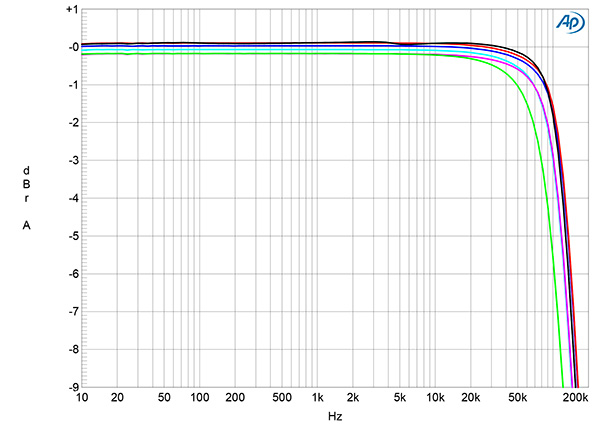
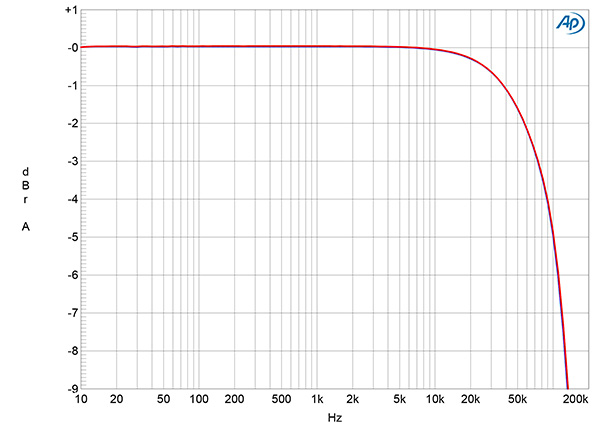
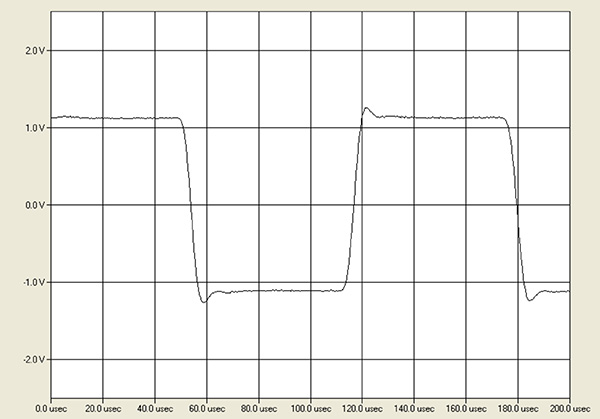
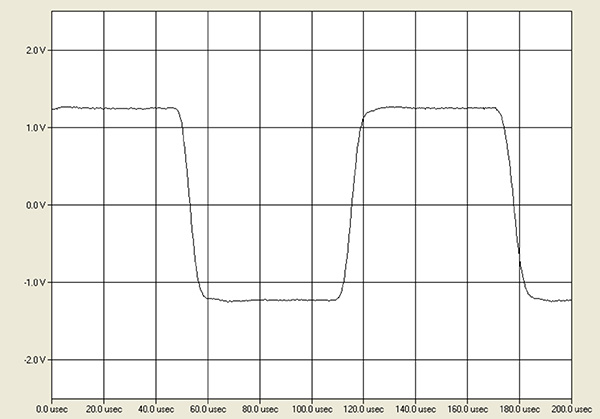
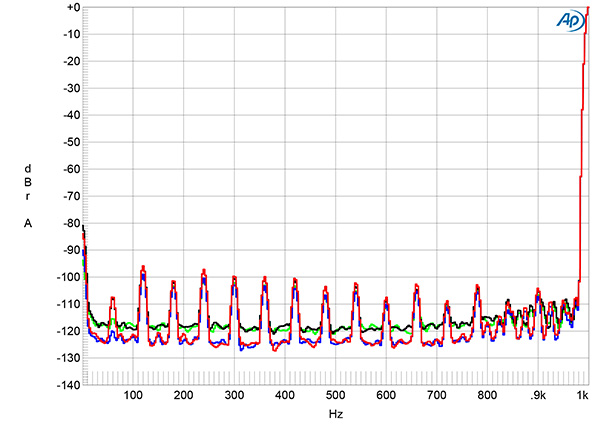
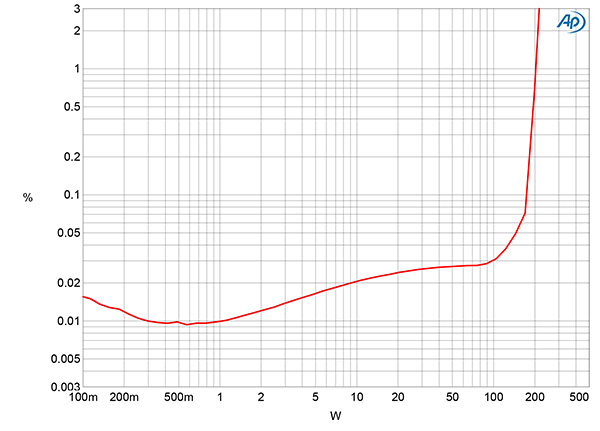
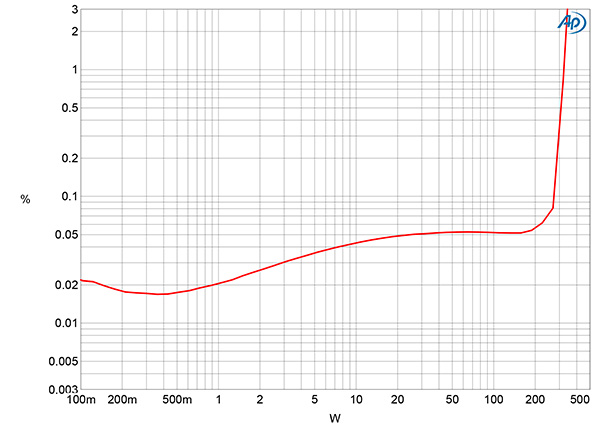
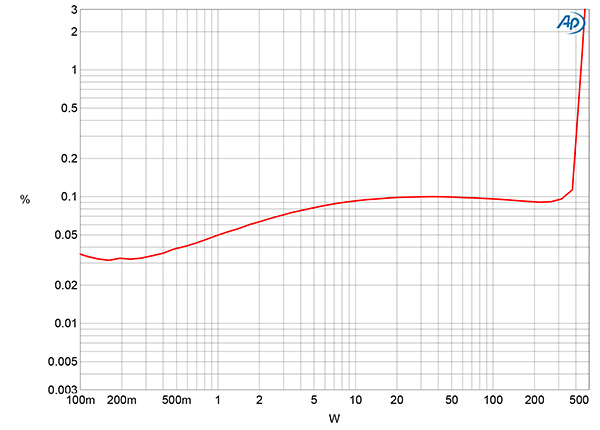
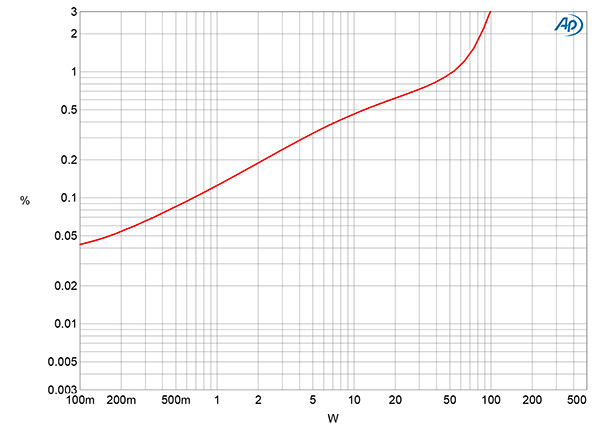
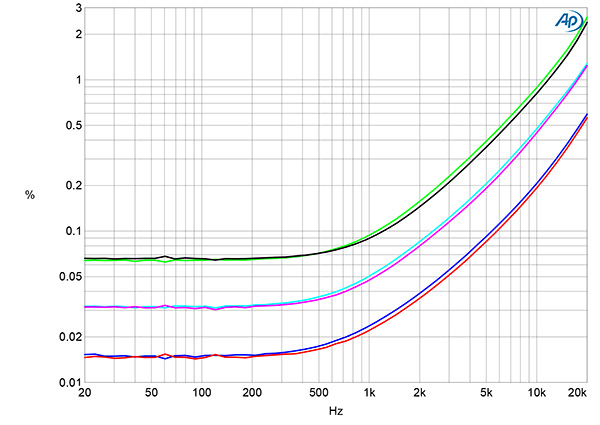
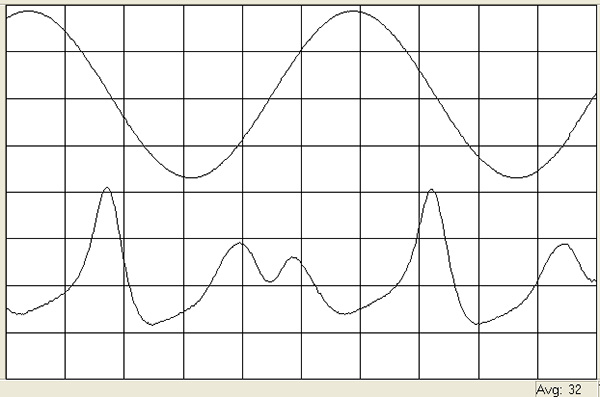
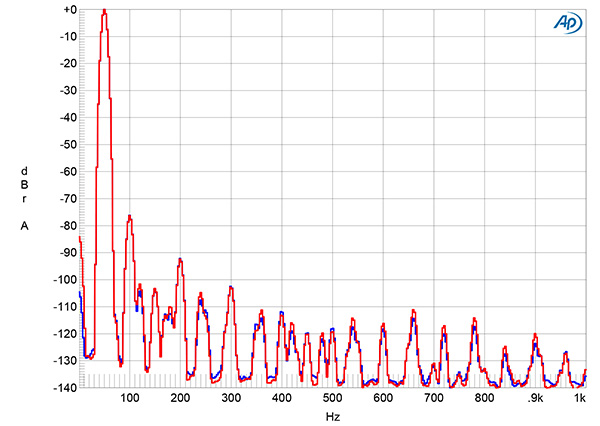
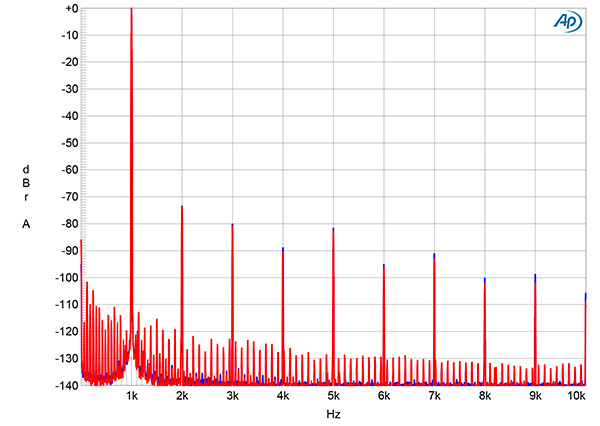
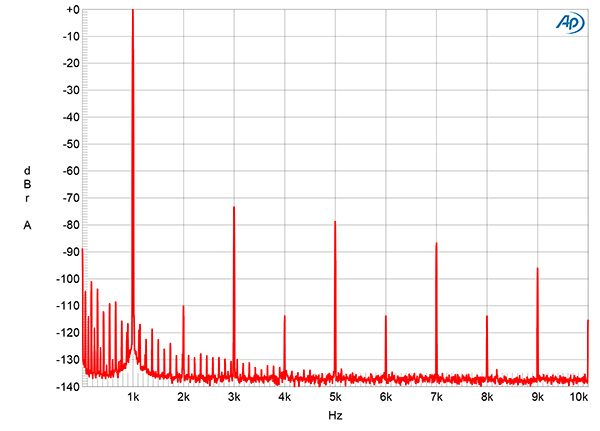
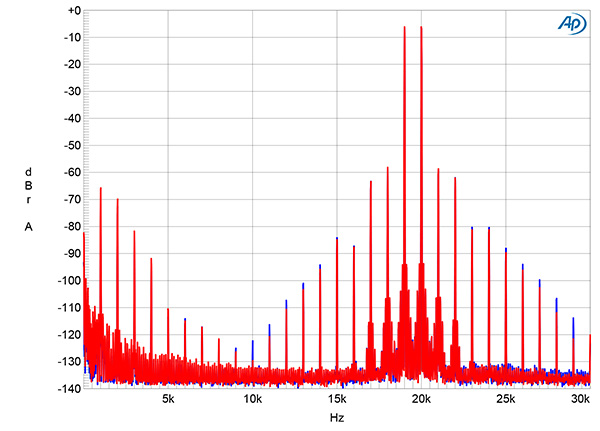
Fig.1 Eversolo AMP-F10, sensitivity set to "23dB," frequency response at 2.83V into: simulated loudspeaker load (gray), 8 ohms (left channel blue, right red), 4 ohms (left cyan, right magenta), and 2 ohms (green) (1dB/vertical div.).
Fig.2 Eversolo AMP-F10, sensitivity set to "29dB," frequency response at 2.83V into 8 ohms (left channel blue, right red) (1dB/vertical div.).
The output impedance was low, at 0.03 ohms at 20Hz and 1kHz, 0.015 ohms at 20kHz. As a result, the variation in the amplifier's frequency response with our standard simulated loudspeaker (fig.1, gray trace) was negligible. The response into resistive loads was flat up to 40kHz, rolling off by 3dB at 110kHz into 8 ohms (blue, red traces), at 100kHz into 4 ohms (cyan, magenta traces), and at 80kHz into 2 ohms (green trace). This graph was taken with the gain set to "23dB." Set to "29dB," the Eversolo's frequency response started to roll off above 20kHz, reaching –3dB at 74kHz into 8 ohms (fig.2).
Fig.3 Eversolo AMP-F10, sensitivity set to "23dB," small-signal 10kHz squarewave into 8 ohms.
Fig.4 Eversolo AMP-F10, sensitivity set to "29dB," small-signal 10kHz squarewave into 8 ohms.
While the AMP-F10's reproduction of a 10kHz squarewave into 8 ohms with the sensitivity set to "23dB" featured short risetimes (fig.3), there was a small, critically damped overshoot on the waveform's leading edges. This was absent with the amplifier set to "29dB" (fig.4).
In Bridged Mono mode, the gains in the "23dB" and "29dB" settings were, respectively, 27.9dB and 34.8dB. As there are now two output stages in series, the output impedance was significantly higher, at 0.25 ohms in the bass and midrange, dropping to 0.2 ohms at the top of the audioband. The frequency response in this mode was still flat in the audioband but was down by 3dB at 74kHz with the sensitivity set to "23" and at 52kHz with it set to "29dB."
Fig.5 Eversolo AMP-F10, spectrum of 1kHz sinewave, DC–1kHz, at 1W into 8 ohms with sensitivity set to "23dB" (left channel blue, right red) and to "29dB" (left green, right gray) (linear frequency scale).
Back to Stereo mode: the channel separation was excellent, at >110dB in both directions below 3kHz and still 83dB at 20kHz. The Eversolo's unweighted, wideband signal/noise ratio, taken with the input shorted to ground and the sensitivity set to "23dB," was a very good 79dB ref. 1W into 8 ohms (average of both channels). This ratio improved to 86.5dB when the measurement bandwidth was restricted to the audioband, and to 88.5dB when A-weighted. The S/N ratios were 3–4dB lower with the sensitivity set to "29dB." Spectral analysis of the low-frequency noisefloor while the Eversolo set to "23dB" drove a 1kHz tone at 1Wpc into 8 ohms revealed that the random noisefloor was very low in level, at –124dB (fig.5, blue and red traces). Repeating the analysis at "29dB" raised the level of the random noisefloor by approximately 5dB (green and gray traces). However, power supply–related spuriae at 60Hz and its even- and odd-order harmonics were present in both sensitivity modes. The levels of these spuriae didn't change when I connected a wire from the grounding terminal on the amplifier's rear panel to the Audio Precision analyzer's chassis ground.
Fig.6 Eversolo AMP-F10, distortion (%) vs 1kHz continuous output power into 4 ohms.
Fig.7 Eversolo AMP-F10, distortion (%) vs 1kHz continuous output power into 4 ohms.
Fig.8 Eversolo AMP-F10, distortion (%) vs 1kHz continuous output power into 2 ohms.
Eversolo specifies the AMP-F10's maximum power as 200Wpc into 8 ohms (23dBW), 320Wpc into 4 ohms (22dBW), and 450Wpc into 2 ohms (20.5dBW). We define clipping as when the THD+noise reaches 1%. With both channels driven and in both sensitivity modes, the Eversolo amplifier slightly exceeded the specified powers with a 1kHz signal into the higher impedances, clipping at 205W into 8 ohms (23.1dBW, fig.6) and 325W into 4 ohms (22.1dBW, fig.7). The amplifier clipped at 430Wpc into 2 ohms (20.3dBW, fig.8), but it is fair to note that the wall voltage, which was 121.6V with the Eversolo idling, had dropped to 117.8V with the amplifier clipping into 2 ohms.
Fig.9 Eversolo AMP-F10, distortion (%) vs 20kHz continuous output power into 8 ohms.
The FTC's updated "Amplifier Rule" states that maximum power should also be assessed at frequencies other than 1kHz. I therefore repeated the clipping test with a 20kHz signal. Unfortunately, the THD+N reached 1% at just 55Wpc into 8 ohms (17.3dB, fig.9) at this frequency.
In Bridged Mono mode, the Eversolo's specified powers are 650W into 8 ohms (28.13dBW) and 950W into 4 ohms (26.77dBW). I measured clipping powers of 605W into 8 ohms (27.8dBW) and 900W into 4 ohms (26.5dBW), though the AC wall voltage had respectively dropped to 116.7V and 115.1V when the amplifier was clipping into these loads.
Fig.10 Eversolo AMP-F10, THD+N (%) vs frequency at 12.67V into: 8 ohms (left channel blue, right red), 4 ohms (left channel cyan, right magenta), and 2 ohms (left channel green, right gray).
I examined how the AMP-F10's THD+N percentage in Stereo mode varied with frequency at 12.67V, which is equivalent to 20W into 8 ohms, 40W into 4 ohms, and 80W into 2 ohms (fig.10). The THD+N was very low in the bass and midrange into 8 ohms (blue and red traces), but doubled with each halving of the load impedance (cyan, magenta, green, and gray traces). More importantly, the THD+N rose precipitously at higher frequencies. This will be due to the amplifier having a limited open-loop bandwidth, which means that the amount of corrective negative feedback reduces as the frequency rises. This behavior is the reason for the limited clipping power at 20kHz.
Fig.11 Eversolo AMP-F10, 1kHz waveform at 50W into 8 ohms, 0.027% THD+N (top); distortion and noise waveform with fundamental notched out (bottom, not to scale).
Fig.12 Eversolo AMP-F10, spectrum of 50Hz sinewave, DC–1kHz, at 50Wpc into 8 ohms (left channel blue, right red, linear frequency scale).
The distortion waveform with a 1kHz tone at 50W into 8 ohms was dominated by low-order harmonics (fig.11). Spectral analysis with a 50Hz tone (fig.12) revealed that the second and fourth harmonics were the highest in level, with the second lying at –77dB (0.014%). The spectrum at the same voltage into 4 ohms was similar, though the second harmonic had risen to –70dB (0.03%).
Fig.13 Eversolo AMP-F10, spectrum of 1kHz sinewave, DC–1kHz, at 50Wpc into 8 ohms (left channel blue, right red, linear frequency scale).
Fig.14 Eversolo AMP-F10, bridged-mono mode, spectrum of 1kHz sinewave, DC–1kHz, at 50Wpc into 8 ohms (linear frequency scale).
Repeating the spectral analysis with a 1kHz signal (fig.13) indicated that odd-order harmonics were now present, though still at levels lower than the second. As expected, the levels of the even-order harmonics dropped by almost 40dB in Bridged Mono mode; with two output stages in series, the even-order harmonics in each stage are in opposite polarity and therefore cancel. With the amplifier in this mode driving 1kHz at 100W into 8 ohms, the third harmonic was now the highest in level, lying at –74dB (fig.14).
Fig.15 Eversolo AMP-F10, HF intermodulation spectrum, DC–30kHz, 19+20kHz at 100Wpc peak into 4 ohms (left channel blue, right red, linear frequency scale).
The AMP-F10's reduced linearity in the top audio octaves meant that when I examined the output spectrum with an equal mix of 19kHz and 20kHz tones at 100W peak into 4 ohms, while the difference product at 1kHz lay at –66dB (0.05%), the higher-order intermodulation products at 17kHz, 18kHz, 21kHz, and 22kHz were higher in level. The levels of harmonic and intermodulation distortion were very similar with both sensitivity settings.
Although the Eversolo AMP-F10 can deliver high powers into low impedances and the spectrum of its harmonic distortion is dominated by the subjectively innocuous second harmonic, I was concerned by the higher levels of distortion in the treble compared with those in the midrange and bass.—John Atkinson