Sidebar 3: Measurements
Ed Meitner's MDAT code has evolved over the last two decades from a 44.1kHz/SACD-centric platform to one that services both 44.1kHz and 48kHz base sample rates. This latest MDAT algorithm still employs a series of FIR digital filters whose characteristics are adapted by the transient conditions of the signal on a sample-by-sample basis, but this now operates at a much higher rate. MDAT2's upsampling takes all input sample rates (including DSD) to 256×; base 44.1/48kHz inputs begin with a 2× stage, followed by 8× then 16× (totaling 256×) to deliver the final 11.2896/12.288MHz data rate. Similarly, 176.4/192kHz inputs are upsampled by 4× and 16×, and 352.8kHz/384kHz by 2× and 16×. The 24-bit data is truncated to a 1-bit bitstream en route, delivering a mere 6dB dynamic range across what is eventually a 1024× (45.1584/49.152MHz) bandwidth. High (possibly fifth) order digital noise-shaping is employed to shift the excess noise to far higher frequencies, recovering a full ~120dB dynamic range in the audioband before the bitstream is addressed to EMM's custom MDAC2 bit converters.
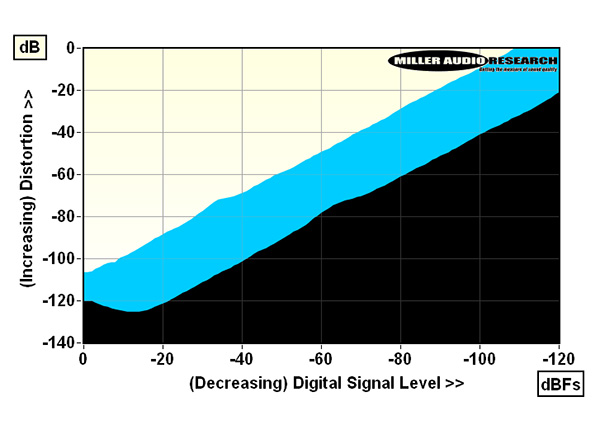
It largely holds this low distortion over the top 20dB of its dynamic range, dipping to a minimum of 0.00003% at –10dBFs. At 20kHz, THD+N is 0.0005% at 0dBFs, increasing with decreasing digital level to 0.005% at –30dBFs. Furthermore, because there is minimal (I hesitate to say "zero") requantisation noise within the 20Hz–20kHz audioband, the A-weighted S/N ratio remains a very respectable 116dB, and low-level resolution is good to ±0.1dB over a 100dB dynamic range (and ±0.2dB over a 110dB range).
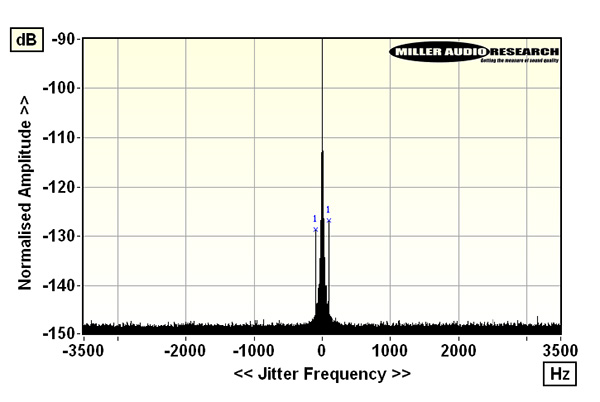
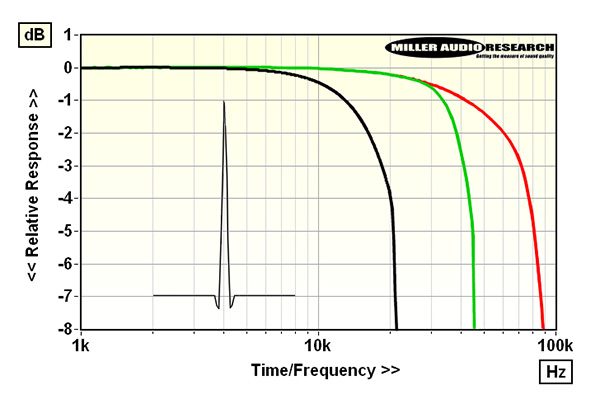
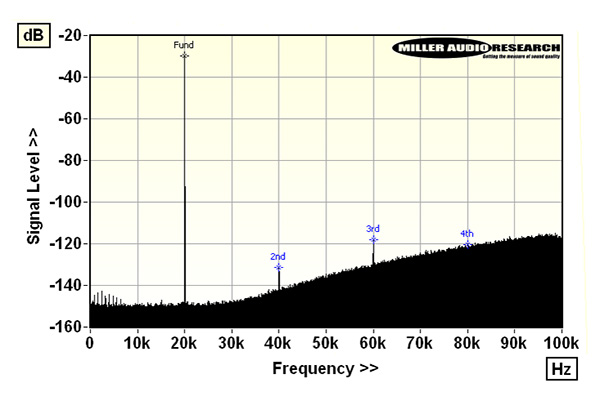
Fig.1 A single sine tone at 20kHz/–30dBFs (24-bit/48kHz) illustrating the gentle sweep of requantization noise that is "shaped" away from the audioband.
However, because the noise-shaping—a form of digital feedback—decreases with frequency, it's possible to "see" the noise rising outside the audio range, illustrated here by a 20kHz tone at –30dBFs (see fig.1). Look familiar? It should, because the shaped noise mirrors the ultrasonic spectrum of a 1-bit DSD256 audio file.
Fig.2 Distortion + noise versus 24-bit/48kHz digital signal level over a 120dB range (black, 1kHz; blue, 20kHz). Note 140dB Y axis.
This swell in requantization noise necessarily increases the THD+N measured at high frequencies (blue trace, fig.2); distortion through bass and midrange is exceptionally low, at 0.00017% (ref. 1kHz/0dBFs), where the DA2i's output reaches a high 6.84V in its maximum gain mode.
Fig.3 High-resolution jitter spectrum (24-bit/48kHz). Very minor PSU-related sidebands only.
Also illustrative of the DA2i's top-flight performance is the low phase noise and low correlated jitter: just 28ps (fig.3). This jitter manifests as a simple ±100Hz power-supply modulation.
One other benefit of Meitner's custom DAC regime is the freedom this gives the designer to accommodate digital headroom into the upsampled data. As the DA2i passed our intersample clipping test, I would estimate this at 2–3dB.
Fig.4 Time (impulse) and frequency responses with 48kHz (black), 96kHz (green), and 192kHz (red) inputs.
EMM Labs' digital filter remains something of a moving target. By design it is linear phase but with coefficients that offer the much smaller time-domain ripples of a slow roll-off type, trending to a NOS type with transient-rich signals—see fig.4—combined with the excellent, 106dB stopband rejection of a "fast" high-ripple filter. Responses roll away gently at HF in place of an abrupt cut-off with all sample rates, reaching –3.0dB at 20kHz, –5.1dB at 45kHz, and –9.1dB at 90kHz with 48kHz, 96kHz, and 192kHz media, respectively. Low bass is flat to 5Hz; the DA2i's source impedance is an equally flat 145 ohms from 5Hz to 20kHz.
Finally, stereo separation is a wide 125dB in the midband, holding to 115dB at 20kHz.
All told, the DA2i is a wonderful example of a proven technology, tastefully matured.—Paul Miller