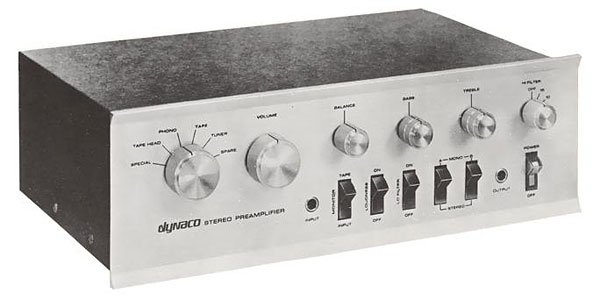
This review of one of the first solid-state preamplifiers was published in 1968. It includes some of JGH's first thoughts on the ongoing subject of "Accuracy vs. Musicality."
Preview, from July 1968 (Vol.2 No.6): Overall sound extremely good, but phono sounds slightly lacking in deep bass, despite impeccable measurements. Scratch filter judged very highly effective, but tone controls felt to be less than ideal because of excessively coarse action and marked tendency to affect midrange output. Spring-return Tape Monitor switch probably will not appeal to serious tapesters. This preamp is slated for a full report in the next issue.
The Review
Through long experience, we've come to expect a lot from Dynaco equipment. None of it has ever enjoyed the status value of the Marantzes and the Mclntoshes, perhaps because Dynakits are inexpensive and don't have that look of chromium-plated Class that impresses status-seekers. The strong points of Dyna's components usually aren't visible, they're audible. They just sound very good, some in fact being the sonic equals of the highest-priced Status models. And although Dyna's preamps have lacked some of the flexibility of the costlier ones, and recent models have had less-than-ideal tone control character: there were always enough inputs, outputs, and controls to do a job of preamping. This is why, though our exposure to other state preamps to date had left us unimpressed, we undertook the tests with considerable curiosity.
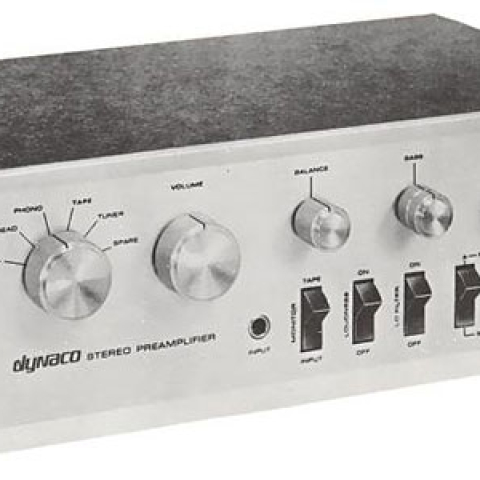
At first glance—and every second and third glances plus perusal of the specifications, the PAT-4 looks like nothing more than a solid-state version of Dyna's type PAS-3x preamplifier. There are differences, though, and some them are even visible.
The PAS-3x had provision for selecting full stereo separation, partial blending (to reduce ping-ponging of hyperstereo recordings) and full blending (A+B mono reproduction of two-channel sources, as well as the usual arrangement for piping either A or B input to both channels. The is the same except that the PAS-3x's blend mode has been eliminated. Instead, the A+B mono mode retains 6dB of separation, which is low enough to suppress vertical-tracking distortion when reproducing mono discs, but also enables the system to use the Hafler (Dynaco) center-speaker hookup arrangement without further system modification.
Also new in the PAT-4 are a front-panel input jack for a high-level stereo signal source, and a highly effective sharp-cutoff treble filter, for getting rid of noise and distortion from imperfect program material.
The PAT-4 has two extra outputs per channel, too. One stereo output jack is on the front panel, and there are two pairs of output receptacles at the rear of the preamp. One pair of these is operative at all times, but the other pair is controlled by the front-panel output jack, so that inserting a plug in the jack kills the signal from the controlled rear-panel receptacles. Thus, if the controlled receptacles are used to feed the power amplifier, the speakers will cut off automatically when a headset is plugged into the front-panel jack.
The front-panel outputs are in parallel with the main outputs, and deliver the same 600 ohms impedance. Dynaco advises the use of any head set having an impedance of 600 ohms or higher, but since high-impedance headphones aren't all that common, you'll probably end up using a pair of small matching transformers to drive 8-ohm phones. Most headphone makers can supply suitable transformers at moderate cost.
That controversial switch
The PAT-4 differs from previous Dyna preamps in one other minor respect, too, but this is one change that we question. As usual, this preamp has a TAPE MONITOR switch that allows a three-headed tape recorder to be inserted in series with the signal path, to allow monitoring from the playback head while recording. But unlike any other preamp we have seen, the PAT-4 has a spring-return MONITOR switch that selects the playback mode only as long as the switch is held down.
It has been our observation that most tape recordists who have three headed tape machines prefer to do most of their taping while listening to the playback from the tape. To do this with the PAT-4 would result in a very tired pinkie. On this preamp, you use the MONITOR switch to sample the tape's playback, or you jam a toothpick under the switch to keep it in the MONITOR position.
Our first question about this was Why the heck? To which Dynaco replied: Stupid customers, that's why! It seems that, ever since Dyna started including a tape monitor switch on their preamps, they have been plagued by customers who would flip the switch the wrong way, get no sound from any input, and bounce their preamps back to Dynaco for "servicing." Usually under warranty, at no cost (to said customer). The spring-loaded arrangement on the PAT-4 was Dyna's way of ensuring that the switch would stay in the Normal position except when the user decided that he wanted to monitor from tape.
We find it hard to believe that Dynaco is the only preamp manufacturer that has had this trouble. Yet no other manufacturer has, to our knowledge, felt it necessary to dilute the usefulness of the MONITOR function as a service to those customers who don't care to use it. Frankly, we don't think Dynaco has any right to blame those unnecessary "service" kickbacks on the stupidity of customers when there has been practically no effort made to warn the customer about this possible source of "trouble." A short paragraph in bold-face type in the "In Case of Trouble" section of the instruction manual would probably forestall 90% of the user problems with the MONITOR switch, and a little red tag attached to the back of the preamp might take care of another 5% of them. Instead, previous instruction manuals have had a single, eight-word sentence on the subject, buried in a paragraph about wiring errors, bad connections and short circuits. If the problem was severe enough to warrant the design change in the MONITOR switch, it certainly deserved more attention in the instruction manual than it got.
There's a standing gag in the manufacturing business that goes "If all else fails, read the instructions." And it is true that most people don't, if they can avoid doing so. But when all else fails, people will read the instructions, and they'll usually follow them if given the chance. We don't really think Dynaco gave them the chance.
As we noted, if you're not a serious tape recordist, the PAT-4's spring-return switch won't bother you. If you are, you can order a regular-type switch from Dynaco before you build the kit and use it instead. You can even make the necessary modification in a factory- built PAT-4, but it's a rather nasty job.
Sound Quality
So much for the features. How does the PAT-4 sound? One extremely critical test of any preamplifier is the "bypass test," whereby the sound coming out of it is compared with the same sound fed directly from the signal source into the power amplifier. We have never yet found any preamp that did not add at least a subtle coloration—a little extra bass or a little added high-end roughness—to the sound, although the PAS-3x and the Marantz 7C (not the 7T) came as close to perfection as anything we had ever tested. Now, both of these have been bettered—sonically, at least.
With all of its tone controls and filters set to Flat, and feeding any high-level input, we were simply unable to tell whether we were listening to the original "raw" signal or the output from the PAT-4. In this respect, we cannot see how any preamp, present or future, could surpass the PAT-4.
Accuracy?
This is not to say that everyone will like what he hears from it; some systems, and some ears, need the colorations introduced by other preamps. But if you like what you hear when you pipe your tuner or your tape machine directly into your power amp, with no intervening preamp, you'll like the same lack of coloration in the sound that passes through the PAT-4. We feel a little less positive about the PAT-4's performance on Phono inputs. As compared with other top preamplifiers, the PAT-4 sounded rather thin at the low end when reproducing discs. Equalization measurements were not at all enlightening; there was no more than 1dB of deviation from the RIAA curve down to 30Hz, below which there's little more than rumble on any disc
Through long experience, we've come to expect a lot from Dynaco equipment. None of it has ever enjoyed the status value of the Marantzes and the Mclntoshes, perhaps because Dynakits are inexpensive and don't have that look of chromium-plated Class that impresses status-seekers. The strong points of Dyna's components usually aren't visible, they're audible. They just sound very good, some in fact being the sonic equals of the highest-priced Status models. And although Dyna's preamps have lacked some of the flexibility of the costlier ones, and recent models have had less-than-ideal tone control character: there were always enough inputs, outputs, and controls to do a job of preamping. This is why, though our exposure to other state preamps to date had left us unimpressed, we undertook the tests with considerable curiosity.
The PAT-4 differs from previous Dyna preamps in one other minor respect, too, but this is one change that we question. As usual, this preamp has a TAPE MONITOR switch that allows a three-headed tape recorder to be inserted in series with the signal path, to allow monitoring from the playback head while recording. But unlike any other preamp we have seen, the PAT-4 has a spring-return MONITOR switch that selects the playback mode only as long as the switch is held down.
So much for the features. How does the PAT-4 sound? One extremely critical test of any preamplifier is the "bypass test," whereby the sound coming out of it is compared with the same sound fed directly from the signal source into the power amplifier. We have never yet found any preamp that did not add at least a subtle coloration—a little extra bass or a little added high-end roughness—to the sound, although the PAS-3x and the Marantz 7C (not the 7T) came as close to perfection as anything we had ever tested. Now, both of these have been bettered—sonically, at least.
This is not to say that everyone will like what he hears from it; some systems, and some ears, need the colorations introduced by other preamps. But if you like what you hear when you pipe your tuner or your tape machine directly into your power amp, with no intervening preamp, you'll like the same lack of coloration in the sound that passes through the PAT-4. We feel a little less positive about the PAT-4's performance on Phono inputs. As compared with other top preamplifiers, the PAT-4 sounded rather thin at the low end when reproducing discs. Equalization measurements were not at all enlightening; there was no more than 1dB of deviation from the RIAA curve down to 30Hz, below which there's little more than rumble on any disc