In the introduction to "Recommended Components" in the final issue in Volume One of what was then called The Stereophile, published in May 1966, founder J. Gordon Holt briefly described his Top-Rated Loudspeaker Systems.
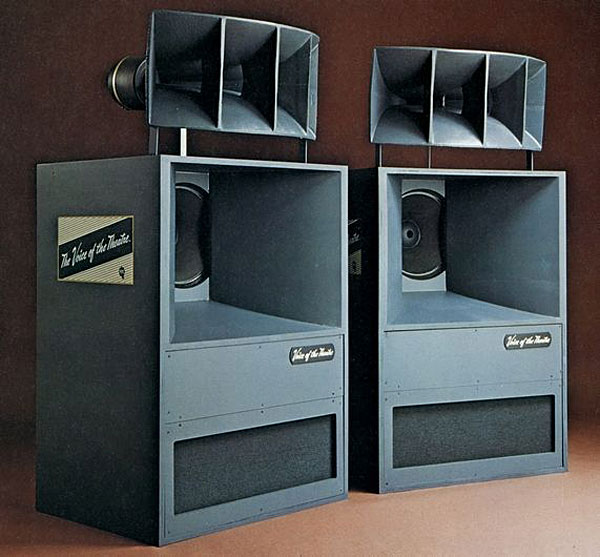
Altec A-7
A highly efficient horn-loaded system for use in large to very large listening rooms (at least 15' from the listening area), or for very high-volume "Row-A" listening. Excellent woofer-tweeter blending, moderately deep (useful 45Hz limit in most rooms) and very taut, well-defined low end. Highs smooth and slightly soft, yielding most natural high-end quality at high listening levels. Middles smooth, rather forward, placing closely miked instruments somewhat in front of the system itself. A very lifelike, natural-sounding system in most acoustical environments. Stereo imaging good but not phenomenal; system configuration allows placement against one wall, for adjustment of stereo spread.
Electro-Voice Patrician 800
A highly efficient, corner-type horn system for use in very large listening rooms (at least 20' from the listening area) or for very high-volume Row-A listening. Driver blending (five units) moderately good. Bass (in corner location) slightly heavy and "wooly"—not outstandingly well-damped—good to a usable 20Hz in a suitable room. Wide range of driver level adjustment provides choice of very forward, hard sound, dull, heavy sound, or just about anything in between. Individual drivers are moderately smooth, but with some colorations of their own.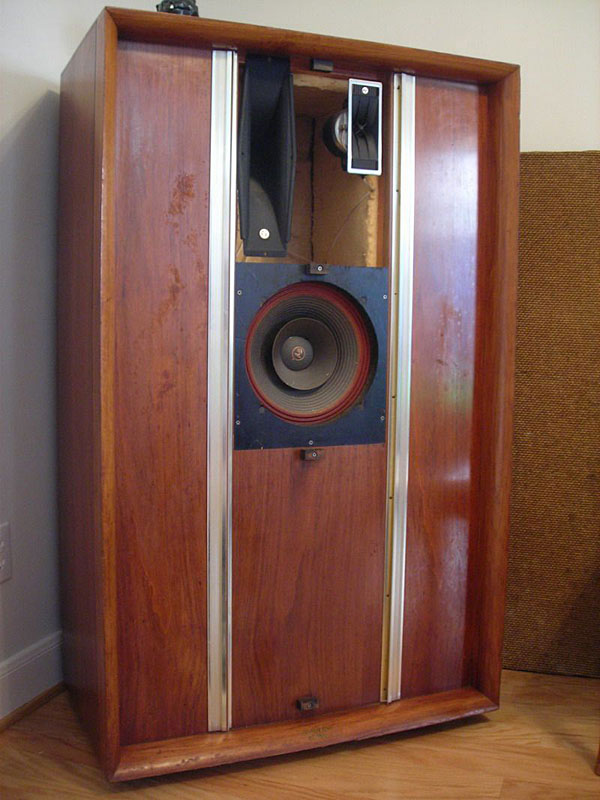 With balance set for "Row-M" perspective, sound tends to be somewhat rough and confused. Overall realism improves, up to a point, as balances are set for more forward sound. At optimum settings (dependent on room size and acoustics), sound is "authoritarian"-realistic, fairly natural, although slightly favoring brass instruments, and quite "immediate," yielding a strong illusion of "performers in the room." Disc surface noise slightly exaggerated, with a predominantly "papery" coloration.
Corner placement will generally impair the stereo imaging, but the systems may be placed flat against the wall at the expense of some deep-bass response. Overall low-end sound will often be better when a stereo pair are out of their corners; two of them in corners tend to produce excessively boomy bass in most listening rooms.
With balance set for "Row-M" perspective, sound tends to be somewhat rough and confused. Overall realism improves, up to a point, as balances are set for more forward sound. At optimum settings (dependent on room size and acoustics), sound is "authoritarian"-realistic, fairly natural, although slightly favoring brass instruments, and quite "immediate," yielding a strong illusion of "performers in the room." Disc surface noise slightly exaggerated, with a predominantly "papery" coloration.
Corner placement will generally impair the stereo imaging, but the systems may be placed flat against the wall at the expense of some deep-bass response. Overall low-end sound will often be better when a stereo pair are out of their corners; two of them in corners tend to produce excessively boomy bass in most listening rooms.
Footnote: JGH also included the Bozak LM-310 in his 1966 list. His comments on this loudspeaker have already been reprinted on this website. You can find them here.—Editor
A highly efficient horn-loaded system for use in large to very large listening rooms (at least 15' from the listening area), or for very high-volume "Row-A" listening. Excellent woofer-tweeter blending, moderately deep (useful 45Hz limit in most rooms) and very taut, well-defined low end. Highs smooth and slightly soft, yielding most natural high-end quality at high listening levels. Middles smooth, rather forward, placing closely miked instruments somewhat in front of the system itself. A very lifelike, natural-sounding system in most acoustical environments. Stereo imaging good but not phenomenal; system configuration allows placement against one wall, for adjustment of stereo spread.
A highly efficient, corner-type horn system for use in very large listening rooms (at least 20' from the listening area) or for very high-volume Row-A listening. Driver blending (five units) moderately good. Bass (in corner location) slightly heavy and "wooly"—not outstandingly well-damped—good to a usable 20Hz in a suitable room. Wide range of driver level adjustment provides choice of very forward, hard sound, dull, heavy sound, or just about anything in between. Individual drivers are moderately smooth, but with some colorations of their own.
With balance set for "Row-M" perspective, sound tends to be somewhat rough and confused. Overall realism improves, up to a point, as balances are set for more forward sound. At optimum settings (dependent on room size and acoustics), sound is "authoritarian"-realistic, fairly natural, although slightly favoring brass instruments, and quite "immediate," yielding a strong illusion of "performers in the room." Disc surface noise slightly exaggerated, with a predominantly "papery" coloration.
Corner placement will generally impair the stereo imaging, but the systems may be placed flat against the wall at the expense of some deep-bass response. Overall low-end sound will often be better when a stereo pair are out of their corners; two of them in corners tend to produce excessively boomy bass in most listening rooms.
Footnote: JGH also included the Bozak LM-310 in his 1966 list. His comments on this loudspeaker have already been reprinted on this website. You can find them here.—Editor