 The apparent demise of Audio Alchemy left a niche in the marketplace for a supplier of innovative, high-value digital components to provide the less-than-wealthy audiophile with state-of-the-art technology. Although Camelot Technology existed before Audio Alchemy went away, they have quickly taken over this niche with some interesting components. And I understand that some of the former AA technical personnel consulted for Camelot in the development of these products. (A recent press release indicates that Genesis Technology also played a major role in their design.)
While one cannot completely ignore the heritage of some of these products, it would be unfair to treat Camelot as Audio Alchemy reincarnated. These are newly-thought-out components that are, for the most part, considerable advances over their predecessors. Also, they are part of a program of product development that is moving them still further from that older line.
The devices under consideration here constitute a complete CD system:
The Merlin I is a relatively low-cost CD transport, based on a Sony mechanism, that offers S/PDIF, AES/EBU, and—be still, my heart—I2S outputs (footnote 1). As such, it seems a ready replacement for my Audio Alchemy DDSPro transport. All my listening experience indicates that, all else being equal, simply changing from any single line interface to I2S results in an improvement in the reproduced sound. Plugging the Merlin into the Camelot components (Dragon and Uther) or into the Audio Alchemy components (DTI and DDE 3) confirmed this: with either, the I2S link gave a more relaxed spatial rendition, with better differentiation of music and ambience. Not that the Camelot and AA components sounded the same; rather, they distinguished between the interfaces in the same ways.
[Editorial note: we were informed by Camelot during the preparation of this review that the Merlin I is no longer available, and will be replaced by the Merlin Pro, which uses a Pioneer "Stable Platter" mechanism. We have therefore retained KR's comments on the Merlin only where they throw light on the other two products.—Ed.]
The apparent demise of Audio Alchemy left a niche in the marketplace for a supplier of innovative, high-value digital components to provide the less-than-wealthy audiophile with state-of-the-art technology. Although Camelot Technology existed before Audio Alchemy went away, they have quickly taken over this niche with some interesting components. And I understand that some of the former AA technical personnel consulted for Camelot in the development of these products. (A recent press release indicates that Genesis Technology also played a major role in their design.)
While one cannot completely ignore the heritage of some of these products, it would be unfair to treat Camelot as Audio Alchemy reincarnated. These are newly-thought-out components that are, for the most part, considerable advances over their predecessors. Also, they are part of a program of product development that is moving them still further from that older line.
The devices under consideration here constitute a complete CD system:
The Merlin I is a relatively low-cost CD transport, based on a Sony mechanism, that offers S/PDIF, AES/EBU, and—be still, my heart—I2S outputs (footnote 1). As such, it seems a ready replacement for my Audio Alchemy DDSPro transport. All my listening experience indicates that, all else being equal, simply changing from any single line interface to I2S results in an improvement in the reproduced sound. Plugging the Merlin into the Camelot components (Dragon and Uther) or into the Audio Alchemy components (DTI and DDE 3) confirmed this: with either, the I2S link gave a more relaxed spatial rendition, with better differentiation of music and ambience. Not that the Camelot and AA components sounded the same; rather, they distinguished between the interfaces in the same ways.
[Editorial note: we were informed by Camelot during the preparation of this review that the Merlin I is no longer available, and will be replaced by the Merlin Pro, which uses a Pioneer "Stable Platter" mechanism. We have therefore retained KR's comments on the Merlin only where they throw light on the other two products.—Ed.]
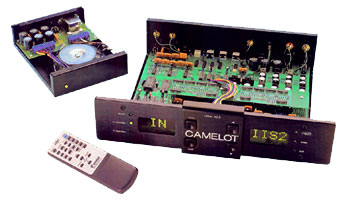
All its myriad control and connection possibilities aside, how does the Uther sound? In a word, super. Fed by the Dragon Pro or directly from the transport, the Uther was smooth on the top end, clean and balanced in the voice range, and possessed of considerable slam on the bottom. For the past few months the Dragon/Uther has become my preferred D/A combo, and I've run all my test CDs through them with great success. As I write this, I'm listening to the Dragon/Uther directly driving (no preamp!) a Simaudio Moon W-5 amp and a pair of PMC IB-1S speakers, and to a remarkable recording of Sallinen's Symphonies 2 and 6 (BIS CD-511). It is not just a courtesy that the percussionist, Gert Mortensen, is given top billing on this CD's cover. His contributions, particularly on timpani in the last movement of the 6th, were reproduced powerfully and articulately by the Camelot components. Yet there was no artificial spotlighting, and the rest of the orchestra and the ambience were beautifully balanced. Comparisons? Forget the Audio Alchemy DDE v.3; it was outclassed, as it should be, by the much more expensive Uther. Face-offs between the DDSPro/Dragon/Uther with the Sonic Frontiers SFCD-1 were curiously dependent on sources and on the rest of the system. With the Apogee Duettas and the DNA-1, the bass from the Camelots could be a bit overripe, emphasizing a room/speaker resonance to a degree not experienced before. On the other hand, the SFCD-1 educed no such problems with this combination, and seemed slightly more forgiving and natural with female voices. The new Diana Krall CD (Love Scenes, Impulse! IMPD-233) made both of these effects quite apparent right from the opening cut. On the other hand, the SFCD-1 was less extended in the bass when auditioned with the EOS Signature/Bass Modules and the McCormack DNA-1. The magnitude of these differences, however, was quite small, and noticeable primarily with direct A/B comparisons. Besides, if you want to savor a slightly different flavor, try another dither setting on the Uther.
Okay, okay. What didn't I like about the Camelot components? Well, their appearance didn't suit my taste, but each person can judge this for himself. Moreover, Camelot will be improving this in their Mk.2 versions. I was also annoyed by Camelot's adherence to RCA jacks, even though gold-plated, for all the coaxial digital connections. Surely, at this point in the digital era, some or all of these should be BNCs. Finally, the quality of the printed overlay on the Uther remote is a little tacky. But all of this amounts to a hill of beans when considered with the performance one gets from the Camelot components. The Dragon Pro should become the new standard for anti-jitter processing, and the Uther 2.0 is simply the best DAC I've used to date. Together, they sounded great, have immense flexibility in configuration, and do not require a preamp or controller. Adding up the prices, they may not be the most cost-effective one-time purchase—one can buy other Class A-rated CD players for less. On the other hand, just add an amp and speakers and you're on your way to wonderful sound.
Footnote 1: The I2S bus is a proprietary digital-audio-data interconnection standard intended by its progenitor, Philips, to be used inside a CD player or digital control center. As it runs a separate connection for the data clock signal, it is much less prone to introducing jitter into the recovered clock than the S/PDIF and AES/EBU data standards, in which the clock is embedded in the data and needs to be extracted.—John Atkinson