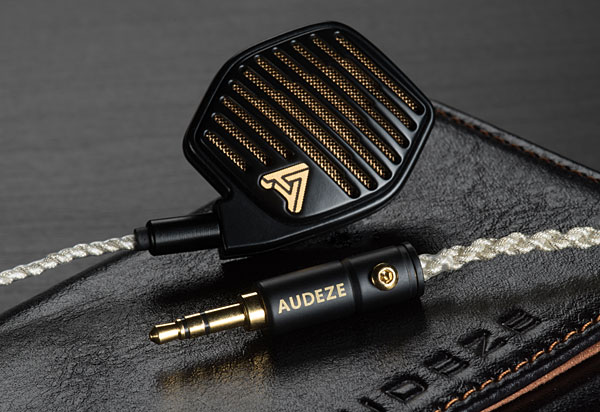
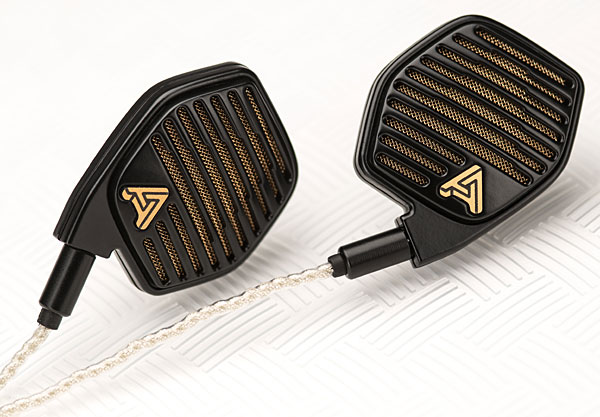
The 1/3-octave warble tones on Editor's Choice (ALAC files ripped from CD, Stereophile STPH016-2) were audible at full level down to 32Hz, and the 25 and 20Hz tones were just audible if I raised the volume. With the half-step toneburst track on Editor's Choice the Audezes spoke cleanly and evenly in the bass, though there was a slight reduction in energy in the 2–4kHz octave. Driving the LCDi4s with Faber Acoustical's SignalSuite app on my iPhone, I heard no distortion in the low bass. This is a difficult test to pass for conventional in-ear headphones that use armatures, though the Ultimate Ears and JH models use multiple armatures at low frequencies to improve linearity. At the other end of the audioband, the Audeze 'phones produced audible output up to my current HF cutoff of 14kHz.
Enough test tones—time for some music. Well, not music. I'd recently been archiving old cassette tapes to digital, and had come across the BBC's 1981 binaural production of Oliver Goldsmith's play She Stoops to Conquer, featuring a young Judi Dench as Miss Hardcastle. The beauty of a good binaural recording is that it places all the acoustic objects outside the head, rather than stringing them on a line between your ears. With the LCDi4s, voices and the instruments playing the incidental music were positioned well to the left and right of me, but voices at the center of the stage remained inside my head instead of being projected forward. This was primarily due to the fact that the transfer function of my outer ears doesn't match that of the dummy head that was used to make the recording. But when Tony Lumpkin (Wayne Sleep) makes his first entry by slamming open a door at far stage right/audience left and running to center stage, I looked around to see what the disturbance in my room was, such was the sense of binaural realism with the Ayre-driven Audezes.
 Okay, now it was time for music. With the David Haseltine Trio's treatment of Bach's "Jesu, Joy of Man's Desiring," from Dr. Chesky's Ultimate Headphone Demonstration Disc (24/44.1k ALAC, Chesky/HDtracks), this binaural recording through the Audeze LCDi4s relocated me from my listening room to the recording venue, with the piano to the left of me, the drums to the right, and the double bass slightly in front of my nose. But as I'd preordered Stevie Winwood's Greatest Hits Live (2 CDs, Wincraft/Thirty Tigers WM002; see David Sokol's review elsewhere in this issue) and it arrived the day I unpacked the Audezes, I paused Dr. Chesky and, not waiting to rip the CD to the NAD's storage, loaded it into my Ayre C-5xeMP player and fed AES/EBU data to the DAC. Ahh . . . while I would have much preferred there to have been a bass player in the band rather than Winwood using his Hammond for the bass lines, the sound of this album is generally excellent ("While You Take a Chance" being an unfortunate exception). Through the LCDi4s, Winwood's voice sounded as naturally soulful as I remember it from first hearing him sing in the 1960s, the organ's bass pedals had a satisfying combination of weight and extension, and the cymbals had plenty of top-octave air.
With their lack of edge or brightness, the Audeze LCDi4s excelled with electric guitar. José Neto's electric guitar on the Winwood album sounded clean when necessary and overdriven when musically appropriate, as in his solo in "The Low Spark of High Heeled Boys." And if I'm mentioning recordings of electric guitar, I must play something by that master of the instrument, Bill Frisell. Listening to "That Was Then," from Live in Tokyo, Japan: July 21, 2000 (16/44.1 FLAC, Bill Frisell Downloads), again I was struck by how the LCDi4s' lack of mid-treble aggression allowed me to appreciate both Frisell's artistry and his artful use of effects. Perhaps some might feel that the Audeze 'phones were taking away some of the instrument's attack, but I didn't feel musically shortchanged.
Okay, now it was time for music. With the David Haseltine Trio's treatment of Bach's "Jesu, Joy of Man's Desiring," from Dr. Chesky's Ultimate Headphone Demonstration Disc (24/44.1k ALAC, Chesky/HDtracks), this binaural recording through the Audeze LCDi4s relocated me from my listening room to the recording venue, with the piano to the left of me, the drums to the right, and the double bass slightly in front of my nose. But as I'd preordered Stevie Winwood's Greatest Hits Live (2 CDs, Wincraft/Thirty Tigers WM002; see David Sokol's review elsewhere in this issue) and it arrived the day I unpacked the Audezes, I paused Dr. Chesky and, not waiting to rip the CD to the NAD's storage, loaded it into my Ayre C-5xeMP player and fed AES/EBU data to the DAC. Ahh . . . while I would have much preferred there to have been a bass player in the band rather than Winwood using his Hammond for the bass lines, the sound of this album is generally excellent ("While You Take a Chance" being an unfortunate exception). Through the LCDi4s, Winwood's voice sounded as naturally soulful as I remember it from first hearing him sing in the 1960s, the organ's bass pedals had a satisfying combination of weight and extension, and the cymbals had plenty of top-octave air.
With their lack of edge or brightness, the Audeze LCDi4s excelled with electric guitar. José Neto's electric guitar on the Winwood album sounded clean when necessary and overdriven when musically appropriate, as in his solo in "The Low Spark of High Heeled Boys." And if I'm mentioning recordings of electric guitar, I must play something by that master of the instrument, Bill Frisell. Listening to "That Was Then," from Live in Tokyo, Japan: July 21, 2000 (16/44.1 FLAC, Bill Frisell Downloads), again I was struck by how the LCDi4s' lack of mid-treble aggression allowed me to appreciate both Frisell's artistry and his artful use of effects. Perhaps some might feel that the Audeze 'phones were taking away some of the instrument's attack, but I didn't feel musically shortchanged.
 Comparisons
It's difficult to match levels precisely by ear with in-ear headphones, but for comparisons with my Audeze LCD-Xes ($1699) and Ultimate Ears 18 Pro IEMs ($1350, plus the cost of having an audiologist taking impressions of the owner's inner ears), I played the pink-noise track from Editor's Choice and, using the single-ended ¼" output (where the levels sounded closest) on the Ayre QX-5 Twenty D/A headphone amplifier, noted the Ayre's volume-control settings. This was easier to write than to do, due to the three headphones' different frequency balances, but the LCDi4s seemed to be about 4dB less sensitive than the LCD-Xes, and 10dB less sensitive than the Ultimate Ears. The 18 Pros sounded considerably more forward in the midrange than the LCDi4s. In addition, there appeared to be less top-octave extension and a reduced sense of weight, despite the fact that the Ultimate Ears' molds completely block my ear canals, thus maximizing the low-frequency performance. With the Silverman Liszt, there was a somewhat diminished sense of the acoustic of the Albuquerque church where I'd made the recording, though the 18 Pros' tonal balance made the piano sound more forceful. With the Frisell, the guitar moved forward in the mix, Kenny Wollesen's drums and Tony Scherr's double bass both took a couple of steps back, and the cymbals had less HF extension.
Changing to the LCD-Xes gave a balance in "That Was Then" that was much closer to that with the LCDi4s, but with a touch less top-octave air and overall delicacy. This was somewhat offset by an increased sense of low-frequency weight, especially when I switched to a balanced connection. With the Silverman Liszt recording, there was again a slightly diminished sense of the church's acoustic.
 I'd used the LCD-Xes for monitoring when recording the Portland State Chamber Choir in 2014 for the CD Into Unknown Worlds (CD Baby: https://store.cdbaby.com/cd/portlandstatechamberchoi2). Listening to the 24/88.2k master file of "Hear My Prayer," a brief setting of Psalm 102 composed by Purcell in 1682 that sounds surprisingly modern, the LCD-Xes reproduced this recording exactly as I remembered hearing it at the session. Changing to the LCDi4s, some of the bass bloom was lost, but I got a clearer picture of the complex layering of the vocal parts, and the warmly supportive acoustic of Portland's St. Stephen's Church was a little more apparent than it had been through the LCD-Xes.
Summing Up
I'd used the LCD-Xes for monitoring when recording the Portland State Chamber Choir in 2014 for the CD Into Unknown Worlds (CD Baby: https://store.cdbaby.com/cd/portlandstatechamberchoi2). Listening to the 24/88.2k master file of "Hear My Prayer," a brief setting of Psalm 102 composed by Purcell in 1682 that sounds surprisingly modern, the LCD-Xes reproduced this recording exactly as I remembered hearing it at the session. Changing to the LCDi4s, some of the bass bloom was lost, but I got a clearer picture of the complex layering of the vocal parts, and the warmly supportive acoustic of Portland's St. Stephen's Church was a little more apparent than it had been through the LCD-Xes.
Summing Up
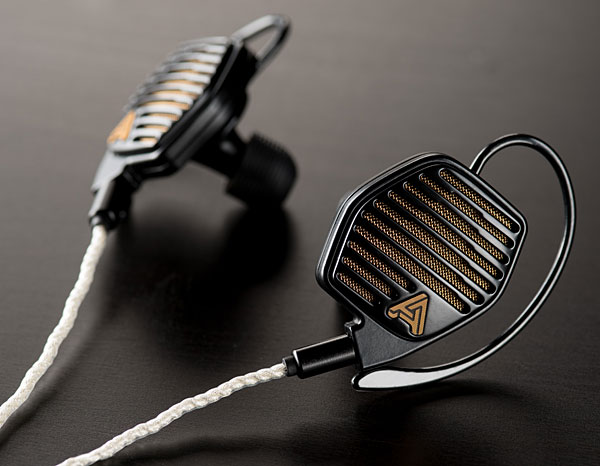
I was very impressed by Audeze's LCD-4 open-back, circumaural headphones when I reviewed them in July 2016, but was a bit taken aback by their price: $3995. At $2495, Audeze's LCDi4s are also expensive, but excel in their naturally balanced sound, reproduction of recorded detail, top-octave air, and surprisingly extended low-frequency response for earphones that rely on rubber tips to seal the user's ear canals. The LCDi4s' treble balance might be too polite for some tastes, but I prefer aggression that is encoded in the recording rather than added by the playback gear. The LCDi4s played sufficiently loud with my iPhone 6S, but that's a bit of a moot point considering their lack of acoustic isolation.
I had one quibble: I would have liked a longer cable. Other than that, I have nothing negative to add. I'll miss the LCDi4s when I return them to Audeze; but until I do, I'll continue using them to rediscover forgotten gems in my music library.
Okay, now it was time for music. With the David Haseltine Trio's treatment of Bach's "Jesu, Joy of Man's Desiring," from Dr. Chesky's Ultimate Headphone Demonstration Disc (24/44.1k ALAC, Chesky/HDtracks), this binaural recording through the Audeze LCDi4s relocated me from my listening room to the recording venue, with the piano to the left of me, the drums to the right, and the double bass slightly in front of my nose. But as I'd preordered Stevie Winwood's Greatest Hits Live (2 CDs, Wincraft/Thirty Tigers WM002; see David Sokol's review elsewhere in this issue) and it arrived the day I unpacked the Audezes, I paused Dr. Chesky and, not waiting to rip the CD to the NAD's storage, loaded it into my Ayre C-5xeMP player and fed AES/EBU data to the DAC. Ahh . . . while I would have much preferred there to have been a bass player in the band rather than Winwood using his Hammond for the bass lines, the sound of this album is generally excellent ("While You Take a Chance" being an unfortunate exception). Through the LCDi4s, Winwood's voice sounded as naturally soulful as I remember it from first hearing him sing in the 1960s, the organ's bass pedals had a satisfying combination of weight and extension, and the cymbals had plenty of top-octave air.
ComparisonsIt's difficult to match levels precisely by ear with in-ear headphones, but for comparisons with my Audeze LCD-Xes ($1699) and Ultimate Ears 18 Pro IEMs ($1350, plus the cost of having an audiologist taking impressions of the owner's inner ears), I played the pink-noise track from Editor's Choice and, using the single-ended ¼" output (where the levels sounded closest) on the Ayre QX-5 Twenty D/A headphone amplifier, noted the Ayre's volume-control settings. This was easier to write than to do, due to the three headphones' different frequency balances, but the LCDi4s seemed to be about 4dB less sensitive than the LCD-Xes, and 10dB less sensitive than the Ultimate Ears. The 18 Pros sounded considerably more forward in the midrange than the LCDi4s. In addition, there appeared to be less top-octave extension and a reduced sense of weight, despite the fact that the Ultimate Ears' molds completely block my ear canals, thus maximizing the low-frequency performance. With the Silverman Liszt, there was a somewhat diminished sense of the acoustic of the Albuquerque church where I'd made the recording, though the 18 Pros' tonal balance made the piano sound more forceful. With the Frisell, the guitar moved forward in the mix, Kenny Wollesen's drums and Tony Scherr's double bass both took a couple of steps back, and the cymbals had less HF extension.
I'd used the LCD-Xes for monitoring when recording the Portland State Chamber Choir in 2014 for the CD Into Unknown Worlds (CD Baby: https://store.cdbaby.com/cd/portlandstatechamberchoi2). Listening to the 24/88.2k master file of "Hear My Prayer," a brief setting of Psalm 102 composed by Purcell in 1682 that sounds surprisingly modern, the LCD-Xes reproduced this recording exactly as I remembered hearing it at the session. Changing to the LCDi4s, some of the bass bloom was lost, but I got a clearer picture of the complex layering of the vocal parts, and the warmly supportive acoustic of Portland's St. Stephen's Church was a little more apparent than it had been through the LCD-Xes.
Summing UpI was very impressed by Audeze's LCD-4 open-back, circumaural headphones when I reviewed them in July 2016, but was a bit taken aback by their price: $3995. At $2495, Audeze's LCDi4s are also expensive, but excel in their naturally balanced sound, reproduction of recorded detail, top-octave air, and surprisingly extended low-frequency response for earphones that rely on rubber tips to seal the user's ear canals. The LCDi4s' treble balance might be too polite for some tastes, but I prefer aggression that is encoded in the recording rather than added by the playback gear. The LCDi4s played sufficiently loud with my iPhone 6S, but that's a bit of a moot point considering their lack of acoustic isolation.