The first headphones I owned, circa mid-1970s, were made by Pioneer. They jutted out from my ears, with small, paper-cone speakers inside. I was 11. I plugged them into the little no-frills Lafayette integrated amplifier that was the heart of my first stereo system, put a record on the BSR "record-wrecker" changer, dropped the needle, and was transported to my own musical world. It was an early magic sound experience.
"Head-Fi" is a whole different world nowadays than it was back then. The biggest change is Bluetooth, which lets us untether ourselves from our stereo systems. Some headphones these days are a whole stereo system to themselves, or close to it. Use Bluetooth to connect to a smartphone, open your favorite streaming app, and the whole world of recorded music is at your disposal, in your ears and brain, no matter where you go.
For audiophiles, that go-anywhere convenience comes at a cost: Bluetooth audio is resolution-constrained; in fact it's almost always lossy. The latest Bluetooth iterations support Sony's LDAC and Qualcomm's aptX Lossless, which can send CD-resolution (16/44.1) audio from a phone to wireless headphones or earbuds, but Apple—by far the biggest smartphone manufacturer—doesn't support Qualcomm's codecs.
So then the question becomes, just how much lossiness—how big a reduction in digital music information—is an audiophile willing to accept for go-anywhere wireless convenience? It's a question each of us must answer for ourselves. For me, it's complicated.
Complex, deluxe wireless 'phones from B&W
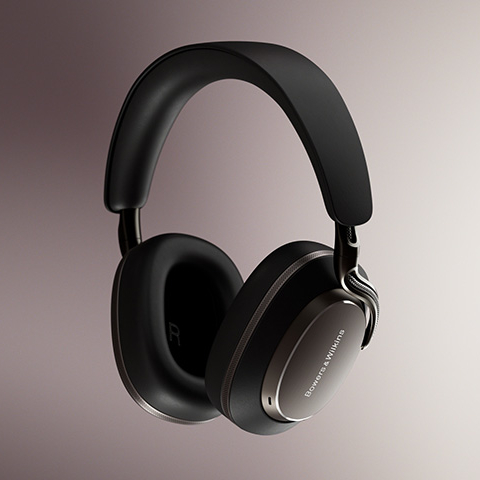
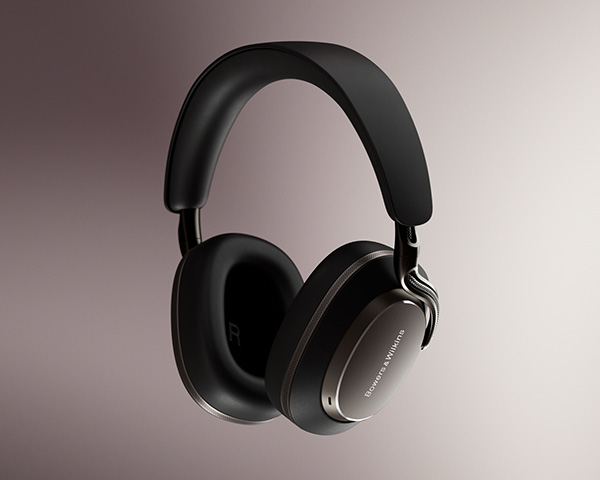
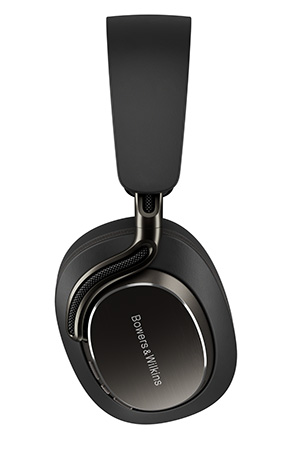
The Bowers & Wilkins Px8 S2's are over-ear active-noise-canceling wireless headphones. They are lightweight and compact, and they tend toward the luxury end of the market, priced around $800 and fitted with earcups of memory foam and Nappa leather, the same materials padding the headband. Inside these headphones are a Bluetooth transceiver, a USB interface, a digital signal processing (DSP) platform, and a DAC capable of resolution up to 24/192—plus amplifiers for the two 40mm (1.6") "full-range carbon drivers" (B&W's words). For talking on the phone and to support noise-canceling DSP, each earcup has four tiny microphones. Powering all that is a lightweight battery system B&W says provides 30 hours of playback. Just 15 minutes of charge is good for seven hours of playback. Wowzer, that's a lotta tech sitting comfortably on my head!
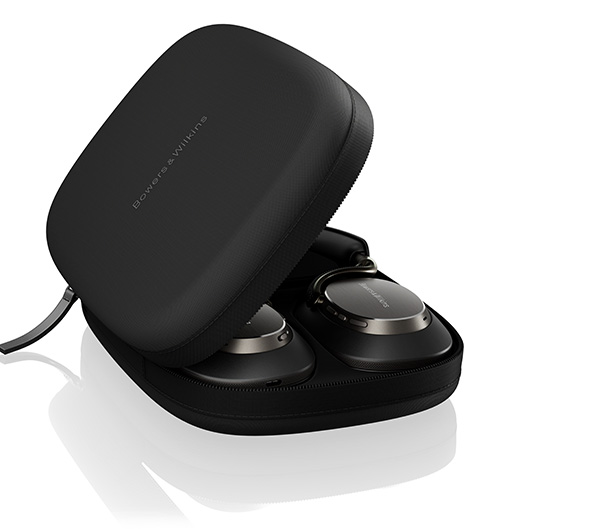
Alongside the headphones inside the solid-feeling zip-up carrying case are a 1.2m (47") USB-C to USB-C cable and a 1.2m USB-C to 1/8" stereo headphone plug cable. The USB-C cable—in fact any functional USB-C cable—can connect to a phone, tablet, or computer. Andy Kerr, B&W's director of product marketing and communications, said that when the 1/8" plug is used, the signal is digitized at 24/96 and fed into the onboard DSP processor then on to the DAC.
On the outside of each earcup are various control buttons. Their functions vary depending on whether you're on the phone or listening to music. It's all explained on p.3 of the user manual (footnote 1), so I'll skip it here. Which brings us to the control app.
The Bowers & Wilkins Music app is available for Apple and Android devices. From its main screen, you can monitor and control Bluetooth connectivity, select noise cancellation or "pass through"—feeding some ambient sound from the microphones into your ears—or connect to Qobuz, Tidal, or other streaming services. If you use Qobuz or Tidal through this app, you can see what resolution of audio is actually being fed to the 'phones.
The user can adjust several sound and user-interface parameters via the Settings screen. Most useful for music listening is the five-band "advanced EQ" equalizer. Custom EQ profiles may be created and saved. Up top is a button labeled "TrueSound": that's the standard flat-EQ profile of the Px8 S2 with no user adjustment. A toggle lets the user choose among three modes: noise cancellation, pass through, and off. "Voice Assistant" mode activates the 'phone's contact searching and call-initiating processes in response to the user's voice picked up by the external microphones.
In their cups
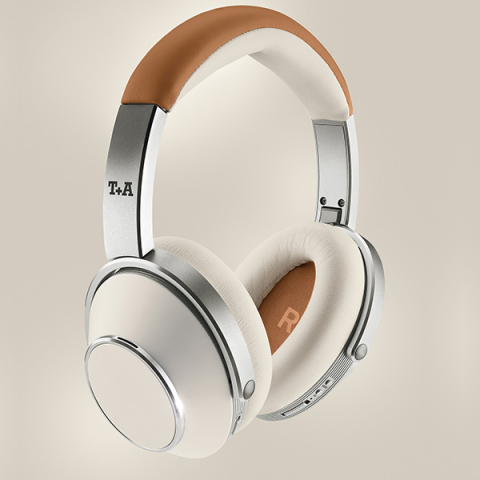
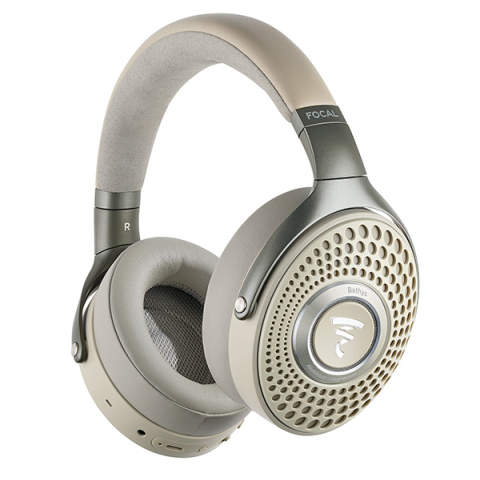
Inside the soft-leather earcups there's a lot going on. Kerr said, "We use a discrete DSP/DAC/ADC (chip) from Analog Devices capable of running at a true 24/96 plus a separate, dedicated headphone amplifier, also from Analog Devices. These are in addition to the primary Qualcomm [Bluetooth] chipset." B&W plans to add support for Bluetooth LE Audio (footnote 2) and "Spatial Audio"; he didn't provide a timeline. I asked: What does B&W consider the Px8 S2's competition? His answer: "AirPods Max, Focal Bathys, B&O H100, Bose QuietComfort Ultra (gen 2), Sony WH-1000XM6. Plus, possibly, our own Px7 S3!" That's the upper echelon of wireless ANC 'phones—except for the very top of the tier, the T+A Solitaire T, which sells for around $2000.
Windows 10 immediately recognized the Px8 S2s, as a "USB DAC." When that was done, they became a "speakers" choice in all my streaming apps.
 In use
Before I started writing this review, I listened to the Px8 S2s for a couple hundred hours. Wearing them for hours on end did not fatigue me. They never felt sweaty or clammy. Even marathon sessions didn't dent the battery: I never encountered a low-charge situation. The Px8 S2s are about the same weight, subjectively, as my studio reference Neumann NDH 30 traditional passive open-backs. The tiny buttons on the earcups took some getting used to. I had to turn down the Wear Sensor sensitivity to Low, else slight movements of my head or bending over to pick something up off the floor would cause the music to stop playing. A virtual toggle switch in the app lets you turn this feature off completely, which I eventually did.
The noise cancellation is quite good. I ran my snowblower while listening to quiet jazz. Using the Quick Action button to toggle between noise cancellation, pass through, and off, I learned that the roar of the blower's Tecumseh four-stroke engine was substantially reduced by the noise cancellation, to the point that it was easy to hear and enjoy the music.
I was rocking out to some Slayer in my own thrash world when my phone rang. The music faded. I slid my finger to answer and chat with my buddy Dave, whom I've known since sixth grade. He said he could hear me just fine, and he came through loud and clear. It was strange, though, as I could only hear my own voice rattling inside my head. I switched to the pass through mode and could hear myself clearly as I spoke.
Conversation finished, I ended the call. The music ramped back up. Back to head banging.
I've owned and reviewed quite a few headphones, mainly for the pro-audio publication Tape Op. Unlike some—maybe most—headphones I've reviewed, I liked the Px8 S2s more the more I wore them and used them. Their sound relaxed a little, the ear cushions got more squishy, and my fumbling fingers figured out those tiny buttons.
Wired vs wireless, aptX, and not
For listening comparisons, I made a Qobuz playlist of my friend Rich "Deep Groove Mono" Capeless's top-40 jazz albums, leaving off those that don't stream (footnote 3). Rich's list leans heavily toward the Blue Note catalog. Those Rudy Van Gelder recordings, with sizzling close-miked cymbals, "piano in a box," and EMT plate reverb sounds, can be dead giveaways of lossy digital audio. Lossiness makes the cymbals sound swishy. The boxy piano gets tinny. Reverb tails don't make it through all that perceptual encoding and bit dumping. To establish a best-case sound, I listened for a while with the Px8 S2s connected to my office computer, the 'phones acting as a self-contained USB DAC, headphone amp, and headphones, playing music directly from the Qobuz desktop app. I turned off the Bluetooth transceiver on my iPhone, so the only thing the 'phones were doing was digital audio. They sounded very good, if a bit bright for my liking. I turned the Bluetooth back on, opened the B&W app, navigated to the Advanced EQ screen, and turned the 40Hz slider to "+0.5," the 4kHz slider to "–2.5," and the 8kHz slider to "–3.0." I saved that EQ profile as a preset and used it throughout my comparative listening. Those settings were retained when I turned Bluetooth off again. The tonal balance with those settings was similar to that of my Neumann NDH 30 headphones served by my Grace m900 DAC/headphone amp. The Neumanns sounded flatter and more reserved, but I didn't mind the exciting, beat-forward sound of the B&Ws now that the brightness was tamed. I remain an advocate of tone-shaping controls. Kudos to B&W for doing it well with DSP.
Next, I connected the Px8 S2s to my iPhone 15 with the included USB-C cable. I turned off Bluetooth. A headphone icon appeared in both the Qobuz and Spotify apps. I was able to set Spotify to lossless streaming with the cable connection;
I assume Qobuz was also streaming at full resolution. In this setting, the sound was very close if not identical to the wired USB connection with the computer. I happened to notice that the headphones were charging themselves from the phone battery. That could end poorly when you're out and about all day and then need your phone to call an Uber. If there's a way to keep it from happening, I failed to find it. So be forewarned.
 It was time for some wireless listening. First I did it the way most people do these days, pairing my iPhone with the Px8 S2s using Apple's AAC Bluetooth protocols. It sounded like every other wireless listening device in this situation: lossy. Swishy cymbals, tinny piano, lost reverb tails—all audible to varying degrees. With some tracks, it's fine. With others, it's noticeable and annoying. This isn't the B&Ws; the same is true with any lossy Bluetooth connection.
How annoying is it? Is it too annoying? I wish I could avoid it, but it's the cost of convenience and portability. Whatever was going on in the iPhone, music sounded best via Qobuz. Streamed from the Spotify app, the same albums at the same resolution sounded more processed, as though they were missing something important. In neither case did I hear serious, annoying digital artifacts, which I am used to hearing over SiriusXM in the car.
It turns out there is a way to force an iPhone to do Lossless: tiny Bluetooth dongles that connect to your phone's USB-C port and take over Bluetooth transceiver duties. At the recommendation of B&W engineers, I bought a Creative Labs BT-W6 (footnote 4). I was able to pair it with the Px8 S2s immediately after inserting it. The music sounded weird, worse than the standard Apple wireless 'phones M.O. WTF?
I opened the B&W app and saw that the iPhone and BT-W6 Bluetooth connections were both active. I toggled the iPhone connection off, and the sound improved right away.
The Creative Labs BT-W6 is highly automated, and it isn't very communicative. Its specifications say it supports aptX Lossless, but I was never certain I was using it. In any case, the sound was good enough that it was hard to tell if it was lossy. What differences existed didn't bother me at all.
As with many good solutions, this one had a drawback: I had to remove the phone from its Otterbox protective case because the dongle is too fat to fit in the svelte little slot for a USB cable. Only you can decide whether this improvement in the sound is worth putting your phone at risk by keeping it out of its case.
My final wireless listening scenario was with the Creative dongle connected to my recent-vintage ASUS mini laptop. I installed the Creative driver and desktop app, which allowed me to set the resolution and monitor the sample rate and bit depth. I set it to aptX Lossless, which maxes out at CD resolution (16/44.1).
I then streamed tracks from several favorite albums at CD resolution on both Qobuz and Spotify using those services' desktop apps. They sounded to me like actual CDs, and I could now hear little difference between Qobuz and Spotify. Maybe none. Higher-than-CD resolution tracks on Qobuz—Spotify doesn't offer that—were downconverted seamlessly. I don't know whether the app or the Creative driver was doing it. That last way of listening was my favorite. Even though I sacrificed the nth degree of resolution available from a USB cable connection, the convenience of wireless headphones is compelling. Get up, move around, walk across the room, answer the front door, all while the music plays on (footnote 5).
It was time for some wireless listening. First I did it the way most people do these days, pairing my iPhone with the Px8 S2s using Apple's AAC Bluetooth protocols. It sounded like every other wireless listening device in this situation: lossy. Swishy cymbals, tinny piano, lost reverb tails—all audible to varying degrees. With some tracks, it's fine. With others, it's noticeable and annoying. This isn't the B&Ws; the same is true with any lossy Bluetooth connection.
How annoying is it? Is it too annoying? I wish I could avoid it, but it's the cost of convenience and portability. Whatever was going on in the iPhone, music sounded best via Qobuz. Streamed from the Spotify app, the same albums at the same resolution sounded more processed, as though they were missing something important. In neither case did I hear serious, annoying digital artifacts, which I am used to hearing over SiriusXM in the car.
It turns out there is a way to force an iPhone to do Lossless: tiny Bluetooth dongles that connect to your phone's USB-C port and take over Bluetooth transceiver duties. At the recommendation of B&W engineers, I bought a Creative Labs BT-W6 (footnote 4). I was able to pair it with the Px8 S2s immediately after inserting it. The music sounded weird, worse than the standard Apple wireless 'phones M.O. WTF?
I opened the B&W app and saw that the iPhone and BT-W6 Bluetooth connections were both active. I toggled the iPhone connection off, and the sound improved right away.
The Creative Labs BT-W6 is highly automated, and it isn't very communicative. Its specifications say it supports aptX Lossless, but I was never certain I was using it. In any case, the sound was good enough that it was hard to tell if it was lossy. What differences existed didn't bother me at all.
As with many good solutions, this one had a drawback: I had to remove the phone from its Otterbox protective case because the dongle is too fat to fit in the svelte little slot for a USB cable. Only you can decide whether this improvement in the sound is worth putting your phone at risk by keeping it out of its case.
My final wireless listening scenario was with the Creative dongle connected to my recent-vintage ASUS mini laptop. I installed the Creative driver and desktop app, which allowed me to set the resolution and monitor the sample rate and bit depth. I set it to aptX Lossless, which maxes out at CD resolution (16/44.1).
I then streamed tracks from several favorite albums at CD resolution on both Qobuz and Spotify using those services' desktop apps. They sounded to me like actual CDs, and I could now hear little difference between Qobuz and Spotify. Maybe none. Higher-than-CD resolution tracks on Qobuz—Spotify doesn't offer that—were downconverted seamlessly. I don't know whether the app or the Creative driver was doing it. That last way of listening was my favorite. Even though I sacrificed the nth degree of resolution available from a USB cable connection, the convenience of wireless headphones is compelling. Get up, move around, walk across the room, answer the front door, all while the music plays on (footnote 5).
 Conclusions
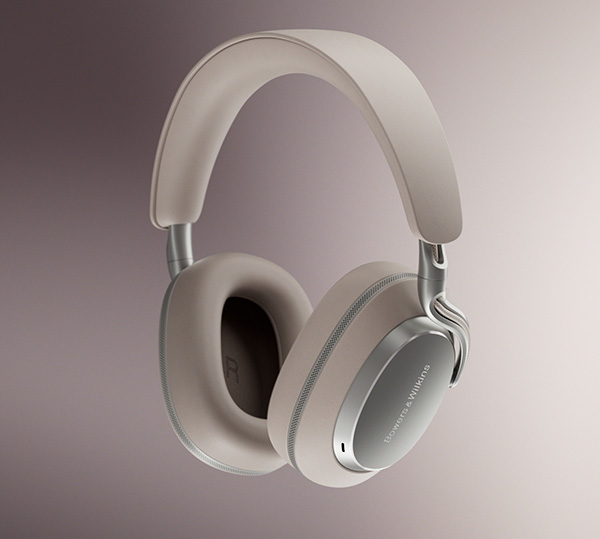
The B&W Px8 S2 is a deluxe, complex device. It proved capable of advanced noise cancellation, good sound, and physical comfort over many hours. That's excellent performance for any pair of headphones. The onboard DAC and DSP processor sounded clean, fast, and modern, with no weird "digital" sound and no phony added warmth. I appreciated the DSP equalizer, which I used to tame the brightness of the default tuning. When it comes to style, I'm not the guy to ask, but I thought these 'phones looked sharp. The review pair was in a color called "warm stone," a sort of beige-gray. The build quality is excellent, and they are comfortable to wear for hours at a time. They didn't make me feel like I was shut off from the world, unless I wanted to be—as when I turned noise cancellation on and cranked the music up on a Metro-North commuter train to Manhattan. When I set them to "pass through," I felt aurally (hence physically) connected to the space around me.
The question every potential buyer, of these or any other wireless headphones, must ask themselves is, are they worth the price given the current state of Bluetooth audio? That's personal preference. You can spend a lot more than $800 on top-notch analog wired headphones. There's a lot of bleeding-edge tech in these things; they're well beyond what was available even 5 years ago. If you're on the go a lot, a relatively high-fidelity listening environment can make the going very pleasant. If you decide to go for top-tier on-the-go headphones, try going out wearing the Px8 S2s.
Footnote 1: See tinyurl.com/uyrtd9sp. Footnote 2: "LE" stands for "low energy," but that's just part of the picture. LE Audio is the latest version of Bluetooth audio with many improvements; see tinyurl.com/mshxzsub. Footnote 3: Rich's list is here: tinyurl.com/2fa69dfb; his blog is content-rich. My Qobuz playlist is here: open.qobuz.com/playlist/51214131.
Footnote 4: See us.creative.com/p/accessories/creative-bt-w6.
Footnote 5: There's another kind of device that does the same thing, at home at least. It's called a home stereo system.—Jim Austin
The Bowers & Wilkins Px8 S2's are over-ear active-noise-canceling wireless headphones. They are lightweight and compact, and they tend toward the luxury end of the market, priced around $800 and fitted with earcups of memory foam and Nappa leather, the same materials padding the headband. Inside these headphones are a Bluetooth transceiver, a USB interface, a digital signal processing (DSP) platform, and a DAC capable of resolution up to 24/192—plus amplifiers for the two 40mm (1.6") "full-range carbon drivers" (B&W's words). For talking on the phone and to support noise-canceling DSP, each earcup has four tiny microphones. Powering all that is a lightweight battery system B&W says provides 30 hours of playback. Just 15 minutes of charge is good for seven hours of playback. Wowzer, that's a lotta tech sitting comfortably on my head!
Inside the soft-leather earcups there's a lot going on. Kerr said, "We use a discrete DSP/DAC/ADC (chip) from Analog Devices capable of running at a true 24/96 plus a separate, dedicated headphone amplifier, also from Analog Devices. These are in addition to the primary Qualcomm [Bluetooth] chipset." B&W plans to add support for Bluetooth LE Audio (footnote 2) and "Spatial Audio"; he didn't provide a timeline. I asked: What does B&W consider the Px8 S2's competition? His answer: "AirPods Max, Focal Bathys, B&O H100, Bose QuietComfort Ultra (gen 2), Sony WH-1000XM6. Plus, possibly, our own Px7 S3!" That's the upper echelon of wireless ANC 'phones—except for the very top of the tier, the T+A Solitaire T, which sells for around $2000.
In useBefore I started writing this review, I listened to the Px8 S2s for a couple hundred hours. Wearing them for hours on end did not fatigue me. They never felt sweaty or clammy. Even marathon sessions didn't dent the battery: I never encountered a low-charge situation. The Px8 S2s are about the same weight, subjectively, as my studio reference Neumann NDH 30 traditional passive open-backs. The tiny buttons on the earcups took some getting used to. I had to turn down the Wear Sensor sensitivity to Low, else slight movements of my head or bending over to pick something up off the floor would cause the music to stop playing. A virtual toggle switch in the app lets you turn this feature off completely, which I eventually did.
For listening comparisons, I made a Qobuz playlist of my friend Rich "Deep Groove Mono" Capeless's top-40 jazz albums, leaving off those that don't stream (footnote 3). Rich's list leans heavily toward the Blue Note catalog. Those Rudy Van Gelder recordings, with sizzling close-miked cymbals, "piano in a box," and EMT plate reverb sounds, can be dead giveaways of lossy digital audio. Lossiness makes the cymbals sound swishy. The boxy piano gets tinny. Reverb tails don't make it through all that perceptual encoding and bit dumping. To establish a best-case sound, I listened for a while with the Px8 S2s connected to my office computer, the 'phones acting as a self-contained USB DAC, headphone amp, and headphones, playing music directly from the Qobuz desktop app. I turned off the Bluetooth transceiver on my iPhone, so the only thing the 'phones were doing was digital audio. They sounded very good, if a bit bright for my liking. I turned the Bluetooth back on, opened the B&W app, navigated to the Advanced EQ screen, and turned the 40Hz slider to "+0.5," the 4kHz slider to "–2.5," and the 8kHz slider to "–3.0." I saved that EQ profile as a preset and used it throughout my comparative listening. Those settings were retained when I turned Bluetooth off again. The tonal balance with those settings was similar to that of my Neumann NDH 30 headphones served by my Grace m900 DAC/headphone amp. The Neumanns sounded flatter and more reserved, but I didn't mind the exciting, beat-forward sound of the B&Ws now that the brightness was tamed. I remain an advocate of tone-shaping controls. Kudos to B&W for doing it well with DSP.
It was time for some wireless listening. First I did it the way most people do these days, pairing my iPhone with the Px8 S2s using Apple's AAC Bluetooth protocols. It sounded like every other wireless listening device in this situation: lossy. Swishy cymbals, tinny piano, lost reverb tails—all audible to varying degrees. With some tracks, it's fine. With others, it's noticeable and annoying. This isn't the B&Ws; the same is true with any lossy Bluetooth connection.
ConclusionsThe B&W Px8 S2 is a deluxe, complex device. It proved capable of advanced noise cancellation, good sound, and physical comfort over many hours. That's excellent performance for any pair of headphones. The onboard DAC and DSP processor sounded clean, fast, and modern, with no weird "digital" sound and no phony added warmth. I appreciated the DSP equalizer, which I used to tame the brightness of the default tuning. When it comes to style, I'm not the guy to ask, but I thought these 'phones looked sharp. The review pair was in a color called "warm stone," a sort of beige-gray. The build quality is excellent, and they are comfortable to wear for hours at a time. They didn't make me feel like I was shut off from the world, unless I wanted to be—as when I turned noise cancellation on and cranked the music up on a Metro-North commuter train to Manhattan. When I set them to "pass through," I felt aurally (hence physically) connected to the space around me.
Footnote 1: See tinyurl.com/uyrtd9sp. Footnote 2: "LE" stands for "low energy," but that's just part of the picture. LE Audio is the latest version of Bluetooth audio with many improvements; see tinyurl.com/mshxzsub. Footnote 3: Rich's list is here: tinyurl.com/2fa69dfb; his blog is content-rich. My Qobuz playlist is here: open.qobuz.com/playlist/51214131.