Sidebar 3: Measurements
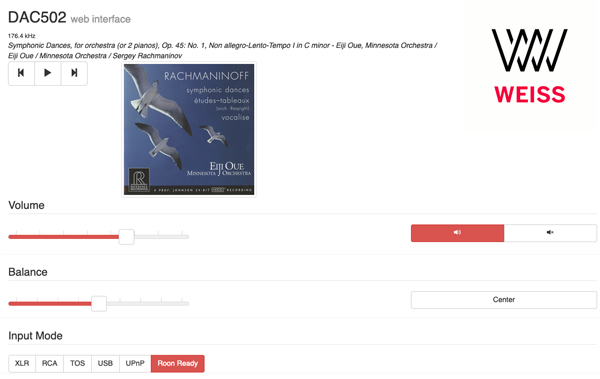 The Weiss DAC202, which Erick Lichte reviewed in January 2012, was one of the highest-resolution digital processors I have measured, so I was intrigued to see if the DAC502 would match its predecessor's performance. As I had done with the DAC202, I measured the Weiss DAC502 with my Audio Precision SYS2722 system (see the January 2008 "As We See It"). Apple's USB Prober utility identified the DAC502 as "DAC501" from "Weiss_Engineering_Ltd." with the serial number string "0.0.1" (footnote 1).The USB port operated in the optimal isochronous asynchronous mode, and Apple's AudioMIDI utility revealed that the DAC502 accepted 32-bit integer data sampled at all rates from 44.1kHz to 384kHz. The AES/ EBU and S/PDIF inputs accepted data sampled at rates up to 192kHz.
The DAC502's maximum output level at 1kHz with the balanced outputs or the headphone outputs feeding a high 100k ohm load was 6.85V with the level set to "0dB"; 2.17V with it set to "–10dB," which is exactly 10dB lower; 684mV set to "–20dB," 20dB lower; and 217mV set to "–30dB," 30dB lower. As expected, the maximum levels from the unbalanced outputs were half those from the balanced outputs. With its polarity button set to Normal, the DAC502 preserved absolute polarity (ie, was noninverting) from all of its outputs. The balanced output impedance was 94 ohms at all audio frequencies; the unbalanced output impedance was 47 ohms. The front-panel headphone jack's output impedance was a very low 0.66 ohm. The DAC502 will have no problem driving low-impedance headphones.
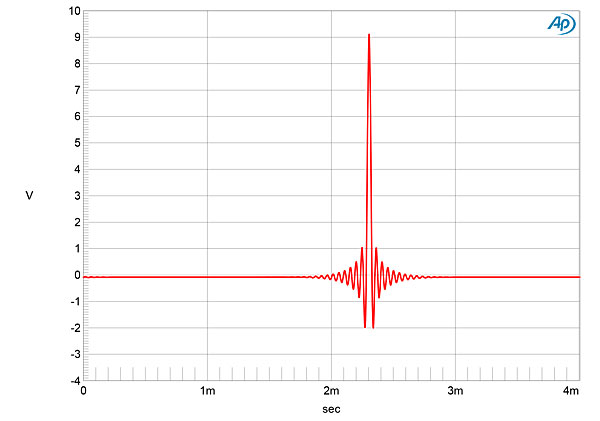
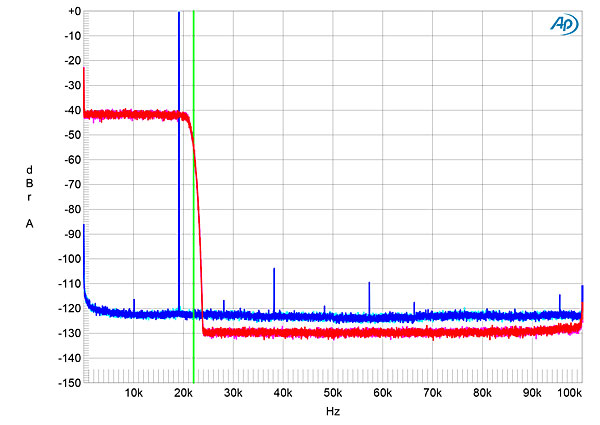
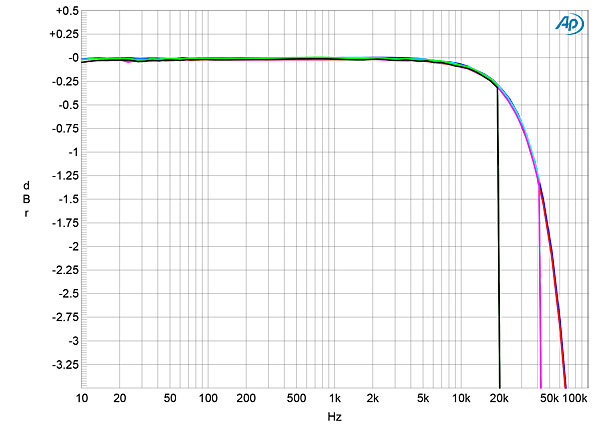
Fig.1 shows the DAC502's impulse response with 44.1kHz data. It is typical of a conventional linear-phase filter with a symmetrical ringing before and after the single full-scale sample. This filter's ultrasonic rolloff (fig.2, magenta and red traces) reaches full stop-band attenuation at 24kHz with complete suppression of the aliased image at 25kHz of a full-scale tone at 19.1kHz (cyan, blue). The harmonics associated with the 19.1kHz tone all lie below –104dB. Fig.3 shows the DAC502's frequency response with data sampled at 44.1, 96, and 192kHz. The response with all three sample rates is down by just 0.3dB at the top of the audioband, with then a steep rolloff just before half of each sample rate. The response with 192kHz data continues the relatively gentle ultrasonic rolloff, reaching –3dB at 61kHz.
The Weiss DAC202, which Erick Lichte reviewed in January 2012, was one of the highest-resolution digital processors I have measured, so I was intrigued to see if the DAC502 would match its predecessor's performance. As I had done with the DAC202, I measured the Weiss DAC502 with my Audio Precision SYS2722 system (see the January 2008 "As We See It"). Apple's USB Prober utility identified the DAC502 as "DAC501" from "Weiss_Engineering_Ltd." with the serial number string "0.0.1" (footnote 1).The USB port operated in the optimal isochronous asynchronous mode, and Apple's AudioMIDI utility revealed that the DAC502 accepted 32-bit integer data sampled at all rates from 44.1kHz to 384kHz. The AES/ EBU and S/PDIF inputs accepted data sampled at rates up to 192kHz.
The DAC502's maximum output level at 1kHz with the balanced outputs or the headphone outputs feeding a high 100k ohm load was 6.85V with the level set to "0dB"; 2.17V with it set to "–10dB," which is exactly 10dB lower; 684mV set to "–20dB," 20dB lower; and 217mV set to "–30dB," 30dB lower. As expected, the maximum levels from the unbalanced outputs were half those from the balanced outputs. With its polarity button set to Normal, the DAC502 preserved absolute polarity (ie, was noninverting) from all of its outputs. The balanced output impedance was 94 ohms at all audio frequencies; the unbalanced output impedance was 47 ohms. The front-panel headphone jack's output impedance was a very low 0.66 ohm. The DAC502 will have no problem driving low-impedance headphones.
Fig.1 shows the DAC502's impulse response with 44.1kHz data. It is typical of a conventional linear-phase filter with a symmetrical ringing before and after the single full-scale sample. This filter's ultrasonic rolloff (fig.2, magenta and red traces) reaches full stop-band attenuation at 24kHz with complete suppression of the aliased image at 25kHz of a full-scale tone at 19.1kHz (cyan, blue). The harmonics associated with the 19.1kHz tone all lie below –104dB. Fig.3 shows the DAC502's frequency response with data sampled at 44.1, 96, and 192kHz. The response with all three sample rates is down by just 0.3dB at the top of the audioband, with then a steep rolloff just before half of each sample rate. The response with 192kHz data continues the relatively gentle ultrasonic rolloff, reaching –3dB at 61kHz.


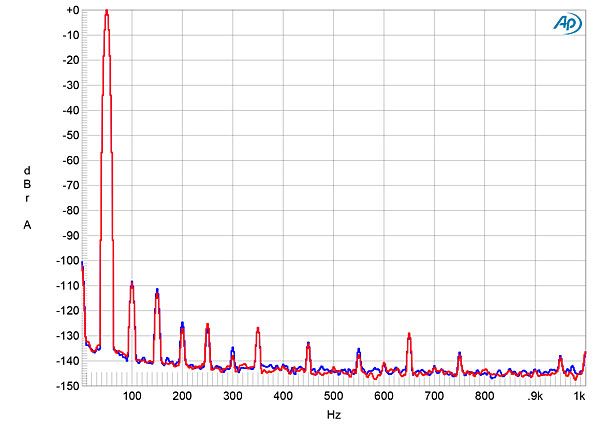
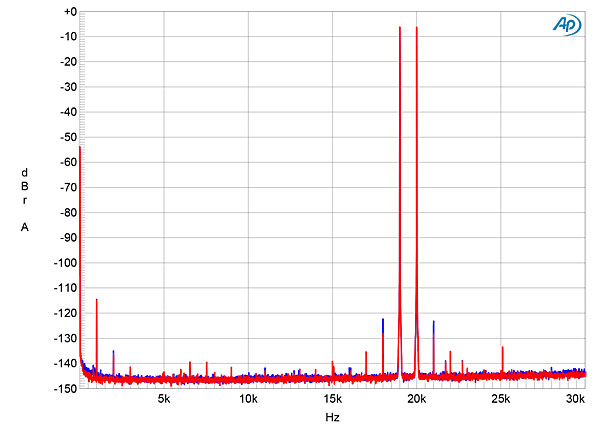
 Even set to its highest output level, the DAC502 produced very low levels of harmonic distortion with full-scale data into the high 100k ohm load (fig.11). The subjectively benign second and third harmonics were the highest in level, but each lay close to a negligible –110dB (0.0003%). While the level of the second harmonic rose to –98dB (0.001%) when I reduced the load impedance to the punishing 600 ohms, the third harmonic remained below –110dB. The Weiss DAC has a bombproof output stage! Intermodulation distortion with an equal mix of 19 and 20kHz tones at –6dBFS was similarly very low (fig.12), with the difference tone at 1kHz lying at –115dB (0.0002%). Again the DAC502 wasn't fazed by the 600 ohm load. While the difference product increased in level, this was to a still-minuscule –106dB (0.0005%).
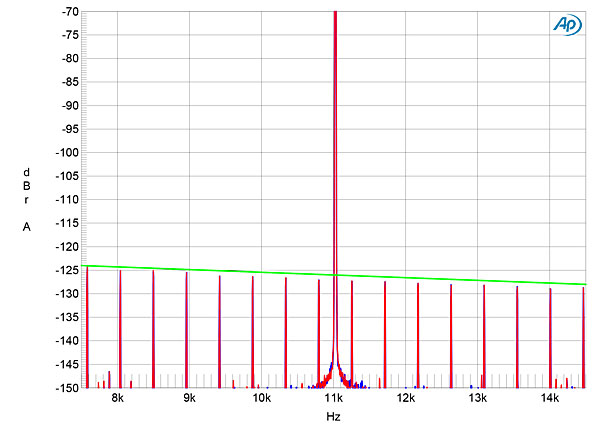
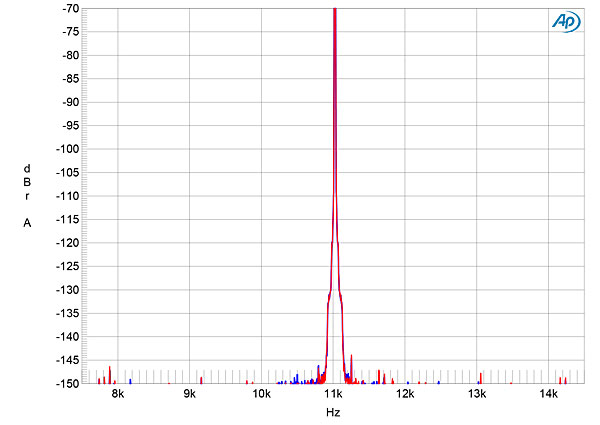
 The DAC502 offered excellent rejection of word-clock jitter. Fig.13 shows the spectrum of the DAC502's output when it was fed high-level 16-bit J-Test data via USB. All the odd-order harmonics of the undithered low-frequency, LSB-level squarewave lie at the correct levels, there are no other sideband pairs visible, and the central spike that represents the high-level tone at one-quarter the sample rate (Fs/4) is narrow. The spectrum was similarly clean with 24-bit J-Test data via USB, though there was some spectral broadening of the Fs/4 spike with S/PDIF and AES/EBU data (fig.14).
 I summed my measurements of the Weiss DAC202 by writing "The DAC202 is the best-measuring D/A processor I have measured in my quarter-century career at Stereophile. It just doesn't get any better than this." Weiss's DAC502 matched the DAC202 by also performing supremely well on the test bench.—John Atkinson
Footnote 1: Weiss's DAC501 and DAC502 differ only in their form factor—the 501 is narrower and slightly taller—and an extra, 4-pin headphone connector on the back of the DAC502.
The Weiss DAC202, which Erick Lichte reviewed in January 2012, was one of the highest-resolution digital processors I have measured, so I was intrigued to see if the DAC502 would match its predecessor's performance. As I had done with the DAC202, I measured the Weiss DAC502 with my Audio Precision SYS2722 system (see the January 2008 "As We See It"). Apple's USB Prober utility identified the DAC502 as "DAC501" from "Weiss_Engineering_Ltd." with the serial number string "0.0.1" (footnote 1).The USB port operated in the optimal isochronous asynchronous mode, and Apple's AudioMIDI utility revealed that the DAC502 accepted 32-bit integer data sampled at all rates from 44.1kHz to 384kHz. The AES/ EBU and S/PDIF inputs accepted data sampled at rates up to 192kHz.
The DAC502's maximum output level at 1kHz with the balanced outputs or the headphone outputs feeding a high 100k ohm load was 6.85V with the level set to "0dB"; 2.17V with it set to "–10dB," which is exactly 10dB lower; 684mV set to "–20dB," 20dB lower; and 217mV set to "–30dB," 30dB lower. As expected, the maximum levels from the unbalanced outputs were half those from the balanced outputs. With its polarity button set to Normal, the DAC502 preserved absolute polarity (ie, was noninverting) from all of its outputs. The balanced output impedance was 94 ohms at all audio frequencies; the unbalanced output impedance was 47 ohms. The front-panel headphone jack's output impedance was a very low 0.66 ohm. The DAC502 will have no problem driving low-impedance headphones.
Fig.1 shows the DAC502's impulse response with 44.1kHz data. It is typical of a conventional linear-phase filter with a symmetrical ringing before and after the single full-scale sample. This filter's ultrasonic rolloff (fig.2, magenta and red traces) reaches full stop-band attenuation at 24kHz with complete suppression of the aliased image at 25kHz of a full-scale tone at 19.1kHz (cyan, blue). The harmonics associated with the 19.1kHz tone all lie below –104dB. Fig.3 shows the DAC502's frequency response with data sampled at 44.1, 96, and 192kHz. The response with all three sample rates is down by just 0.3dB at the top of the audioband, with then a steep rolloff just before half of each sample rate. The response with 192kHz data continues the relatively gentle ultrasonic rolloff, reaching –3dB at 61kHz.
Fig.1 Weiss DAC502, impulse response (one sample at 0dBFS, 44.1kHz sampling, 4ms time window).
Fig.2 Weiss DAC502, wideband spectrum of white noise at –4dBFS (left channel red, right magenta) and 19.1kHz tone at 0dBFS (left blue, right cyan) into 100k ohms with data sampled at 44.1kHz (20dB/vertical div.).
Fig.3 Weiss DAC502, frequency response at –12dBFS into 100k ohms with data sampled at: 44.1kHz (left channel green, right gray), 96kHz (left cyan, right magenta), and 192kHz (left blue, right red) (0.25dB/vertical div.).
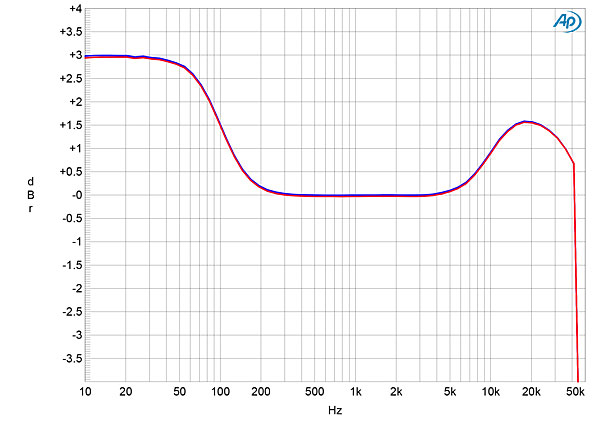
Fig.4 shows the effect of two of the DAC502's Creative EQ filters, high and low shelves at 110Hz and 10kHz, set to their maximum and minimum of ±10dB and measured with data sampled at 96kHz. The output reaches its specified boost or cut an octave below or above the selected turnover frequency; the boost or cut is 7dB at the turnover frequencies. Fig.5 shows the equalization I used to optimize the sound of the KEF LS50s in my room.
Fig.4 Weiss DAC502, typical EQ response at –12dBFS into 100k ohms with 96kHz data: high and low shelves at 110Hz and 10kHz set to "0dB" (left channel green, right gray) and set to ±10dB (left blue, right red) (2dB/vertical div.).
Fig.5 Weiss DAC502, Creative EQ settings used for the KEF LS50s in my room (left channel blue, right red) (0.5dB/vertical div.).
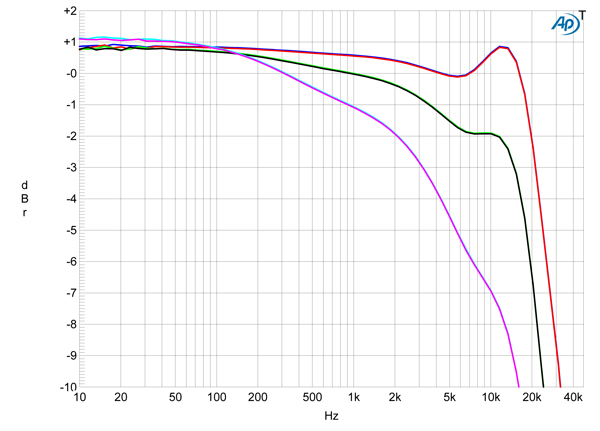
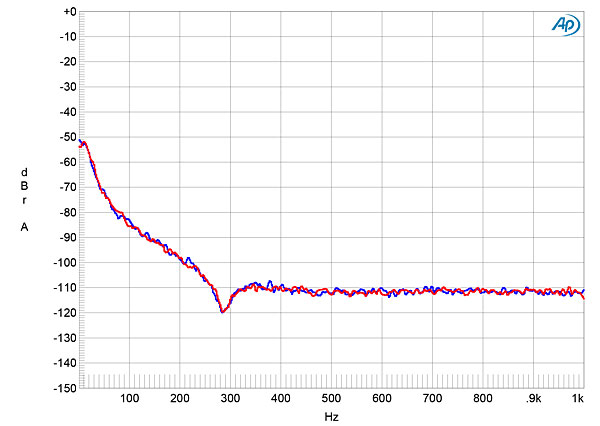
The effect of the Vinyl Emulator function on the DAC502's frequency response is shown in fig.6. The response varies significantly with the setting of the "Saturation" control. The central green and gray traces in this graph show what happens with it set to "0.0dB": The output slopes down above the midrange, with a –3dB plateau between 7kHz and 12kHz referred to the low-frequency level, and then a steep rolloff. With the control set to "–9dB," the high-frequency balance is closer to neutral, but with it set to "+9.0dB," the DAC's output is down by 3dB at 2kHz and by 10dB at 10kHz. The Emulator also introduces noise with a spectrum that tilts up below 300Hz (fig.7), adds mainly second-harmonic distortion, and reduces channel separation to around 20dB.
Fig.6 Weiss DAC502, effect of Vinyl Emulation at –12dBFS into 100k ohms with 96kHz data with Saturation set "–9dB" (left channel blue, right red), "0.0dB" (left green, right gray), and +9dB (left cyan right magenta) (1dB/vertical div.)
Fig.7 Weiss DAC502, Vinyl Emulation mode, spectrum of noise floor, 24-bit data (left blue, right red) (10dB/vertical div.).
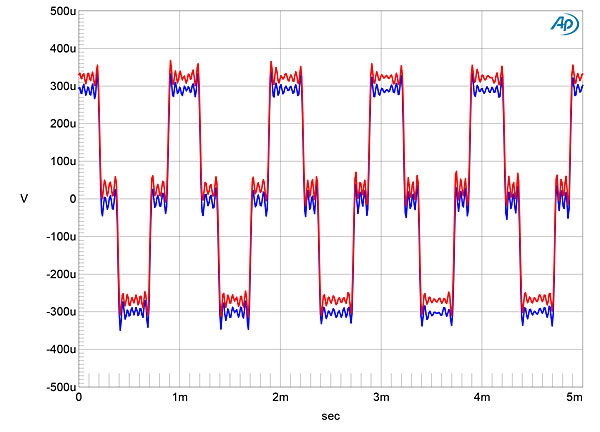
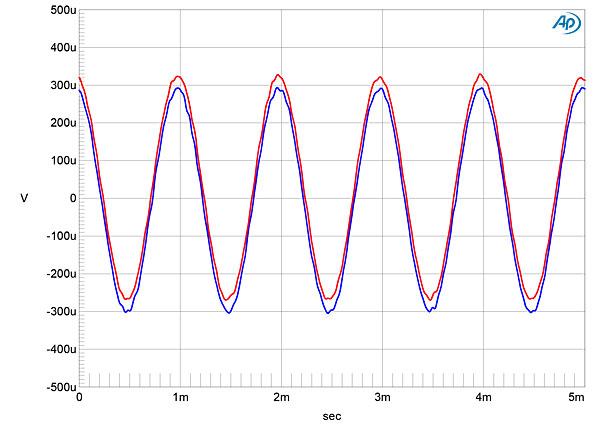
Channel separation with the Vinyl Emulator bypassed was simply superb, at >122dB in both directions below 3kHz, decreasing to a still-superb 113dB at 20kHz. An increase in bit depth from 16 to 24, with dithered data representing a 1kHz tone at –90dBFS, dropped the DAC502's noise floor by 30dB (fig.8). This implies a resolution of 21 bits, which is one of the highest I have encountered and equals that of the Weiss DAC202. When I played undithered data representing a tone at exactly –90.31dBFS, the waveform was symmetrical, with negligible DC offset, and the three DC voltage levels described by the data were free from noise (fig.9). With undithered 24-bit data (fig.10) the DAC502's very low analog noise floor means it can output a clean sinewave, even at this very low signal level.
Fig.8 Weiss DAC502, spectrum with noise and spuriae of dithered 1kHz tone at –90dBFS with: 16-bit data (left channel cyan, right magenta), 24-bit data (left blue, right red) (20dB/vertical div.).
Fig.9 Weiss DAC502, waveform of undithered 1kHz sinewave at –90.31dBFS, 16-bit data (left channel blue, right red).
Fig.10 Weiss DAC502, waveform of undithered 1kHz sinewave at –90.31dBFS, 24-bit data (left channel blue, right red).
Fig.11 Weiss DAC502, 24-bit data, spectrum of 50Hz sinewave, DC–1kHz, at 0dBFS into 100k ohms (left channel blue, right red; linear frequency scale).
Fig.12 Weiss DAC502, 24-bit data, HF intermodulation spectrum, DC–30kHz, 19+20kHz at –6dBFS into 100k ohms, 44.1kHz data (left channel blue, right red; linear frequency scale).
Fig.13 Weiss DAC502, high-resolution jitter spectrum of analog output signal, 11.025kHz at –6dBFS, sampled at 44.1kHz with LSB toggled at 229Hz: 16-bit USB data sourced from MacBook Pro (left channel blue, right red). Center frequency of trace, 11.025kHz; frequency range, ±3.5kHz.
Fig.14 Weiss DAC502, high-resolution jitter spectrum of analog output signal, 11.025kHz at –6dBFS, sampled at 44.1kHz with LSB toggled at 229Hz: 24-bit AES/EBU data (left channel blue, right red). Center frequency of trace, 11.025kHz; frequency range, ±3.5kHz.
Footnote 1: Weiss's DAC501 and DAC502 differ only in their form factor—the 501 is narrower and slightly taller—and an extra, 4-pin headphone connector on the back of the DAC502.