 Construction
Housing all HV-series components is a nonmagnetic, glass-bead– blasted solid-block aluminum chassis with 10mm-thick walls, separated internal chambers, good shielding, and uniform heat distribution. Outer surfaces are hardened and anodized with a special aluminum coating. The heatsinks are optimized to increase heat diffusion. Different circuits are housed in separate internal chambers and layers.
The A 3100 HV's upper compartment houses its dual-mono, symmetrical balanced amplifier stages, including "very sensitive" discrete circuits, no op-amps, Vishay RNC55 resistors, mica and polypropylene capacitors, and rhodium-plated speaker terminals (footnote 5). It is constructed from nonmagnetic materials. "Hermetically encapsulated gold-contact relays" are said to be free of noise and distortion. A combination of electromagnetic encapsulation and galvanic isolation shields circuit groups from each other.
The A 3100 HV's exceptionally large toroidal output transformer, output-stage circuitry, and high-speed capacitors are housed in the shielded lower compartment; Siggi calls this the "dirty room, with a lot of energy flying around that could disturb a sensitive preamplifier section." Galvanic (optical and magnetic) isolation and the "shortest possible" voltage paths contribute to the ability to perform at two different voltage levels, which are set by a switch on the rear panel.
"All switching—even the volume control in our preamps—is done by capsuled relays that have no resistance," Siggi said. "There are no magnetic parts, no iron or steel. And, of course, all stages are shielded from each other. We do this because if you can measure it, you can hear it, but there are many things you can hear which you can't measure."
Siggi describes the 3100's transformer as "ultra hard." What does that mean? "Due to the internal resistance of its wiring, every transformer's voltage collapses a little bit when outputting high power," he said. "For example, if you use 100 volts for full power, and a big impulse comes, then voltage will tend to dip a bit. This is what we call collapse or break-in, and it makes the bass response soft. Our transformer dips very little. It's extremely stable at very high volumes, and the bass response is always extremely tight and precise, even with speakers with a very nonlinear impedance. To make this possible, the A 3100 HV's capacitors store 120,000 microfarads and charge 100 times per second." (footnote 6)
T+A pricing
I recently switched from driving a 1994 Toyota Corolla DX to a 2008 Honda Fit, so I would be the last to call the A 3100 HV's $29,900 price chump change. Yet it costs far less than much of its competition. "We don't think that there are companies building with higher-quality parts, higher-quality construction, and more engineering resources," Shannon said. "But we operate in an environment where many of our competitors price things at what they believe the market will bear.
"From day one, T+A has had what I think is the most honest and straightforward pricing strategy possible. Every year, every product is evaluated to the penny for the actual cost for labor, parts, and overhead. Then we generate a specific, fair margin for each of our partners and adjust that on an annual basis. Every price increase is based on actual costs and nothing more. On occasion, we
lower price at the end of the year. That's one of the reasons you'll never see an across-the-board 10% price increase from T+A, because it wouldn't honestly reflect what each product we build costs."
Tariff instability is, of course, as much of a problem for T+A as for every other audio company based outside the United States that serves the US market. Customs and Border Protection sometimes drills down to see if your screws are made in China, Europe, or some other country, Siggi said. This puts a huge burden on the US team, which must document the source of every part.
 What you'll see and use, and what I did
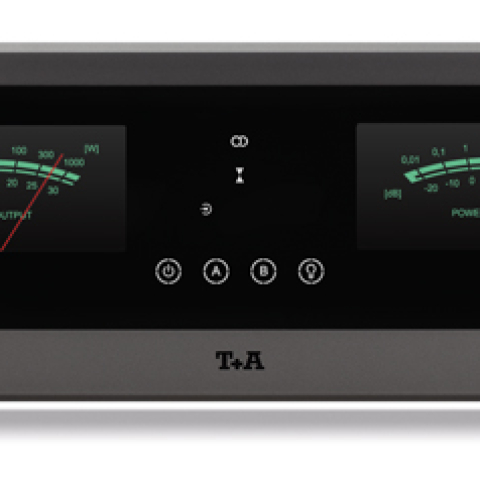
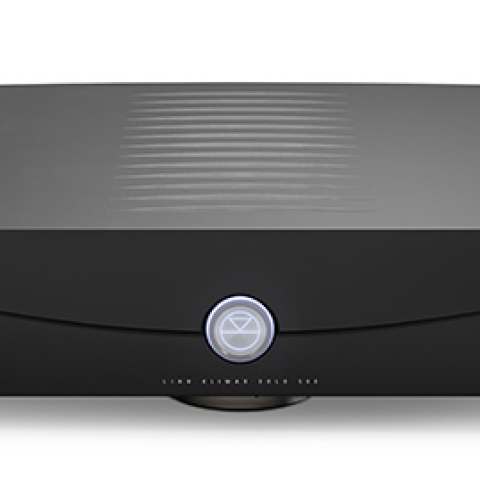
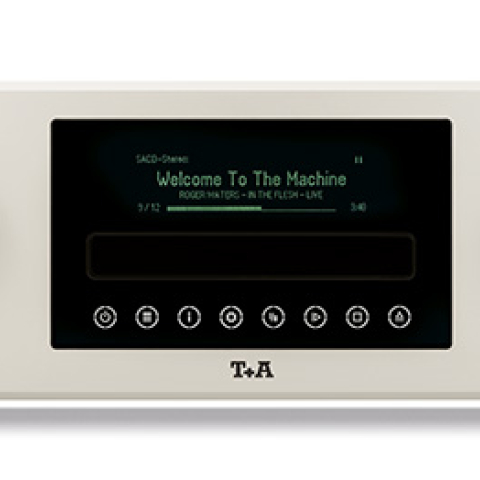
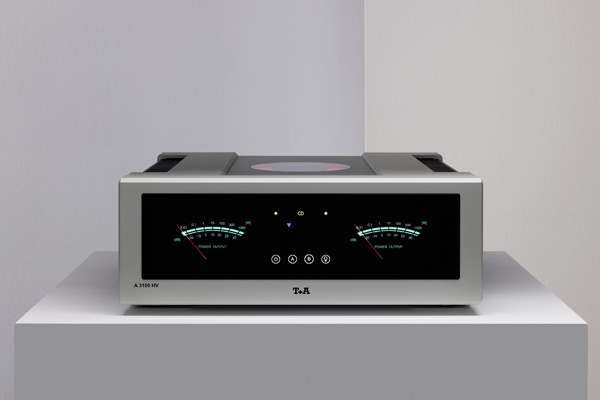
The main feature on the A 3100 HV's front panel is a huge two-channel VU power meter display. There are touchscreen buttons for On/Off, choice of outputs, and a seven-step display brightness adjustment. The level meter's measuring range is adjustable. Status symbols are displayed to let you know how things are going inside the amp: one turns red if the output stage clips; others light up to indicate stereo or mono mode, ideal or less-than-ideal operating temperature, which output is in use, High Current mode, and that protection has been triggered.
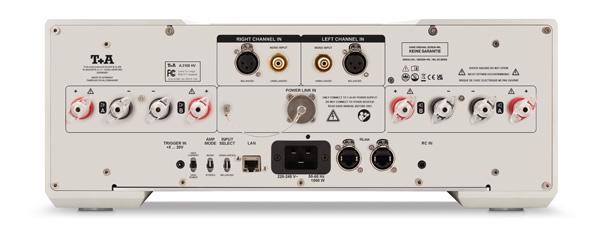
The rear panel includes, in addition to single pairs of left- and right-channel balanced (XLR) and single-ended (RCA) inputs, a link to connect with the optional PS 3100 HV power supply, HLINKs to connect to other T+A products, a LAN input for updates, two pairs of loudspeaker binding posts, two trigger inputs, and a 20-amp IEC power receptacle. Of special importance are three little up/down switches. The first chooses between mono and stereo modes, the second between the balanced and unbalanced inputs, and the third between High Current and High Power modes. You may use the first two during operation, but if you attempt to switch between High Current and High Power when the amplifier is operating, the software will block the change, so power down first.
At 84 lb, the A 3100 HV was far easier to lift than some of the behemoths that have come my way. Positioning it on one of my
Grand Prix Audio Monza amp stands with three Wilson Pedestals beneath it was a snap, and hooking it up was a breeze.
Listen, I did
For the first 8–10 days, I let the amp run 24/7. Once the amp had reached the 200-hour mark (more or less), I began serious listening.
The arrival of the
Innuos NazaréNET and NazaréFLOW has greatly enhanced musical coherence and detail retrieval of music emerging from my musical source, the dCS Varèse, but I wasn't prepared for how much more the "NET&FLOW," in partnership with the T+A A 3100 HV, would reveal differences between preamps. Bass weight and tightness, color, air, image specificity and focus, and soundstage width and depth all changed. For its part in this affair, the A 3100 HV proved itself to be a mightily revealing amplifier.
The second thing I discovered, during several additional listening sessions, is that the A 3100 HV required additional break-in beyond the recommended 200 hours for its sound to fully stabilize. During my first session, my friend Scott Campbell and I were in heaven. The T+A amp/
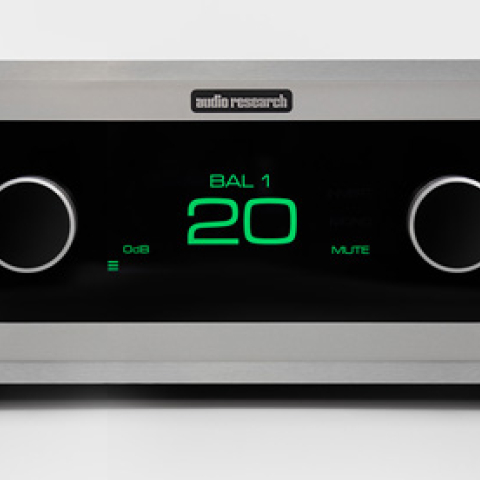
Audio Research REF20 preamp pairing seemed, surprisingly, a bit warmer than the all-tube
Audio Research REF 330M monoblock/REF20 preamp combination. Yet its beauty and ability to convey emotion were totally, positively, and completely enrapturing. Editor Jim Austin may accuse me of adjective overkill (footnote 7), but that's how I felt. Really.
The next session, I was surprised by the system's neutrality. The time after that, I noticed some edginess.
I decided to let it run for another 36 hours, resuming my perpetually unsuccessful effort to seduce my electric meter into running backward. Speaking of seduction, playing
Salome's "Dance of the Seven Veils" at high volume regrettably only made it run faster. Finally I reached a place where the sound remained consistent over days of listening. Overly warm and edgy were out. Neutrality and clarity were in.
 Happy, I was
Even before the T+A A 3100 HV stereo amplifier was fully settled in, when I listened in High Current mode, I found its soundstage width and depth almost as impressive, if not as limitless, as that from the best monoblocks I've auditioned over the past few years. Bass was excellent in the opening movement of Mahler's Symphony 5 from Rafael Payare and Orchestre symphonique de Montréal (24/96 FLAC download, Pentatone) and on Ike Quebec's "Minor Impulse" from
Blue & Sentimental, remastered in 2007 as part of the Rudy Van Gelder Edition (24/192 FLAC, Blue Note/Qobuz).
When I played Ella Fitzgerald's "Black Coffee," from
Ella Fitzgerald Sings Songs from "Let No Man Write My Epitaph" (24/192 FLAC, Verve Reissues/Qobuz), I realized I'd never heard so much studio-enhanced resonance around her voice. I also noted, during one of my favorite bass torture tests, the blood-curdling second movement of Shostakovich's Symphony 11 on the excellent recording
Shostakovich: Symphonies Nos.4 & 11 from Andris Nelsons and the Boston Symphony Orchestra (24/96 WAV download, Deutsche Grammophon), that the A 3100 HV could beautifully flesh out the hard-to-distinguish low-lying lines in this everything-at-once total assault.
"This is one revealing amp!" I exclaimed.
Days later, when Jim Shannon arrived to ensure that everything was functioning as it should, I had the opportunity to listen to mostly unfamiliar tracks. (I am grateful for visitors with good taste in music.) The title track from the Enrico Pieranunzi Quintet's 1987 release
Don't Forget the Poet (16/44.1 FLAC, Baseline Jazz/Qobuz) sounded clean, fresh, warm, and totally tight (in a good way). Ella Fitzgerald's midrange on "Good Morning Heartache," from
Clap Hands, Here Comes Charlie! (24/192 FLAC, Verve/Qobuz), was gorgeous. George Colligan's "Three Views of a Secret" from
Past-Present-Future (16/44.1 FLAC, Criss Cross Jazz/Qobuz) demonstrated how natural the range of the piano can sound. Finally, on Joshua Redman and his quartet's "Second Snow (Pts. I & II)" from
Spirit of the Moment: Live at the Village Vanguard (16/44.1 FLAC, Warner Jazz/Qobuz), every instrument was reproduced with stellar accuracy.
On Debussy's Sonata for Flute, Viola, and Harp, from
Debussy: Sonates & Trios (24/96 WAV download, Erato), I missed the last iota of glow, soundstage openness, and transparency, but instrumental timbres sounded natural and lovely. The A 3100 HV conveyed with aplomb all the complex, intersecting, low-lying orchestral lines that build up to the pounding bass in the aforementioned Shostakovich bass torture test. If you can hear everything that's on this recording, you're blessed with great equipment and a very well-controlled room.

My next listening session, which took place late at night, consisted entirely of JVS comfort music. I hadn't played Arleen Auger's early digital triumph
Love Songs (16/44.1 FLAC, Delos/Qobuz) for far too long. I turned to a song I hadn't heard for many years, Francis Poulenc's beautiful "
Fiançailles pour rire: No.6, Fleurs." I sat stunned at the warmth of Auger's heartwarming soprano, which sounded fresher and better focused than I had heard it reproduced on other occasions. I was similarly entranced by the colors of Dalton Baldwin's piano and the song's intrinsic beauty.
Feeling like someone who had promised himself to eat just one, only to lick his lips and reach for a second, I continued with the next track, Pietro Cimara's touching "
Stornello." On such an early digital recording, I didn't expect to be blown away by Auger's dynamic transition from full-throated forte to bare whisper. I didn't expect to find everything sounding as natural and ideally focused as it would in a live performance.
Soprano Sabine Devieilhe's performance of the final movement of Mahler's Fourth Symphony, from François-Xavier Roth's period-instrument ensemble Les Siècles (24/96 WAV download, Harmonia Mundi), has sometimes sounded edgy on my system (footnote 8). Now it sounded ideally fresh, alive, and inviting. Roth's period instruments were reproduced with excellent depth and warmth. On a comparison track—the touchstone version of this work, soprano Kathleen Battle's performance, with the Vienna Philharmonic under Lorin Maazel, from
Classic Kathleen Battle (16/44.1 FLAC, Sony/Qobuz)—I heard a bit of grayness at the center of Battle's tone, but it could not detract from the special warmth with which the A 3100 HV portrayed her ideal voice, supported by one of the world's plushest-sounding orchestras.

After a 3.75-mile power walk through the woods, I learned that my new friend and walking companion was a Joni Mitchell fan. I invited him to the music room and cued up her soulful, cigarette-scarred 2000 remake of "
Both Sides Now," with orchestra (16/44.1 FLAC, Reprise/Qobuz). The electronically enhanced orchestra, complete with some low rumble, sounded all-enveloping, the voice tinged with melancholy and regret. I heard one persistently bloated bass note, which I promised myself to investigate further, and a bit of gray in the center of the tone, which did not detract from all the winning colors on the recording (footnote 9).
As the review period neared its end, I realized I had never compared High Current and High Power modes directly, so I did. Maybe High Power provided a teeny bit more
oomph on the Shostakovich, though not enough to notice in normal listening. Nor did High Power better control that pesky note on Joni's remake of "Both Sides Now."
When I switched between High Current and High Power on successive plays of J.S. Bach's mighty
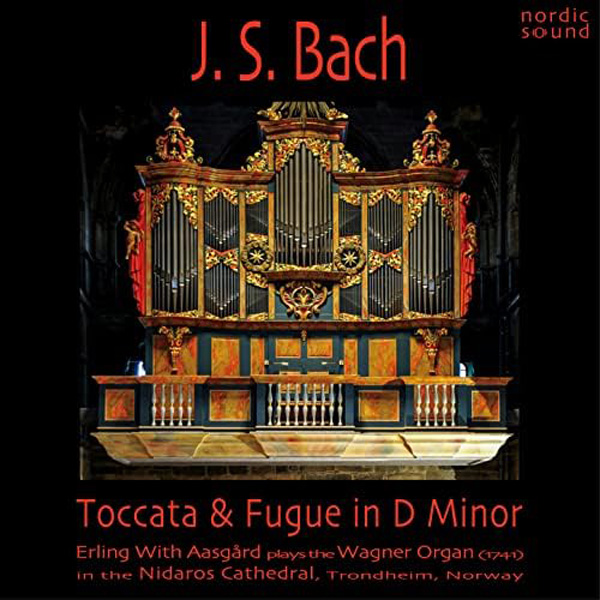
Toccata and Fugue in D Minor, fluently performed by Erling With Aasgård on the famous 1741 Wagner organ in the Nidaros Cathedral in Trondheim, Norway (24/192 FLAC, Nordic Sound/Qobuz), I heard no change in either dynamic range or the amp's laudable ability to portray challenging musical lines with ease. The only thing missing was dark strength and solidity in the very bottom octave, in the range that stretches my speakers and room to their limit. This was the only instance that I felt something was missing in my time with the A 3100 HV. If I'd had a monoblock pair, those lowest notes might well have been all there.
The main difference I heard between High Current and High Power was in aspects of music that are hard to measure but easy enough to hear or to sense. High Current's class-A sound was warmer and airier; it also seemed more organic, present, and real. High Current mode rendered every note and phrase more palpable and moving. The change in perception of music's physical, emotional, and spiritual impact was major. In High Power mode, the T+A A 3100 HV came across as another achievement in a long line of fine solid state amplifiers. In High Current mode, it sounded special.
Conclusion
This amplifier's considerable glory lies in class-A. In High Current mode, its musicality competes with some of the finest amps I've auditioned, many of which cost far more. Still, I'd advise anyone with sufficient resources, a large room, or hard-to-drive speakers to audition a mono pair—which, thanks to T+A's rational pricing strategy, is possible for more people than it would be with other, sonically competitive brands.
"A 3100 HV" is a plain name for an amplifier of this quality, but its sound is anything but plain. Any music lover would be blessed to have this amplifier in their system. The A 3100 HV is a stellar musical achievement.
Footnote 5: At about $9000/oz, rhodium costs twice as much as gold—we checked—but Siggi said it's the best material for contact surfaces subject to heavy wear because it is much harder and far more corrosion-resistant than gold is.
Footnote 6: Strictly speaking, essentially all power supply capacitors in Europe recharge 100 times per second, because AC power there operates at 50Hz. In the US, capacitors will recharge even faster, 120 times per second.—
Jim Austin
Footnote 7: I deleted a few adjectives here, just for my own amusement—and readability.—
Jim Austin
Footnote 8: Period string instruments always have an edge, even when you hear them live. Inferior systems can render this edginess as something unpleasant, lifting it out of its context, while the best systems make it sound simply characterful. That, anyway, has been my experience.—
Jim Austin
Footnote 9: Both of these issues—the bloat and the grayness—are on the recording, I judged. Certainly this amplifier did not cause bloat on just one bass note; I've heard this grayness with the $210,000/pair CH Precision M10 monoblocks in my home system, and I've heard it in other systems.