The first thing to note is that, while the amplitude of the speaker's Helmholtz or bass tuning frequency around 63Hz doesn't change much with the change in interface material, the mode three octaves higher, at 156Hz, is vanquished by all the compliant supports. Fig.1, for example, shows the waterfall plot for the AE1's side panel with the speaker sitting on the three upward-pointing German Acoustics brass cones, while fig.2 shows it when supported by the German Acoustics soft feet. (The frequency resolution of these cumulative spectral-decay plots is 8Hz, which is why the lower frequency modes appear to be of lower Q.) There the 156Hz mode is, gone. It is possible that this resonance is due to the interaction between the speaker and the stand, emphasized by the tight coupling offered by the cones and eliminated by the compliant supports.  Fig.1 Acoustic Energy AE1 side panel, Celestion Si stand, three German Acoustics brass cones, cumulative spectral-decay plot (8Hz-2kHz, 75ms time window).
 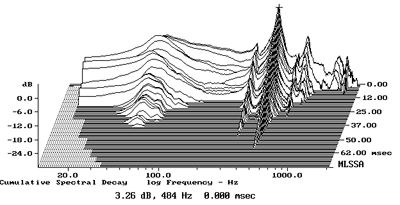 Fig.2 Acoustic Energy AE1 side panel, Celestion Si stand, three German Acoustics damping feet, cumulative spectral-decay plot (8Hz-2kHz, 75ms time window).
However, nearly all the compliant interfaces raise the amplitude of the main mode at 484Hz to some degree, as well as that of the small modes at 344Hz and 1406Hz, presumably because their inherent springiness is giving the cabinet something to work against. The sheet of Navcom, however, does clean up the HF hash in the plot, reducing the level at 1.6kHz by 6dB. The winner in this comparison, however, is the cheapest: the three pads of Blu-Tack, squashed flat between the base of the speaker and the stand top-plate. As can be seen in fig.3, not only do these pads reduce the amplitude of the main mode by more than 6dB, and almost zap the 156Hz and 344Hz modes out of existence, they significantly clean up the cabinet wall's HF vibrations. Their improvement on the cabinet's vibrational behavior can also be seen in the time domain. Fig.4 shows the side-wall's impulse response with the speaker sitting on the AudioPrism damping spheres, fig.5 with the speaker supported by the Blu-Tack pads.
Fig.2 Acoustic Energy AE1 side panel, Celestion Si stand, three German Acoustics damping feet, cumulative spectral-decay plot (8Hz-2kHz, 75ms time window).
However, nearly all the compliant interfaces raise the amplitude of the main mode at 484Hz to some degree, as well as that of the small modes at 344Hz and 1406Hz, presumably because their inherent springiness is giving the cabinet something to work against. The sheet of Navcom, however, does clean up the HF hash in the plot, reducing the level at 1.6kHz by 6dB. The winner in this comparison, however, is the cheapest: the three pads of Blu-Tack, squashed flat between the base of the speaker and the stand top-plate. As can be seen in fig.3, not only do these pads reduce the amplitude of the main mode by more than 6dB, and almost zap the 156Hz and 344Hz modes out of existence, they significantly clean up the cabinet wall's HF vibrations. Their improvement on the cabinet's vibrational behavior can also be seen in the time domain. Fig.4 shows the side-wall's impulse response with the speaker sitting on the AudioPrism damping spheres, fig.5 with the speaker supported by the Blu-Tack pads.  Fig.3 Acoustic Energy AE1 side panel, Celestion Si stand, three flattened pads of Blu-Tack, cumulative spectral-decay plot (8Hz-2kHz, 75ms time window).
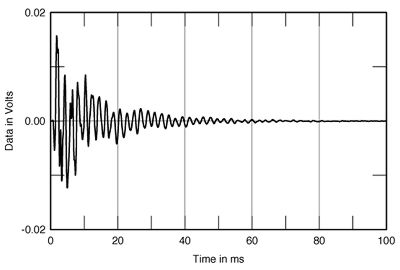 Fig.4 Acoustic Energy AE1 side panel, Celestion Si stand, three AudioPrism Iso-Bearings, impulse response (100ms time window).
 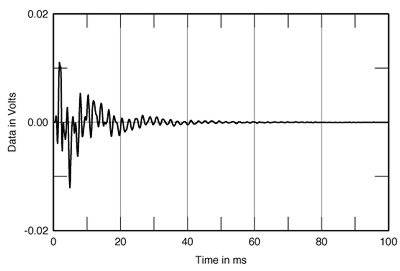 Fig.5 Acoustic Energy AE1 side panel, Celestion Si stand, three flattened pads of Blu-Tack, impulse response (100ms time window).
Fig.1 Acoustic Energy AE1 side panel, Celestion Si stand, three German Acoustics brass cones, cumulative spectral-decay plot (8Hz-2kHz, 75ms time window). Fig.2 Acoustic Energy AE1 side panel, Celestion Si stand, three German Acoustics damping feet, cumulative spectral-decay plot (8Hz-2kHz, 75ms time window). Fig.3 Acoustic Energy AE1 side panel, Celestion Si stand, three flattened pads of Blu-Tack, cumulative spectral-decay plot (8Hz-2kHz, 75ms time window). Fig.4 Acoustic Energy AE1 side panel, Celestion Si stand, three AudioPrism Iso-Bearings, impulse response (100ms time window). Fig.5 Acoustic Energy AE1 side panel, Celestion Si stand, three flattened pads of Blu-Tack, impulse response (100ms time window).