Sidebar 3: Measurements
I measured the Rotel Michi S5 with my Audio Precision SYS2722 system, preconditioning the amplifier by operating it at 1/8 the specified power into 8 ohms for 30 minutes. At the end of that time, the top panel's temperature was 86°F/30°C, and that of the side panels next to the heatsinks 101.1°F/38.4°C. Though the rear-panel fans had turned on and were venting hot air, they were silent.
The Michi S5's voltage gain at 1kHz into 8 ohms was 23.6dB for the balanced input and 27.7dB for the unbalanced input, both values close to the specified gains. Both inputs preserved absolute polarity, ie, were noninverting. The single-ended input impedance is specified as 12.5k ohms. I measure 12.7k ohms at low and middle frequencies, decreasing inconsequentially to 11.7k ohms at the top of the audioband. The balanced input impedance, specified as 100k ohms, was 94k ohms at 20Hz and 1kHz, 88k ohms at 20kHz.
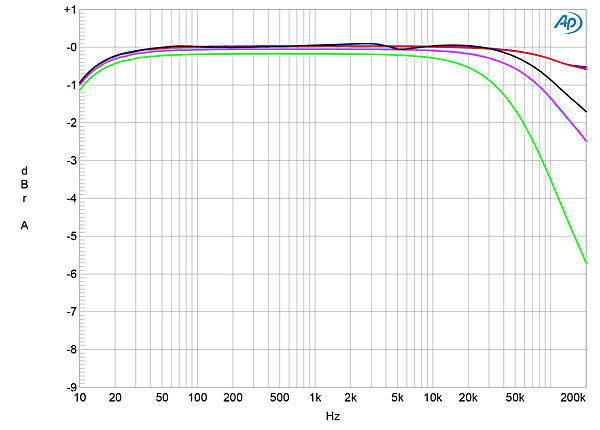
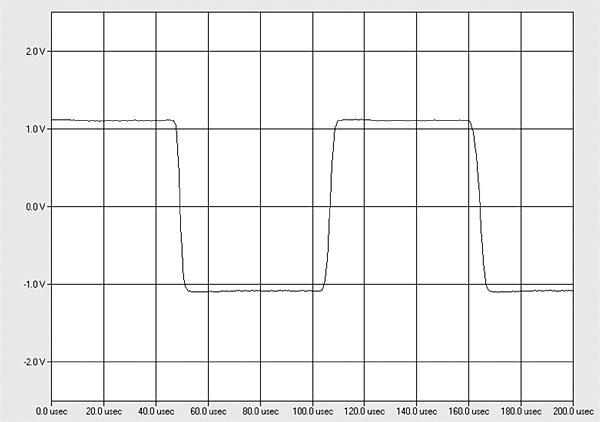
The S5's output impedance (including the series resistance of 6' of speaker cable) was low, at 0.07 ohm at 20Hz, 0.12 ohm at 1kHz, and 0.135 ohm at 20kHz. As a result, the variations in the Michi S5's small-signal frequency response into our standard simulated loudspeaker response (fig.1, gray trace) were inconsequential. Into resistive loads (blue, red, cyan, magenta, and green traces), the amplifier gently rolled off well above the audioband, the –3dB frequency dependent on the load. The response into 2 ohms (green trace) was down by 3dB at 85kHz. The Michi S5's reproduction of a 10kHz squarewave into 8 ohms (fig.2) featured very short risetimes and no overshoot or ringing.
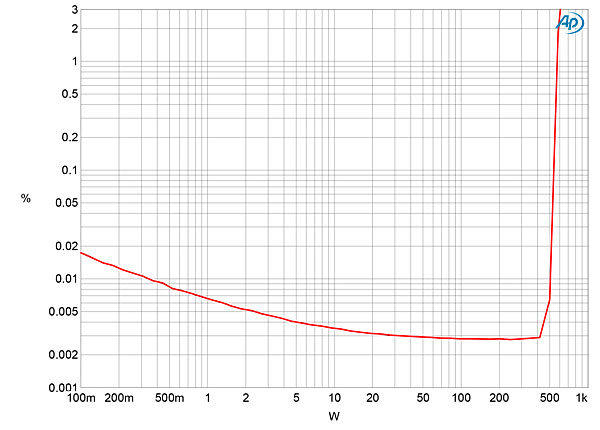
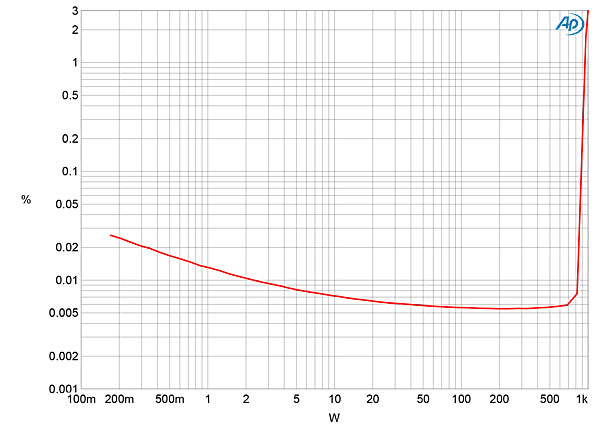
 The Michi S5's maximum continuous power is specified as 500Wpc into 8 ohms (27.0dBW) and 800W into 4 ohms (26.2dBW). With our usual definition of clipping as being when the THD+noise reaches 1%, I measured a clipping power with both channels driven into 8 ohms of 570Wpc (27.56dBW, fig.4). Even though the wall voltage had dropped from 119.1V to 115.4V with both channels clipping into 4 ohms, the Michi S5 still easily exceeded its specified power into that load, the maximum power measuring 940Wpc (26.72dBW, fig.5). As the S5's manual says that 4 ohms is the recommended minimum load impedance, I didn't test the clipping power into 2 ohms.
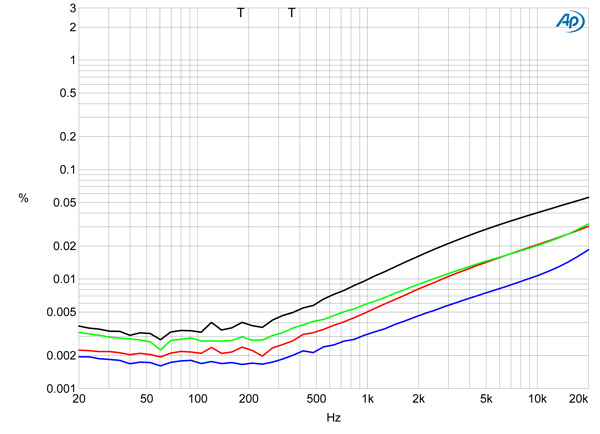 The distortion signature into 8 ohms was predominantly the second harmonic (fig.7), though when I examined the spectrum with 50Hz at a level of 100Wpc into 8 ohms (fig.8), this harmonic was lower in level than the AC supply–related spuriae. Repeating the spectral analysis with a 1kHz signal at the same voltage into 8 ohms (fig.9), the second harmonic lay at –89dB (0.003%), the third harmonic was negligible, and the fourth harmonic lay at –97dB (0.0014%). Despite the decreasing linearity at high frequencies seen in fig.6, the Michi S5 performed well when driving an equal mix of 19 and 20kHz tones at 50Wpc into 8 ohms (fig.10). Both the 1kHz difference product and the higher-order products at 18 and 21kHz were more than 90dB below the peak signal level.
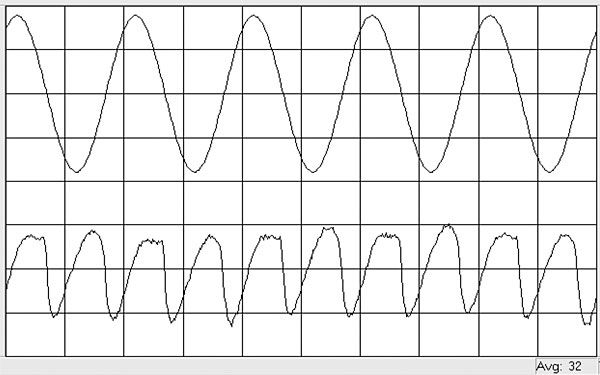
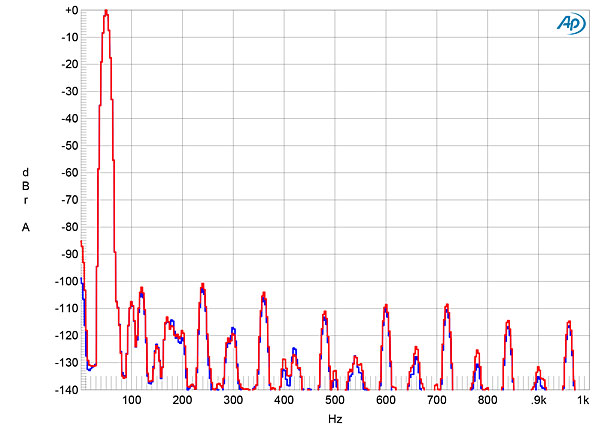
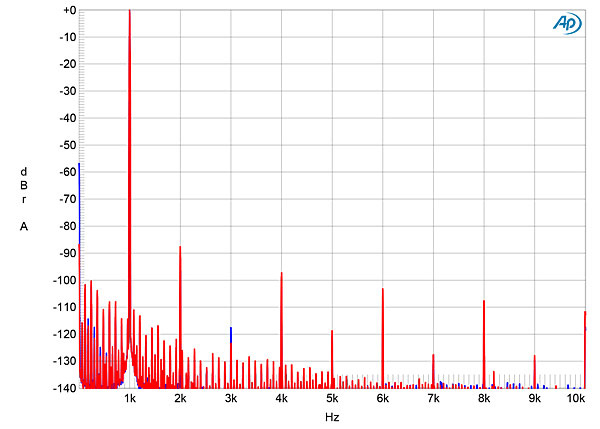
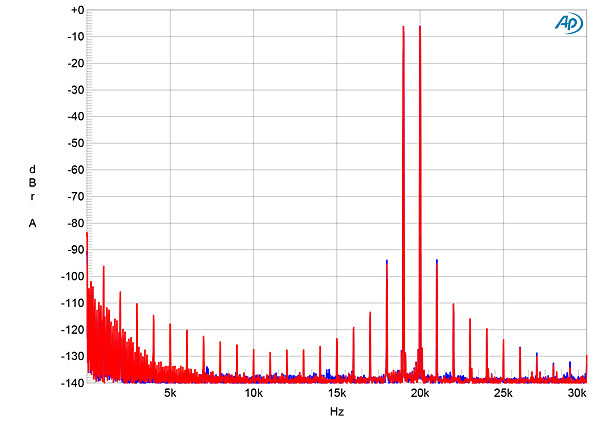
Fig.1 Rotel Michi S5, balanced frequency response at 2.83V into: simulated loudspeaker load (gray), 8 ohms (left channel blue, right red), 4 ohms (left cyan, right magenta), and 2 ohms (green) (1dB/vertical div.).
Fig.2 Rotel Michi S5, small-signal 10kHz squarewave into 8 ohms.
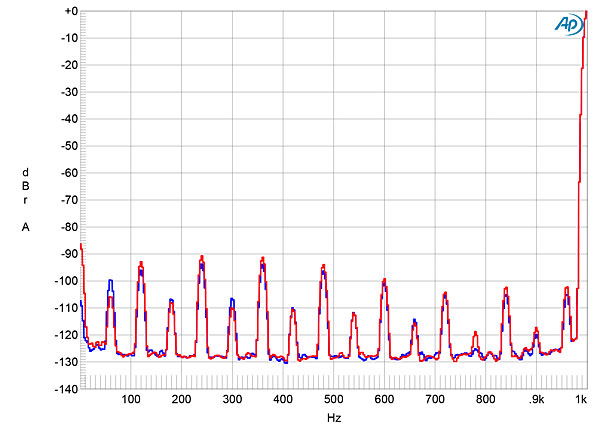
The Michi's channel separation (not shown) was very good, at >80dB below 2kHz and still 64dB at the top of the audioband. The unweighted, wideband signal/noise ratio (ref. 1W into 8 ohms and measured with the unbalanced input shorted to ground) was also very good, measuring 79.5dB (average of the two channels). This ratio improved to an excellent 88.7dB, left channel, and 85.7dB, right, when the measurement bandwidth was restricted to 22Hz–22kHz, and to 92.1dB, left, and 89.7dB, right, when A-weighted. Spectral analysis of the low-frequency noisefloor while the Michi S5 drove a 1kHz tone at 1Wpc into 8 ohms (fig.3) revealed that although some AC-related spuriae were present, these all lay at or below –90dB.
Fig.3 Rotel Michi S5, spectrum of 1kHz sinewave, DC–1kHz, at 1W into 8 ohms (left channel blue, right red; linear frequency scale).
Fig.4 Rotel Michi S5, distortion (%) vs 1kHz continuous output power into 8 ohms.
Fig.5 Rotel Michi S5, distortion (%) vs 1kHz continuous output power into 4 ohms.
Fig.6 shows how the percentage of THD+noise varies with frequency into 8 and 4 ohms at 20V (equivalent to 50W into 8 ohms and 100W into 4 ohms). The THD was very low at low and middle frequencies, though a little higher in the right channel (red and gray traces) than the left (blue and green). It rose in the top three audio octaves, this presumably due to the amount of corrective negative feedback reducing with increasing frequency.
Fig.6 Rotel Michi S5, THD+N (%) vs frequency at 20V into: 8 ohms (left channel blue, right red) and 4 ohms (left green, right gray).
Fig.7 Rotel Michi S5, 1kHz waveform at 50W into 8 ohms, 0.003% THD+N (top); distortion and noise waveform with fundamental notched out (bottom, not to scale).
Fig.8 Rotel Michi S5, spectrum of 50Hz sinewave, DC–1kHz, at 100Wpc into 8 ohms (linear frequency scale).
Fig.9 Rotel Michi S5, spectrum of 1kHz sinewave, DC–10kHz, at 100Wpc into 8 ohms (linear frequency scale).
Fig.10 Rotel Michi S5, HF intermodulation spectrum, DC–30kHz, 19+20kHz at 50Wpc peak into 8 ohms (linear frequency scale).
As with the Rotel Michi M8 monoblock that Michael Fremer reviewed in July 2021, the Rotel Michi S5 combines high power with a wide bandwidth, low noise, and very low, primarily even-order distortion.—John Atkinson