

Moving from this somewhat lightweight fodder to meatier stuff, I next played the new Beethoven: Symphony No.6; Steven Stucky: Silent Spring with Manfred Honeck and the Pittsburgh Symphony (DSF rip from Reference Recording FR-747). Honeck, true to form, drove his orchestra with pace and power, and the A35.8 drove the music commensurably and with remarkable detail—especially noticeable in multichannel.
 When played in stereo, it seemed paler in every way, and I missed the subtle weight of the lower strings. I tried turning up the volume to compensate for having only two speakers instead of five, but this was only a partial cure. Two channels of the A35.8, each rated at 150Wpc at 8 ohms and 300Wpc at 4 ohms, did not seem powerful enough for my Revel Ultima Studio2s in stereo; they need more power to open up.
It's a five-channel amp!
When played in stereo, it seemed paler in every way, and I missed the subtle weight of the lower strings. I tried turning up the volume to compensate for having only two speakers instead of five, but this was only a partial cure. Two channels of the A35.8, each rated at 150Wpc at 8 ohms and 300Wpc at 4 ohms, did not seem powerful enough for my Revel Ultima Studio2s in stereo; they need more power to open up.
It's a five-channel amp!
Here's where the extra channels and bridging options of the A35.8 come into play. Primare says that bridged-channel outputs are rated at 740W into 8 ohms and 750W into 4 ohms. I'll await JA's measurements, but that seems a better match to the Studio2s, whose impedance remains mostly between 4 and 6 ohms below 1kHz. I set the amplifier up with three bridged-channel pairs to run the Studio2s for L/C/R and left the remaining two channels independent for the two F206s surround speakers. This configuration attests to Primare's wisdom in choosing to offer eight channels instead of the usual seven and providing the option to attenuate bridged outputs to the output level of the unbridged outputs.
 Bridging transformed the A35.8 into a much more exciting amplifier. Not only was the bass balance restored in Honeck's Beethoven 6th (in stereo); everything else I tried impressed. I became addicted to Josh Tatsuo Cullen's recording of Florence Price's piano pieces Scenes in a Tin Can Alley (24/96 download, Blue Griffin BGR615). Played with the A35.8 bridged, the piano was tonally balanced from the pearly treble to the woody, tight, clean bass. The imaging was so convincing that I just had to walk up and confirm that there was no sound coming from the center speaker between the active stereo pair.
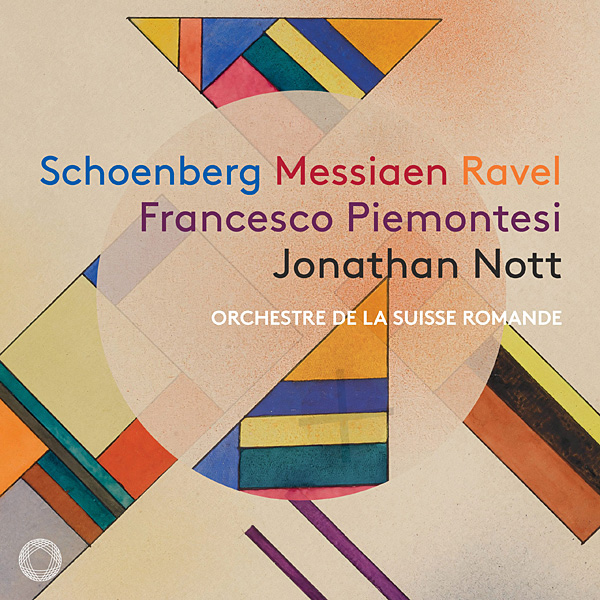 Next, I tried a wonderful new recording of works for piano and orchestra by Schoenberg, Messiaen, and Ravel with pianist Francesco Piemontesi with the Orchestre de la Suisse Romande under Jonathan Nott (Pentatone PTC5186949). I played it in various combinations: stereo and multichannel, DSD64 and 24/192 PCM; all sounded spectacular. With the sparkling, often bluesy Ravel, the winds, brass, and percussion seemed arrayed around and behind the strings in a believable acoustic space. All were deliciously clear and detailed. Balance was satisfying at all dynamic levels, but it was particularly pleasing in the quiet section about halfway into the first movement. Here, the harp and lower strings play in hushed tones but were still full-bodied. As the passage ends, the other instruments return thunderously, the bass drum over on the right. The sense of space was compelling. The multichannel soundstage was a little wider and much deeper than in the stereo presentation, but it didn't reveal anything new.
Even in stereo, bridging channels transformed the A35.8 into a beast that dared me to turn it up. When I did, the music just got bigger and more immersive.
It's a two-channel amp!
Next, I tried a wonderful new recording of works for piano and orchestra by Schoenberg, Messiaen, and Ravel with pianist Francesco Piemontesi with the Orchestre de la Suisse Romande under Jonathan Nott (Pentatone PTC5186949). I played it in various combinations: stereo and multichannel, DSD64 and 24/192 PCM; all sounded spectacular. With the sparkling, often bluesy Ravel, the winds, brass, and percussion seemed arrayed around and behind the strings in a believable acoustic space. All were deliciously clear and detailed. Balance was satisfying at all dynamic levels, but it was particularly pleasing in the quiet section about halfway into the first movement. Here, the harp and lower strings play in hushed tones but were still full-bodied. As the passage ends, the other instruments return thunderously, the bass drum over on the right. The sense of space was compelling. The multichannel soundstage was a little wider and much deeper than in the stereo presentation, but it didn't reveal anything new.
Even in stereo, bridging channels transformed the A35.8 into a beast that dared me to turn it up. When I did, the music just got bigger and more immersive.
It's a two-channel amp!
Primare has one more trick up its sleeve. How about configuring the A35.8 as four bridged-channel pairs and biamping a pair of stereo speakers, each getting two 740Wpc engines? I am not an advocate of bi-amping loudspeakers with fixed, passive crossovers (footnote 3), but I gave it a shot. I inserted an XLR splitter to direct the left-channel signal cable into two of the A35.8's nominally 750W bridged amps and did the same for the right channel. I removed the left and right input-shorting links from my Studio2 speakers and ran two lengths of Canare 4S11 speaker cable from the Primare to the upper and lower terminals of each speaker. With a little trepidation, I powered up the A35.8 and started playback on Track 10, "High and Lonesome," from Robert Plant and Alison Kraus's Raise the Roof (Rounder/Concord 1166101371). At any volume up to my tolerance limit, the bass was powerful and tight, the accompanying instruments clear, the voices human (if a human could sing that loud). I was also stunned by other "big sound": the last movement of Mahler's 6th Symphony with Leonard Bernstein conducting the Vienna Philharmonic Orchestra (CD, DG 427 697-2), for example, and also "Stimela" from Hugh Masekela's Hope (SACD, Analogue Productions CAPJ 82020), which I played at unneighborly volume. For extended listening, though, I could not tolerate higher volume than I could with the standard bridged configuration (not biamped). Perhaps with bigger, less sensitive speakers in a much bigger room, one might be able to take advantage of this extra muscle.
Comparisons
With a little trepidation, I powered up the A35.8 and started playback on Track 10, "High and Lonesome," from Robert Plant and Alison Kraus's Raise the Roof (Rounder/Concord 1166101371). At any volume up to my tolerance limit, the bass was powerful and tight, the accompanying instruments clear, the voices human (if a human could sing that loud). I was also stunned by other "big sound": the last movement of Mahler's 6th Symphony with Leonard Bernstein conducting the Vienna Philharmonic Orchestra (CD, DG 427 697-2), for example, and also "Stimela" from Hugh Masekela's Hope (SACD, Analogue Productions CAPJ 82020), which I played at unneighborly volume. For extended listening, though, I could not tolerate higher volume than I could with the standard bridged configuration (not biamped). Perhaps with bigger, less sensitive speakers in a much bigger room, one might be able to take advantage of this extra muscle.
Comparisons
Overall, in any configuration, there was never any evidence of the "gray" treble I experienced with earlier Ncore-based amplifiers, even with the A35.8's basic, unbridged configuration. In my preferred five-channel configuration, the A35.8 equaled other good amplifiers in the treble.
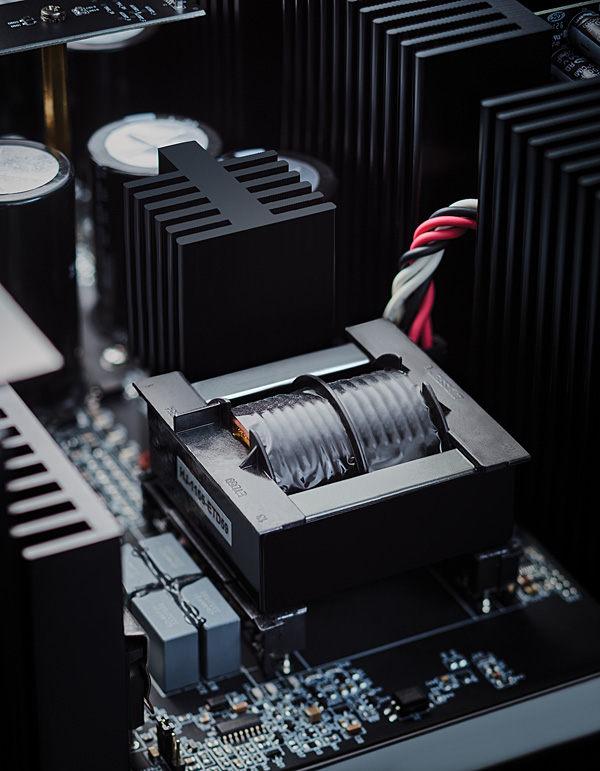 On paper, the A35.8 is most similar to the NAD M28 ($4999), the seven-channel amplifier I use in my Connecticut system. I also have a pair of NAD C 298 stereo amplifiers. The two NAD amplifiers, both based on Purifi amplifiers, sound identical to me. They were not appreciably different from the Primare. If anything, the Primare seemed slightly more forward, often conveying an appealing liveliness compared to the NADs. Conversely, I often felt that the NADs presented a more natural soundstage, which I find important. The A35.8 gets you one more channel than the NAD M28 and way more versatility for a 10% price bump.
Comparing the A35.8 to my Benchmark AHB2, an honest, accurate amp, revealed more contrast. I almost always preferred the Benchmark for its neutral tonal balance and undistorted soundstage, but in some instances, on some recordings, including Hugh Masekela's live "Stimela," the Primare was more convincingly live than the Benchmark.
On paper, the A35.8 is most similar to the NAD M28 ($4999), the seven-channel amplifier I use in my Connecticut system. I also have a pair of NAD C 298 stereo amplifiers. The two NAD amplifiers, both based on Purifi amplifiers, sound identical to me. They were not appreciably different from the Primare. If anything, the Primare seemed slightly more forward, often conveying an appealing liveliness compared to the NADs. Conversely, I often felt that the NADs presented a more natural soundstage, which I find important. The A35.8 gets you one more channel than the NAD M28 and way more versatility for a 10% price bump.
Comparing the A35.8 to my Benchmark AHB2, an honest, accurate amp, revealed more contrast. I almost always preferred the Benchmark for its neutral tonal balance and undistorted soundstage, but in some instances, on some recordings, including Hugh Masekela's live "Stimela," the Primare was more convincingly live than the Benchmark.
 Conclusions
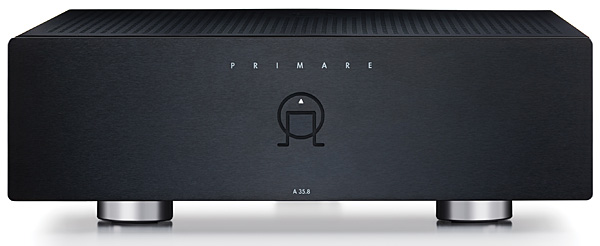
The Primare A35.8 amplifier surprised me. Its performance in my system corroborated Primare's claim that they can make a great amplifier from Ncore modules, one that can rival amplifiers based on the newer Purifi technology as well as amplifiers utilizing traditional, nonswitching technology. Its eight channels and bridged gain options endow it with tremendous versatility. To me, the Primare A35.8 is worthy of an audition in any multichannel setup. It is a pleasure to use and to listen to.
Footnote 3: Passive biamping with a stereo amplifier, where the speaker's built-in crossover network is used, has two main theoretical advantages: The first is that more power is available to the speaker when driven by two channels than by one. (In theory, the maximum increase is only 3dB, but in practice less than that is achieved due to the power spectrum of music.) The second advantage is that isolating the two channels and cables prevents distortion and nonlinearities generated in the LF leg from contaminating the HF leg. This has been demonstrated by instruments, but audibility has not been proven.
When played in stereo, it seemed paler in every way, and I missed the subtle weight of the lower strings. I tried turning up the volume to compensate for having only two speakers instead of five, but this was only a partial cure. Two channels of the A35.8, each rated at 150Wpc at 8 ohms and 300Wpc at 4 ohms, did not seem powerful enough for my Revel Ultima Studio2s in stereo; they need more power to open up.
It's a five-channel amp!Here's where the extra channels and bridging options of the A35.8 come into play. Primare says that bridged-channel outputs are rated at 740W into 8 ohms and 750W into 4 ohms. I'll await JA's measurements, but that seems a better match to the Studio2s, whose impedance remains mostly between 4 and 6 ohms below 1kHz. I set the amplifier up with three bridged-channel pairs to run the Studio2s for L/C/R and left the remaining two channels independent for the two F206s surround speakers. This configuration attests to Primare's wisdom in choosing to offer eight channels instead of the usual seven and providing the option to attenuate bridged outputs to the output level of the unbridged outputs.
Bridging transformed the A35.8 into a much more exciting amplifier. Not only was the bass balance restored in Honeck's Beethoven 6th (in stereo); everything else I tried impressed. I became addicted to Josh Tatsuo Cullen's recording of Florence Price's piano pieces Scenes in a Tin Can Alley (24/96 download, Blue Griffin BGR615). Played with the A35.8 bridged, the piano was tonally balanced from the pearly treble to the woody, tight, clean bass. The imaging was so convincing that I just had to walk up and confirm that there was no sound coming from the center speaker between the active stereo pair.
Next, I tried a wonderful new recording of works for piano and orchestra by Schoenberg, Messiaen, and Ravel with pianist Francesco Piemontesi with the Orchestre de la Suisse Romande under Jonathan Nott (Pentatone PTC5186949). I played it in various combinations: stereo and multichannel, DSD64 and 24/192 PCM; all sounded spectacular. With the sparkling, often bluesy Ravel, the winds, brass, and percussion seemed arrayed around and behind the strings in a believable acoustic space. All were deliciously clear and detailed. Balance was satisfying at all dynamic levels, but it was particularly pleasing in the quiet section about halfway into the first movement. Here, the harp and lower strings play in hushed tones but were still full-bodied. As the passage ends, the other instruments return thunderously, the bass drum over on the right. The sense of space was compelling. The multichannel soundstage was a little wider and much deeper than in the stereo presentation, but it didn't reveal anything new.
Even in stereo, bridging channels transformed the A35.8 into a beast that dared me to turn it up. When I did, the music just got bigger and more immersive.
Primare has one more trick up its sleeve. How about configuring the A35.8 as four bridged-channel pairs and biamping a pair of stereo speakers, each getting two 740Wpc engines? I am not an advocate of bi-amping loudspeakers with fixed, passive crossovers (footnote 3), but I gave it a shot. I inserted an XLR splitter to direct the left-channel signal cable into two of the A35.8's nominally 750W bridged amps and did the same for the right channel. I removed the left and right input-shorting links from my Studio2 speakers and ran two lengths of Canare 4S11 speaker cable from the Primare to the upper and lower terminals of each speaker.
With a little trepidation, I powered up the A35.8 and started playback on Track 10, "High and Lonesome," from Robert Plant and Alison Kraus's Raise the Roof (Rounder/Concord 1166101371). At any volume up to my tolerance limit, the bass was powerful and tight, the accompanying instruments clear, the voices human (if a human could sing that loud). I was also stunned by other "big sound": the last movement of Mahler's 6th Symphony with Leonard Bernstein conducting the Vienna Philharmonic Orchestra (CD, DG 427 697-2), for example, and also "Stimela" from Hugh Masekela's Hope (SACD, Analogue Productions CAPJ 82020), which I played at unneighborly volume. For extended listening, though, I could not tolerate higher volume than I could with the standard bridged configuration (not biamped). Perhaps with bigger, less sensitive speakers in a much bigger room, one might be able to take advantage of this extra muscle.
ComparisonsOverall, in any configuration, there was never any evidence of the "gray" treble I experienced with earlier Ncore-based amplifiers, even with the A35.8's basic, unbridged configuration. In my preferred five-channel configuration, the A35.8 equaled other good amplifiers in the treble.
On paper, the A35.8 is most similar to the NAD M28 ($4999), the seven-channel amplifier I use in my Connecticut system. I also have a pair of NAD C 298 stereo amplifiers. The two NAD amplifiers, both based on Purifi amplifiers, sound identical to me. They were not appreciably different from the Primare. If anything, the Primare seemed slightly more forward, often conveying an appealing liveliness compared to the NADs. Conversely, I often felt that the NADs presented a more natural soundstage, which I find important. The A35.8 gets you one more channel than the NAD M28 and way more versatility for a 10% price bump.
Comparing the A35.8 to my Benchmark AHB2, an honest, accurate amp, revealed more contrast. I almost always preferred the Benchmark for its neutral tonal balance and undistorted soundstage, but in some instances, on some recordings, including Hugh Masekela's live "Stimela," the Primare was more convincingly live than the Benchmark.
ConclusionsThe Primare A35.8 amplifier surprised me. Its performance in my system corroborated Primare's claim that they can make a great amplifier from Ncore modules, one that can rival amplifiers based on the newer Purifi technology as well as amplifiers utilizing traditional, nonswitching technology. Its eight channels and bridged gain options endow it with tremendous versatility. To me, the Primare A35.8 is worthy of an audition in any multichannel setup. It is a pleasure to use and to listen to.
Footnote 3: Passive biamping with a stereo amplifier, where the speaker's built-in crossover network is used, has two main theoretical advantages: The first is that more power is available to the speaker when driven by two channels than by one. (In theory, the maximum increase is only 3dB, but in practice less than that is achieved due to the power spectrum of music.) The second advantage is that isolating the two channels and cables prevents distortion and nonlinearities generated in the LF leg from contaminating the HF leg. This has been demonstrated by instruments, but audibility has not been proven.















