Ever since I reviewed PrimaLuna's ProLogue Premium, for the June 2012 issue, it has been the model I would turn to when I wanted a moderately priced integrated amplifier to try with a new speaker. It never disappointed me, and never seemed outclassed, even when the speaker was the MartinLogan Montis ($10,000/pair). At $2399, the ProLogue Premium to me represents the "sweet spot" for systems in the range of $4000–$10,000 or higher. Although its 35Wpc may not be enough for some speakers (depending on the room and personal preference), I never had any such problem, regardless of whether the speaker had a built-in powered subwoofer (eg, the Montis or the GoldenEar Technology Triton Two) or was a passive design (Wharfedale's Jade 7 or Focal's Aria 936). With differences noted depending on whether EL34 or KT88 output tubes were used, the ProLogue Premium delivered sound that was always smooth and musically involving.
The first mention I saw of the DiaLogue Premium HP integrated was in a report by Jason Victor Serinus from the 2014 Consumer Electronics Show. He'd been impressed with the sound of the system that featured the Premium HP, describing it as "really nice, with very natural timbres that rival or surpass those of the high-priced spread," and quoted PrimaLuna's Kevin Deal: "It's the best amp we've ever done."
Hmmm. Sounded like something I needed to check out for myself.
Description and Design
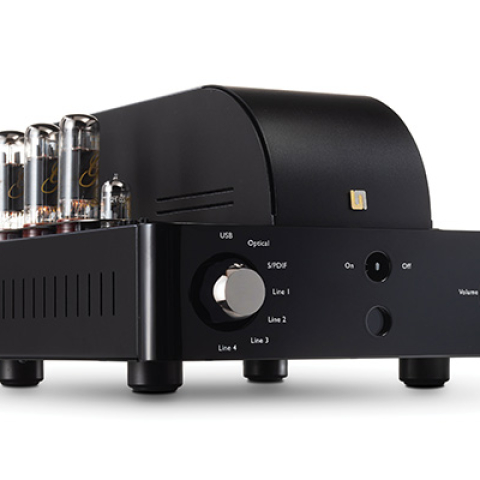
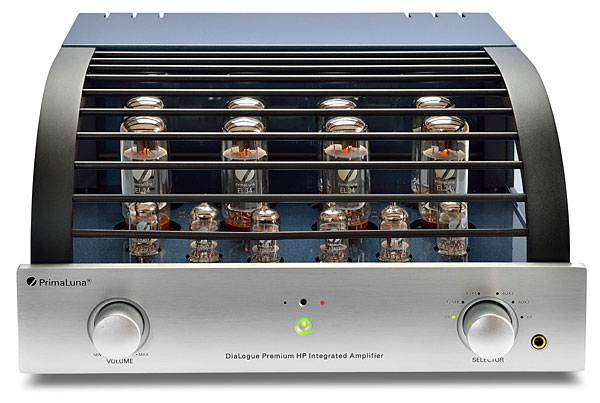
If you gave the DiaLogue Premium HP ($4199) only a brief glance, you might mistake it for a ProLogue Premium. However, placing the two models side by side makes their physical differences obvious: the DiaLogue Premium HP has eight rather than four output tubes, and six rather than four small tubes. And if you were blindfolded and asked to lift each amp—the ultimate blind test—you'd have no difficulty telling them apart. At 46 lbs, the ProLogue Premium is heavy—but the DiaLogue Premium HP is really heavy: 66 lbs. The DiaLogue Premium HP also has a headphone jack, a switch on the right side for selecting between speakers and headphones, and two small indicator lights on the front panel, to signal whether the amp is operating in triode (green) or ultralinear (red) mode.
It would take two pages of small print to describe all of the features of the DiaLogue Premium HP, as it does on PrimaLuna's website. I won't duplicate all that information, but here are the salient differences between it and the ProLogue Premium. The DiaLogue Premium HP has:
Dual Premium Adaptive AutoBias boards, with twice the number of output tubes and the circuitry to support them. Kevin Deal notes that PrimaLuna could have raised the power by running fewer tubes harder, but their more conservative approach results in less wear on the tubes. The Adaptive AutoBias circuitry includes protection, and a Bad Tube LED indicator if a tube fails. PrimaLuna's implementation of the autobias principle is said to be more sophisticated than that of most manufacturers, who use cathode autobias only.
All-tube headphone amplifier built in. This is not selected with a simple switch, but with relays that open and close to reduce any interference. I don't use headphones for serious listening, so I couldn't verify Deal's claim that the Premium HP's headphone amp "will compete with the best," but I must say I've never heard my ancient Grado SR125 'phones sound so good.
AC Offset Killer ensures that the power transformer doesn't hum, even in areas with bad AC.
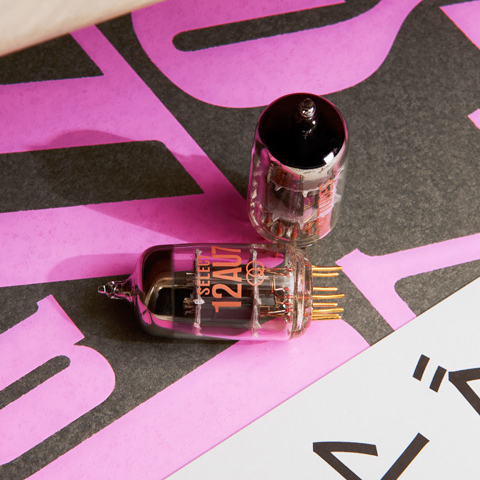
New front-end design, using six 12AU7 tubes instead of four, is said to result in better dynamics and wider bandwidth.
Triode/ultralinear switching on the fly via remote control.
Swiss-made wiring of silver-plated copper with Teflon dielectric in all signal paths.
Audiophile-grade Takman resistors from Japan used in the signal path.
SCR tinfoil caps in critical positions.
Setup and System
Setting up a solid-state amplifier for review is a pretty simple matter. About the only decision you have to make is whether to use the single-ended or the balanced inputs (if both are available). Then it's just a matter of swapping the amplifier to be tested for the reference amp, turning on the system, and listening for similarities and differences.
For a tube amplifier, it's a bit more complicated: You may have to decide what output terminals to use—4, 8, or 16 ohms, (assuming that all of these are provided; the DiaLogue Premium HP omits 16 ohms)—but that's about it. I had found that I slightly preferred the sound of the ProLogue Premium's 4 ohm terminals with the Focal Aria 936 speakers, which I also used for this review. I briefly listened to both sets of the DiaLogue Premium HP's output terminals, and again, the Focals sounded better through the 4 ohm taps, which I used for the rest of my listening.
But this was only the beginning. The DiaLogue Premium HP can use a variety of output tubes, the choice of which can have a major effect on the sound. The Premium HP features autobiasing of output tubes; all you have to do is select, with a rocker switch, the type of tube. (If the switch is in the wrong position, this apparently does no harm; it's just not optimal in terms of performance.) The amplifier comes with EL34 tubes as standard; in addition, Deal offered to send along whatever other tubes I was interested in trying. I'm not inclined toward tube rolling, but I was curious about the sound with KT120s, a new variant of the KT88 design that has received mostly positive reports. (It's used in the latest Audio Research amps.) As with any audio product, the praise for the KT120 has not been universal; some have noted that this tube draws more current than KT88, which may, over time, damage an amplifier not designed for it. (McIntosh doesn't recommend using KT120s in their MC275LE, my reference amplifier.) PrimaLuna, which has a sterling reputation for amplifier reliability, endorses use of the KT120. I assumed they know what they're doing and asked Deal to send along a set. I report below on the differences I heard.
Nor was that the end of it. Whichever output tubes are used can be used in triode or ultralinear mode. Put all this together, and the DiaLogue Premium HP gives you a choice of, effectively, eight different amplifiers: EL34 triode or ultralinear, and KT120 triode or ultralinear, each with the 4 or 8 ohm output terminals.
My choice of Focal's Aria 936 speakers was determined by several reasons: 1) at $3995/pair, the Aria 936 is typical of the kind of speaker likely to be paired with a $4199 integrated; 2) having reviewed the Aria 936 in the November 2014 issue, I was very familiar with its sound; 3) the Aria 936 has the transparency and overall sound quality that would allow me to evaluate the quality of the driving amplifier; and 4) I still had the review samples of the Aria on hand, and Audio Plus Services, Focal's US importer, had no problem with my holding on to them for a while.
Sound
My review sample of the DiaLogue Premium HP review sample was the one that had been demoed at CES, so I figured I didn't have to worry too much about breaking it in. Still, before doing any serious listening, I played a variety of CDs at various levels, switching willy-nilly between triode and ultralinear, and trying to dissociate my impressions from the analytical/critical part of my brain. Of course, the latter is not really possible, and I quickly came to feel that, as good as the ProLogue Premium is, with the DiaLogue Premium HP PrimaLuna had taken a major step forward in amplifier performance.
If you gave the DiaLogue Premium HP ($4199) only a brief glance, you might mistake it for a ProLogue Premium. However, placing the two models side by side makes their physical differences obvious: the DiaLogue Premium HP has eight rather than four output tubes, and six rather than four small tubes. And if you were blindfolded and asked to lift each amp—the ultimate blind test—you'd have no difficulty telling them apart. At 46 lbs, the ProLogue Premium is heavy—but the DiaLogue Premium HP is really heavy: 66 lbs. The DiaLogue Premium HP also has a headphone jack, a switch on the right side for selecting between speakers and headphones, and two small indicator lights on the front panel, to signal whether the amp is operating in triode (green) or ultralinear (red) mode.
Setting up a solid-state amplifier for review is a pretty simple matter. About the only decision you have to make is whether to use the single-ended or the balanced inputs (if both are available). Then it's just a matter of swapping the amplifier to be tested for the reference amp, turning on the system, and listening for similarities and differences.
My review sample of the DiaLogue Premium HP review sample was the one that had been demoed at CES, so I figured I didn't have to worry too much about breaking it in. Still, before doing any serious listening, I played a variety of CDs at various levels, switching willy-nilly between triode and ultralinear, and trying to dissociate my impressions from the analytical/critical part of my brain. Of course, the latter is not really possible, and I quickly came to feel that, as good as the ProLogue Premium is, with the DiaLogue Premium HP PrimaLuna had taken a major step forward in amplifier performance.