

The Lumin L1 is expensive for a NAS. However, when it is the only NAS on your network, it links automatically and seamlessly to the Lumin app: Fit-and-forget ease of use, which is especially welcome for those, like me, who have bad network karma.
Listening with Roon
I started my auditioning in "Roon Ready" mode, using Roon to stream audio data from the internal drive in my Nucleus+ server. In this mode, the P1 utilizes Roon's "RAAT" protocol, which stands for Roon Advanced Audio Transport. Still on a prolonged Rachmaninoff kick, I played Vladimir Ashkenazy performing the second Piano Concerto accompanied by Bernard Haitink conducting the Concertgebouw Orchestra (16/44.1 ALAC file ripped from CD, Decca 4757550).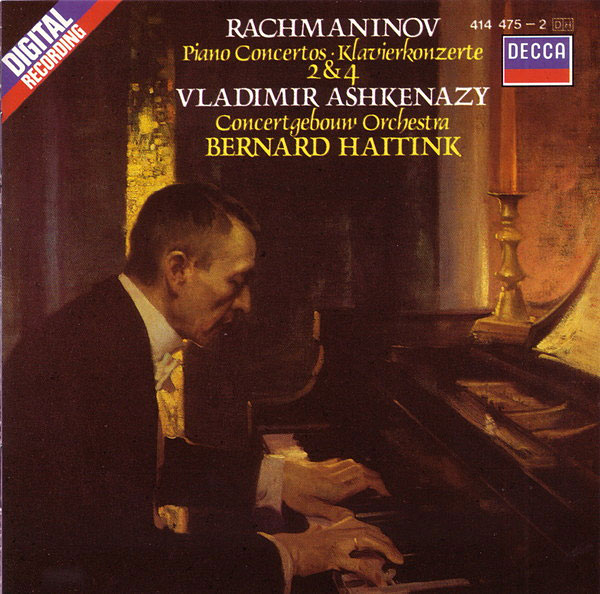 The track's elapsed and total playing time appeared within the blue ring on the right of the P1's display, with the elapsed time also shown as the portion of the ring highlighted in bold. Clicking on the small orange button on the Roon screen shows that the P1's volume was being controlled with Leedh. Using the app, I disabled Leedh. Though the volume was the same, a thin gauze screen was now interposed between the music and me. I reactivated Leedh and used it for the rest of my time with the P1.
The orchestra in the Rachmaninoff recording had excellent dynamics and a wide, deep soundstage. Ashenazy's piano had well-defined weight in the left-hand register, even when I changed from the Bowers & Wilkins 804D loudspeakers I reviewed in the January 2022 issue to the GoldenEar BRX standmounts. But to make absolute judgments on the P1's performance, I needed to play something with which I was intimately familiar.
The track's elapsed and total playing time appeared within the blue ring on the right of the P1's display, with the elapsed time also shown as the portion of the ring highlighted in bold. Clicking on the small orange button on the Roon screen shows that the P1's volume was being controlled with Leedh. Using the app, I disabled Leedh. Though the volume was the same, a thin gauze screen was now interposed between the music and me. I reactivated Leedh and used it for the rest of my time with the P1.
The orchestra in the Rachmaninoff recording had excellent dynamics and a wide, deep soundstage. Ashenazy's piano had well-defined weight in the left-hand register, even when I changed from the Bowers & Wilkins 804D loudspeakers I reviewed in the January 2022 issue to the GoldenEar BRX standmounts. But to make absolute judgments on the P1's performance, I needed to play something with which I was intimately familiar.
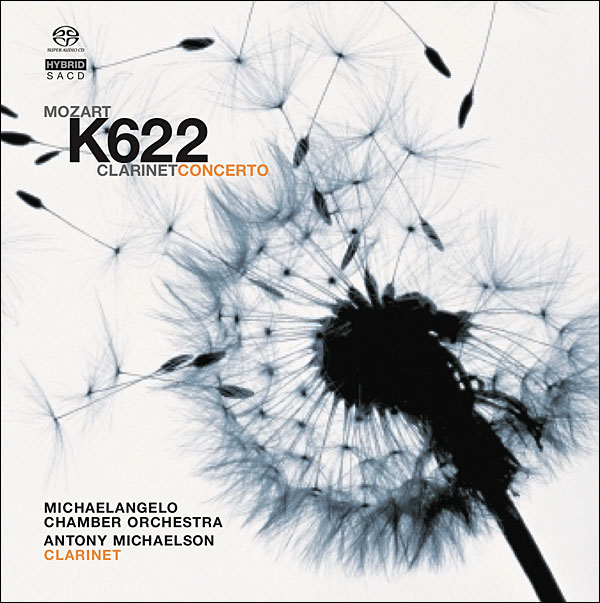 I cued up Antony Michaelson's 2003 performance of the Mozart Clarinet Concerto with the Michaelangelo Chamber Orchestra conducted by Robert Bailey (16/44.1 ALAC file ripped from CD, Musical Fidelity Records), which I produced. Engineer Tony Faulkner had done a superb job in the mix of presenting the image of Antony's clarinet in front of the orchestra in London's Henry Wood Hall; the soloist's careful placement was readily audible with the P1 decoding the bits. The clarinet's lower, chalumeau register sounded appropriately warm, and the delicacy of Mozart's orchestral scoring was preserved, with excellent soundstage depth.
Compared with the MBL N31 at the same volume using the MBL's slow-rolloff reconstruction filter, which is similar to the P1's filter, the P1's highs were slightly more forward-sounding.
I cued up Antony Michaelson's 2003 performance of the Mozart Clarinet Concerto with the Michaelangelo Chamber Orchestra conducted by Robert Bailey (16/44.1 ALAC file ripped from CD, Musical Fidelity Records), which I produced. Engineer Tony Faulkner had done a superb job in the mix of presenting the image of Antony's clarinet in front of the orchestra in London's Henry Wood Hall; the soloist's careful placement was readily audible with the P1 decoding the bits. The clarinet's lower, chalumeau register sounded appropriately warm, and the delicacy of Mozart's orchestral scoring was preserved, with excellent soundstage depth.
Compared with the MBL N31 at the same volume using the MBL's slow-rolloff reconstruction filter, which is similar to the P1's filter, the P1's highs were slightly more forward-sounding.
 What about DSD? I have been a fan of UK band Talk Talk since I was belatedly turned on to them by Stereophile's erstwhile assistant editor Stephen Mejias. I have a version of the track "Happiness Is Easy" in my library, ripped from a SACD of the band's 1986 album The Colour of Spring (DSD64 file, EMI 591452). I selected the track in Roon and pressed Play. "DSD 2.822 MHz 1 Bit" appeared on the P1's display.
The drum intro sounded natural on the P1, with well-defined attacks. The reverb surrounding the piano and acoustic guitar interjections was well-resolved, and the children's choir was placed well behind Mark Hollis's plaintive vocal. The sparse double bass and electric bass lines sounded suitably forceful, even on the diminutive KEF LS50s. The P1 does DSD well.
What about DSD? I have been a fan of UK band Talk Talk since I was belatedly turned on to them by Stereophile's erstwhile assistant editor Stephen Mejias. I have a version of the track "Happiness Is Easy" in my library, ripped from a SACD of the band's 1986 album The Colour of Spring (DSD64 file, EMI 591452). I selected the track in Roon and pressed Play. "DSD 2.822 MHz 1 Bit" appeared on the P1's display.
The drum intro sounded natural on the P1, with well-defined attacks. The reverb surrounding the piano and acoustic guitar interjections was well-resolved, and the children's choir was placed well behind Mark Hollis's plaintive vocal. The sparse double bass and electric bass lines sounded suitably forceful, even on the diminutive KEF LS50s. The P1 does DSD well.
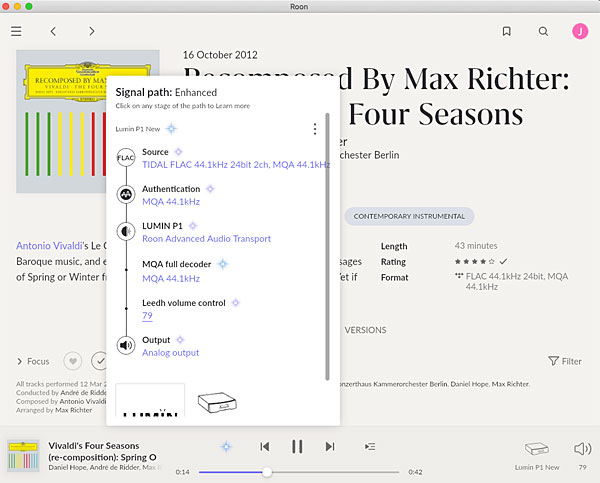 And MQA? Max Richter's post-minimalist reimagining of Vivaldi's Four Seasons caught my ear at a 2019 dealer event, and I subsequently found the MQA-encoded album, with violinist Daniel Hope and the Konzerthaus Kammerorchester Berlin conducted by André de Ridder, on Tidal (24/44.1 MQA, DG). With 24/44.1 MQA, the FLAC file didn't unfold to a higher sample rate, but as decoded and rendered by the P1, the eerie-sounding strings that surrounded the bold solo violin in Winter's first movement were set well back in the soundstage. The lower strings sounded rich. Turning off MQA decoding with the Lumin app brought the midrange forward and reduced soundstage depth. Score one for the P1 and MQA.
 Listening with the Lumin app
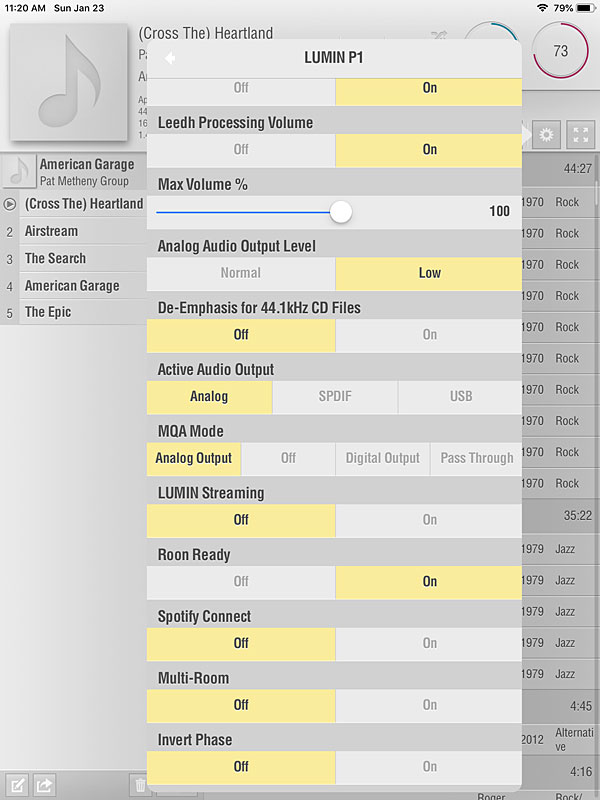
When you use the Lumin app, the P1 manages the music. The app's control screen allows a multiplicity of options: Switch on or off MQA decoding, Leedh processing, Lumin Streaming (which allows compatibility with Apple AirPlay), and Roon Ready operation. Preset the maximum volume and switch between Normal and Low volume ranges. Specify the desired output—analog, USB, or S/PDIF—and the polarity of each, direct or inverted. Select an input, remembering the last volume set. Specify whether to play CD data with or without deemphasis. And select what music to play: from whatever is connected to the analog inputs; from files stored on the L1 or other local servers; or from Spotify, Tidal, Qobuz, other streaming services, or internet radio stations.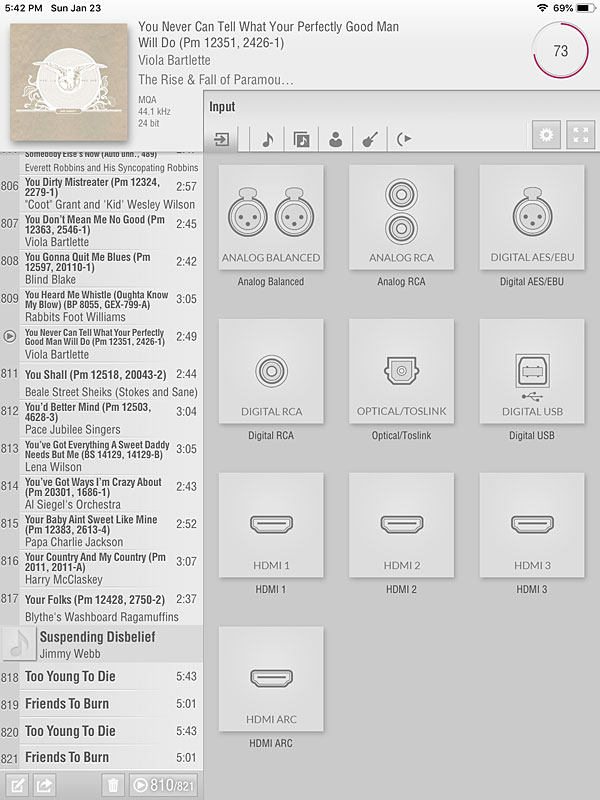 With the app (v7.2.0) installed on my iPad mini 2 running iOS 12.5.5, I selected the balanced analog outputs, set the Leedh volume to "79" (out of 100), called up the music library on the L1 NAS, and chose 11 Tracks of Whack, Walter Becker's 1994 solo album (16/44.1 ALAC ripped from CD, Giant 24579-2), which I had played with Roon after the Richter Four Seasons. My favorite track from Whack is "Book of Liars," which has a beautifully even-sounding bass line. To my surprise, the bass guitar had a better sense of drive than when I had played the file from the Nucleus's internal storage with Roon.
 I wanted to compare what I had just heard from the L1 with the CD played on my Ayre C-5xeMP and connected to the P1 via an AES3 link—but I couldn't find it in my compulsively alphabetized CD racks! I therefore selected a track I did have to hand on CD: "Friends to Burn" from Jimmy Webb's Suspending Disbelief (16/44.1 ALAC, ripped from CD, Elektra 61506). Recorded and mixed by the incomparable George Massenburg and released in 1993, before the advent of the Loudness War (footnote 3), Suspending Disbelief is a rock album with dynamic light and shade.
This track's verses feature a relentless bass riff played by Leland Sklar. With the track sourced from the L1 and selected with the Lumin app, the bass line had a touch more of a certain chugging quality and the same improved sense of drive I heard with the Walter Becker track. With the same track on CD, with the Ayre's digital output fed to the Lumin's AES3 input, the chugging was very slightly better defined, and, if I had to swear to it on the first issue of Stereophile, there was a little more space around Russ Kunkel's drums. A close-run thing, but overall, playback via AES3 edged slightly ahead when it came to presenting the music's sense of timing.
I wanted to compare what I had just heard from the L1 with the CD played on my Ayre C-5xeMP and connected to the P1 via an AES3 link—but I couldn't find it in my compulsively alphabetized CD racks! I therefore selected a track I did have to hand on CD: "Friends to Burn" from Jimmy Webb's Suspending Disbelief (16/44.1 ALAC, ripped from CD, Elektra 61506). Recorded and mixed by the incomparable George Massenburg and released in 1993, before the advent of the Loudness War (footnote 3), Suspending Disbelief is a rock album with dynamic light and shade.
This track's verses feature a relentless bass riff played by Leland Sklar. With the track sourced from the L1 and selected with the Lumin app, the bass line had a touch more of a certain chugging quality and the same improved sense of drive I heard with the Walter Becker track. With the same track on CD, with the Ayre's digital output fed to the Lumin's AES3 input, the chugging was very slightly better defined, and, if I had to swear to it on the first issue of Stereophile, there was a little more space around Russ Kunkel's drums. A close-run thing, but overall, playback via AES3 edged slightly ahead when it came to presenting the music's sense of timing.
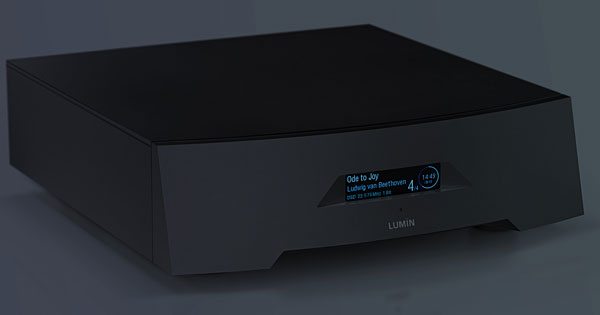 Finally, I switched to the P1's balanced analog inputs fed from the Ayre's analog outputs. The presentation was a tad lighter, but the sound of Sklar's bass guitar had excellent definition. Used as an analog-in/analog-out line preamplifier, the P1 did an excellent job of preserving the sonic character of the Ayre player.
Conclusion
Finally, I switched to the P1's balanced analog inputs fed from the Ayre's analog outputs. The presentation was a tad lighter, but the sound of Sklar's bass guitar had excellent definition. Used as an analog-in/analog-out line preamplifier, the P1 did an excellent job of preserving the sonic character of the Ayre player.
Conclusion
I very much enjoyed my time with Lumin's P1. Not only is it a superb-sounding D/A processor, but its transparent-sounding analog inputs and full video functionality are a welcome bonus. The Lumin app proved to be an excellent means of controlling the P1. And while I remain puzzled why the presentation with files sourced from the L1 UPnP server had more drive than with the same music played with Roon, I can recommend the L1 as a useful companion to the P1.
Footnote 3: The Waves L1, the first digital brickwall limiter with look-ahead, was introduced in 1994.—Jim Austin
I started my auditioning in "Roon Ready" mode, using Roon to stream audio data from the internal drive in my Nucleus+ server. In this mode, the P1 utilizes Roon's "RAAT" protocol, which stands for Roon Advanced Audio Transport. Still on a prolonged Rachmaninoff kick, I played Vladimir Ashkenazy performing the second Piano Concerto accompanied by Bernard Haitink conducting the Concertgebouw Orchestra (16/44.1 ALAC file ripped from CD, Decca 4757550).
The track's elapsed and total playing time appeared within the blue ring on the right of the P1's display, with the elapsed time also shown as the portion of the ring highlighted in bold. Clicking on the small orange button on the Roon screen shows that the P1's volume was being controlled with Leedh. Using the app, I disabled Leedh. Though the volume was the same, a thin gauze screen was now interposed between the music and me. I reactivated Leedh and used it for the rest of my time with the P1.
I cued up Antony Michaelson's 2003 performance of the Mozart Clarinet Concerto with the Michaelangelo Chamber Orchestra conducted by Robert Bailey (16/44.1 ALAC file ripped from CD, Musical Fidelity Records), which I produced. Engineer Tony Faulkner had done a superb job in the mix of presenting the image of Antony's clarinet in front of the orchestra in London's Henry Wood Hall; the soloist's careful placement was readily audible with the P1 decoding the bits. The clarinet's lower, chalumeau register sounded appropriately warm, and the delicacy of Mozart's orchestral scoring was preserved, with excellent soundstage depth.
Compared with the MBL N31 at the same volume using the MBL's slow-rolloff reconstruction filter, which is similar to the P1's filter, the P1's highs were slightly more forward-sounding.
What about DSD? I have been a fan of UK band Talk Talk since I was belatedly turned on to them by Stereophile's erstwhile assistant editor Stephen Mejias. I have a version of the track "Happiness Is Easy" in my library, ripped from a SACD of the band's 1986 album The Colour of Spring (DSD64 file, EMI 591452). I selected the track in Roon and pressed Play. "DSD 2.822 MHz 1 Bit" appeared on the P1's display.
The drum intro sounded natural on the P1, with well-defined attacks. The reverb surrounding the piano and acoustic guitar interjections was well-resolved, and the children's choir was placed well behind Mark Hollis's plaintive vocal. The sparse double bass and electric bass lines sounded suitably forceful, even on the diminutive KEF LS50s. The P1 does DSD well.
And MQA? Max Richter's post-minimalist reimagining of Vivaldi's Four Seasons caught my ear at a 2019 dealer event, and I subsequently found the MQA-encoded album, with violinist Daniel Hope and the Konzerthaus Kammerorchester Berlin conducted by André de Ridder, on Tidal (24/44.1 MQA, DG). With 24/44.1 MQA, the FLAC file didn't unfold to a higher sample rate, but as decoded and rendered by the P1, the eerie-sounding strings that surrounded the bold solo violin in Winter's first movement were set well back in the soundstage. The lower strings sounded rich. Turning off MQA decoding with the Lumin app brought the midrange forward and reduced soundstage depth. Score one for the P1 and MQA.
Listening with the Lumin appWhen you use the Lumin app, the P1 manages the music. The app's control screen allows a multiplicity of options: Switch on or off MQA decoding, Leedh processing, Lumin Streaming (which allows compatibility with Apple AirPlay), and Roon Ready operation. Preset the maximum volume and switch between Normal and Low volume ranges. Specify the desired output—analog, USB, or S/PDIF—and the polarity of each, direct or inverted. Select an input, remembering the last volume set. Specify whether to play CD data with or without deemphasis. And select what music to play: from whatever is connected to the analog inputs; from files stored on the L1 or other local servers; or from Spotify, Tidal, Qobuz, other streaming services, or internet radio stations.
With the app (v7.2.0) installed on my iPad mini 2 running iOS 12.5.5, I selected the balanced analog outputs, set the Leedh volume to "79" (out of 100), called up the music library on the L1 NAS, and chose 11 Tracks of Whack, Walter Becker's 1994 solo album (16/44.1 ALAC ripped from CD, Giant 24579-2), which I had played with Roon after the Richter Four Seasons. My favorite track from Whack is "Book of Liars," which has a beautifully even-sounding bass line. To my surprise, the bass guitar had a better sense of drive than when I had played the file from the Nucleus's internal storage with Roon.
I wanted to compare what I had just heard from the L1 with the CD played on my Ayre C-5xeMP and connected to the P1 via an AES3 link—but I couldn't find it in my compulsively alphabetized CD racks! I therefore selected a track I did have to hand on CD: "Friends to Burn" from Jimmy Webb's Suspending Disbelief (16/44.1 ALAC, ripped from CD, Elektra 61506). Recorded and mixed by the incomparable George Massenburg and released in 1993, before the advent of the Loudness War (footnote 3), Suspending Disbelief is a rock album with dynamic light and shade.
Finally, I switched to the P1's balanced analog inputs fed from the Ayre's analog outputs. The presentation was a tad lighter, but the sound of Sklar's bass guitar had excellent definition. Used as an analog-in/analog-out line preamplifier, the P1 did an excellent job of preserving the sonic character of the Ayre player.
ConclusionI very much enjoyed my time with Lumin's P1. Not only is it a superb-sounding D/A processor, but its transparent-sounding analog inputs and full video functionality are a welcome bonus. The Lumin app proved to be an excellent means of controlling the P1. And while I remain puzzled why the presentation with files sourced from the L1 UPnP server had more drive than with the same music played with Roon, I can recommend the L1 as a useful companion to the P1.
Footnote 3: The Waves L1, the first digital brickwall limiter with look-ahead, was introduced in 1994.—Jim Austin















