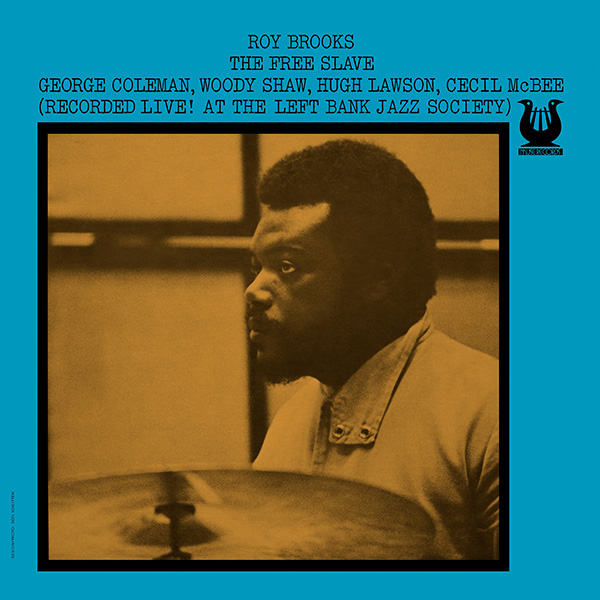
Roy Brooks: The Free Slave
Brooks, drums; four others
Time Traveler TT-M001 (LP; auditioned on promo CD).
1972/2025. Brooks, prod.; Zev Feldman, James Batsford, reissue prods.; Orville O'Brien, eng.
Performance ****
Sonics *** In its day, the Muse label featured a roster of significant artists including Sonny Stitt, Cedar Walton, and Kenny Barron. Muse never acquired cult status like Blue Note and ECM. Why? For starters, it lacked their sound quality and collectable cover art. But time changes everything. Fifty years on, Muse now looks like a repository of musical riches. The Free Slave is one of three LP releases that announce a new historical label, Time Traveler, and a new series, Muse Master Edition.
Very few drummers could kick a band like Roy Brooks, though his life and career were derailed by mental illness and he is all but forgotten today. This live album was recorded at the Left Bank Jazz Society in Baltimore in 1970, when Brooks was still riding high. His world-class quintet has Woody Shaw on trumpet, George Coleman on tenor saxophone, Hugh Lawson on piano, and Cecil McBee on bass. Brooks was a clever composer, with range. The title track is filthy funk. "Understanding" is graceful, even lilting. "Five for Max" is slightly kinky 5/4 swing. The varied material provides opportunities for Shaw and Coleman to strut all their stuff. Shaw's signature open intervals inject intellectual surprise into the greasy groove of "The Free Slave." As for Coleman, being in his musical presence is like having a 300lb bodyguard at your side. You don't mess with George. Even when he is being relatively lyrical and gentle, like on McBee's "Will Pan's Walk," you feel his power in reserve.
Shaw died young at 44. Coleman is still playing his ass off today at 90. The work of both has been well documented. The revelation is Brooks and the motivational energy he relentlessly unleashed. This album is a new chance to hear him when he was still his own bad self, before his demons overwhelmed him.—Thomas Conrad
 Amanda Monaco: Deathblow
Monaco, guitar; three others
Genevieve GR30604 (LP; auditioned in WAV). 2025. Monaco, prod.; Tom Tedesco, eng.
Performance ****
Sonics ****½
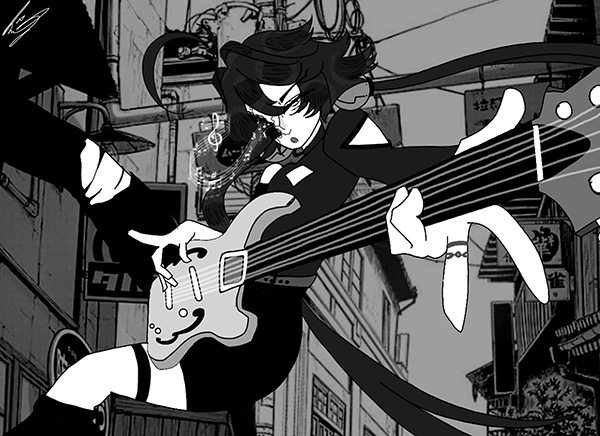
Deathblow is one of the most original and challenging guitar records of 2025. Amanda Monaco's project explores diverse intricacies of ensemble form that emerge from her idiosyncratic compositions and daring arrangements. Her guitar is one vivid sonority among a quartet of distinctive voices. In this band, the focal point shifts among Monaco, Sean Conly's commanding bass, Michaël Attias's volatile saxophones, and Satoshi Takeishi's lean, mean drums.
In Monaco's tunes, disparate parts are juxtaposed into asymmetrical designs. Band members fill varied roles, which sweep past you so fast you must keep on high alert. The first impression of tunes like "Aw Gee Thanks" and "Post-Toenail Theory" is their technical complication and intellectual erudition. Monaco's creativity is a function of her proprietary logic. It is remarkable how many moving parts she derives from only four players. Deathblow is an album-length succession of surprises. Most tunes are like "Four People": Convoluted themes are introduced by the ensemble, with Monaco and Attias intensely intersecting, then fresh themes emerge as a song pitches forward. Solos tend to be collaborative. In Monaco's music, composition and arrangement and improvisation are one enterprise.
But in jazz, you wait for individual solos in which improvisers reveal themselves. On "Cranky" and "J. Walter Hawkes Will Save the Day," space opens. The former contains extended, free-associative encounters with the melody by Monaco and Attias. (Even Monaco's densest forms have appealing melodies embedded in them.) The latter has a wild baritone saxophone catharsis from Attias. Monaco's guitar stabs at him as he flies by. Then Monaco solos herself, keening and rasping.
Deathblow is for the curious. It is not for the faint of heart.—Thomas Conrad
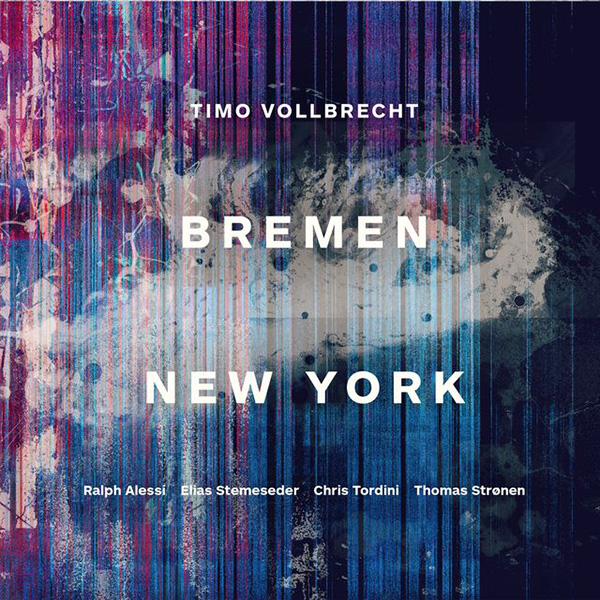 Timo Vollbrecht: Bremen New York
Vollbrecht, tenor saxophone; four others
Berthold BR324175 (CD). 2025. Berthold Radio Bremen, Vollbrecht, prods.; Frank Jacobsen, eng.
Performance ****
Sonics ***½ Some people will take note of this record because of the sidemen: Ralph Alessi (an A-list trumpet player); Elias Stemeseder (a young European pianist who has started a buzz on the international jazz street); Chris Tordini/Thomas Strønen (a topnotch bass/drum team). But those who come for the sidemen will discover a highly creative tenor saxophonist, composer, and bandleader who is not yet famous. The title refers to the fact that Timo Vollbrecht is from Germany but moved to New York 15 years ago. He now directs the jazz program at Brown University. The opener, "Com Tempo," sets the scene for this project. Over an insistent throb from Tordini and Strønen, Alessi spatters fragments in space that gradually cohere into veering lines. When Vollbrecht joins in, it is revealed that "Com Tempo" has been a song all along, with a spare, incantatory theme. The entire ensemble turns inward, and the mood changes softer and more pensive. Alessi's earlier outbursts have, with Vollbrecht beside him, become yearning.
The aura of lyricism that coalesces in the opening track pervades the album, even through moments of concentrated intensity, like Alessi's fervent smears on "Spicy Moon" and Vollbrecht's passionate runs on "Brighton Blues." Vollbrecht's achievement as a leader is to sustain this unifying atmosphere even as, within it, each player is free to live in the moment. Alessi is the badass. Vollbrecht is the romantic.
Stemeseder is also a huge asset. His solos are compact, yet every one is like his foray on "New York Love Affair," where, with his chiming touch, he spills free of the song with brilliant new songs of his own.
Bremen New York was beautifully recorded in Sendesaal, Bremen's radio hall, which Vollbrecht credibly describes as "one of the best sounding venues in Europe."—Thomas Conrad
 Sun Ra And His Intergalactic Myth Science Solar Arkestra: Sleeping Beauty
Strut 474LP (LP). 2025. Sun Ra, prod. Mike Dacek, orig. eng.; Quinton Scott, Heather Sheret, reissue coordinators
. Performance ****
Sonics ***½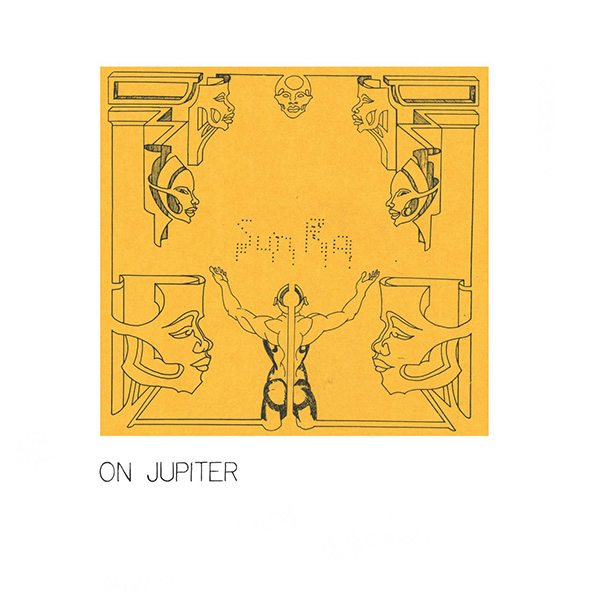 Sun Ra And His Intergalactic Myth Science Solar Arkestra: On Jupiter
Strut 476LP (LP) 2025. Sun Ra, prod.; No orig. eng. listed.; Quinton Scott, Heather Sheret, reissue coordinators
. Performance ****
Despite a reputation for deliberately creating chaos and reigning over the noisy and to some ears undisciplined horde that was his Arkestra in its endless variations, Sun Ra had quieter, more conventional sides. On occasion, he could even raise a convincing groove.
Recently reissued by Strut for the first time in the US since its 1979 release, Sleeping Beauty, with 28 players, is one of three albums recorded in 1979 at Variety Studios in New York during a furious burst of creativity.
Sleeping Beauty, a mellow threesome of longish tracks, opens with the delightful "Springtime Again." Starting slowly, with Ra playfully frolicking up and down the keys, the horns enter together in an effect grand and also loose and free, in the way Ra compositions can often present themselves.
Ra switches to electric piano, on which he always has a special gift for expressing himself. Then Marshall Allen (who today in 2025 still leads the Arkestra at age 100) and other horns step in to solo. A gentle repeated theme, over which the band eventually begins chanting "It's spring, it's spring, springtime again," closes this melodic bit of the usually daunting Ra. This is the Arkestra and its leader at their most relaxed and agreeable.
Often spoken of wrongly as one of Ra's "disco" tracks, "Door of the Cosmos" raises the temperature some, working in a rolling funk mode, with trumpet solos by Michael Ray, guitarwork from Skeeter McFarland, and the unifying Ra on electric piano. This easygoing tune, again structured in ways not often found in the Ra catalog, opens with vocalist June Tyson chanting "Love and life interested me so/That I dared to knock at the door of the cosmos."
The 11-plus–minute title track is uncommonly placid for Ra and features him playing sparkling chords on electric piano backed again by hushed spoken word chants from bandmembers. This track concludes one of the few Sun Ra albums that can be described as both "chill" and "affable."
On Jupiter, with fewer members (18) but the same instrumental mainstays as Sleeping Beauty, was until now a Ra rarity; it now sees its second US reissue since its 1979 release. On Jupiter is more upbeat but no less structured and intelligible than Sleeping Beauty. While the short (4:01) title track leans toward post-bop, with conventional big band charts, "UFO," the second track of three, is the true, full-on Ra disco inferno. Convincing horn-accented funk with foundational Ra tenor player John Gilmore stretching out in a long solo make this Ra and the Arkestra's funkiest moment on record. Always on the message of Ra's galactic worldview, the track features tight, exacting guitar and trumpet solos before male voices chant, "Watch out everybody for the UFO."
The long "Seductive Fantasy" is a typically freeform Ra exploration that spins off into a cacophony of horns, including a pair of baritone saxophones and a bassoon played by James Jacson.
The best news here is that both albums were well recorded originally, and these remasterings and fresh vinyl cuts are both gorgeously precise and quiet. The reissues do a fine job of representing the original mix, whose only flaw, and it was slight, is that at times the soloists were pushed too far forward, leaving the rest of the band to fade into the background. Both albums were remastered by the UK's Technology Works. Lacquers were ably cut at The Carvery, also in the UK. The vinyl was pressed at Pallas in Germany. Essential for the Ra curious.—Robert Baird
Brooks, drums; four others
Time Traveler TT-M001 (LP; auditioned on promo CD).
1972/2025. Brooks, prod.; Zev Feldman, James Batsford, reissue prods.; Orville O'Brien, eng.
Performance ****
Sonics *** In its day, the Muse label featured a roster of significant artists including Sonny Stitt, Cedar Walton, and Kenny Barron. Muse never acquired cult status like Blue Note and ECM. Why? For starters, it lacked their sound quality and collectable cover art. But time changes everything. Fifty years on, Muse now looks like a repository of musical riches. The Free Slave is one of three LP releases that announce a new historical label, Time Traveler, and a new series, Muse Master Edition.
Amanda Monaco: DeathblowMonaco, guitar; three others
Genevieve GR30604 (LP; auditioned in WAV). 2025. Monaco, prod.; Tom Tedesco, eng.
Performance ****
Sonics ****½
Timo Vollbrecht: Bremen New YorkVollbrecht, tenor saxophone; four others
Berthold BR324175 (CD). 2025. Berthold Radio Bremen, Vollbrecht, prods.; Frank Jacobsen, eng.
Performance ****
Sonics ***½ Some people will take note of this record because of the sidemen: Ralph Alessi (an A-list trumpet player); Elias Stemeseder (a young European pianist who has started a buzz on the international jazz street); Chris Tordini/Thomas Strønen (a topnotch bass/drum team). But those who come for the sidemen will discover a highly creative tenor saxophonist, composer, and bandleader who is not yet famous. The title refers to the fact that Timo Vollbrecht is from Germany but moved to New York 15 years ago. He now directs the jazz program at Brown University. The opener, "Com Tempo," sets the scene for this project. Over an insistent throb from Tordini and Strønen, Alessi spatters fragments in space that gradually cohere into veering lines. When Vollbrecht joins in, it is revealed that "Com Tempo" has been a song all along, with a spare, incantatory theme. The entire ensemble turns inward, and the mood changes softer and more pensive. Alessi's earlier outbursts have, with Vollbrecht beside him, become yearning.
Sun Ra And His Intergalactic Myth Science Solar Arkestra: Sleeping BeautyStrut 474LP (LP). 2025. Sun Ra, prod. Mike Dacek, orig. eng.; Quinton Scott, Heather Sheret, reissue coordinators
. Performance ****
Sonics ***½
Sun Ra And His Intergalactic Myth Science Solar Arkestra: On JupiterStrut 476LP (LP) 2025. Sun Ra, prod.; No orig. eng. listed.; Quinton Scott, Heather Sheret, reissue coordinators
. Performance ****
Despite a reputation for deliberately creating chaos and reigning over the noisy and to some ears undisciplined horde that was his Arkestra in its endless variations, Sun Ra had quieter, more conventional sides. On occasion, he could even raise a convincing groove.