 The Cooper Hewitt Ojas system
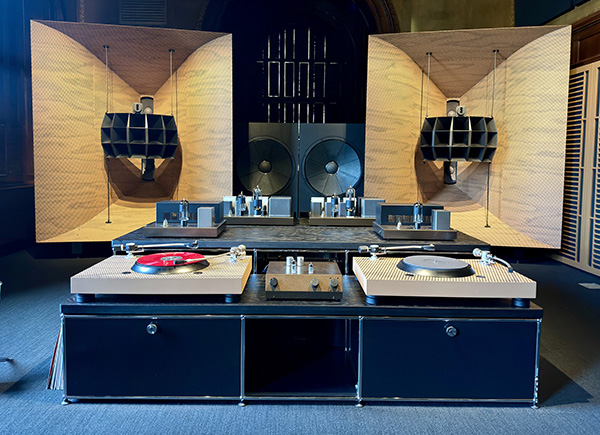
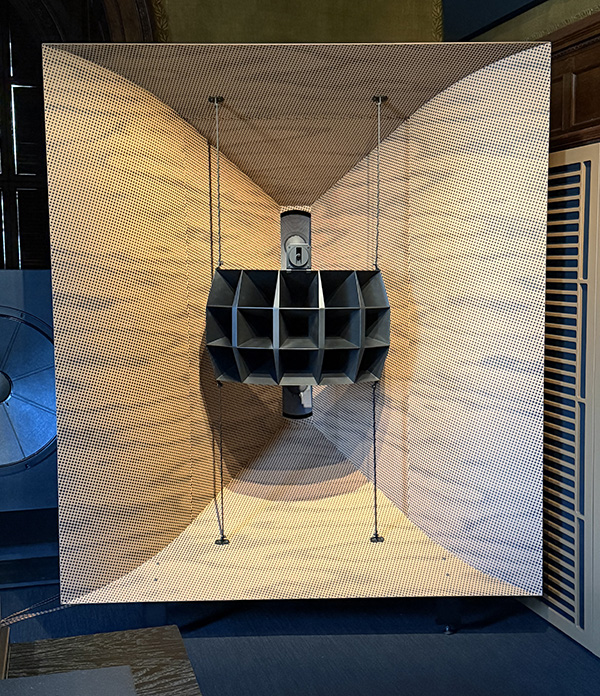
The Cooper Hewitt system is built around a massive pair of horn-loaded speakers that nearly scrape the exhibit space's walls and ceiling. The screen-printed midbass horn is 7'9" tall, 6'4" wide, and 4'6" deep. It's driven by a TAD TL-1601A 15" dynamic woofer.
That midbass horn is a companion for the Ojas 1505 Multicell horn, a mid/treble horn based on the Altec 1505B Multicell. The Ojas 1505 Multicell is driven by a TAD 1401 compression driver. "It uses the geometry and size to provide horizontal dispersion control similar to the [Altec] Multicell and the depth to have a decent overlap with the large-format subs," Turnbull said.
"What's unique about this speaker system is the virtual coaxial configuration of the two horns and the fact that they're mechanically time-aligned," Turnbull wrote in an email.
Vertically, "the distance between the drivers contributes to the dispersion control along with the size and geometry. The coaxial placement and physical time alignment between the woofers and compression driver makes this large format loudspeaker behave close to a point-source. A significant advantage with such a design is that all reflections from the room will contain the full bandwidth of frequencies reflected, time-aligned, thus a reflection will sound similar to the direct sound and still be intelligible."
The large horn's rear chamber is a proprietary design, patented by Rune Skramstad, CTO of NNNN. It "provides linear loading of the driver movement regardless of the sound pressure within the intended bandwidth and sound pressure capability of the horn."
Positioned behind the horns, the big subwoofers use a Fostex FW800HS driver in a transmission-line cabinet. "This is the first transmission-line application of the FW800 that I'm aware of. Transmission line subs generally blend very well with high-efficiency systems"—better, Turnbull said, than a "typical sealed or bass-reflex design."
At the top of the four-way system, attached to the Multicell horn, is a prototype supertweeter made for Ojas in Japan by Fostex. It will be available in the coming months as a standalone product for the DIY market.
Point source, uniform dispersion: This is classical loudspeaker engineering, reinterpreted in a giant horn system. Time alignment is less well-established but has a long history in hi-fi, going back in horn systems at least to Western Electric days.
In a series of later emails, Turnbull told
Stereophile, "I think the thing that is so pleasing about the system we're talking about is the combination of time-aligned drivers, uniform dispersion, and (importantly) the coaxial configuration. These three things in combination make a larger-than-life point source. It's a lot of fun!"
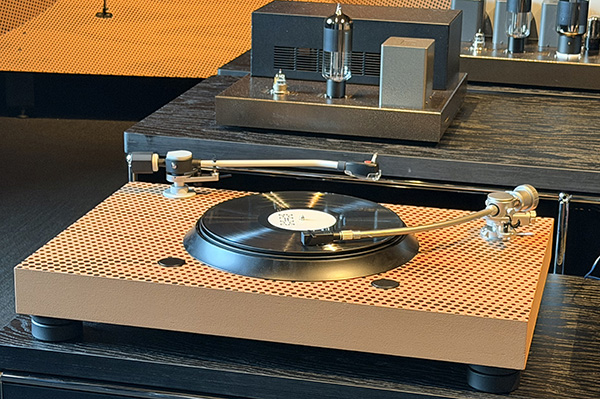
The rest of the system: Ojas screen-printed turntables with a Denon motor, two Ortofon AS-309R tonearms, and a Groovemaster IV. Cartridges in rotation include a modified
Denon DL-103R dubbed DL-103O, in an Ojas headshell, mounted on the Groovemaster IV. Two Ortofon AS-309R arms carry Ortofon SPU cartridges: an SPU #1 and a Meister. (Ortofon has renamed the Meister; it is now called Ethos.)
In addition to his own circuit designs, Turnbull was inspired by Susumu Sakuma and Arthur Loesch (both deceased), with engineering help from jazz guitarist Steve Berger, the proprietor of AprilSound.
The system's various cartridges feed a rotary selector switch; the output of the switch feeds a pair of mono Ojas/Cinemag SUTs. The SUT output goes to an Ojas/AprilSound phono stage. Turnbull says it's "a cascode design, using a 6N6 as the upper part, loading a 2sk170 (JFET), cap-coupled to a passive EQ network using very closely matched polystyrene caps and 1% resistors, DC coupled to a [constant current source]-loaded 6DJ8. Its input capacitance is extremely low, and its output impedance is only around 200 ohms. Phono stage gain is 45dB. A second selector switch lets us select the phono circuit or a couple of passive line inputs to an Alps Blue Velvet pot—a special version I source in Akihabara"—the Tokyo neighborhood, a hub for electronics retailers. "From here we have some options: an Ojas DSP and class-D rack amps that we use for high-end listening bars and some home systems, or a totally unique analog path."
"We are working on two pairs of amps for the main speakers, a single-ended 211 and a single-ended 801A," Turnbull wrote. "The 211 amp is a 211, cap coupled to the 801A tube, which is DC-coupled to a Western Electric 417A. The output should be about 18–20 watts. The other design is basically the first two stages of the 211 amp. A single-ended 801A/VT-25 or equivalent will be about 3W." Turnbull acknowledges a debt to adviser and former Western Electric engineer Trieu Ly, who goes by "lycan3r" on Instagram; the 3 R's stand for "research, re-imaging and redesign of vintage horns."
Until those amplifiers are ready, a pair of class-D amps is in use in the Cooper Hewitt system—a surprising choice perhaps considering that for many, the main appeal of class-D is efficiency and power. "I am thrilled with the way the system sounds now, and it's only going to be more engaging when people get to participate in the completion of the analog circuit path," Turnbull said. The new amplifiers should be ready by the end of January.
When presenting a system in a gallery or museum, what is Turnbull's goal?
"The first goal is to share the experience of listening with a wide range of people," he responded. "The second goal is to share some of my process of developing and making the work, to the extent that's possible.
"The same was true of the Lisson shows; it wasn't even my idea. I would NEVER presume that a blue-chip fine-art gallery would be interested in showing the work of an audio craftsman. Alex Logsdail, who runs the gallery, invited me to show, first in a group show and then a solo show at their flagship gallery in London. I think he recognized that there was continuity and consistency between the way I approach making audio equipment to the way their artists make paintings or sculptures. I'm not sure if it's the intent, process, or what, but I was extremely honored and jumped on the opportunity."
How do your systems change from venue to venue?
"Every one of these 'HiFi Pursuit Listening Room Dream' systems is a representation of my work at the time. A huge part of my process is traveling the world, listening, collaborating, learning, establishing relationships, all in the pursuit of special concepts and components. There are always vintage or handmade parts that I can only get a small number of, and therefore that piece can't be replicated."
How do patrons listen or react in the museum space?
"Well, it's a fundamentally different kind of presentation than a Hi-Fi show. I'm not exhibiting a commercially available product, and people are not there to evaluate something that they're considering spending money on. The goal is just for them to have a pleasant experience. Many people cry, many people get hooked and then start their own Hi-Fi journey."
Are attendees buying Ojas components after coming to a Turnbull event?
"My commercial business has scaled drastically since I started doing these shows, but it's hard to say directly, because there's no one there trying to capture leads or sell anything. There's usually just museum staff there, like a security person who knows nothing about audio."
Ojas owners
Ojas systems are found in many private homes, serving a high-profile clientele including Blue Note President Don Was, producer Mark Ronson, and rapper Tyler the Creator. An Ojas-based system can also be found in the Red Hook, Brooklyn, home of Jaime and Ben Krone, both architects. Jaime is senior director of exhibition design and architectural strategic planning at The Guggenheim Museum. Ben is principal architect at his own firm, Gradient Arch.
"What I love about the audiophile world, as an architect, is how it's bringing the spatial aspects back to sound in a way that is hard to replicate or even verbalize," Jaime said during an interview that took place at their home. "Music is audial of course, but it's also undeniably visual and physical to a certain extent," she continued. "I react to that in terms of how Devon is designing his systems, as well as the technical aspects of what's inside the systems. The physicality of a horn. ... There is something beautiful about the integrity of those shapes, and having them on display is a part of what he's designing. They celebrate that spatial aspect of what their job is, and the big ones at Cooper Hewitt are going to accentuate that. ... They are undeniably three-dimensional objects on display, and Devon's taking this into consideration. It's not just a box. He's letting the materials, the forms, be honest. Display what they are doing well as opposed to trying to make it into something it's not."
Jaime sees Turnbull's speaker designs as form following function. "Normally, manufacturers cover the cabinet with veneers that are completely overtreated and fussy. Devon does this clever screen-printing material technique instead, giving a graphic nod to the wood, or he's painting them, or exposing the plywood altogether. The idea isn't to conceal them in laminate but to say plywood is good for the job, it's stable, it doesn't need to be more, and that's a beautiful thing."
Not all the Krones' hi-fi equipment is countercultural; some of it is on
Stereophile's Recommended Components list:
CH Precision P1 phono preamp,
L1 and X1 line stage/power supply; a
Weiss Helios DAC; a
Grimm MU1 streamer. Those Ojas speakers are powered by a pair of 300B monoblocks from TW Acustic. Their turntable is custom, with a Technics direct-drive motor and tonearms by Technics and Acoustic Signature; their current main cartridge is an AirTight Opus. For those ultradeep analog dives, they keep a Studer A810 reel-to-reel machine with a Doshi Audio tape preamp.
Ben believes that much traditional audio gear doesn't function well within its purposed role in culture. "Part of the problem with the audiophile world is being a bit backwards in thinking and design," he noted. "In other types of industries like fashion, for instance, it's constantly turning over, and part of its whole job is to remain current. Audio gear, however, is so far behind on design and the way that things are made. ... There's an unwillingness to catch up because of the cost of constantly changing.
"Devon is aware of these shifts in design thinking. Because there's nothing esoteric about what he's doing, and everything remains relatively simple," he added, "it allows him to experiment without having to rewrite or recreate the entire thing. He's using a known set of circumstances, a known engineered general design idea. He can tinker around those edges for a long time without having to completely remake everything. That enables him to lean into doing other artistic moves. He's already tapping into that contemporary culture—and he can do things like issue limited runs, which only build upon and broaden his base."