CH Precision's approach to optimizing timing in digital audio has much in common with the MQA approach. CH Precision tries to achieve as much time compaction as possible without having access to information about the ADCs used in the original digital conversion—and, of course, without MQA's controversial "audio origami," which reduces file size. Of course, MQA wasn't the first to think about these things, either. Heeb told me that this line of thinking goes back at least to the late 1980s, to Luxman's Fluency DAC, a design based on the splines-related DSP work of Professor Kazuo Toraichi of the University of Tsukuba in Tokyo. Other early splines users in digital audio include Robert Moses of Wadia and Pioneer products employing the "Legato Linear" filter.
A related issue—related, that is, to timing precision—is phase coherence. Heeb: "Phase coherence is extremely important, we find out. What we mean by phase coherence is how the phase at a given frequency compares to the phase at neighboring frequencies. It is important to keep a certain level of what we call coherence between the phase response of adjacent frequency bins. This is one of the key points of the digital filters that we use in the D1.5." Consequently, Heeb told me, when we measure the frequency response, we'll "see that it has a little bit of a rolloff at 20kHz." (Actually, we found more than a little bit, but only at the highest potentially audible frequencies: See the Measurements sidebar.) "On the other hand, it has a very short time localization and implements to the full this concept of phase coherence that I was talking about before. That's really the essence.
"The other very important point that we have in those digital filters is the minimization of the errors in the computing itself," Heeb said. "A typical example would be the errors that round up when you do floating-point representations and [when] you do additions of very large and very small numbers that will create a distortion due to the limited precision [of] floating-point numbers." Get the calculations right, in other words.
That's the CH Precision approach to digital, as manifested in the D1.5, in a hefty nutshell.
In use
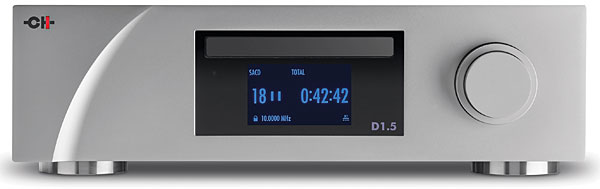
Once you know how to operate it, the control system on the D1.5 is simple and elegant. On the right side of the front panel are two coaxial knobs. Turning the inside knob to the left opens the CD drawer. Turning it to the right closes the drawer. Turning it to the right again initiates play. Turning it to the left stops play. The outside knob, turned clockwise, moves the player to the next track; turning it the other way moves it to the previous track. The inner knob is also a button; pushing it provides access to the Setup menu, which can then be navigated, intuitively, via the two knobs.
You can also set up most functions on the D1.5, and on other CH Precision products, using the CH Precision app, which. However. is only available on the Android platform: No iOS (Apple) version is available. There's also an elegant, chunky, metal remote control, with minimal functions: Play/Pause, Stop, Forward, Back, Mute. Some functions can only be performed on the player itself, via its setup menu. If you want to choose a different layer of a multilayer disc—say, the MQA layer on a hybrid SACD/MQA-CD disc, such as those from 2L or Impex, you'll need to get out of your listening chair.
Listening
Reviewing the D1.5 proved a logistical challenge because most of my silver discs are in storage. My reference recordings are mostly files and LPs; I also utilize Qobuz and Tidal for reviews. None of that is helpful in reviewing a transport/player. I dug through boxes to access a few CDs; otherwise, I relied on discs I've received over the last couple of years as promos and review copies.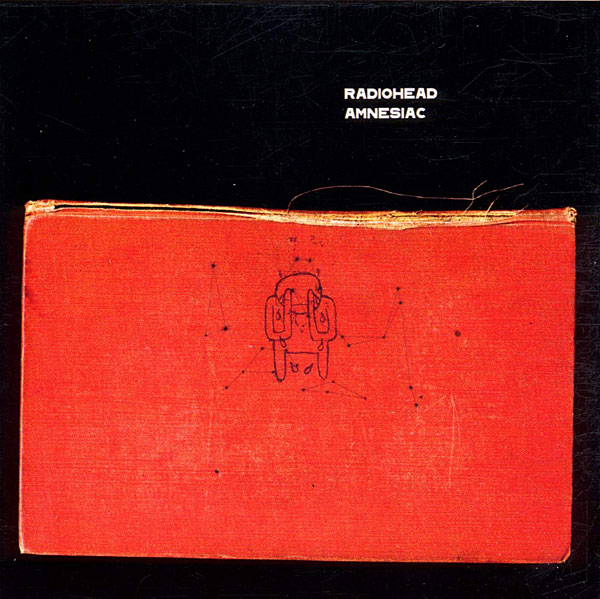 The first disc I chose was Radiohead's Amnesiac, on a regular CD (Capitol CDP 724353276423), which I had recovered from its storage box a few months ago because I wanted to listen to it in my car. I bought this disc at a Barnes & Noble in northwest Washington, DC, during a month-long stay in that city years ago when I was starting a new job. I recall walking along the Lincoln Memorial Reflecting Pool on a rainy Saturday and lying still on the bed in a meditative state in the basement room I was staying in, listening to this on a portable CD player. This is how Records to Die For are made.
This disc sounds plenty good on anything, including that portable player and whatever cheap headphones I was using circa 2001. Did I hear any advantage to this expensive player? Yes, I did: It was most noticeable in the bass, which felt more fundamental (with emphasis on the root of that word, fundament): seismic weight, especially on the 10th track, "Like Spinning Plates." On the third track, "Pulk/Pull Revolving Doors," in the electronic interlude that starts before 9:00, percussion had real, physical presence in the room, even though much of it is electronic. On the final track, "Life in a Glasshouse," the feeling of immersion, amidst a noodling quasi-Dixieland jazz band, was as powerful as I've experienced with two-channel audio, even as I sat 12' from the Wilson Alexx V speakers. Thom Yorke's voice, as haunting as ever, just hung there in space between the two speakers.
From there I moved on to Vladimir Ashkenazy's 1965 recording of Chopin, Debussy, and Ravel on a 2007 CD (Decca 475 8499) from Decca's "The Originals" series. It's a superb performance—the young Ashkenazy was a machine, although a very human one—and a very good-sounding CD. The piano sound is very natural from top to bottom, and the instrument has real, tangible body when it resonates in the lower part of its range.
There's not a lot to say about its reproduction by the D1.5, and I mean that in the best way. The recording sounded the way I've come to expect it to sound, with real sparkle in the highs, lovely tone in the midrange in the powerful, soft passages, and real power when the pianist plumbs the depths. The image of the instrument has depth; you can hear the notes moving back to front as he runs up and down the keyboard. Better piano recordings exist, but this disc—as played back here—makes a strong case for "Red Book" CD as a valid high-end container for acoustic music.
The first disc I chose was Radiohead's Amnesiac, on a regular CD (Capitol CDP 724353276423), which I had recovered from its storage box a few months ago because I wanted to listen to it in my car. I bought this disc at a Barnes & Noble in northwest Washington, DC, during a month-long stay in that city years ago when I was starting a new job. I recall walking along the Lincoln Memorial Reflecting Pool on a rainy Saturday and lying still on the bed in a meditative state in the basement room I was staying in, listening to this on a portable CD player. This is how Records to Die For are made.
This disc sounds plenty good on anything, including that portable player and whatever cheap headphones I was using circa 2001. Did I hear any advantage to this expensive player? Yes, I did: It was most noticeable in the bass, which felt more fundamental (with emphasis on the root of that word, fundament): seismic weight, especially on the 10th track, "Like Spinning Plates." On the third track, "Pulk/Pull Revolving Doors," in the electronic interlude that starts before 9:00, percussion had real, physical presence in the room, even though much of it is electronic. On the final track, "Life in a Glasshouse," the feeling of immersion, amidst a noodling quasi-Dixieland jazz band, was as powerful as I've experienced with two-channel audio, even as I sat 12' from the Wilson Alexx V speakers. Thom Yorke's voice, as haunting as ever, just hung there in space between the two speakers.
From there I moved on to Vladimir Ashkenazy's 1965 recording of Chopin, Debussy, and Ravel on a 2007 CD (Decca 475 8499) from Decca's "The Originals" series. It's a superb performance—the young Ashkenazy was a machine, although a very human one—and a very good-sounding CD. The piano sound is very natural from top to bottom, and the instrument has real, tangible body when it resonates in the lower part of its range.
There's not a lot to say about its reproduction by the D1.5, and I mean that in the best way. The recording sounded the way I've come to expect it to sound, with real sparkle in the highs, lovely tone in the midrange in the powerful, soft passages, and real power when the pianist plumbs the depths. The image of the instrument has depth; you can hear the notes moving back to front as he runs up and down the keyboard. Better piano recordings exist, but this disc—as played back here—makes a strong case for "Red Book" CD as a valid high-end container for acoustic music.
 Clique
Clique, the latest album from Patricia Barber, with liner notes by Stereophile jazz critic Tom Conrad, was engineered by Jim Anderson, who has won three Grammy Awards and may well win a fourth, for this recording. (He has already been nominated.) Anderson also wrote the My Back Pages column in the February 2022 issue of Stereophile. Clique is a beautifully recorded album, and much more musically interesting than it seems on first listen, but it took a while to grow on me. The silver-disc version from Impex includes audio in three formats: stereo and surround DSD and MQA CD. Listening at first to the stereo DSD layer, I had the repeated impression of being pleasantly surprised by aspects of the sound—the way particular sounds emerged from otherwise empty space, by the creamy texture of one of Barber's vocals (as on "The In Crowd"), by the realism, that in-the-room feeling. Such things caused me to smile and look up with something like delight. It made me think Jim Anderson must have been having great fun sitting at the console, collaborating with Barber and the other musicians in creating this. What is it about this music, produced by this player and this system, that makes me respond this way? It feels like surprise, the unexpected. Little pearls of piano notes, almost visible, float in space, each with unexpected nuance, inflection, and tonal color. It can be a surprising bit of imaging or surprisingly deep and resonant bass. I sense that dynamics are important in this. Music that's dynamically compressed loses that sense of surprise. Dynamic compression is imposed monotony.
What causes this sense of surprise? I can tell you what it feels like (footnote 3). It's novelty. Nonuniformity. No order is imposed; the individuality of each sound is preserved. This makes me think of a concept in Zen—the pattern that is no pattern, the pattern of perfect randomness, like the pattern leaves form on grass after falling from a tree. No conscious mind could arrange them that way. This is something like that: Natural patterns are untainted. They remain interesting, colorful, artful, human.
Sometimes, in listening, it's not clear what is surprising, what keeps us engaged or re-engages us, but something is. Something does.
One thing I noticed early on in my time with the D1.5 is how good it sounds at low volume. This sense of surprise was present even—perhaps especially—when the music was playing at background levels. Notes kept their shape—their character—even when the music was quiet.
Why is this all better through the D1.5? Surely, to make a great player, you've got to get a lot of things right, but what sets the D1.5 apart? Considering the focus of Heeb and Cossy in designing the D1.5, as expressed in the interview above, could it perhaps be the timing?
As a final experiment, for now: Using the CH Precision app, I changed the clock source from the D1.5's internal clock to the T1 Time Reference, which was already connected. I don't really understand the use of external clocks when you're using just one high-quality component. If you've got both a transport and a DAC that need to work together—well, then it certainly makes sense. But with just one component, isn't the most important thing to put the clock as close as possible to the digital converter? The external clock would need to be very much better to offset the disadvantages of being external.
 I was listening to a recent acquisition, En attendant from the Marcin Wasilewski Trio (CD, ECM 2677). With the internal clock, the sound was very good—remarkable in some ways. There was plenty of surprise—sounds popping up all over the stage, with interesting timbre and tonal color, lots of wood and sparkle. But when I switched in the T1 Time Reference, the improvement wasn't subtle. Though I'd been completely unaware of it—completely happy with the sound—it now seemed as though the music had been slouching and now it snapped to attention. More depth, more separation. The stage was slightly bigger, slightly deeper, more erect. Percussion instruments became more distinctive in timbre and in their position in space. The remarkable thing was that now bass had extra impact, quite apparent on the louder low notes of the piano and the upright bass. I don't know why an external clock would make the bass more forceful, but this last experiment makes me think: Yes, it must be the timing.
MQA CD
I was listening to a recent acquisition, En attendant from the Marcin Wasilewski Trio (CD, ECM 2677). With the internal clock, the sound was very good—remarkable in some ways. There was plenty of surprise—sounds popping up all over the stage, with interesting timbre and tonal color, lots of wood and sparkle. But when I switched in the T1 Time Reference, the improvement wasn't subtle. Though I'd been completely unaware of it—completely happy with the sound—it now seemed as though the music had been slouching and now it snapped to attention. More depth, more separation. The stage was slightly bigger, slightly deeper, more erect. Percussion instruments became more distinctive in timbre and in their position in space. The remarkable thing was that now bass had extra impact, quite apparent on the louder low notes of the piano and the upright bass. I don't know why an external clock would make the bass more forceful, but this last experiment makes me think: Yes, it must be the timing.
MQA CD
From the time I first heard about it, MQA CD seemed like an interesting idea. On the one hand, on a 16-bit CD, there's no place to squirrel away data, as MQA is known to do on 24-bit files. On the other hand, if it's true—as both MQA and CH Precision believe—that time smearing is a serious issue in digital playback, then correcting it is likely to be much more audible at CD resolution than at higher resolutions, where filtering need not be as aggressive. The numbers are still small, but there are more MQA CDs out there than I realized. Most are on audiophile labels such as Impex, 2L, and Eudora—but the format is becoming more mainstream: Some recent Doors reissues on Rhino/Elektra include MQA CD, and a series of rock-pop MQA CDs (Blondie, Police, Stevie Wonder, King Crimson) has been released in Japan, available as imports at, eg, Amazon.com. Until now, I'd never had an opportunity to listen to an MQA CD on an MQA-CD–enabled player. (How many such players exist?) Patricia Barber's Clique has an MQA layer. It's time to compare it to the SACD layer auditioned above.
I created a shortcut to switch layers, which is very easy to do. Once the shortcut was created, switching layers was trivial, although after each change, the player has to read the disc again, which takes several seconds.
The first thing I noticed: The MQA layer is significantly louder than the SACD layer, by perhaps 3dB (footnote 4). So, for the comparison, I lowered the volume by 3dB.
On the MQA layer, "This Town" (first track) sounded superb. Barber's voice had a lovely, creamy texture. Slap was accentuated on Patrick Mulcahey's bass. After the 2:00 mark, as the music got louder, I detected some congestion. Textures thickened. It was subtle.
Switching back to the SACD layer (and increasing levels by 3dB), I didn't hear as much creaminess on the vocals, but they didn't sound worse—just different. I listened for that congestion in the louder parts. I didn't hear it.
 Wrapping up—for now
One of the reasons that audio is so addictive—and takes such a big hit on our pocketbooks—is that we get used to a certain level of performance. We raise our systems to a certain level and acclimate. We stop noticing the surprise, and the music starts to bore us again. There are ways around it: meditation, rituals, certain substances—but if we don't employ those or other methods, we may soon find ourselves craving something new, better, and probably more expensive. Except that sometimes, at a certain level of performance, this doesn't happen anymore. The music keeps surprising us. That level may be different for each of us. Lately, I've had the privilege of listening consistently to very good equipment—I'm used to good digital—and after several months with the D1.5, I never got bored. If that sounds like faint praise—well, it isn't.
Software, of course, is a major variable, which is why I chose a superbly recorded disc—Clique—for the most important bit of listening. Some digital recordings have monotony encoded in the bits and pits. Among the CDs I recovered from those boxes was a Philips recording of Schubert's Winterreisse by Dietrich Fischer-Dieskau, with Alfred Brendel on piano. It's an early digital recording, from 1985, remastered and reissued in 2001 as part of the Philips "50 Great Recordings" series. It's not a bad recording, just a bit dim: monochromatic and lacking that element of surprise. A player can't dig out what isn't there. Probably.
I've mentioned that I have the whole CH Precision digital system here: the D1.5, the C1 DAC, the T1 clock, the X1 power supply, and a bunch of very expensive cables installed for this review. It's all stacked (appropriately, using CH Precision's interesting stacking system) on an HRS amplifier stand. That's $136,000 worth of CH Precision components, plus the cables and stand. I'm not letting it go before writing about how it all works together—but that will have to wait. For now, my work here is done
Footnote 3: See this month's As We See It. Footnote 4: Later, I confirmed a 3dB difference by comparing maximum levels.
Once you know how to operate it, the control system on the D1.5 is simple and elegant. On the right side of the front panel are two coaxial knobs. Turning the inside knob to the left opens the CD drawer. Turning it to the right closes the drawer. Turning it to the right again initiates play. Turning it to the left stops play. The outside knob, turned clockwise, moves the player to the next track; turning it the other way moves it to the previous track. The inner knob is also a button; pushing it provides access to the Setup menu, which can then be navigated, intuitively, via the two knobs.
Reviewing the D1.5 proved a logistical challenge because most of my silver discs are in storage. My reference recordings are mostly files and LPs; I also utilize Qobuz and Tidal for reviews. None of that is helpful in reviewing a transport/player. I dug through boxes to access a few CDs; otherwise, I relied on discs I've received over the last couple of years as promos and review copies.
The first disc I chose was Radiohead's Amnesiac, on a regular CD (Capitol CDP 724353276423), which I had recovered from its storage box a few months ago because I wanted to listen to it in my car. I bought this disc at a Barnes & Noble in northwest Washington, DC, during a month-long stay in that city years ago when I was starting a new job. I recall walking along the Lincoln Memorial Reflecting Pool on a rainy Saturday and lying still on the bed in a meditative state in the basement room I was staying in, listening to this on a portable CD player. This is how Records to Die For are made.
CliqueClique, the latest album from Patricia Barber, with liner notes by Stereophile jazz critic Tom Conrad, was engineered by Jim Anderson, who has won three Grammy Awards and may well win a fourth, for this recording. (He has already been nominated.) Anderson also wrote the My Back Pages column in the February 2022 issue of Stereophile. Clique is a beautifully recorded album, and much more musically interesting than it seems on first listen, but it took a while to grow on me. The silver-disc version from Impex includes audio in three formats: stereo and surround DSD and MQA CD. Listening at first to the stereo DSD layer, I had the repeated impression of being pleasantly surprised by aspects of the sound—the way particular sounds emerged from otherwise empty space, by the creamy texture of one of Barber's vocals (as on "The In Crowd"), by the realism, that in-the-room feeling. Such things caused me to smile and look up with something like delight. It made me think Jim Anderson must have been having great fun sitting at the console, collaborating with Barber and the other musicians in creating this. What is it about this music, produced by this player and this system, that makes me respond this way? It feels like surprise, the unexpected. Little pearls of piano notes, almost visible, float in space, each with unexpected nuance, inflection, and tonal color. It can be a surprising bit of imaging or surprisingly deep and resonant bass. I sense that dynamics are important in this. Music that's dynamically compressed loses that sense of surprise. Dynamic compression is imposed monotony.
I was listening to a recent acquisition, En attendant from the Marcin Wasilewski Trio (CD, ECM 2677). With the internal clock, the sound was very good—remarkable in some ways. There was plenty of surprise—sounds popping up all over the stage, with interesting timbre and tonal color, lots of wood and sparkle. But when I switched in the T1 Time Reference, the improvement wasn't subtle. Though I'd been completely unaware of it—completely happy with the sound—it now seemed as though the music had been slouching and now it snapped to attention. More depth, more separation. The stage was slightly bigger, slightly deeper, more erect. Percussion instruments became more distinctive in timbre and in their position in space. The remarkable thing was that now bass had extra impact, quite apparent on the louder low notes of the piano and the upright bass. I don't know why an external clock would make the bass more forceful, but this last experiment makes me think: Yes, it must be the timing.
From the time I first heard about it, MQA CD seemed like an interesting idea. On the one hand, on a 16-bit CD, there's no place to squirrel away data, as MQA is known to do on 24-bit files. On the other hand, if it's true—as both MQA and CH Precision believe—that time smearing is a serious issue in digital playback, then correcting it is likely to be much more audible at CD resolution than at higher resolutions, where filtering need not be as aggressive. The numbers are still small, but there are more MQA CDs out there than I realized. Most are on audiophile labels such as Impex, 2L, and Eudora—but the format is becoming more mainstream: Some recent Doors reissues on Rhino/Elektra include MQA CD, and a series of rock-pop MQA CDs (Blondie, Police, Stevie Wonder, King Crimson) has been released in Japan, available as imports at, eg, Amazon.com. Until now, I'd never had an opportunity to listen to an MQA CD on an MQA-CD–enabled player. (How many such players exist?) Patricia Barber's Clique has an MQA layer. It's time to compare it to the SACD layer auditioned above.
Wrapping up—for nowOne of the reasons that audio is so addictive—and takes such a big hit on our pocketbooks—is that we get used to a certain level of performance. We raise our systems to a certain level and acclimate. We stop noticing the surprise, and the music starts to bore us again. There are ways around it: meditation, rituals, certain substances—but if we don't employ those or other methods, we may soon find ourselves craving something new, better, and probably more expensive. Except that sometimes, at a certain level of performance, this doesn't happen anymore. The music keeps surprising us. That level may be different for each of us. Lately, I've had the privilege of listening consistently to very good equipment—I'm used to good digital—and after several months with the D1.5, I never got bored. If that sounds like faint praise—well, it isn't.
Footnote 3: See this month's As We See It. Footnote 4: Later, I confirmed a 3dB difference by comparing maximum levels.