Follow-Up: New Measurements, from June 2025
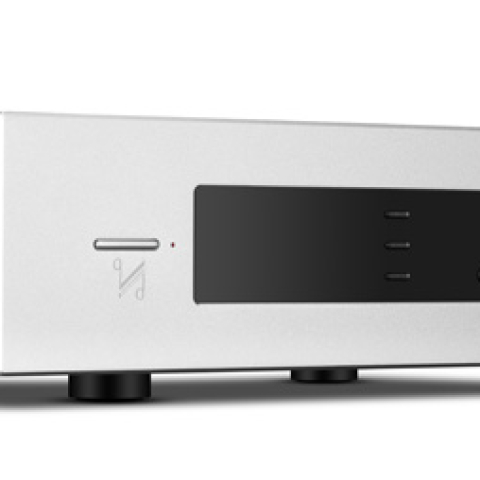
When Kalman Rubinson reviewed this affordably priced amplifier in the January 2025 issue, he was impressed by what he heard. "Sonically, the Buckeye 1ET9040BA monoblocks are superb," he concluded, adding that "to their credit, they are transparent, open and balanced, and with the right program material, thrilling. ... Physically, they are compact, lightweight, and utilitarian in the best meanings of the word. I could happily adopt them into my own system."
Because class-D amplifiers emit high levels of ultrasonic noise that would drive my analyzer's input into slew-rate limiting, I inserted an Audio Precision AUX-0025 passive low-pass filter between the test load and the analyzers, as I do when testing all class-D amplifiers. This filter mitigates noise above 80kHz and eliminates noise above 200kHz—noise that would otherwise drive the SYS2722's input circuitry into lew-rate limiting.
The new amplifiers' gain, input and output impedances, frequency and squarewave responses, and S/N ratios were identical to those of the original samples. However, they now exceeded the specified maximum output power of 375W into 8 ohms (25.75dBW) without turning off.
Footnote 1: The Buckeye amplifier costs $2300/pair, including free shipping in the US. Manufacturer: Buckeye Amps, 4280 Weckerly Rd., Monclova, OH 43542. Tel: (419) 351-5704. Web: buckeyeamp.com.
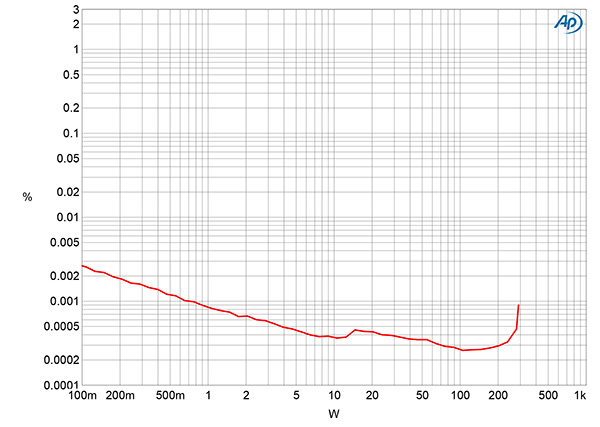
Fig.1 Buckeye Purifi 1ET9040BA, original sample, distortion (%) vs 1kHz continuous output power into 8 ohms.
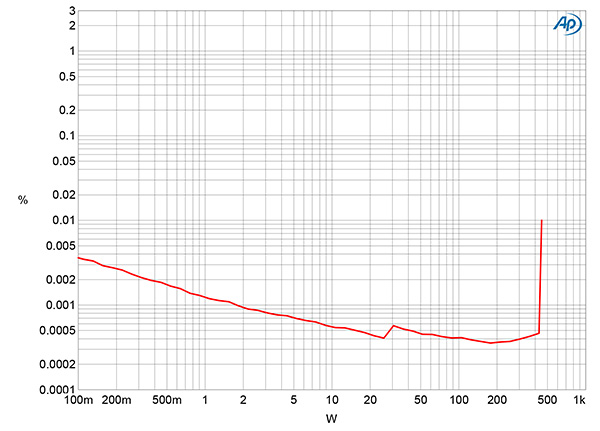
Fig.2 Buckeye Purifi 1ET9040BA, original sample, distortion (%) vs 1kHz continuous output power into 4 ohms.
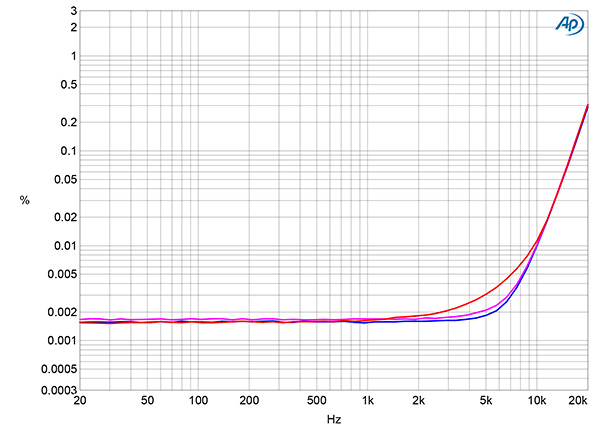
Fig.3 Buckeye Purifi 1ET9040BA, original sample, THD+N (%) vs frequency at 20V into: 8 ohms (blue), 4 ohms (magenta), and 2 ohms (red).
However, when I examined how one of the Buckeye amplifier's THD+noise varied with power, I found that the amplifier turned itself off before reaching its specified clipping power into both 8 ohms (fig.1) and 4 ohms (fig.2). In addition, while the THD+N percentage was very low at low, midrange, and low-treble frequencies, it rose precipitously in the top two audio octaves (fig.3, plotted at 20V, which is equivalent to 50W into 8 ohms, 100W into 4 ohms, and 200W into 2 ohms). This was not what I was expecting from an amplifier that used the Eigentakt 1ET9040BA class-D output module from the well-regarded Purifi company and was praised without reservation by Kal Rubinson.
After the review had been published, we learned that there was a problem with the modules used in the review samples. Purifi published a statement on Facebook.
"In June 2024, we delivered a small number of pilot production units that had passed outgoing screening but were later found to contain an issue affecting high-frequency performance. We have since corrected and expanded our QC procedure to ensure such issues do not occur in all successive batches. "All production units now meet specifications. However, it appears that a faulty unit was not recalled in time and was apparently used in a product sent for review. We are very sorry for the mistake and are working closely with our OEM partners to ensure a replacement is provided as quickly as possible."Accordingly, Buckeye submitted a new pair of Eigentakt 1ET9040BA amplifiers, fitted with correctly working output modules. I performed a complete set of measurements on one of the new amplifiers with my Audio Precision SYS2722 system, then repeated some of the testing on the other sample. They behaved identically.
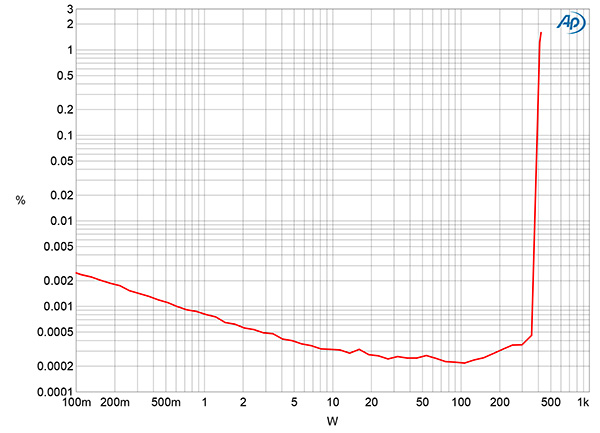
Fig.4 Buckeye Purifi 1ET9040BA, new sample, distortion (%) vs 1kHz continuous output power into 8 ohms.
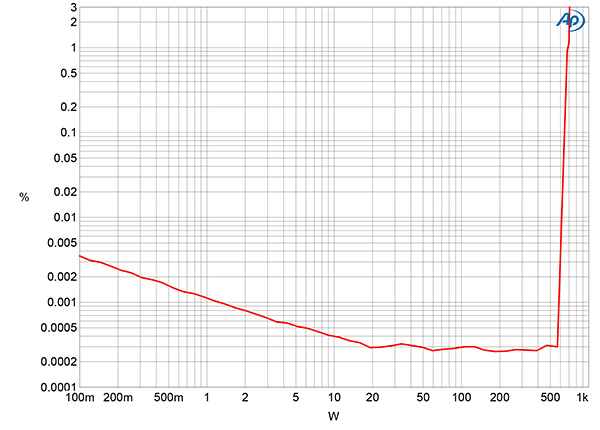
Fig.5 Buckeye Purifi 1ET9040BA, new sample, distortion (%) vs 1kHz continuous output power into 4 ohms.
We define clipping as when the THD+noise reaches 1%, and the new amplifiers reached this THD+N percentage at 400W into 8 ohms (26.02dBW, fig.4) with both 1kHz and 20kHz signals. The maximum power into 4 ohms is specified as 750W (25.75dBW); the new samples almost reached that power, clipping at 690W into 4 ohms (25.38dBW, fig.5), while into 2 ohms, they clipped at the specified 1200W (24.77dBW, not shown).
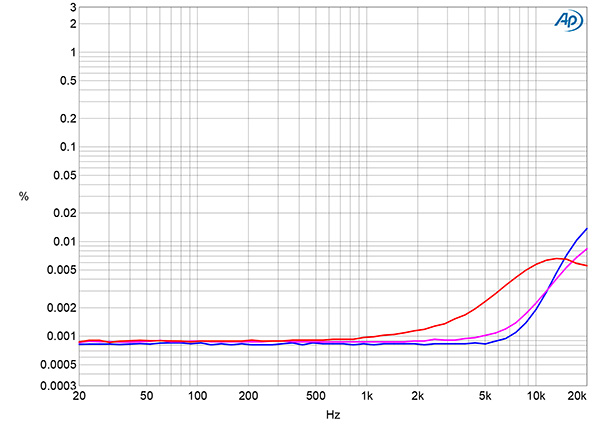
Fig.6 Buckeye Purifi 1ET9040BA, new sample, THD+N (%) vs frequency at 20V into: 8 ohms (blue), 4 ohms (magenta), and 2 ohms (red).
Fig.6 shows how one of the new samples' THD+N percentage varied with frequency at the same 20V I used to generate fig.3. The THD+N was even lower in the bass, midrange, and mid-treble into all three loads than it was with the original amplifier, and there only a small increase above 5kHz.
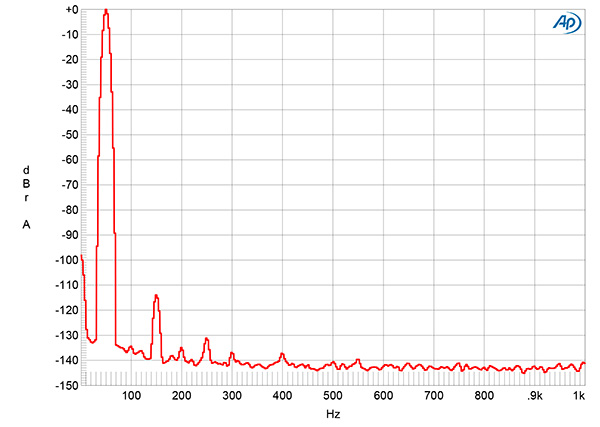
Fig.7 Buckeye Purifi 1ET9040BA, new sample, spectrum of 50Hz sinewave, DC–1kHz, at 100W into 8 ohms (linear frequency scale).
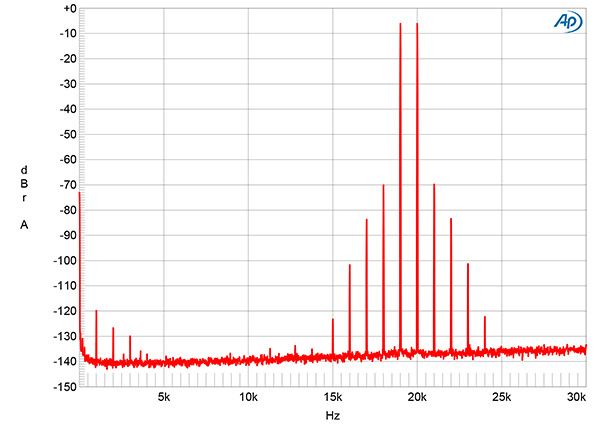
Fig.8 Buckeye Purifi 1ET9040BA, original sample, HF intermodulation spectrum, DC–30kHz, 19+20kHz at 50W peak into 8 ohms (linear frequency scale).
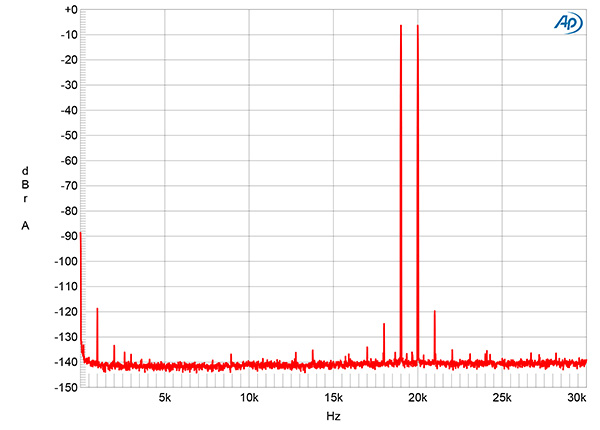
Fig.9 Buckeye Purifi 1ET9040BA, new sample, HF intermodulation spectrum, DC–30kHz, 19+20kHz at 100W peak into 8 ohms (linear frequency scale).
The new sample's distortion signature was still the third harmonic at an extremely low level (fig.7), but the higher-order harmonics that were present with the original sample's output spectrum are now absent. With the original amplifier's severely reduced linearity in the top audio octave, the spectrum of its output with an equal mix of 19kHz and 20kHz tones at 50W peak into 8 ohms had high levels of the intermodulation products at 18kHz and 21kHz, as well as other high-order products (fig.8). In contrast, the new samples performed very much better on this test, even at 100W into 8 ohms (fig.9), with the very few intermodulation products all lying close to –120dB (0.0001%).
To be fair, the original sample still offered high power with superbly low levels of distortion and noise from the bass through to the low treble. Its shortfall in high-frequency linearity would not have been an issue during KR's auditioning, as recorded music rarely has high-level content above 5kHz. But the new samples' measured performance is very much better across the board, confirming that their Eigentakt class-D output modules were performing correctly. After I finished the measurements, I shipped the new amplifiers to KR; I am looking forward to reading what he thought of their sound.—John Atkinson.
Footnote 1: The Buckeye amplifier costs $2300/pair, including free shipping in the US. Manufacturer: Buckeye Amps, 4280 Weckerly Rd., Monclova, OH 43542. Tel: (419) 351-5704. Web: buckeyeamp.com.