Culshaw's Rheingold, made in 1958, was the first recording to exploit stereo technology's ability not only to reproduce the spatial characteristics of a recorded performance, but to re-create, for the listener, spatial effects created entirely in the studio, including the singers' relative positions on an imaginary stage and their movements across that stage as they perform. Through the Air Tight, that stage was notably larger than through most amps; indeed, it was considerably larger than with other tube amps of my experience that use negative feedback—something I associate with amps whose spatial performance is precisely detailed but lacking in scale at the large end of the spectrum.
In recording Scene iii of Rheingold, Culshaw and engineer Gordon Parry devised a way to portray the dwarf Alberich (baritone Gustav Neidlinger) as having rendered himself invisible in order to attack his brother, Mime (tenor Paul Kuân): They recorded Neidlinger in an isolation booth to make his voice sound separate from the rest of the recorded space—an effect that the producers of live performances have tried but reportedly failed to pull off. (Originally, the baritone portraying Alberich would slip backstage and sing through an elongated horn of Wagner's own design.) Through the ATM-300R, those effects were eerily convincing; even more so was the physical, forceful sound of Alberich's whip. The ATM-300R also did well with another special effect cooked up for the orchestral interludes between scenes ii and iii and between iii and iv: the sounds of the Nibelung workers whom Alberich has enslaved, hammering away at his gold. For this, Culshaw and his assistants located and rented 18 anvils of different size, on which his percussionists played, with various types of hammers, the rhythmic patterns Wagner had written for these passages. The effect sounds like noise through lesser gear, yet was clear, precise, and, again, forceful through the Air Tight.
The ATM-300R did more than just an impressive job with this recording's spatial effects. The sounds of the brasses in various recurrences of the Valhalla leitmotif were spine-tinglingly beautiful and just plain right through this amp—as was every note sung by Fricka (Kirsten Flagstad) and, even more so, Freia (Claire Watson). And in the opening measures of the Prelude, the low E-flat on the double basses had tremendous—but not overblown—depth and power, and far greater clarity of pitch than I've heard through any other 300B amplifier, bar none.
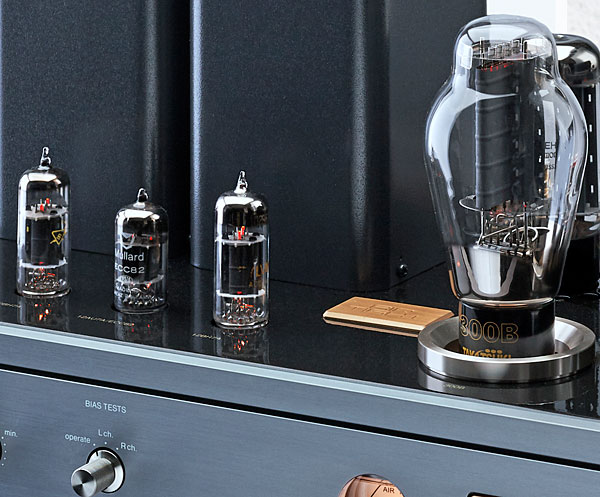 Another multidisc set that I listened to more than once through the ATM-300R amp was the 1972 recording of Elgar's oratorio The Dream of Gerontius, directed by Benjamin Britten, with Peter Pears et al and the London Symphony Orchestra and Chorus (2 LPs, London OSA 1293). I dare say the Air Tight's presence in my system was a major factor in pushing me toward Britten's interpretation, which is generally brisker but no less emotionally powerful than Sir Adrian Boult's more stolid, stentorian, broader-paced recording with Nicolai Gedda et al, the New Philharmonia Orchestra, and the London Philharmonic Chorus (2 LPs, EMI SLS 987). The ATM-300R clarified some of the scoring for choir and woodwinds alike, without sacrificing the opulence of the LSO's string tone, but it was the way it reproduced the big orchestral bass drum that really won me over: The combined forces of the 8Wpc Air Tight and the woofers of my DeVore Fidelity Orangutan O/93 speakers created bass fundamentals that were impressively, thunderously powerful yet perfectly clear of pitch, without wobble or excess boom.
After spending so much time listening to George Bernard Shaw's two favorite composers, I found myself in the mood to hear something from Brahms, whom the playwright and occasional music critic—the latter under the name Corno di Basseto—held in contempt. The Air Tight did a lovely job with Rafael Kubelik and the Vienna Philharmonic's recording of Brahms's Symphony 1 (LP, London CS 6016). String and woodwind tones throughout were lusciously textured and colorful, but not pushed to unrealistic extremes in those regards: tones were beautiful and faithful. The kettledrum in the introductory measures had realistic force, and a convincing increase in intensity leading to that portion's climax. In the scherzo-like third movement, both the clarinet's tone and the believability of the air surrounding it in the recording space were remarkable—and the ATM-300R conveyed the rhythmic change as the bubbly first part led into the more accented rhythms of the Trio section. The sound was consistently involving, and held my attention right through the smooth transition into the final movement, with the swooping strings allowed a believable sense of scale: Here, as in Das Rheingold, the Air Tight was capable of letting the music sound big.
In my next day of listening I reached for something entirely different: Neil Young's "Cortez the Killer," from his Zuma (LP, Reprise MS 2242). Throughout its weeks in my system, the Air Tight amp proved not the least bit bright, yet it gave an almost startlingly detailed presentation of this familiar recording—details of musical nuance, such as when Young briefly uses the heel of his right hand as a mute near the bridge of his guitar while raking the strings, and spatial cues that describe the positions on the soundstage, from side to side and from front to back, of Young's voice and solo guitar. Interestingly, with the ATM-300R, all of Young's vocals, portions of his guitar solos, and even some sounds from the drums—eg, a rim shot that sounded accidental—came farther forward from the speakers as they grew not only in loudness but in physical intensity. I noticed the same effect from the congas in the album's next and final song, "Through My Sails."
Another multidisc set that I listened to more than once through the ATM-300R amp was the 1972 recording of Elgar's oratorio The Dream of Gerontius, directed by Benjamin Britten, with Peter Pears et al and the London Symphony Orchestra and Chorus (2 LPs, London OSA 1293). I dare say the Air Tight's presence in my system was a major factor in pushing me toward Britten's interpretation, which is generally brisker but no less emotionally powerful than Sir Adrian Boult's more stolid, stentorian, broader-paced recording with Nicolai Gedda et al, the New Philharmonia Orchestra, and the London Philharmonic Chorus (2 LPs, EMI SLS 987). The ATM-300R clarified some of the scoring for choir and woodwinds alike, without sacrificing the opulence of the LSO's string tone, but it was the way it reproduced the big orchestral bass drum that really won me over: The combined forces of the 8Wpc Air Tight and the woofers of my DeVore Fidelity Orangutan O/93 speakers created bass fundamentals that were impressively, thunderously powerful yet perfectly clear of pitch, without wobble or excess boom.
After spending so much time listening to George Bernard Shaw's two favorite composers, I found myself in the mood to hear something from Brahms, whom the playwright and occasional music critic—the latter under the name Corno di Basseto—held in contempt. The Air Tight did a lovely job with Rafael Kubelik and the Vienna Philharmonic's recording of Brahms's Symphony 1 (LP, London CS 6016). String and woodwind tones throughout were lusciously textured and colorful, but not pushed to unrealistic extremes in those regards: tones were beautiful and faithful. The kettledrum in the introductory measures had realistic force, and a convincing increase in intensity leading to that portion's climax. In the scherzo-like third movement, both the clarinet's tone and the believability of the air surrounding it in the recording space were remarkable—and the ATM-300R conveyed the rhythmic change as the bubbly first part led into the more accented rhythms of the Trio section. The sound was consistently involving, and held my attention right through the smooth transition into the final movement, with the swooping strings allowed a believable sense of scale: Here, as in Das Rheingold, the Air Tight was capable of letting the music sound big.
In my next day of listening I reached for something entirely different: Neil Young's "Cortez the Killer," from his Zuma (LP, Reprise MS 2242). Throughout its weeks in my system, the Air Tight amp proved not the least bit bright, yet it gave an almost startlingly detailed presentation of this familiar recording—details of musical nuance, such as when Young briefly uses the heel of his right hand as a mute near the bridge of his guitar while raking the strings, and spatial cues that describe the positions on the soundstage, from side to side and from front to back, of Young's voice and solo guitar. Interestingly, with the ATM-300R, all of Young's vocals, portions of his guitar solos, and even some sounds from the drums—eg, a rim shot that sounded accidental—came farther forward from the speakers as they grew not only in loudness but in physical intensity. I noticed the same effect from the congas in the album's next and final song, "Through My Sails."
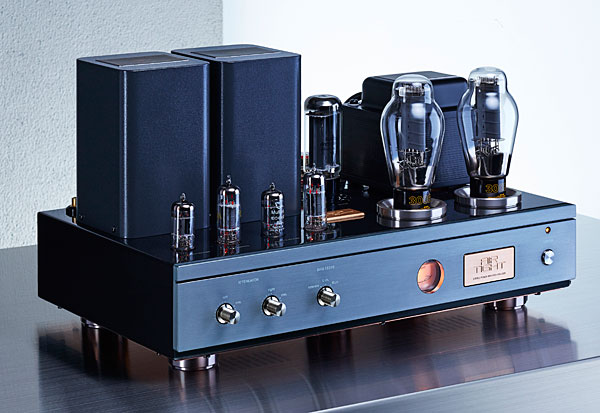 Solo-piano music was also to the Air Tight's liking. Henriette Faure's decidedly romantic playing on her recording of Book 1 of Debussy's Préludes (LP, EMI 350 C 004/Electric Recording Company ERC 006) was very well served by the ATM-300R, which followed, apparently faithfully, Faure's dynamic shadings, her variable tempi, and the texture of playing (as distinct from the texture of the sound) she brought to arpeggiated chords and the like: a lovely experience. The piano sounded stringy—appropriately so, I think—with generous purr and every last ounce of the low-octave power I hear from this record through more powerful amps. Indeed, the ATM-300R's sound remained poised—clean, not harsh—during the loudest moments of Prélude 7, Ce qu'a vu le vent d'ouest: No thickness of sound intruded to betray the amp's modest power reserves.
Conclusions
Solo-piano music was also to the Air Tight's liking. Henriette Faure's decidedly romantic playing on her recording of Book 1 of Debussy's Préludes (LP, EMI 350 C 004/Electric Recording Company ERC 006) was very well served by the ATM-300R, which followed, apparently faithfully, Faure's dynamic shadings, her variable tempi, and the texture of playing (as distinct from the texture of the sound) she brought to arpeggiated chords and the like: a lovely experience. The piano sounded stringy—appropriately so, I think—with generous purr and every last ounce of the low-octave power I hear from this record through more powerful amps. Indeed, the ATM-300R's sound remained poised—clean, not harsh—during the loudest moments of Prélude 7, Ce qu'a vu le vent d'ouest: No thickness of sound intruded to betray the amp's modest power reserves.
Conclusions
Unfortunately, although Cary Audio's similarly priced CAD-805RS single-ended monoblocks ($15,995/pair). immediately preceded the Air Tight ATM-300R in my system, I didn't have both here at the same time, for a direct comparison. But my memory of the big Carys' sound was sufficiently fresh that I can say, with assurance, that while the US-made amp produced somewhat wider stages than the Air Tight, the latter managed to sound bigger overall, apparently by dint of its greater sense of spatial depth. An even more audible difference was the absence, in the ATM-300R's sound, of the goosed-up bass that characterized the Cary's. Also by comparison, my Shindo Laboratory Haut-Brion sounded a mite richer and more lush than the Air Tight, but not as powerful and tight in its lowest octaves: I keep coming back to how scary-good the orchestral bass drum in Britten's recording of Elgar's The Dream of Gerontius sounded through the ATM-300R.
In all, the Air Tight ATM-300R impressed me as an amplifier whose only flaw derived from the prescribed limitations of its breed: its low power relative to most other domestic amplifiers. Because it requires loudspeakers of higher-than-average efficiency—ie, high electrical sensitivity combined with consistently high impedance—the ATM-300R is not for everyone. Fair enough: Criticizing a single-ended 300B amp for its low power is like criticizing a haiku for its limited narrative. To put it another way: Being disappointed in a 300B for not offering Herculean levels of power is like being disappointed in The Seventh Seal for not including a car chase.
As I write this, I'm one or two weeks away from moving my playback system from my smallish living room to my recently expanded family room—at which time my extremely efficient Altec Flamenco loudspeakers will end their exile (think: Wilford Brimley in John Carpenter's The Thing) and rejoin my system. I hope I'll be able to keep the Air Tight amp long enough to try it with those speakers; I also wouldn't turn down an opportunity to hear it with the Takatsuki output tubes (hint, hint). Even so, based on my experiences with it during the last few weeks, the Air Tight ATM-300R stands alongside the Shindo Laboratory D'Yquem, the Lamm Industries ML2.2, the original (Japanese) Audio Note Ongaku, and my own Shindo Haut-Brion as one of the finest amplifiers I've ever heard.
Another multidisc set that I listened to more than once through the ATM-300R amp was the 1972 recording of Elgar's oratorio The Dream of Gerontius, directed by Benjamin Britten, with Peter Pears et al and the London Symphony Orchestra and Chorus (2 LPs, London OSA 1293). I dare say the Air Tight's presence in my system was a major factor in pushing me toward Britten's interpretation, which is generally brisker but no less emotionally powerful than Sir Adrian Boult's more stolid, stentorian, broader-paced recording with Nicolai Gedda et al, the New Philharmonia Orchestra, and the London Philharmonic Chorus (2 LPs, EMI SLS 987). The ATM-300R clarified some of the scoring for choir and woodwinds alike, without sacrificing the opulence of the LSO's string tone, but it was the way it reproduced the big orchestral bass drum that really won me over: The combined forces of the 8Wpc Air Tight and the woofers of my DeVore Fidelity Orangutan O/93 speakers created bass fundamentals that were impressively, thunderously powerful yet perfectly clear of pitch, without wobble or excess boom.
After spending so much time listening to George Bernard Shaw's two favorite composers, I found myself in the mood to hear something from Brahms, whom the playwright and occasional music critic—the latter under the name Corno di Basseto—held in contempt. The Air Tight did a lovely job with Rafael Kubelik and the Vienna Philharmonic's recording of Brahms's Symphony 1 (LP, London CS 6016). String and woodwind tones throughout were lusciously textured and colorful, but not pushed to unrealistic extremes in those regards: tones were beautiful and faithful. The kettledrum in the introductory measures had realistic force, and a convincing increase in intensity leading to that portion's climax. In the scherzo-like third movement, both the clarinet's tone and the believability of the air surrounding it in the recording space were remarkable—and the ATM-300R conveyed the rhythmic change as the bubbly first part led into the more accented rhythms of the Trio section. The sound was consistently involving, and held my attention right through the smooth transition into the final movement, with the swooping strings allowed a believable sense of scale: Here, as in Das Rheingold, the Air Tight was capable of letting the music sound big.
In my next day of listening I reached for something entirely different: Neil Young's "Cortez the Killer," from his Zuma (LP, Reprise MS 2242). Throughout its weeks in my system, the Air Tight amp proved not the least bit bright, yet it gave an almost startlingly detailed presentation of this familiar recording—details of musical nuance, such as when Young briefly uses the heel of his right hand as a mute near the bridge of his guitar while raking the strings, and spatial cues that describe the positions on the soundstage, from side to side and from front to back, of Young's voice and solo guitar. Interestingly, with the ATM-300R, all of Young's vocals, portions of his guitar solos, and even some sounds from the drums—eg, a rim shot that sounded accidental—came farther forward from the speakers as they grew not only in loudness but in physical intensity. I noticed the same effect from the congas in the album's next and final song, "Through My Sails."
Solo-piano music was also to the Air Tight's liking. Henriette Faure's decidedly romantic playing on her recording of Book 1 of Debussy's Préludes (LP, EMI 350 C 004/Electric Recording Company ERC 006) was very well served by the ATM-300R, which followed, apparently faithfully, Faure's dynamic shadings, her variable tempi, and the texture of playing (as distinct from the texture of the sound) she brought to arpeggiated chords and the like: a lovely experience. The piano sounded stringy—appropriately so, I think—with generous purr and every last ounce of the low-octave power I hear from this record through more powerful amps. Indeed, the ATM-300R's sound remained poised—clean, not harsh—during the loudest moments of Prélude 7, Ce qu'a vu le vent d'ouest: No thickness of sound intruded to betray the amp's modest power reserves.
ConclusionsUnfortunately, although Cary Audio's similarly priced CAD-805RS single-ended monoblocks ($15,995/pair). immediately preceded the Air Tight ATM-300R in my system, I didn't have both here at the same time, for a direct comparison. But my memory of the big Carys' sound was sufficiently fresh that I can say, with assurance, that while the US-made amp produced somewhat wider stages than the Air Tight, the latter managed to sound bigger overall, apparently by dint of its greater sense of spatial depth. An even more audible difference was the absence, in the ATM-300R's sound, of the goosed-up bass that characterized the Cary's. Also by comparison, my Shindo Laboratory Haut-Brion sounded a mite richer and more lush than the Air Tight, but not as powerful and tight in its lowest octaves: I keep coming back to how scary-good the orchestral bass drum in Britten's recording of Elgar's The Dream of Gerontius sounded through the ATM-300R.