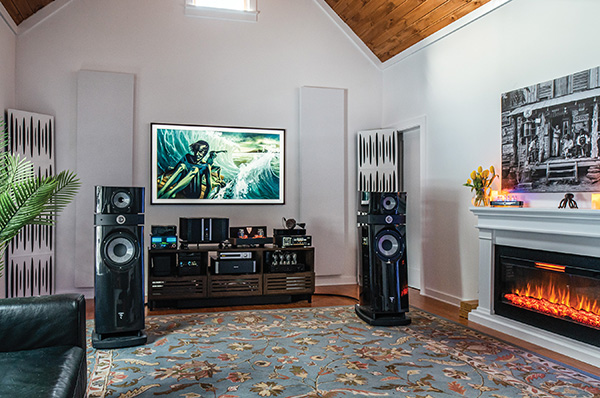
 In trying for a balance between pleasant living space and audiophile lair, I made a few other deals with the devil. For instance, there are no audiophile-approved audio racks in my room. I'd have needed nine or 10 shelves—two racks, give or take. Aside from the expense, high-end racks would've given less of a "livable" vibe to the room, so I'm happy I found the equipment console I mentioned. For the best sound, it should probably be closer to me, along one of the two long sides of the room, but for various reasons, this proved impractical. I ultimately put the console about 2' from the front wall so that I can get behind it when swapping out equipment and cables. The Focal Scala speakers are positioned far enough into the room—their baffles are 7' 6" from the front wall—that the sonic effect of the console behind and between them is small.
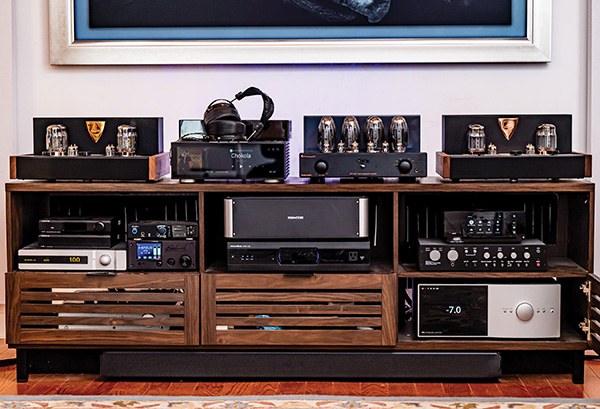 Originally, the console wasn't really suited for the heavy amplifiers I intended to place on it. A local carpenter fitted it with vibration-resistant Sorbothane strips, then reinforced the structure with a thick, black valance (spanning the 6' width of the cabinet) that supports the bottom shelf. This had the added advantage that, from my listening chair, I no longer had the distraction of seeing cables on the floor behind the equipment.
Few visitors suspect that the big work of art on the front wall is a TV screen (footnote 4). With its power cable hidden in the wall, its matte finish, and with brightness auto-dimmed to low, it does a surprisingly credible job of disguising itself as a framed photo or painting. (I have always disliked how a large TV looks like a black hole when it's not on.)
Originally, the console wasn't really suited for the heavy amplifiers I intended to place on it. A local carpenter fitted it with vibration-resistant Sorbothane strips, then reinforced the structure with a thick, black valance (spanning the 6' width of the cabinet) that supports the bottom shelf. This had the added advantage that, from my listening chair, I no longer had the distraction of seeing cables on the floor behind the equipment.
Few visitors suspect that the big work of art on the front wall is a TV screen (footnote 4). With its power cable hidden in the wall, its matte finish, and with brightness auto-dimmed to low, it does a surprisingly credible job of disguising itself as a framed photo or painting. (I have always disliked how a large TV looks like a black hole when it's not on.)
 Smaller, cheaper tweaks
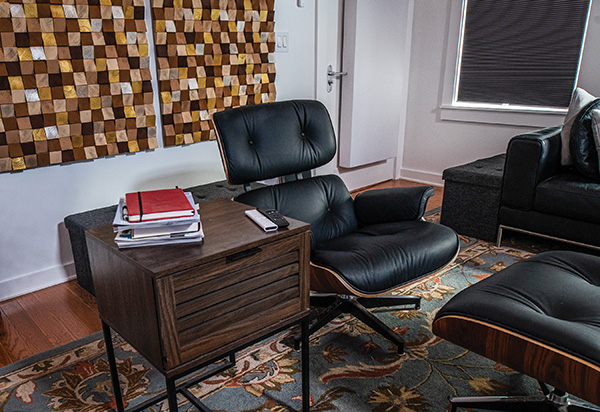
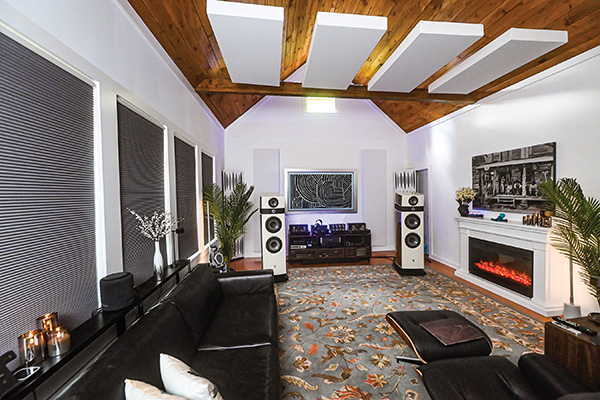
Things were rapidly improving soundwise. Still, a few more room-response issues had to be addressed. On my left side, where there's a bank of five windows, I obviously couldn't mount an absorption panel at the first reflection point. I placed a large, soft-leather couch there instead. The window coverings, too, were chosen for sound-taming effect: They're accordion-shaped, cloth cellular blinds that have minor absorptive and reflective properties.
 All's well that ends well?
The second serious listen came at the end of February. There was still a room mode around 35Hz, but the ARC Genesis room correction software made quick work of it, and we reveled in the excellent sonics. The hassle and just-over-six-figure cost had been well worth it. Here's the main thing: A dedicated high-end space allows your music's full dynamics to blossom (and not just decibels, though that's a big part of it). It's next to useless to play Led Zeppelin's "When the Levee Breaks," Control Machete's "Si Señor," or the Minnesota Orchestra's version of Rimsky-Korsakov's "The Snow Maiden" at low levels. I'm not embarrassed to say that for me, the power of such recordings isn't unleashed until the SPLs begin to border on unreasonable. Most audiophiles have spent a small (or large) fortune on speakers and electronics, and another bundle on cables, antivibration solutions, power conditioners, and so on. The vital component most often overlooked is the room. I'm very fortunate that I was able to build mine almost from scratch. The expense seemed excessively self-indulgent until I realized that, unlike equipment, an extra room should more than pay for itself when the time comes to sell the house.
Footnote 4: See samsung.com/us/tvs/the-frame/highlights.