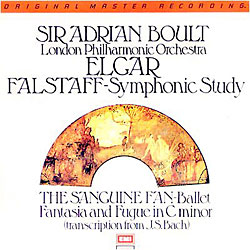
 Elgar: Orchestral Works
Falstaff, The Sanguine Fan, Fantasia and Fugue in c (transcribed from J.S. Bach), excerpt from The Starlight Express
London Philharmonic Orchestra, Sir Adrian Boult
Mobile Fidelity Sound Lab 2-501 (half-speed–mastered LP, pressed in Japan, 1981). Originally released as HMV ASD 2970 (LP, 1974). Reissued as EMI CDM 7 63133 2 (CD, 1989). Christopher Bishop, prod.; Christopher Parker, Stuart Eltham, engs. It's finally happened. Until now, every symphonic recording that has come along has been compromised to some extent by an indifferent performance or an imperfect recording, or (much more frequently) by both. It almost seemed as if the better the recording, the worse the musical performance (or vice versa). Now, for the first time in the history of symphonic recording, we have a musical performance that is never likely to be bettered, on a recording whose sound is so good that it doesn't leave enough room for improvement to make another recording of these works worth the effort. This is an absolute Must Buy for any audiophile who enjoys symphonic music, whether or not he has ever even heard of Sir Edward Elgar. The music is delicious and the recording is—well, just listen to it.
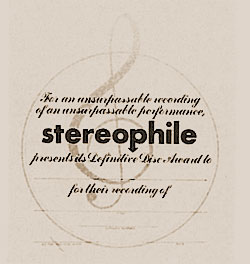 We have never before bestowed an award on anyone for anything. We have never before given an award to a recording, because we've never found one worthy of it. We felt obliged to do it on Mobile Fidelity for their remastering of the EMI Elgar Falstaff recording because it is the first time to our knowledge that a single classical release has combined a performance and a recording which are both good enough that neither need be done again. Our congratulations to Mobile Fidelity's Gary Giorgi. Now, let's have some more, from Mobile Fidelity or any other source. We have more awards to hand out when and if.—J. Gordon Holt
Editor's Note: I have searched Stereophile's back-issue archive and it appears that J. Gordon Holt never wrote more about this outstanding Mobile Fidelity release. However, it was on my short list for our very first "Records To Die For" listing in 1991.—John Atkinson
We have never before bestowed an award on anyone for anything. We have never before given an award to a recording, because we've never found one worthy of it. We felt obliged to do it on Mobile Fidelity for their remastering of the EMI Elgar Falstaff recording because it is the first time to our knowledge that a single classical release has combined a performance and a recording which are both good enough that neither need be done again. Our congratulations to Mobile Fidelity's Gary Giorgi. Now, let's have some more, from Mobile Fidelity or any other source. We have more awards to hand out when and if.—J. Gordon Holt
Editor's Note: I have searched Stereophile's back-issue archive and it appears that J. Gordon Holt never wrote more about this outstanding Mobile Fidelity release. However, it was on my short list for our very first "Records To Die For" listing in 1991.—John Atkinson