I'd been told that the review samples had been used at a show, and had also been played at MoFi's headquarters; nonetheless, their sound benefited from break-in. Over a period of several weeks, playing music as well as various speaker-break-in CDs, I found that the ESL-2912s sounded more open and more dynamic. I also felt that there was some warm-up effect: Before a listening session, the Quads benefited from my playing through them the five-minute "Rejuvenation (rapid refresher)" track from Full System Enhancer & Rejuvenation Disc (CD, IsoTek IBD-CD1).
 Which amp?
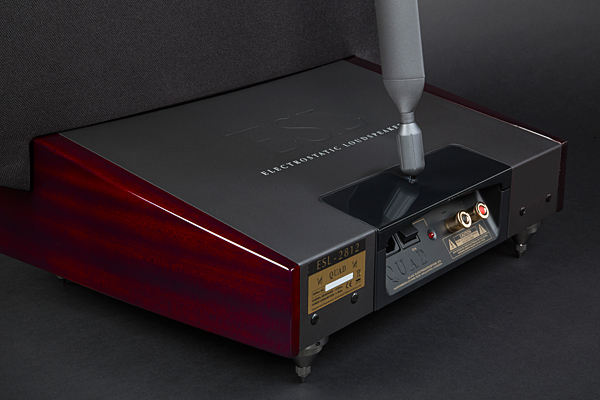
I had on hand two amplifiers to drive the ESL-2912: McIntosh Laboratory's MC275 LE (tubed, 75Wpc) and Theta Digital's Prometheus (solid-state, 250Wpc). The McIntosh seemed a natural match—its history goes back to the era of the original Quad ESL. And, indeed, the combination provided a smooth sound that was easy on the ears—but perhaps a little too smooth, and dynamically a bit on the polite side. I tried the MC275's 8 and 4 ohm terminals; the sound was very slightly better through the 4 ohm taps, so that's what I used. On paper, the conservatively specified 75Wpc of the MC275 LE is more than enough to drive the Quads, and the 250Wpc of the Theta Prometheus (500Wpc into 4 ohms) might have seemed like overkill. But I'd had good experience with the Prometheus driving Wilson Audio's Sabrina and Monitor Audio's PL300 II, and, well . . . it was available. In fact, the combination of ESL-2912s and Prometheus was a good one: more dynamic, more extended and better controlled bass, and, generally, squeaky-clean sound. I can imagine some people preferring the MC275 LE, others the Prometheus; I was quite happy listening through either. My comments about the sound of the ESL-2912 are a kind of averaging of the speaker's sounds with the two amplifiers.
 Sound
Sound
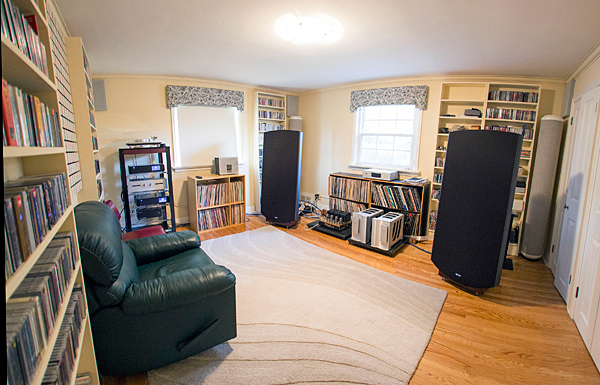
As had been the case with the Quad ESL-63s, my most immediate positive impression of the ESL-2912s was of their presentation of space. Voices and instruments were fixed precisely in space with an almost three-dimensional quality. I've heard this type of imaging from other flat-panel electrostatic speakers, including my old KLH Nines, but the trade-off had always seemed to be a very small sweet spot: the head-in-a-vise effect. Some panel speakers—eg, MartinLogan's Montis—counter this problem with curved panels. This broadens the sweet spot, but the downside is somewhat less precise imaging. The ESL-2912s, presumably because of their circular stators and delay lines, produced precise images over a wider sweet spot. Although the imaging was not quite as good when I sat in a chair next to my central listening seat, instead of collapsing entirely it just shifted to the side. A speaker with dipole transducers, radiating to the rear as well as to the front, has an easier time filling a room with sound than a unipolar design radiating only to the front. The potential downside is interference with and cancellation of the front radiation by the rearward radiation. I've installed no sound-absorbing treatments on my room's front wall, but the distances between the backs of the ESL-2912s and that wall, and between the speakers and the sidewalls, were well beyond the minimums recommended by Quad. In any case, there was no noticeable front/back interference effect. If there had been, I would have expected it to adversely affect the soundstaging. But the soundstage was wide and deep—depending, of course, on the recording. Listening to the "Depth of Image: Acoustic Clicker" tracks on Best of Chesky Jazz and More Audiophile Tests, Volume 2 (CD, Chesky JD68), I could distinguish depth up to 70', which is just short of what I can hear with such topnotch unipolar designs as Monitor's Platinum PL300 IIs. In view of the history of criticism of the ESL-63, perhaps the most important questions to answer about the ESL-2912 are "Does it go loud?" and "Does it go low?" My answers are "Yes" and "Yes"—with qualifications. The ESL-2912s played loud enough to please me at what I would call realistic levels, but different people have different ideas of what level is appropriate for listening to music. I recently attended a birthday party held in a nightclub, where music was provided by a five-person rock group. I measured the peak level with the trusty Audiotool SPL meter app on my iPhone 6: 103dB (C weighting, fast). I'm pretty sure the ESL-2912s can't produce that sort of sound level—and I have no problem with that: For me, that's too loud. (At the party, to protect our hearing, my wife and I balled up Kleenex and stuck it our ears.)
As a check on the ESL-2912's loudness abilities under more normal conditions, I played Eiji Oue and the Minnesota Orchestra's recording of Rimsky-Korsakov's Dance of the Tumblers, from Tutti! An Orchestral Sampler (CD, Reference RR-906CD), at a level that I considered realistic: 92dB peaks, C weighting, fast. The ESL-2912s took this in stride, not protesting in any way, and with no obvious compression of the peaks. Although some audiophiles think of electrostatics as being suitable only for chamber music or music played at background levels, I found the ESL-2912 capable of much more than that.
What about the ESL-2912's bass response? According to its specs, the two additional bass panels extend the –6dB frequency response to 32Hz, compared to 37Hz for the two–bass-panel ESL-2812. Not having a pair of ESL-2812s on hand, I can't say how the two models' bass performances would compare in my room, but I've heard the ESL-63 and its various two–bass-panel successors often enough at dealers and shows to say that the ESL-2912 sounded more full-range, and was more capable of producing real bass.
In view of the history of criticism of the ESL-63, perhaps the most important questions to answer about the ESL-2912 are "Does it go loud?" and "Does it go low?" My answers are "Yes" and "Yes"—with qualifications. The ESL-2912s played loud enough to please me at what I would call realistic levels, but different people have different ideas of what level is appropriate for listening to music. I recently attended a birthday party held in a nightclub, where music was provided by a five-person rock group. I measured the peak level with the trusty Audiotool SPL meter app on my iPhone 6: 103dB (C weighting, fast). I'm pretty sure the ESL-2912s can't produce that sort of sound level—and I have no problem with that: For me, that's too loud. (At the party, to protect our hearing, my wife and I balled up Kleenex and stuck it our ears.)
As a check on the ESL-2912's loudness abilities under more normal conditions, I played Eiji Oue and the Minnesota Orchestra's recording of Rimsky-Korsakov's Dance of the Tumblers, from Tutti! An Orchestral Sampler (CD, Reference RR-906CD), at a level that I considered realistic: 92dB peaks, C weighting, fast. The ESL-2912s took this in stride, not protesting in any way, and with no obvious compression of the peaks. Although some audiophiles think of electrostatics as being suitable only for chamber music or music played at background levels, I found the ESL-2912 capable of much more than that.
What about the ESL-2912's bass response? According to its specs, the two additional bass panels extend the –6dB frequency response to 32Hz, compared to 37Hz for the two–bass-panel ESL-2812. Not having a pair of ESL-2812s on hand, I can't say how the two models' bass performances would compare in my room, but I've heard the ESL-63 and its various two–bass-panel successors often enough at dealers and shows to say that the ESL-2912 sounded more full-range, and was more capable of producing real bass.
 The 32Hz synthesizer note at the beginning of "Temple Caves," from Mickey Hart's Planet Drum (CD, Rykodisc RCD 10206), was there—not room-shaking, but a pure bass note, not merely second harmonic masquerading as deep bass. I was able to play this track at peaks of 94dB (C weighting, fast), a level that I feel is about right with this music. Double basses were reproduced with tunefulness and subtle dynamic variations, making me appreciate once again the artistry of bassist David Finck on Sylvia McNair and André Previn's Sure Thing: The Jerome Kern Songbook (CD, Philips 442 129-2).
But the greatest strength of the Quad ESL series, beginning with the ESL-63 has been, and continues to be, its midrange: smooth, revealing without being over-etched, and presenting a virtual open window on the music. These qualities were particularly revealed by well-recorded voices. One of my 2017 "Records to Die For" was Kristin Chenoweth's The Art of Elegance (CD, Concord CRE00148), which combines respect for popular-song performance traditions with a fresh take on some standards. Through the ESL-2912 I reveled in the beauty of Chenoweth's voice and appreciated the subtle nuances of her phrasing. The Quad also excelled at what some refer to as microdynamics, communicating the subtle ebb and flow of the music, orchestral and vocal.
The 32Hz synthesizer note at the beginning of "Temple Caves," from Mickey Hart's Planet Drum (CD, Rykodisc RCD 10206), was there—not room-shaking, but a pure bass note, not merely second harmonic masquerading as deep bass. I was able to play this track at peaks of 94dB (C weighting, fast), a level that I feel is about right with this music. Double basses were reproduced with tunefulness and subtle dynamic variations, making me appreciate once again the artistry of bassist David Finck on Sylvia McNair and André Previn's Sure Thing: The Jerome Kern Songbook (CD, Philips 442 129-2).
But the greatest strength of the Quad ESL series, beginning with the ESL-63 has been, and continues to be, its midrange: smooth, revealing without being over-etched, and presenting a virtual open window on the music. These qualities were particularly revealed by well-recorded voices. One of my 2017 "Records to Die For" was Kristin Chenoweth's The Art of Elegance (CD, Concord CRE00148), which combines respect for popular-song performance traditions with a fresh take on some standards. Through the ESL-2912 I reveled in the beauty of Chenoweth's voice and appreciated the subtle nuances of her phrasing. The Quad also excelled at what some refer to as microdynamics, communicating the subtle ebb and flow of the music, orchestral and vocal.
 Nonetheless, I heard some departures from strict tonal neutrality, including a midbass emphasis that added to the sound a not-unwelcome warmth. This may have been a function of the speakers' positions in the room. There was also an attenuation of the extreme highs, most clearly evident with percussion instruments, like the ones in Ana Caram's "Viola Fora de Moda," from the Chesky Records Jazz Sampler & Audiophile Test Compact Disc, Vol.1 (CD, Chesky JD37). Monitor Audio's Platinum PL300 II had a more neutral midbass and more extended treble.
One thing I highly value is a speaker's ability not to sound like a speaker. The "speaker sound" originates in the drivers, each of which exhibits a set of resonances—and, if the drivers are in an enclosure, the box adds its own resonances, resulting in a "boxy" sound. Over the years, speaker designers have worked hard to solve this problem, with considerable success. Monitor's Platinum PL300 II, which comprises dynamic drivers in a box, has very little speaker sound, but if you listen very closely, you can hear that it has not been entirely eliminated.
Nonetheless, I heard some departures from strict tonal neutrality, including a midbass emphasis that added to the sound a not-unwelcome warmth. This may have been a function of the speakers' positions in the room. There was also an attenuation of the extreme highs, most clearly evident with percussion instruments, like the ones in Ana Caram's "Viola Fora de Moda," from the Chesky Records Jazz Sampler & Audiophile Test Compact Disc, Vol.1 (CD, Chesky JD37). Monitor Audio's Platinum PL300 II had a more neutral midbass and more extended treble.
One thing I highly value is a speaker's ability not to sound like a speaker. The "speaker sound" originates in the drivers, each of which exhibits a set of resonances—and, if the drivers are in an enclosure, the box adds its own resonances, resulting in a "boxy" sound. Over the years, speaker designers have worked hard to solve this problem, with considerable success. Monitor's Platinum PL300 II, which comprises dynamic drivers in a box, has very little speaker sound, but if you listen very closely, you can hear that it has not been entirely eliminated.
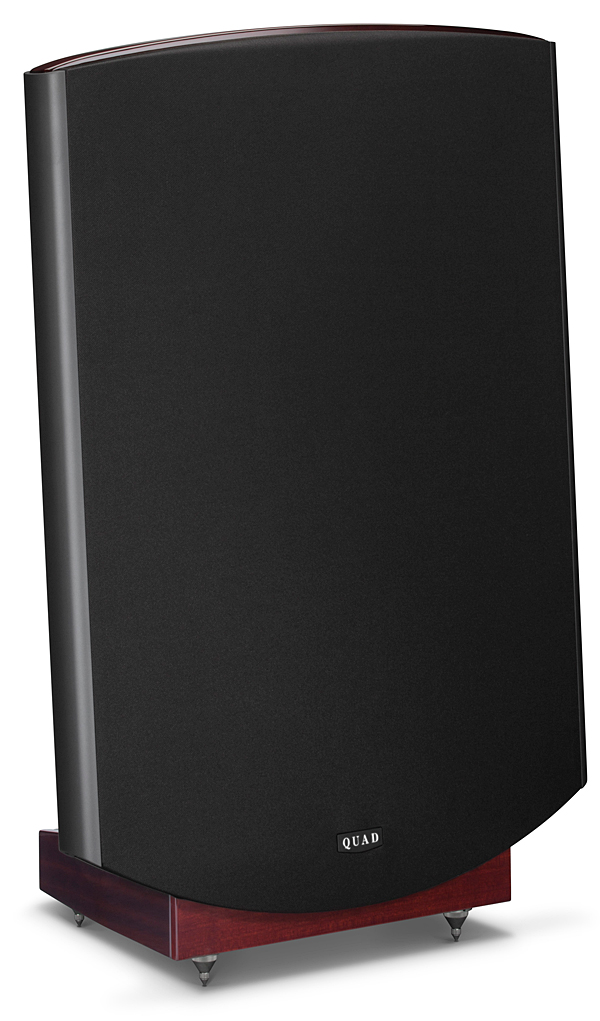 The ESL-2912 has an obvious inherent advantage over box speakers in having no box at all. However, with some music, mostly orchestral, I was at times aware of a kind of drumming sound that wasn't part of the music. I assumed that this was a characteristic of the stretched polyolefin dustcovers. You'll recall that removing their dustcovers is one of the ways Quad ESLs have been modified to improve their sound—but this is an extreme step, and unless your listening room is 100% dust free, it will lead to the speaker being damaged in fairly short order. Not recommended!
I think that the resonant colorations that are the source of "speaker sound" are just something that audiophiles and music lovers have to live with, as we concentrate on the music, not the sound. The surprising thing is not that a loudspeaker contributes to the music sounds of its own that are not characteristics of the recording, but that an electromechanical device can manage to sound as much like musical instruments and human voices as it does while adding so little sound of its own.
Conclusions
The ESL-2912 has an obvious inherent advantage over box speakers in having no box at all. However, with some music, mostly orchestral, I was at times aware of a kind of drumming sound that wasn't part of the music. I assumed that this was a characteristic of the stretched polyolefin dustcovers. You'll recall that removing their dustcovers is one of the ways Quad ESLs have been modified to improve their sound—but this is an extreme step, and unless your listening room is 100% dust free, it will lead to the speaker being damaged in fairly short order. Not recommended!
I think that the resonant colorations that are the source of "speaker sound" are just something that audiophiles and music lovers have to live with, as we concentrate on the music, not the sound. The surprising thing is not that a loudspeaker contributes to the music sounds of its own that are not characteristics of the recording, but that an electromechanical device can manage to sound as much like musical instruments and human voices as it does while adding so little sound of its own.
Conclusions
Peter Walker began work on what was to become the ESL-63 in 1963 (hence the model designation), but the speaker wasn't launched until 1981. Although Walker died in 2003, production of the ESL line continues, and despite changes and improvements along the way, IAG has remained faithful to Walker's original concept. The price range of $10,000–$15,000—into which the ESL-2912, at $13,999/pair, squarely falls—may represent the sweet spot (well, at least for high-end audio!) for sound quality and value. With their continuous development of the electrostatic principle, especially in the successful integration of two more bass panels, Quad has maintained its position in this highly competitive market. Peter Walker would be pleased.
Which amp?I had on hand two amplifiers to drive the ESL-2912: McIntosh Laboratory's MC275 LE (tubed, 75Wpc) and Theta Digital's Prometheus (solid-state, 250Wpc). The McIntosh seemed a natural match—its history goes back to the era of the original Quad ESL. And, indeed, the combination provided a smooth sound that was easy on the ears—but perhaps a little too smooth, and dynamically a bit on the polite side. I tried the MC275's 8 and 4 ohm terminals; the sound was very slightly better through the 4 ohm taps, so that's what I used. On paper, the conservatively specified 75Wpc of the MC275 LE is more than enough to drive the Quads, and the 250Wpc of the Theta Prometheus (500Wpc into 4 ohms) might have seemed like overkill. But I'd had good experience with the Prometheus driving Wilson Audio's Sabrina and Monitor Audio's PL300 II, and, well . . . it was available. In fact, the combination of ESL-2912s and Prometheus was a good one: more dynamic, more extended and better controlled bass, and, generally, squeaky-clean sound. I can imagine some people preferring the MC275 LE, others the Prometheus; I was quite happy listening through either. My comments about the sound of the ESL-2912 are a kind of averaging of the speaker's sounds with the two amplifiers.
SoundAs had been the case with the Quad ESL-63s, my most immediate positive impression of the ESL-2912s was of their presentation of space. Voices and instruments were fixed precisely in space with an almost three-dimensional quality. I've heard this type of imaging from other flat-panel electrostatic speakers, including my old KLH Nines, but the trade-off had always seemed to be a very small sweet spot: the head-in-a-vise effect. Some panel speakers—eg, MartinLogan's Montis—counter this problem with curved panels. This broadens the sweet spot, but the downside is somewhat less precise imaging. The ESL-2912s, presumably because of their circular stators and delay lines, produced precise images over a wider sweet spot. Although the imaging was not quite as good when I sat in a chair next to my central listening seat, instead of collapsing entirely it just shifted to the side. A speaker with dipole transducers, radiating to the rear as well as to the front, has an easier time filling a room with sound than a unipolar design radiating only to the front. The potential downside is interference with and cancellation of the front radiation by the rearward radiation. I've installed no sound-absorbing treatments on my room's front wall, but the distances between the backs of the ESL-2912s and that wall, and between the speakers and the sidewalls, were well beyond the minimums recommended by Quad. In any case, there was no noticeable front/back interference effect. If there had been, I would have expected it to adversely affect the soundstaging. But the soundstage was wide and deep—depending, of course, on the recording. Listening to the "Depth of Image: Acoustic Clicker" tracks on Best of Chesky Jazz and More Audiophile Tests, Volume 2 (CD, Chesky JD68), I could distinguish depth up to 70', which is just short of what I can hear with such topnotch unipolar designs as Monitor's Platinum PL300 IIs.
In view of the history of criticism of the ESL-63, perhaps the most important questions to answer about the ESL-2912 are "Does it go loud?" and "Does it go low?" My answers are "Yes" and "Yes"—with qualifications. The ESL-2912s played loud enough to please me at what I would call realistic levels, but different people have different ideas of what level is appropriate for listening to music. I recently attended a birthday party held in a nightclub, where music was provided by a five-person rock group. I measured the peak level with the trusty Audiotool SPL meter app on my iPhone 6: 103dB (C weighting, fast). I'm pretty sure the ESL-2912s can't produce that sort of sound level—and I have no problem with that: For me, that's too loud. (At the party, to protect our hearing, my wife and I balled up Kleenex and stuck it our ears.)
The 32Hz synthesizer note at the beginning of "Temple Caves," from Mickey Hart's Planet Drum (CD, Rykodisc RCD 10206), was there—not room-shaking, but a pure bass note, not merely second harmonic masquerading as deep bass. I was able to play this track at peaks of 94dB (C weighting, fast), a level that I feel is about right with this music. Double basses were reproduced with tunefulness and subtle dynamic variations, making me appreciate once again the artistry of bassist David Finck on Sylvia McNair and André Previn's Sure Thing: The Jerome Kern Songbook (CD, Philips 442 129-2).
Nonetheless, I heard some departures from strict tonal neutrality, including a midbass emphasis that added to the sound a not-unwelcome warmth. This may have been a function of the speakers' positions in the room. There was also an attenuation of the extreme highs, most clearly evident with percussion instruments, like the ones in Ana Caram's "Viola Fora de Moda," from the Chesky Records Jazz Sampler & Audiophile Test Compact Disc, Vol.1 (CD, Chesky JD37). Monitor Audio's Platinum PL300 II had a more neutral midbass and more extended treble.
One thing I highly value is a speaker's ability not to sound like a speaker. The "speaker sound" originates in the drivers, each of which exhibits a set of resonances—and, if the drivers are in an enclosure, the box adds its own resonances, resulting in a "boxy" sound. Over the years, speaker designers have worked hard to solve this problem, with considerable success. Monitor's Platinum PL300 II, which comprises dynamic drivers in a box, has very little speaker sound, but if you listen very closely, you can hear that it has not been entirely eliminated.
The ESL-2912 has an obvious inherent advantage over box speakers in having no box at all. However, with some music, mostly orchestral, I was at times aware of a kind of drumming sound that wasn't part of the music. I assumed that this was a characteristic of the stretched polyolefin dustcovers. You'll recall that removing their dustcovers is one of the ways Quad ESLs have been modified to improve their sound—but this is an extreme step, and unless your listening room is 100% dust free, it will lead to the speaker being damaged in fairly short order. Not recommended!
I think that the resonant colorations that are the source of "speaker sound" are just something that audiophiles and music lovers have to live with, as we concentrate on the music, not the sound. The surprising thing is not that a loudspeaker contributes to the music sounds of its own that are not characteristics of the recording, but that an electromechanical device can manage to sound as much like musical instruments and human voices as it does while adding so little sound of its own.
ConclusionsPeter Walker began work on what was to become the ESL-63 in 1963 (hence the model designation), but the speaker wasn't launched until 1981. Although Walker died in 2003, production of the ESL line continues, and despite changes and improvements along the way, IAG has remained faithful to Walker's original concept. The price range of $10,000–$15,000—into which the ESL-2912, at $13,999/pair, squarely falls—may represent the sweet spot (well, at least for high-end audio!) for sound quality and value. With their continuous development of the electrostatic principle, especially in the successful integration of two more bass panels, Quad has maintained its position in this highly competitive market. Peter Walker would be pleased.