I first encountered the work of Dave Wilson in the late 1970s. He was then a recording engineer responsible for some great-sounding records, including pianist Mark P. Wetch's Ragtime Razzmatazz (LP, Wilson Audio W-808), which quickly became one of my favorite system-demo records.
Then Wilson turned his attention to designing loudspeakers. His first model was the Wilson Audio Modular Monitor, reviewed for Stereophile by its then-publisher, Larry Archibald, in August 1983, who described it as "the most enjoyable speaker system I've listened to, and significantly valuable as a diagnostic tool." At $35,000/pair ($83,577 in today's dollars), the WAMM may have been the most expensive speaker then on the market.
The next speaker from Dave Wilson was the Wilson Audio Tiny Tot (WATT), later joined by its bass module, the Puppy. The WATT/Puppy combo became one of the most popular—and most widely imitated—high-end speakers ever made, and underwent a number of revisions over the years. The last version, System 8, was reviewed by Wes Phillips in our June 2007 issue. Since then, Wilson Audio has continued to produce new speaker models, concentrating on the range between the WATT/Puppy's replacement, the Sasha W/P ($33,550/pair) and the Alexandria XLF ($210,000/pair).
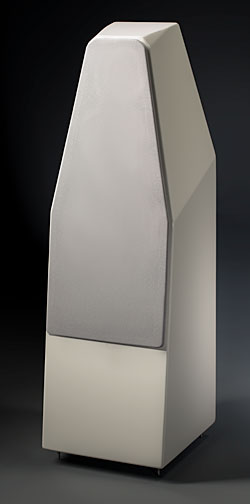 At roughly 40" high by 12" wide by 15" deep, the Wilson Sabrina ($15,900/pair) is about the size of the original WATT/Puppy, but in almost every other way it's different. Most obvious is that the Wilson Sabrina is a single-box speaker, not a two-box affair like the WATT/Puppy. According to Wilson Audio, the inspiration for the Sabrina was the top-of-the-line Alexandria XLF, the objective being "to take the wealth of knowledge and experience contained in the XLF and distill it down to its essence." And while the Sabrina can't be called inexpensive, it costs less than the Wilson Sophia 3 ($22,500/pair)—which was, until now, the company's entry-level floorstander. What has always kept me from considering reviewing a Wilson speaker were the prices. Even Wilson's "bookshelf" speaker, the Duette 2, costs $22,500/pair with stands. For me, $20,000 is a kind of threshold: I'd have to think long and hard before spending that much on a pair of speakers—and the same goes for reviewing them.
But what if "the Wilson sound" were available for significantly less than $20,000? That's the promise of the Sabrina—and listening to a pair at the speaker's Canadian debut convinced me that this was one Wilson speaker I needed to check out.
Description and Design
At roughly 40" high by 12" wide by 15" deep, the Wilson Sabrina ($15,900/pair) is about the size of the original WATT/Puppy, but in almost every other way it's different. Most obvious is that the Wilson Sabrina is a single-box speaker, not a two-box affair like the WATT/Puppy. According to Wilson Audio, the inspiration for the Sabrina was the top-of-the-line Alexandria XLF, the objective being "to take the wealth of knowledge and experience contained in the XLF and distill it down to its essence." And while the Sabrina can't be called inexpensive, it costs less than the Wilson Sophia 3 ($22,500/pair)—which was, until now, the company's entry-level floorstander. What has always kept me from considering reviewing a Wilson speaker were the prices. Even Wilson's "bookshelf" speaker, the Duette 2, costs $22,500/pair with stands. For me, $20,000 is a kind of threshold: I'd have to think long and hard before spending that much on a pair of speakers—and the same goes for reviewing them.
But what if "the Wilson sound" were available for significantly less than $20,000? That's the promise of the Sabrina—and listening to a pair at the speaker's Canadian debut convinced me that this was one Wilson speaker I needed to check out.
Description and Design
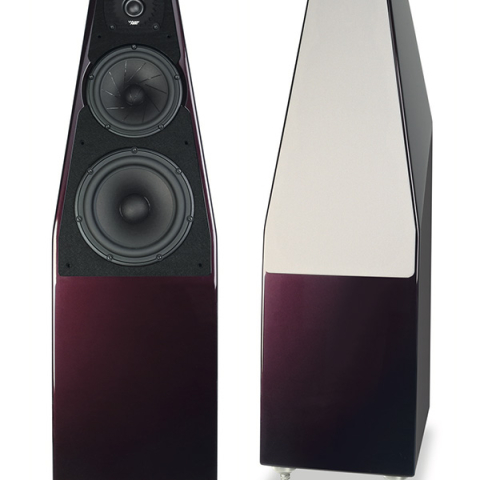
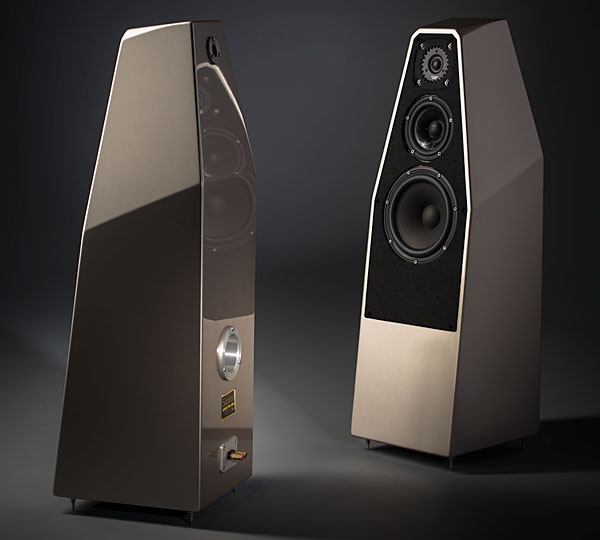
In a video on Wilson Audio's website, the Sabrina is shown next to the Alexandria XLF, highlighting the former's relatively small size. The contrast is indeed great, but that's because the Alexandria, with a height of over 70" and a per-channel weight of 655 lbs, is huge: a giant among loudspeakers. Yes, the Sabrina is much smaller, but compared to "normal" floorstanding speakers it's not that small. What helps make it look relatively small is the fact that its cabinet is slimmer at the top (about 6.5" by 6") and slopes back. But the Sabrina is exceptionally heavy for its size: each speaker weighs 93.8 lbs. Because Wilson Audio has always believed that form should follow function, their speakers have never been the most aesthetically refined. Some have been described as looking like giant robots. Judgments of appearance are subjective, but I find the Sabrina very attractive: I think it has the most pleasing proportions of any Wilson speaker I've seen. It's available in three standard and two upgrade colors, the latter at a $1000/pair premium. (The review samples were in Titan Red, one of the upgrade colors.)
On the face of it, the Sabrina is a fairly straightforward three-way loudspeaker, with no exotic materials used in the drivers, and no powered subwoofer. As always, the success of a design depends on the implementation, and the attention paid to details—and from everything I've seen and know about Wilson Audio, attention to detail is perhaps their greatest strength. The contribution of each component is carefully evaluated, its effect on sound quality being the criterion.
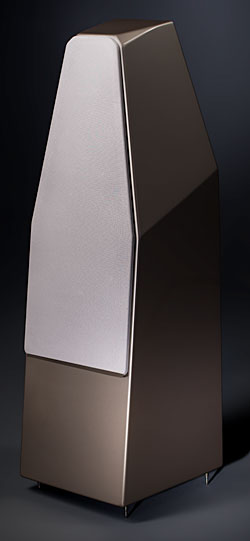 The enclosures of Wilson's more expensive speakers are made of Wilson's proprietary X-Material, a phenolic composite. As a cost-saving measure, only the Sabrina's baffle and bottom panel are made of X; the rest of the cabinet is constructed of high-density fiberboard. Although HDF doesn't match the extreme nonresonant properties of X-Material, it is, by definition, more dense and hard than the commonly used medium-density fiberboard (MDF). The cabinet is assembled by hand, glued with proprietary adhesives, hand sanded, gel coated, painted with multiple layers of automotive-grade paint, then polished and buffed to the same high standard as all Wilson speakers. There are two rear-firing ports: the lower serves the woofer (which has its dedicated internal chamber), and the upper serves the midrange. The tweeter has its own rear-wave chamber, to isolate it from the other drivers' outputs. The baffle is covered with dense felt, with a cutout for each driver.
The Sabrina's three drivers are variations on the ones used in other Wilson speakers. The 1" doped-silk dome tweeter is based on the Convergent Synergy tweeter first used in the Alexandria XLF. It's crossed over to a 5.7" midrange unit with a paper-composite cone, which in turn hands off to an 8" woofer, again with paper-composite cone; the crossover frequencies are in the regions of 1.6–1.9kHz and 290–350Hz, respectively. According to Daryl Wilson, son of David and the person most responsible for the Sabrina's design, "both of these crossover points are higher than we typically cross over our drivers, but work beautifully with the driver complement/configuration in the Sabrina." Each crossover is built individually to match the reference crossover within ±0.2%. The design of the Sabrina crossover uses proprietary measures to reduce distortion, with the primary design goals being bass performance and dynamic contrast. The crossover topologies and specific component choices were made with a combination of computer modeling, acoustical analysis, and listening to recordings of live, unamplified music.
Like all Wilson Audio speakers, the Sabrina does not accommodate biwiring—which, in Wilson Audio's view, would degrade the sound quality: each enclosure has only one pair of terminals.
Setup
The enclosures of Wilson's more expensive speakers are made of Wilson's proprietary X-Material, a phenolic composite. As a cost-saving measure, only the Sabrina's baffle and bottom panel are made of X; the rest of the cabinet is constructed of high-density fiberboard. Although HDF doesn't match the extreme nonresonant properties of X-Material, it is, by definition, more dense and hard than the commonly used medium-density fiberboard (MDF). The cabinet is assembled by hand, glued with proprietary adhesives, hand sanded, gel coated, painted with multiple layers of automotive-grade paint, then polished and buffed to the same high standard as all Wilson speakers. There are two rear-firing ports: the lower serves the woofer (which has its dedicated internal chamber), and the upper serves the midrange. The tweeter has its own rear-wave chamber, to isolate it from the other drivers' outputs. The baffle is covered with dense felt, with a cutout for each driver.
The Sabrina's three drivers are variations on the ones used in other Wilson speakers. The 1" doped-silk dome tweeter is based on the Convergent Synergy tweeter first used in the Alexandria XLF. It's crossed over to a 5.7" midrange unit with a paper-composite cone, which in turn hands off to an 8" woofer, again with paper-composite cone; the crossover frequencies are in the regions of 1.6–1.9kHz and 290–350Hz, respectively. According to Daryl Wilson, son of David and the person most responsible for the Sabrina's design, "both of these crossover points are higher than we typically cross over our drivers, but work beautifully with the driver complement/configuration in the Sabrina." Each crossover is built individually to match the reference crossover within ±0.2%. The design of the Sabrina crossover uses proprietary measures to reduce distortion, with the primary design goals being bass performance and dynamic contrast. The crossover topologies and specific component choices were made with a combination of computer modeling, acoustical analysis, and listening to recordings of live, unamplified music.
Like all Wilson Audio speakers, the Sabrina does not accommodate biwiring—which, in Wilson Audio's view, would degrade the sound quality: each enclosure has only one pair of terminals.
Setup
Wilson's larger, heavier, more expensive speakers are shipped in wooden crates; the Sabrina comes in just under UPS's maximum shipping weight, so Wilson doesn't have to use a more expensive shipping company and are thus able to pass on this saving to the consumer. My review samples arrived on a shipping pallet, packed in heavy-duty cardboard boxes. The speaker is covered with a layer of protective film that must be removed—a tricky process that involves pulling the film gently downward and outward, large sections at a time. The user is warned that if the film is removed at any temperature other than "room temperature," or if the film is torn too aggressively, or without sufficient care near the edges, the paint can be damaged. Also, the protective film should not be left on for an extended period of time, and should not be exposed to a heat source or direct sunlight.
At roughly 40" high by 12" wide by 15" deep, the Wilson Sabrina ($15,900/pair) is about the size of the original WATT/Puppy, but in almost every other way it's different. Most obvious is that the Wilson Sabrina is a single-box speaker, not a two-box affair like the WATT/Puppy. According to Wilson Audio, the inspiration for the Sabrina was the top-of-the-line Alexandria XLF, the objective being "to take the wealth of knowledge and experience contained in the XLF and distill it down to its essence." And while the Sabrina can't be called inexpensive, it costs less than the Wilson Sophia 3 ($22,500/pair)—which was, until now, the company's entry-level floorstander. What has always kept me from considering reviewing a Wilson speaker were the prices. Even Wilson's "bookshelf" speaker, the Duette 2, costs $22,500/pair with stands. For me, $20,000 is a kind of threshold: I'd have to think long and hard before spending that much on a pair of speakers—and the same goes for reviewing them.
But what if "the Wilson sound" were available for significantly less than $20,000? That's the promise of the Sabrina—and listening to a pair at the speaker's Canadian debut convinced me that this was one Wilson speaker I needed to check out.
Description and DesignIn a video on Wilson Audio's website, the Sabrina is shown next to the Alexandria XLF, highlighting the former's relatively small size. The contrast is indeed great, but that's because the Alexandria, with a height of over 70" and a per-channel weight of 655 lbs, is huge: a giant among loudspeakers. Yes, the Sabrina is much smaller, but compared to "normal" floorstanding speakers it's not that small. What helps make it look relatively small is the fact that its cabinet is slimmer at the top (about 6.5" by 6") and slopes back. But the Sabrina is exceptionally heavy for its size: each speaker weighs 93.8 lbs. Because Wilson Audio has always believed that form should follow function, their speakers have never been the most aesthetically refined. Some have been described as looking like giant robots. Judgments of appearance are subjective, but I find the Sabrina very attractive: I think it has the most pleasing proportions of any Wilson speaker I've seen. It's available in three standard and two upgrade colors, the latter at a $1000/pair premium. (The review samples were in Titan Red, one of the upgrade colors.)
The enclosures of Wilson's more expensive speakers are made of Wilson's proprietary X-Material, a phenolic composite. As a cost-saving measure, only the Sabrina's baffle and bottom panel are made of X; the rest of the cabinet is constructed of high-density fiberboard. Although HDF doesn't match the extreme nonresonant properties of X-Material, it is, by definition, more dense and hard than the commonly used medium-density fiberboard (MDF). The cabinet is assembled by hand, glued with proprietary adhesives, hand sanded, gel coated, painted with multiple layers of automotive-grade paint, then polished and buffed to the same high standard as all Wilson speakers. There are two rear-firing ports: the lower serves the woofer (which has its dedicated internal chamber), and the upper serves the midrange. The tweeter has its own rear-wave chamber, to isolate it from the other drivers' outputs. The baffle is covered with dense felt, with a cutout for each driver.
The Sabrina's three drivers are variations on the ones used in other Wilson speakers. The 1" doped-silk dome tweeter is based on the Convergent Synergy tweeter first used in the Alexandria XLF. It's crossed over to a 5.7" midrange unit with a paper-composite cone, which in turn hands off to an 8" woofer, again with paper-composite cone; the crossover frequencies are in the regions of 1.6–1.9kHz and 290–350Hz, respectively. According to Daryl Wilson, son of David and the person most responsible for the Sabrina's design, "both of these crossover points are higher than we typically cross over our drivers, but work beautifully with the driver complement/configuration in the Sabrina." Each crossover is built individually to match the reference crossover within ±0.2%. The design of the Sabrina crossover uses proprietary measures to reduce distortion, with the primary design goals being bass performance and dynamic contrast. The crossover topologies and specific component choices were made with a combination of computer modeling, acoustical analysis, and listening to recordings of live, unamplified music.
Like all Wilson Audio speakers, the Sabrina does not accommodate biwiring—which, in Wilson Audio's view, would degrade the sound quality: each enclosure has only one pair of terminals.
Wilson's larger, heavier, more expensive speakers are shipped in wooden crates; the Sabrina comes in just under UPS's maximum shipping weight, so Wilson doesn't have to use a more expensive shipping company and are thus able to pass on this saving to the consumer. My review samples arrived on a shipping pallet, packed in heavy-duty cardboard boxes. The speaker is covered with a layer of protective film that must be removed—a tricky process that involves pulling the film gently downward and outward, large sections at a time. The user is warned that if the film is removed at any temperature other than "room temperature," or if the film is torn too aggressively, or without sufficient care near the edges, the paint can be damaged. Also, the protective film should not be left on for an extended period of time, and should not be exposed to a heat source or direct sunlight.