Sidebar 3: Measurements
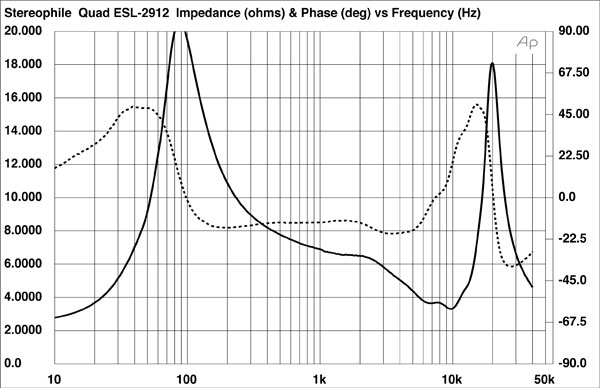
I used DRA Labs' MLSSA system and a calibrated DPA 4006 microphone to measure the Quad ESL-2912's frequency response in the farfield, and an Earthworks QTC-40 for the nearfield responses. My estimate of the Quad's voltage sensitivity was approximately 84dB/2.83V/m, somewhat lower than the specified 86dB. Fig.1 shows how the ESL-2912's impedance magnitude and electrical phase angle vary with frequency. It's basically identical to that of the ESL-2912's predecessor, the ESL-989 (reviewed by Larry Greenhill in November 2002), with a high value in the bass dropping smoothly to a plateau of around 6.5 ohms in the upper midrange, with then a further drop reaching a minimum value of 3.3 ohms at 10kHz. Though the electrical phase angle becomes very inductive between 10 and 20kHz, the impedance magnitude in this octave is high, mitigating any drive difficulty.
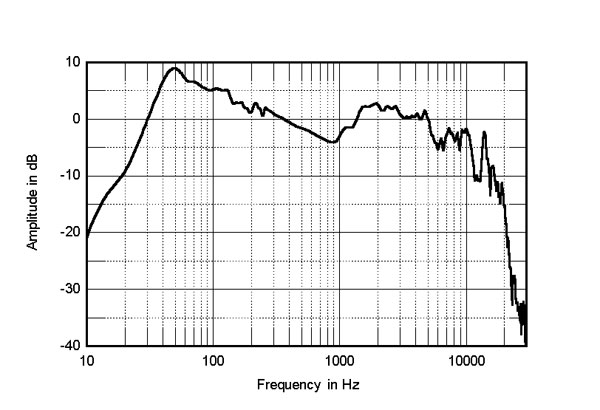 Like the ESL-989's measured response, the ESL-2912's response features a broad depression in the midrange compared with the low treble, while the high treble is first a little peaky, then rolls off sharply above 15kHz or so. In this respect, the ESL-2912 measures less flat than the smaller Quad ESL-2805, which I reviewed in May 2012.
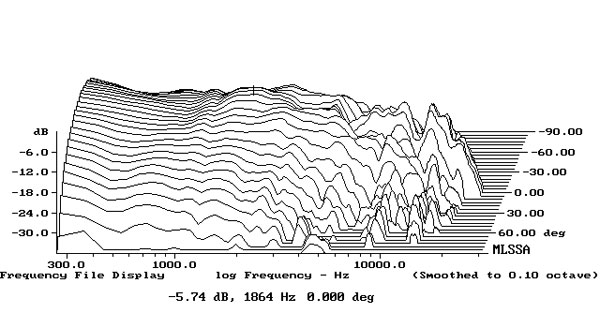
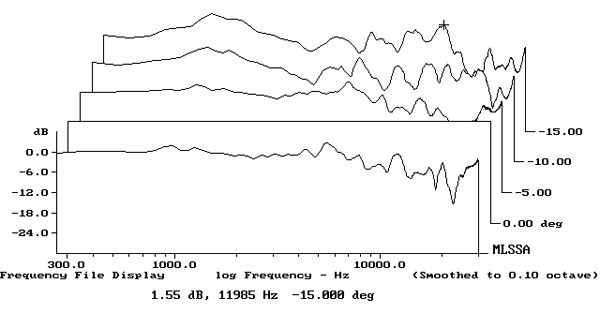
All things being equal, the rather suppressed top two octaves will make the Quad sound somewhat mellow, though I note that RD didn't comment on this aspect of the speaker's high-frequency balance. Fig.3 shows the ESL-2912's lateral dispersion— to make it easier to interpret, actual responses are shown in this graph, rather than, as is usually the case in our reviews, the differences in response off axis. The speaker becomes very directional above 8kHz or so, which will exacerbate the rolled-off top octave in medium to large rooms. However, as RD's room is relatively small, this would have less of a factor in his auditioning, leaving him free to appreciate the Quads' superb stereo imaging, which correlates with the even spacing of the contour lines lower in frequency in this graph. Note also that fig.3 clearly shows the speaker's well-controlled dipolar radiation pattern in the midrange and lower treble, the output 90° to the speaker's sides being suppressed by 30dB. In the vertical plane (fig.4), the speaker's balance doesn't change appreciably over the +15°/–5° window centered on the center of the panel, which is a rather low 33" from the floor.
Like the ESL-989's measured response, the ESL-2912's response features a broad depression in the midrange compared with the low treble, while the high treble is first a little peaky, then rolls off sharply above 15kHz or so. In this respect, the ESL-2912 measures less flat than the smaller Quad ESL-2805, which I reviewed in May 2012.
All things being equal, the rather suppressed top two octaves will make the Quad sound somewhat mellow, though I note that RD didn't comment on this aspect of the speaker's high-frequency balance. Fig.3 shows the ESL-2912's lateral dispersion— to make it easier to interpret, actual responses are shown in this graph, rather than, as is usually the case in our reviews, the differences in response off axis. The speaker becomes very directional above 8kHz or so, which will exacerbate the rolled-off top octave in medium to large rooms. However, as RD's room is relatively small, this would have less of a factor in his auditioning, leaving him free to appreciate the Quads' superb stereo imaging, which correlates with the even spacing of the contour lines lower in frequency in this graph. Note also that fig.3 clearly shows the speaker's well-controlled dipolar radiation pattern in the midrange and lower treble, the output 90° to the speaker's sides being suppressed by 30dB. In the vertical plane (fig.4), the speaker's balance doesn't change appreciably over the +15°/–5° window centered on the center of the panel, which is a rather low 33" from the floor.
Footnote 1: In its formal mathematical sense, chaotic means "the inherent unpredictability in the behavior of a complex natural system."
Fig.1 Quad ESL-2912, electrical impedance (solid) and phase (dashed) (5 ohms/vertical div.).
It's always difficult to assess the acoustic behavior of a large panel speaker like the ESL-989. First, the nearfield measurement of the low frequencies will not show the effect of the dipole cancellation, as the antiphase backwave increasingly wraps around to cancel the speaker's direct output with decreasing frequency. The peaked-up bass shown in fig.2 will therefore tend to be more flat in the farfield than it appears in this graph. In addition, when measuring a loudspeaker, it is assumed that the microphone is in the speaker's farfield; ie, several times the largest dimension of the diaphragm. With the largest dimension of the ESL-2912 being its panel height of 54" and my routine distance from the microphone being 50", this assumption is no longer true. As a result, due to the proximity effect, there will be a slight downward trend with frequency in the measured response, as fig.2 also shows.
Fig.2 Quad ESL-2912, anechoic response on center-panel axis at 50", averaged across 30° horizontal window and corrected for microphone response, with nearfield response of woofer plotted below 300Hz.
Fig.3 Quad ESL-2912, lateral response family at 50", from back to front: responses 90–5° off axis, response on center-panel axis, responses 5–90° off axis.
Fig.4 Quad ESL-2912, vertical response family at 50", normalized to response on center-panel axis, from back to front: differences in response 15–5° above axis, reference response, difference in response 5° below axis.
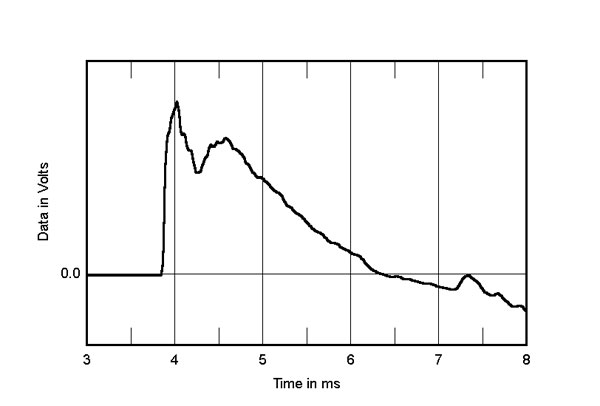
Like every other Quad electrostatic speaker I've measured, the ESL-2912 has a superbly time-coincident wavefront launch. Its step response is shown in fig.5, with what would have been a perfect right-triangle shape disturbed by a second peak 500µs after the first, and a discontinuity just after the 7ms marker, the latter due to the first reflection of the speaker's output from the floor between it and the microphone. In our review of the ESL-989, which had an identical step response, I conjectured that the second peak was due to a reflection of the diaphragm's output from the dustcover. But as the smaller ESL-2805 has an undisturbed step response, I believe that what we see here is the output of the bass panels—which lie above and below the central panels—arriving at the microphone slightly later than the initial arrival.
Fig.5 Quad ESL-2912, step response on center-panel axis at 50" (5ms time window, 30kHz bandwidth).
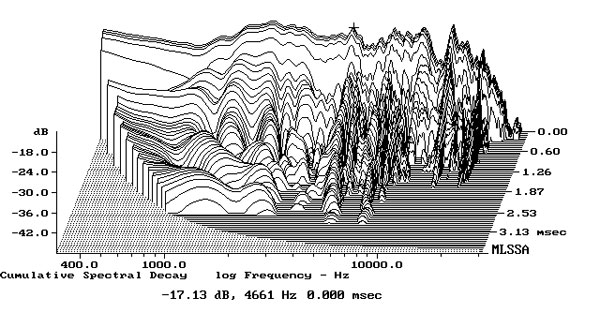
Finally, like that of every other panel speaker I've measured, the Quad ESL-2912's waterfall plot (fig.6) looks hashy, though the initial decay looks relatively clean. But as I explained in our review of MartinLogan's Masterpiece Renaissance ESL 15A electrostatic speaker in January 2017, I suspect that though the average motion of the diaphragm reacts in a linear manner to the drive signal, the panel actually behaves in a chaotic manner (footnote 1). In effect, the panel "shimmies" as it moves—and that, together with local interference from multiple sources arriving at the microphone, gives rise to the messy-looking waterfall plot.
Fig.6 Quad ESL-2912, cumulative spectral-decay plot on center-panel axis at 50" (0.15ms risetime).
Given how closely the ESL-2912's measured performance resembles those of the other Quad speakers we've reviewed, and that all of those earlier models were very well received by our reviewers, I'm not surprised that RD liked this speaker as much as he did.—John Atkinson
Footnote 1: In its formal mathematical sense, chaotic means "the inherent unpredictability in the behavior of a complex natural system."