Sidebar 3: Measurements
I performed a complete set of tests on a different sample of the Octave Jubilee from that auditioned by JVS; mine had the serial number 6119179. I used my Audio Precision SYS2722 system for the tests, repeating some of the measurements with the magazine's APx555 system.
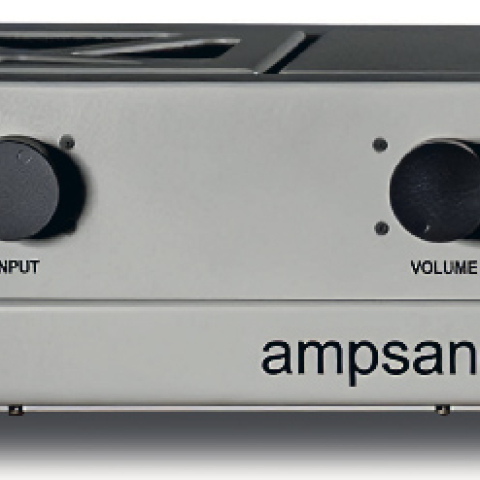
I was initially confused by the presence of a pair of balanced inputs on the rear panel labeled "Phono," as I had understood that the Jubilee was a line preamplifier. However, a look at the manual revealed that the "Phono" input is a line-level input intended to be used with an external phono preamp. JVS told me that he exclusively used the Jubilee's balanced line input and output; the former are labeled "CD SYM," and a switch next to the XLR jacks allows them to be used in balanced or single-ended modes. A second switch allows the input and output XLR jacks' grounds to be connected or lifted.
All the Jubilee's inputs and outputs preserved absolute polarity, ie, were noninverting, with the Phase LED on the top panel turned off. The Jubilee's balanced input impedance was 14k ohms at 20Hz, 18k ohms at 1kHz, and 8.4k ohms at 20kHz. The unbalanced input impedance was 55.6k ohms at 20Hz and 1kHz, dropping inconsequentially to 43.3k ohms at 20kHz. The preamplifier's balanced output impedance was 154 ohms at 20Hz, 66 ohms at 1kHz and 20kHz. The single-ended output impedance was 65 ohms at 20Hz, 41 ohms at higher frequencies.
The maximum gain for the balanced XLR input to the balanced output and the unbalanced RCA inputs to the unbalanced output was 10.1dB with the gain set to Low and 17.6dB with the gain set to High. While the unbalanced gains are the same as those listed in the Jubilee's specifications, the maximum specified balanced gains are 16dB and 23.5dB. (I did find that the maximum gain at the balanced output for the unbalanced RCA inputs was 16.1dB, Low gain, and 23.75dB, High gain.) I checked that I had the XLR input switch set to Balanced for the Balanced CD SYM input. I did. I then checked with the APx555. The result was the same: higher gains for the unbalanced RCA inputs measured at the balanced output and for the CD SYM input set to unbalanced.
Footnote 1: See www.octave.de/en/products/jubilee-line/jubilee-preamp.
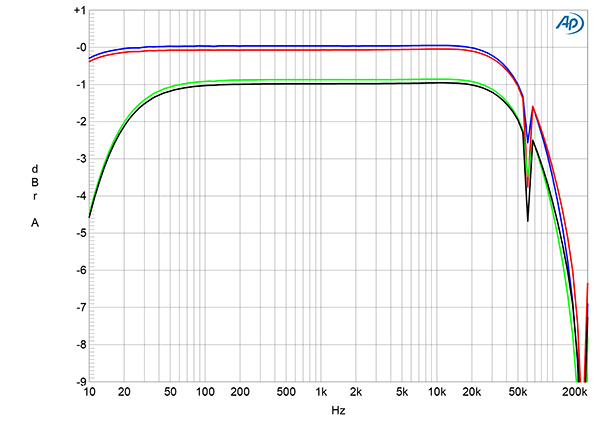
Fig.1 Octave Audio Jubilee, balanced frequency response, with volume control set to the maximum and gain set to High, at 1V into: 100k ohms (left channel blue, right red), 600 ohms (left green, right gray) (1dB/vertical div.).
Fig.1 plots the Jubilee's balanced frequency response into 100k ohms (blue and red traces) and 600 ohms (green and gray traces) with the volume control set to its maximum and gain set to High. The response into the high impedance is flat in the audioband, rolling off above 20kHz to reach –3dB at 95kHz, but with very narrow suckouts centered at 60kHz and 180kHz; these are inconsequential and might be associated with the transformer-coupled circuitry. The ultrasonic rolloff is identical into 600 ohms, but the increase in the output impedance in the low bass results in the response being down by 2dB at 20Hz into this load. The channels' gains are superbly well matched in fig.1; the very close matching was preserved with the gain set to Low and at lower volume-control settings.
Balanced channel separation with the gain set to High was modest, at 53dB below 1kHz in both directions, falling to 40dB at 20kHz. This measurement was not affected by floating the XLR inputs' ground or by setting the gain to Low. (As usual, I looked at the undriven channel's output signal on an oscilloscope to make sure I was measuring actual crosstalk rather than noise.) With the volume control set to the maximum and gain set to High, the wideband, unweighted S/N ratio (ref. 1V output) was a very good 77.6dBdB (average of both channels), increasing to 89.6dB when the measurement bandwidth was reduced to the audioband and to 93.3dB when A-weighted. Setting the gain to Low increased all these ratios by 6dB, again ref. 1V output. These ratios were measured with the XLR input grounds connected to the XLR outputs with the rear-panel switch. While the manual says that floating the grounds gives the lowest noise, I found that this resulted in a higher level of random noise, decreasing the S/N ratios by 10dB.
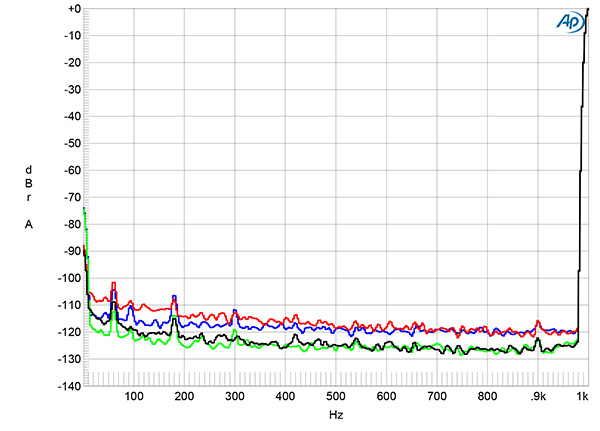
Fig.2 Octave Audio Jubilee, balanced spectrum of 1kHz sinewave, DC–1kHz, at 2V into 100k ohms with volume control to the maximum and gain set to High (left channel blue, right red) and to Low (left green, right gray); (linear frequency scale).
Spectral analysis of the Octave's low-frequency noisefloor with the preamplifier outputting a 1kHz tone at 2V with gain set to Low, the XLR grounds connected, and the volume control set to the maximum (fig.2, green and gray traces) revealed that supply-related spuriae were very low in level, though the random noisefloor is higher in level than I have found with the best-measuring solid state preamplifiers. Repeating the analysis with the gain set to High and the level of the input signal reduced so that the output was the same 2V (blue and red traces) increased the level of the noisefloor by around 6dB. Setting the volume control to –12dB with the output level set to the same 2V increased the noisefloor level by another 12dB.
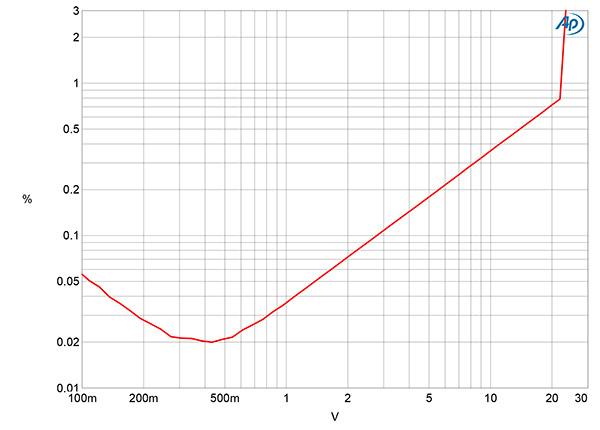
Fig.3 Octave Audio Jubilee, balanced THD+N (%) vs 1kHz output voltage into 100k ohms.
Fig.3 plots the THD+noise percentage in the Octave preamp's balanced output against voltage into 100k ohms with gain set to High and the volume control set to the maximum. Actual distortion lies below the noisefloor up to 500mV output then steadily increases above that level, which confirms that the circuit doesn't have global negative feedback. Octave's specified harmonic distortion of 0.1% at 3V is also confirmed by this graph. With clipping defined as THD+N reaching 1%, the Jubilee's balanced outputs clipped at a very high 21V into this load. The unbalanced outputs clipped at half this voltage, as expected.
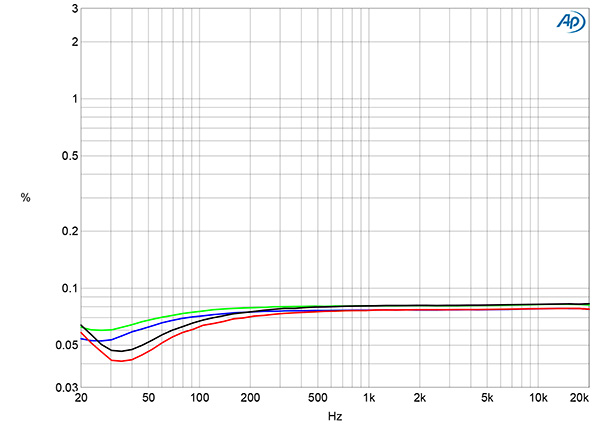
Fig.4 Octave Audio Jubilee, gain set to High, balanced THD+N (%) vs frequency at 2V into 100k ohms (left channel blue, right red) and 600 ohms (left green, right gray).
The Octave Jubilee has no problem driving low impedances. Plotting the balanced THD+N into 600 ohms gave an identical graph to fig.3, with a similar clipping voltage. Fig.4 shows how the balanced THD+N percentage changes with frequency at 2V into 100k ohms (blue and red traces) and into 600 ohms (green, gray traces) with gain set to High. As expected from fig.3, the THD+N lies around 0.08% at this voltage into both loads—slightly lower at low frequencies—but what is truly significant is that there is no rise in THD+N in the top octaves.
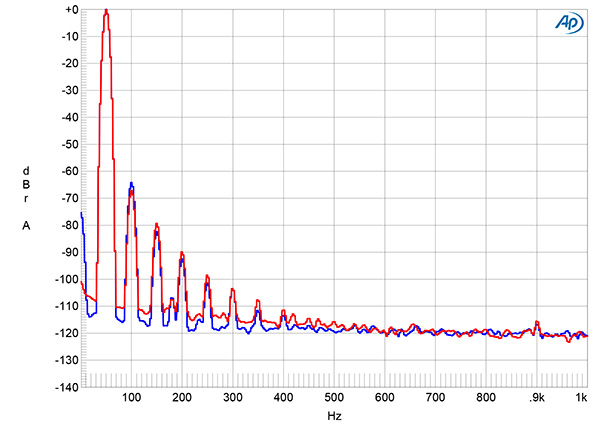
Fig.5 Octave Audio Jubilee, gain set to High, balanced spectrum of 50Hz sinewave, DC–1kHz, at 2V into 100k ohms (left channel blue, right red; linear frequency scale).
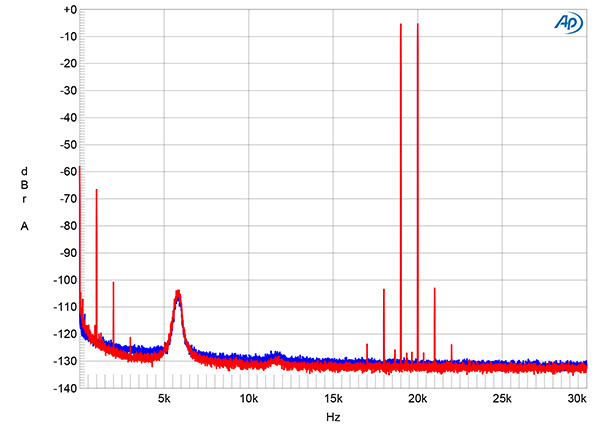
Fig.6 Octave Audio Jubilee, gain set to High, balanced HF intermodulation spectrum, DC–30kHz, 19+20kHz at 2V into 600 ohms (left channel blue, right red; linear frequency scale).
The distortion signature was primarily the second harmonic, with higher-order harmonics progressively decreasing in level (fig.5). Intermodulation distortion with an equal mix of 19 and 20kHz tones was low, even into 600 ohms (fig.6). While the difference product at 1kHz lay just above –70dB, the higher-order components all lay below –100dB (0.001%). Note, however, the peculiar rise in the noisefloor centered on 6kHz. This was present with both gain settings and was not affected by floating the XLR grounds.
Other than the measured gains, which conflict with those published on the Octave website (footnote 1), and the higher-than-usual level of the noisefloor, the Jubilee offers very good measured performance, especially considering that there is no global feedback.—John Atkinson
Footnote 1: See www.octave.de/en/products/jubilee-line/jubilee-preamp.