Nor do those files have to be stored on the M52 Music Vault. I have a Netgear NAS drive on our home network with a 1TB RAID 1 array, on which I store one of my iTunes backups. When I selected "Configure Network Shares" with the iPad app, the M50 recognized the NAS drive. Selecting "Re-index Music Collection" from the "Configure Player" panel added to the M50's library all the songs on the network drive, which then could be played in just the same way as songs stored on the M52. And the ability to copy files from the M52 over the network means that it can also be backed up via that network to another drive, whether an NAS or a drive connected to one of the networked computers.
Sound quality: M50 and M52
I used the combination of M50 and M52 connected, via a 15' AES/EBU link, to both NAD's M51 and the Auralic Vega DAC that I reviewed in February, each with its level control set to the maximum and system volume provided by the Pass Labs XP-30 line preamplifier. Before setting up the NAD music player, I'd been feeding both D/A processors USB data sourced from my 2.7GHz i7 Mac mini fitted with 8GB of RAM and running Pure Music.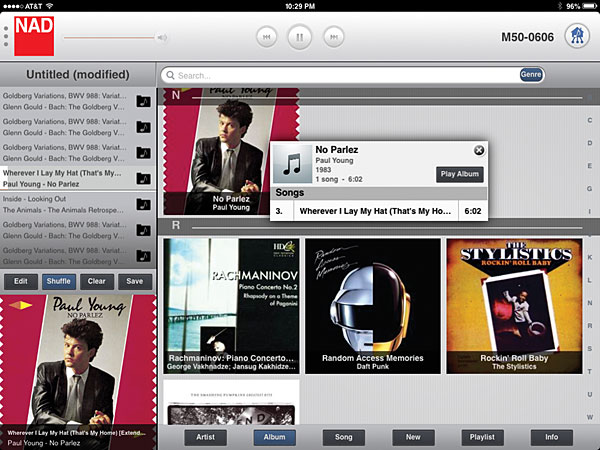 Playing the March issue's "Recording of the Month," Keith Jarrett's 1981 solo concerts from Bregenz and Munich, mastered from the original analog tapes to 24/96 ALAC files (ECM/HDtracks 1227–29), I initially thought the sound with the M50 feeding AES/EBU data to the Auralic converter was identical to what I was used to with the USB connection from the computer. Over time, however, and with many different kinds of music, I felt that there was slightly more ease to the sound. This was not what I was expecting, given that the asynchronous USB connection is theoretically free from jitter, whereas the AES/EBU link's jitter rejection will depend on the quality of both the transmitter and receiver circuits, and the characteristic impedance and length of the cable.
It was more of a wash with NAD's M51 processor. Now the AES/EBU link from the M50 sounded identical to the USB link from my Mac mini, no matter what music I played. The doubled double basses at the start and the space around the kick and snare drum at the end of "Fever," from Tierney Sutton's Desire (ALAC files ripped from CD, Telarc CD-83685), were deliciously clean and well delineated with either source feeding the M51. And playing the same files from the NAS drive in my kitchen via 75' of generic Ethernet cable gave identical sound quality.
Playing files via Ethernet from my NAS drive, the NAD M50 and M51 sounded a little less robust than the Reference NA-11S1, images becoming a little more ethereal. The Marantz has superb-quality analog outputs and costs $1000 less than the NAD combo; however, as I noted in my review last October, the Marantz is incompatible with AIFF and purchased AAC files, whereas the M50 doesn't care about file formats, playing them all with aplomb. On the other hand, the Marantz will play DSD-encoded files, and sound superb as it does so.
Ultimately, after using the M50 on and off for several months, there is no doubt in my mind that it is a true high-end source, whether used with the M51 or with another high-quality DAC.
Playing the March issue's "Recording of the Month," Keith Jarrett's 1981 solo concerts from Bregenz and Munich, mastered from the original analog tapes to 24/96 ALAC files (ECM/HDtracks 1227–29), I initially thought the sound with the M50 feeding AES/EBU data to the Auralic converter was identical to what I was used to with the USB connection from the computer. Over time, however, and with many different kinds of music, I felt that there was slightly more ease to the sound. This was not what I was expecting, given that the asynchronous USB connection is theoretically free from jitter, whereas the AES/EBU link's jitter rejection will depend on the quality of both the transmitter and receiver circuits, and the characteristic impedance and length of the cable.
It was more of a wash with NAD's M51 processor. Now the AES/EBU link from the M50 sounded identical to the USB link from my Mac mini, no matter what music I played. The doubled double basses at the start and the space around the kick and snare drum at the end of "Fever," from Tierney Sutton's Desire (ALAC files ripped from CD, Telarc CD-83685), were deliciously clean and well delineated with either source feeding the M51. And playing the same files from the NAS drive in my kitchen via 75' of generic Ethernet cable gave identical sound quality.
Playing files via Ethernet from my NAS drive, the NAD M50 and M51 sounded a little less robust than the Reference NA-11S1, images becoming a little more ethereal. The Marantz has superb-quality analog outputs and costs $1000 less than the NAD combo; however, as I noted in my review last October, the Marantz is incompatible with AIFF and purchased AAC files, whereas the M50 doesn't care about file formats, playing them all with aplomb. On the other hand, the Marantz will play DSD-encoded files, and sound superb as it does so.
Ultimately, after using the M50 on and off for several months, there is no doubt in my mind that it is a true high-end source, whether used with the M51 or with another high-quality DAC.
A word on the Masters Series M51 Direct Digital D/A processor ($1999) would therefore be in order, given that I've been using it as one of my references since summer 2013. Jon Iverson had enthused about the M51 in his July 2012 review, concluding that he preferred DACs "that reveal as much as possible about what was captured on the tape or in the digits, and couldn't care less about adding a rose-colored tint to dodgy digital sound. In this regard, the NAD M51 succeeds with a wonderfully detailed and revealing sound best described as honest, with a friendly smile." My own experience of the M51 (my sample was serial no. H33M5103771; his was H1XM5101162), driven by the M50 and M52, echoes Jon's. It is transparent to recorded detail without the sound becoming, in that classic phrase, "ruthlessly revealing." Compared to the half-again-as-expensive Electrocompaniet Classic ECD 2 ($3100), which I reviewed in December 2013, the M51's sound was lighter balanced, with less authoritative low frequencies but with a deeper soundstage, longer reverb tails, and a filigree retrieval of fine detail. Playing my 2000 recording of Robert Silverman performing Beethoven's Piano Sonata 18 (24/88.2 master AIFF file from CD, OrpheumMasters KSP-830), the NAD was slightly better at decoding the ambient cues and the leading edges of the piano's percussive character. In direct comparison, the Electrocompaniet's overall presentation of the Bösendorfer was more true to the sound of the piano than the recorded acoustic, I felt.
When, in February 2014, I reviewed the Auralic Vega ($3499)—which is almost identical to the NAD in its feature set, including a digital-domain volume control—the Vega gave more weight to Jaco Pastorius's subterranean bass-guitar notes on a 24/96 needle drop of "Overture—Cotton Avenue" from Joni Mitchell's Don Juan's Reckless Daughter (LP, Reprise K63003), while the M51 focused more on the sound of Mitchell's open-strung acoustic guitar. Ultimately, the overall sound was a little more airy through the M51, with a cleaner if leaner balance. I ended up preferring the Auralic processor, but the NAD gets close to it at 57% of its price.
 This is hardly something for which you can perform an A/B test, but listening to the Thelonious Monk–influenced "Rainbow's Cadillac," from a downloaded Bruce Hornsby concert from Oregon Zoo, in Portland (16/44.1 FLACs), I discovered that the reader had been correct. The bass guitar and kick drum did indeed sound a little fatter than with the latest firmware. This was a benefit with the Joseph Perspective and Wilson Alexia speakers I used in my listening, but not with the Vivid Giya G3s. Who'd a thunk it? (footnote 1)
Summing up
This is hardly something for which you can perform an A/B test, but listening to the Thelonious Monk–influenced "Rainbow's Cadillac," from a downloaded Bruce Hornsby concert from Oregon Zoo, in Portland (16/44.1 FLACs), I discovered that the reader had been correct. The bass guitar and kick drum did indeed sound a little fatter than with the latest firmware. This was a benefit with the Joseph Perspective and Wilson Alexia speakers I used in my listening, but not with the Vivid Giya G3s. Who'd a thunk it? (footnote 1)
Summing up
If you're looking for a 21st-century digital audio source and don't want to have too close a relationship with your computer, NAD's Masters Series M50, in combination with a first-rate D/A processor like NAD's own Masters Series M51, will be all you need. While the M50 can be used both with an NAS drive on the network to which it is connected and a generic USB-connected drive, the matching Masters Series M52 Music Vault is the icing on the cake. Yes, the M52 is more expensive than a home-brewed solution, but it matches the M50's and M51's styling, it's completely quiet, and, most important, its RAID 5 array guarantees that a hard-drive failure will not mean losing your music library. Quibbles? The M51's display was more turquoise in hue than the M50's blue. Didn't bother me none, but I am a critic, and must have something to carp about. Perhaps more important, the M50 doesn't currently play DSD-encoded files—but while I've been impressed by what I've heard from this format, the jury is still out as to whether this ability is essential or merely the current fashion. (Many DSD-encoded music files will have been transcoded to high-resolution PCM at some point in their production, in order to apply gain changes and equalization, and I understand that almost all of the current generation of DSD-capable DAC chips actually transcode to PCM before conversion to analog.) But for those with a growing library of high-resolution files, this NAD system can be highly recommended.
Footnote 1: In his "Manufacturer's Comment," NAD's Greg Stidsen wrote that "Software v1.41 dropped the gain by 1dB, to give that little bit of extra headroom. While 1dB may be at the threshold of human perception, a keen ear will hear the slightly louder playback of v1.39 as "better." Other changes in v1.41 include a revision of the Polarity setting logic, and the addition of an auto standby to comply with EC energy policy. No changes were made that would affect frequency response or dynamics." I reloaded the v.1.41 firmware into my sample of the M51 and rechecked the maximum output level at 1kHz. It was indeed exactly 1dB lower than it had been with this sample loaded with the v.1.39 firmware and with Jon Iverson's original review sample.—John Atkinson
I used the combination of M50 and M52 connected, via a 15' AES/EBU link, to both NAD's M51 and the Auralic Vega DAC that I reviewed in February, each with its level control set to the maximum and system volume provided by the Pass Labs XP-30 line preamplifier. Before setting up the NAD music player, I'd been feeding both D/A processors USB data sourced from my 2.7GHz i7 Mac mini fitted with 8GB of RAM and running Pure Music.
The Music screen on the NAD app can be organized by Artist, Album, Song, etc., with the current Playlist window on the left.
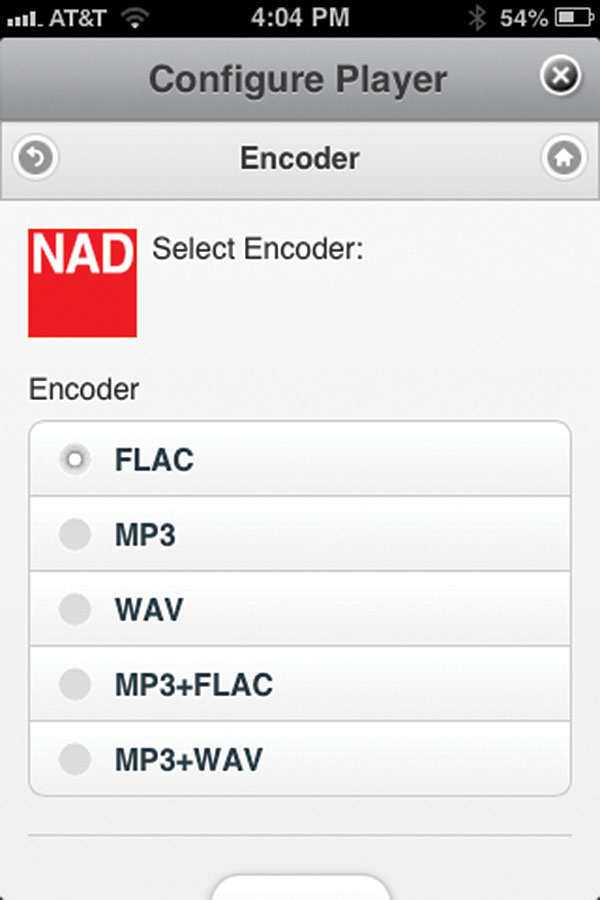
The NAD app's CD-ripping screen offers WAV, FLAC, and MP3 options.
Sound quality: M51A word on the Masters Series M51 Direct Digital D/A processor ($1999) would therefore be in order, given that I've been using it as one of my references since summer 2013. Jon Iverson had enthused about the M51 in his July 2012 review, concluding that he preferred DACs "that reveal as much as possible about what was captured on the tape or in the digits, and couldn't care less about adding a rose-colored tint to dodgy digital sound. In this regard, the NAD M51 succeeds with a wonderfully detailed and revealing sound best described as honest, with a friendly smile." My own experience of the M51 (my sample was serial no. H33M5103771; his was H1XM5101162), driven by the M50 and M52, echoes Jon's. It is transparent to recorded detail without the sound becoming, in that classic phrase, "ruthlessly revealing." Compared to the half-again-as-expensive Electrocompaniet Classic ECD 2 ($3100), which I reviewed in December 2013, the M51's sound was lighter balanced, with less authoritative low frequencies but with a deeper soundstage, longer reverb tails, and a filigree retrieval of fine detail. Playing my 2000 recording of Robert Silverman performing Beethoven's Piano Sonata 18 (24/88.2 master AIFF file from CD, OrpheumMasters KSP-830), the NAD was slightly better at decoding the ambient cues and the leading edges of the piano's percussive character. In direct comparison, the Electrocompaniet's overall presentation of the Bösendorfer was more true to the sound of the piano than the recorded acoustic, I felt.
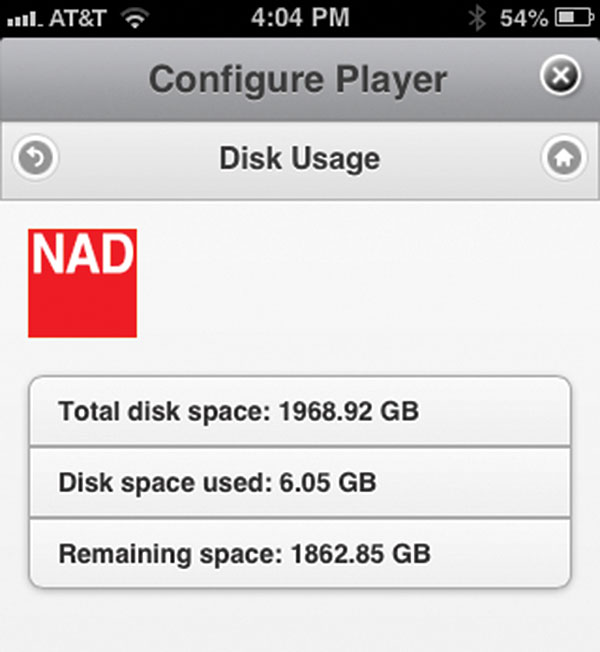
The NAD app lets you check how much storage space remains on the M52 Music Vault's 2TB hard drives
A poster to our website reported that the M51's earlier v1.39 firmware is the best sounding. Turning on the M51 with its Input button pressed revealed that my sample was running the v1.41 firmware, which is supposed to have less bass and to sound not quite as dynamic as v1.39. I downloaded the v1.39 firmware here and rolled the M51 back to that version by loading the code onto a USB stick, plugging it into the Upgrade USB port on the M51's rear panel, and following the instructions in the appropriate NAD software bulletin. All appeared to go correctly, and turning on the M51 with the Input button pressed now indicated that the v1.39 firmware had been installed.
If you're looking for a 21st-century digital audio source and don't want to have too close a relationship with your computer, NAD's Masters Series M50, in combination with a first-rate D/A processor like NAD's own Masters Series M51, will be all you need. While the M50 can be used both with an NAS drive on the network to which it is connected and a generic USB-connected drive, the matching Masters Series M52 Music Vault is the icing on the cake. Yes, the M52 is more expensive than a home-brewed solution, but it matches the M50's and M51's styling, it's completely quiet, and, most important, its RAID 5 array guarantees that a hard-drive failure will not mean losing your music library. Quibbles? The M51's display was more turquoise in hue than the M50's blue. Didn't bother me none, but I am a critic, and must have something to carp about. Perhaps more important, the M50 doesn't currently play DSD-encoded files—but while I've been impressed by what I've heard from this format, the jury is still out as to whether this ability is essential or merely the current fashion. (Many DSD-encoded music files will have been transcoded to high-resolution PCM at some point in their production, in order to apply gain changes and equalization, and I understand that almost all of the current generation of DSD-capable DAC chips actually transcode to PCM before conversion to analog.) But for those with a growing library of high-resolution files, this NAD system can be highly recommended.
Footnote 1: In his "Manufacturer's Comment," NAD's Greg Stidsen wrote that "Software v1.41 dropped the gain by 1dB, to give that little bit of extra headroom. While 1dB may be at the threshold of human perception, a keen ear will hear the slightly louder playback of v1.39 as "better." Other changes in v1.41 include a revision of the Polarity setting logic, and the addition of an auto standby to comply with EC energy policy. No changes were made that would affect frequency response or dynamics." I reloaded the v.1.41 firmware into my sample of the M51 and rechecked the maximum output level at 1kHz. It was indeed exactly 1dB lower than it had been with this sample loaded with the v.1.39 firmware and with Jon Iverson's original review sample.—John Atkinson