Sidebar 3: Measurements
As the NAD M50 has only digital outputs, the most important thing to measure is the quality of those outputs. Using my top-of-the-line Audio Precision SYS2722 system (see the January 2008 "As We See It" and www.ap.com), I connected the M50's AES/EBU output, which I'd used for all of my listening, to one of its AES/EBU inputs using a 45' length of Apogee 110 ohm balanced cable.
The SYS2722's input impedance was set to 110 ohms; the NAD's AES/EBU output impedance was close to this at 125 ohms. Playing 24-bit files, all 24 bits were active in the M50's digital output. With 44.1kHz data, the actual rate of the data was superbly close, at 44,099Hz; even with 176.4kHz data, the actual rate was within 3Hz of the nominal sample rate. It is no mystery, therefore, why the Auralic Vega's fussy Exact receiver setting had no problems locking to the M50. For context, the Lynx AES16e card fitted to my listening-room PC—a Shuttle running Windows 7—had a sample rate of 44,106Hz from its AES/EBU output; my MacBook Pro's optical output offered 44,101Hz; and the coaxial S/PDIF output of the Arcam rBlink Bluetooth DAC I reviewed in March had a sample rate of exactly 44,100.0Hz!
With WAV files representing 16- and 24-bit versions of the Miller-Dunn J-Test signal—the worst case for an AES/EBU connection—the measured jitter level (with a 50Hz–100kHz bandwidth) varied between 394.3 and 443.6 picoseconds, which is only a little higher than the Audio Precision's sensitivity limit. This figure remained unchanged whether I played a WAV file or the same data from a CD or via Ethernet. Confirming this low level of interface jitter, the eye pattern of the received datastream (fig.1) was impressively open, with no blurring at the beginning and end of the unit interval. Again for context, the Lynx PC card's AES/EBU output offered 542.2ps of jitter and the rBlink 395.4ps, but the laptop's optical output was a high 1.38 nanoseconds (1380ps).—John Atkinson
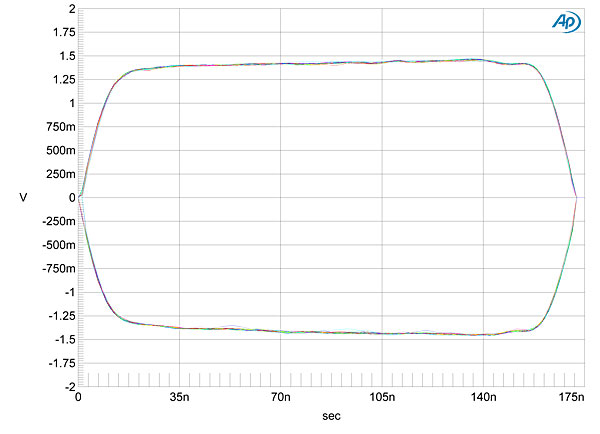
Fig.1 NAD M50, eye pattern of AES/EBU data output carrying 16-bit J-Test signal (±2V vertical scale, 175ns horizontal scale).