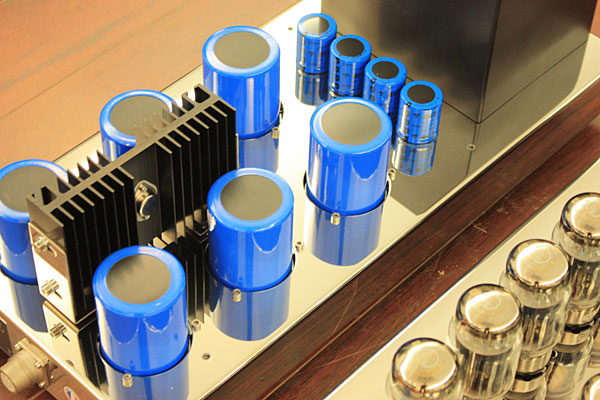
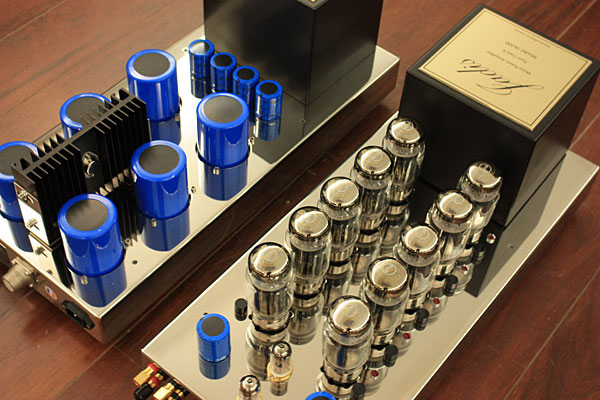
Although Monsieur Scull went to great lengths to position the JA 200s' amplifier and power-supply chassis some distance apart and at right angles to each other, M. Calmettes had no such concerns. We simply placed the pairs of enclosures side by side, a few feet apart: Each channel's power supply sat on the floor, supported by Grand Prix Apex feet, with its corresponding mono amplifier resting 4" above it, on a Grand Prix Monaco stand. A 15-amp Nordost Odin 2 power cord fed each power supply, and Odin 2 speaker cables were attached to one of the two sets of binding posts on amp's rear.
While the JA200 Mk.IIs put out considerable heat, this was less, I felt, than my reference class-A amps, a pair of Pass Laboratories' solid-state XA200.8 monoblocks.
Listening
When the JA200 Mk.IIs were powered up and all had settled in, everything went smoothly. The Jadis amps were so silent from my listening seat that I felt no need to put an ear to an Alexia tweeter to hear if I could detect any buzz. Nor did I hear any of the low-level background noise I've heard from some tubed gear.
I know that some people prefer to draw lines, consigning equipment and audiophiles to diametrically opposed camps—tubes vs solid-state, analog vs digital, subjective vs objective—as if life were composed of black-and-white polarities rather than infinite shades, a rainbow of possibilities. But as I began my listening, I found I couldn't ascribe the distinct differences I heard between the tubed JA200 Mk.IIs and my solid-state Pass XA200.8s to such clichéd descriptors of tube sound as "bloom," "warmth," or "extra sweetness."
The second file, "Limit to Your Love," from James Blake's eponymous album (16/44.1 WAV, A&M), interrupts Blake's singing with electronic deep-bass effects that, through the Alexias, can take over my music room, seeming to emanate from everywhere at once. Through the JA200 Mk.IIs those blasts were less stunning, and the overall sound was more laid-back than I'm used to. Because the top was a bit toned down, the bass less full, and the soundstage less transparent than though the Pass Labs amps, the midrange now stood out as the sound's main strength.
The performance of Terry Riley's In C on Four Four Three: The Music of Terry Riley, with the Ragazze Quartet and Slagwerk den Haag, a percussion quartet (DSD128, Channel Classics 37816/NativeDSD), is the most colorful, sensationally alive, and mesmerizing recording of this minimalist masterpiece I've heard, with a thrilling climax. With the Jadis amplifiers, timbres were extremely natural and neutral, but everything was a bit mellowed out, the sparkle decidedly toned down. As the piece progressed, it felt as if the JA200 Mk.IIs dove into the middle of every sound, at the expense of undertones and overtones. And despite the amps' fast response, percussive impact was less than ideal.
 Nonetheless, the Jadis amps had no trouble conveying complex and contrasting timbres and lines with absolute clarity. This was especially true at the end of In C, when everything comes together at maximum volume. Indeed, even with full symphonic fare, with everything blaring at once, their control was excellent.
Voices, specifically that of soprano Véronique Gens singing "En Sourdine," from Debussy's first set of Fêtes galantes (16/44.1 FLAC rip from CD, Warner Classics 45360-2), sounded absolutely natural and beautiful. Ditto the piano of her accompanist, Roger Vignoles. However, with very bright voices—I sampled many—the lack of emphasis on the leading edge of the note made for smoother if less viscerally thrilling listening.
The mellow voices of the women of Trio Medival in "St. Birgitta Hymn: Rosa Rorans Bonitatem," from Rímur, their album with trumpeter Arve Henriksen (24/96 WAV, ECM New Series 2520/HDtracks), sounded extremely natural—gorgeous, really. Ditto the trumpet's timbre in this track, though the last iota of spaciousness was absent. The low, midrange-strong rasp of Sarah Vaughan singing the title track of her Send in the Clowns, with the Count Basie Orchestra (CD, JVC/XRCD 60246), was toned down, and the sound was to die for.
Lou Harrison's astounding Concerto for Violin with Percussion Orchestra, in the recording by soloist Tim Fain, with Angel Gil-Ordóñez conducting the PostClassical Ensemble (24/48 WAV, Naxos 8.559825/HDtracks), also yielded extremely natural timbres—Fain's dark violin, whose tone lacks a strong, silvery edge, sounded wonderful. But while Harrison's crazy assortment of percussion was presented with ideal speed, I wished that instruments with the deepest reach had more impact and tighter focus.
Nonetheless, the Jadis amps had no trouble conveying complex and contrasting timbres and lines with absolute clarity. This was especially true at the end of In C, when everything comes together at maximum volume. Indeed, even with full symphonic fare, with everything blaring at once, their control was excellent.
Voices, specifically that of soprano Véronique Gens singing "En Sourdine," from Debussy's first set of Fêtes galantes (16/44.1 FLAC rip from CD, Warner Classics 45360-2), sounded absolutely natural and beautiful. Ditto the piano of her accompanist, Roger Vignoles. However, with very bright voices—I sampled many—the lack of emphasis on the leading edge of the note made for smoother if less viscerally thrilling listening.
The mellow voices of the women of Trio Medival in "St. Birgitta Hymn: Rosa Rorans Bonitatem," from Rímur, their album with trumpeter Arve Henriksen (24/96 WAV, ECM New Series 2520/HDtracks), sounded extremely natural—gorgeous, really. Ditto the trumpet's timbre in this track, though the last iota of spaciousness was absent. The low, midrange-strong rasp of Sarah Vaughan singing the title track of her Send in the Clowns, with the Count Basie Orchestra (CD, JVC/XRCD 60246), was toned down, and the sound was to die for.
Lou Harrison's astounding Concerto for Violin with Percussion Orchestra, in the recording by soloist Tim Fain, with Angel Gil-Ordóñez conducting the PostClassical Ensemble (24/48 WAV, Naxos 8.559825/HDtracks), also yielded extremely natural timbres—Fain's dark violin, whose tone lacks a strong, silvery edge, sounded wonderful. But while Harrison's crazy assortment of percussion was presented with ideal speed, I wished that instruments with the deepest reach had more impact and tighter focus.
 Over the course of three listening sessions devoted to pianist Sarah Cahill's Eighty Trips Around the Sun: Music By and For Terry Riley (24/44.1 FLAC, Irritable Hedgehog IHM 020M), I took in the hi-rez equivalent of four CDs' worth of music performed by Cahill and others. Her piano's sound was extremely natural and transparent through the Jadises, with—no surprise—a caressing softness and toned-down edge. When Cahill performed on a piano that she and composer Samuel Adams had prepared—by placing small resonators and a few dimes on some strings and a small stone to bounce against others, as well as weather stripping and other implements, as well as rubbing the instrument inside and out with superball mallets—the rattling sounded so real that I yelped an immediate "Oh no!" and looked around my music room, trying to figure out what was causing all the noise.
At the end of my listening I revisited my reference Pass Labs XA200.8s to confirm that their percussive slam was indeed more intense, their treble more illumined than the Jadises'. They were. I also verified that, in Iván Fischer and the Budapest Festival Orchestra's recording of Mahler's Symphony 2 (SACD/CD, Channel Classics 23506), the double basses that give extra urgency and dread to the symphony's opening were hardly audible through the JA200 Mk.IIs. While I can't confirm that this bass shyness was due to the Alexias' impedance dip down low, neither Thomas J. Norton's measurements of the Jadis amplifier's predecessor nor Jean-Christophe Calmettes himself suggested that that might be the cause.
Conclusions
Over the course of three listening sessions devoted to pianist Sarah Cahill's Eighty Trips Around the Sun: Music By and For Terry Riley (24/44.1 FLAC, Irritable Hedgehog IHM 020M), I took in the hi-rez equivalent of four CDs' worth of music performed by Cahill and others. Her piano's sound was extremely natural and transparent through the Jadises, with—no surprise—a caressing softness and toned-down edge. When Cahill performed on a piano that she and composer Samuel Adams had prepared—by placing small resonators and a few dimes on some strings and a small stone to bounce against others, as well as weather stripping and other implements, as well as rubbing the instrument inside and out with superball mallets—the rattling sounded so real that I yelped an immediate "Oh no!" and looked around my music room, trying to figure out what was causing all the noise.
At the end of my listening I revisited my reference Pass Labs XA200.8s to confirm that their percussive slam was indeed more intense, their treble more illumined than the Jadises'. They were. I also verified that, in Iván Fischer and the Budapest Festival Orchestra's recording of Mahler's Symphony 2 (SACD/CD, Channel Classics 23506), the double basses that give extra urgency and dread to the symphony's opening were hardly audible through the JA200 Mk.IIs. While I can't confirm that this bass shyness was due to the Alexias' impedance dip down low, neither Thomas J. Norton's measurements of the Jadis amplifier's predecessor nor Jean-Christophe Calmettes himself suggested that that might be the cause.
Conclusions
For beauty of sound, the Jadis JA200 Mk.II monoblocks have few rivals. They're extremely quiet and fast, and their midrange, neither over-emphasized nor bloated, is to die for. For those who prefer a smooth, mellow sound, the JA200 Mk.IIs demand to be heard and, if means permit, to take up permanent residence. But those who put a premium on brilliant highs and resounding bass may prefer to admire the sounds of the Jadis amps for a hot date or two, without committing to a long-term relationship.
When the JA200 Mk.IIs were powered up and all had settled in, everything went smoothly. The Jadis amps were so silent from my listening seat that I felt no need to put an ear to an Alexia tweeter to hear if I could detect any buzz. Nor did I hear any of the low-level background noise I've heard from some tubed gear.
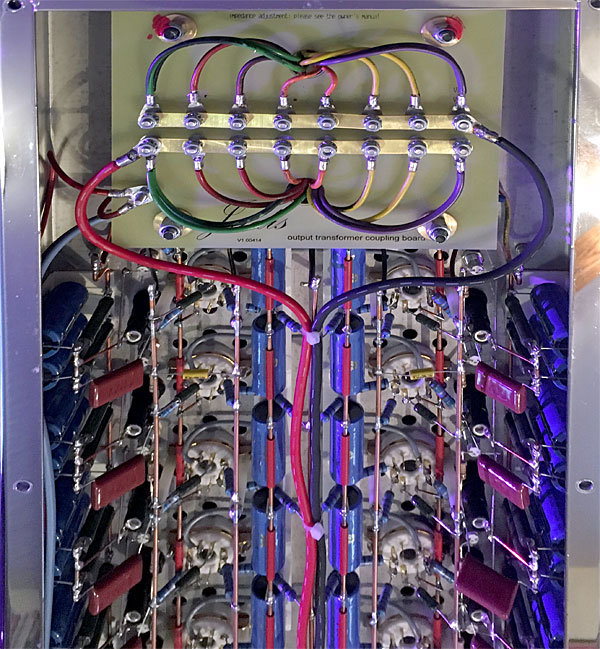
Removing the amplifier's base revealed that our review samples' output transformers were wired for 1 ohm loads.
I first listened to the Sinfonia from Handel's opera Alcina, with Christina Pluhar leading the period-instrument ensemble L'Arpeggiata, from their Händel Goes Wild (24-bit/96kHz WAV, Erato 0190295811). The sound was extremely neutral, but with less shine than I'm accustomed to. Highs were less illumined, lows less than fully fleshed out. Neither deep percussion nor high, tinkly instruments had as much edge and ping as I'm used to. Between those two extremes, however, the sound was smooth, supremely well balanced, and captivatingly beautiful.
I checked out the JA200 Mk.II's low-bass extension with two 16/44.1 WAV files that Wilson Audio's Peter McGrath has used to demonstrate how much deep, powerful bass Wilson's Sabrina loudspeaker can produce, and how much space a pair of them can fill. The first, "Laptevinmeri"/"Laptev Sea," from Pan Sonic's Katodivaihe/Cathodephase (Blast First Petite), is pure electronic doo-doo, but it includes very deep sonic-boom effects and fast-snap treble. Through the JA200 Mk.IIs it had a predominant midrange aura that rendered it more attractive than might be deserved by a composition that seems to proclaim, "Look how many sounds I can use to surround an absolutely vacuous concept."
Nonetheless, the Jadis amps had no trouble conveying complex and contrasting timbres and lines with absolute clarity. This was especially true at the end of In C, when everything comes together at maximum volume. Indeed, even with full symphonic fare, with everything blaring at once, their control was excellent.
Over the course of three listening sessions devoted to pianist Sarah Cahill's Eighty Trips Around the Sun: Music By and For Terry Riley (24/44.1 FLAC, Irritable Hedgehog IHM 020M), I took in the hi-rez equivalent of four CDs' worth of music performed by Cahill and others. Her piano's sound was extremely natural and transparent through the Jadises, with—no surprise—a caressing softness and toned-down edge. When Cahill performed on a piano that she and composer Samuel Adams had prepared—by placing small resonators and a few dimes on some strings and a small stone to bounce against others, as well as weather stripping and other implements, as well as rubbing the instrument inside and out with superball mallets—the rattling sounded so real that I yelped an immediate "Oh no!" and looked around my music room, trying to figure out what was causing all the noise.
At the end of my listening I revisited my reference Pass Labs XA200.8s to confirm that their percussive slam was indeed more intense, their treble more illumined than the Jadises'. They were. I also verified that, in Iván Fischer and the Budapest Festival Orchestra's recording of Mahler's Symphony 2 (SACD/CD, Channel Classics 23506), the double basses that give extra urgency and dread to the symphony's opening were hardly audible through the JA200 Mk.IIs. While I can't confirm that this bass shyness was due to the Alexias' impedance dip down low, neither Thomas J. Norton's measurements of the Jadis amplifier's predecessor nor Jean-Christophe Calmettes himself suggested that that might be the cause.
ConclusionsFor beauty of sound, the Jadis JA200 Mk.II monoblocks have few rivals. They're extremely quiet and fast, and their midrange, neither over-emphasized nor bloated, is to die for. For those who prefer a smooth, mellow sound, the JA200 Mk.IIs demand to be heard and, if means permit, to take up permanent residence. But those who put a premium on brilliant highs and resounding bass may prefer to admire the sounds of the Jadis amps for a hot date or two, without committing to a long-term relationship.