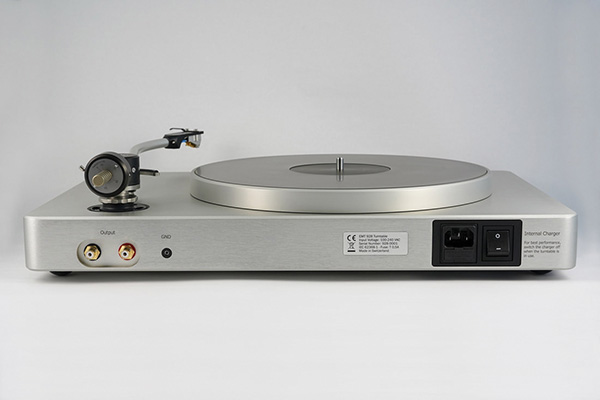
 The EMT 928 II boasts a hefty, 49mm-thick stepped aluminum platter that slots precisely into the plinth's recessed well, rising an inch above its surface. (The platter is "stepped" in the sense that the radius is larger at the top; the part that fits into the plinth's recessed well is smaller.) The platter is topped with an inlaid, textured mat designed to mate well with vinyl records. Huber said, "The exact mixture is a secret, but it consists of a high-density material and vinyl."
A phenolic subplatter supports the main platter, powered by a DC motor hidden beneath the plinth. The bearing system consists of a cast-iron bearing with sintered bronze bushings housing a one-piece, hardened steel spindle and bearing shaft, "meticulously hand-polished using traditional wooden tools," Huber wrote. Finally, a nickel-silver motor pulley, chosen for its harmonic prop erties and superior grip, drives the subplatter via a custom, round rubber belt.
The 908 II rests on four height-adjustable feet. Imagine a metal ball with a grippy, hard-rubber sole. These feet let you level the turntable, and the rubber acts like tiny shock absorbers, keeping external vibrations from traveling up through the plinth and muddying the music.
The EMT 928 II boasts a hefty, 49mm-thick stepped aluminum platter that slots precisely into the plinth's recessed well, rising an inch above its surface. (The platter is "stepped" in the sense that the radius is larger at the top; the part that fits into the plinth's recessed well is smaller.) The platter is topped with an inlaid, textured mat designed to mate well with vinyl records. Huber said, "The exact mixture is a secret, but it consists of a high-density material and vinyl."
A phenolic subplatter supports the main platter, powered by a DC motor hidden beneath the plinth. The bearing system consists of a cast-iron bearing with sintered bronze bushings housing a one-piece, hardened steel spindle and bearing shaft, "meticulously hand-polished using traditional wooden tools," Huber wrote. Finally, a nickel-silver motor pulley, chosen for its harmonic prop erties and superior grip, drives the subplatter via a custom, round rubber belt.
The 908 II rests on four height-adjustable feet. Imagine a metal ball with a grippy, hard-rubber sole. These feet let you level the turntable, and the rubber acts like tiny shock absorbers, keeping external vibrations from traveling up through the plinth and muddying the music.
The 928 II's heavy weight and low profile made leveling frustrating. Its stubby feet tried to crush my fingers as I adjusted them, drawing out some choice words. But first things first. Prior to making those fine adjustments, I had to free the subplatter, which was secured by two small plastic discs and metal bolts. The manual instructs users to reverse the discs 180° to allow free movement, but this didn't work for me; the subplatter remained immovable. So I completely removed the bolts and plastic discs, and the turntable ran fine. After that, it was just a matter of placing the belt (tricky but doable), carefully lowering the main platter onto the subplatter into its well, ensuring that the integral mat is laying flat, doing the final leveling, connecting the interconnects and ground, then setting up the tonearm and cartridge as discussed further up.
I first heard this turntable and tonearm in the DeVore Fidelity room at AXPONA 2024. John DeVore was playing very clean vintage 78s using this combo with an EMT TND65 cartridge. Playing shellac discs by Dizzy Gillespie, Eartha Kitt, Chet Atkins, and Charlie "Peanut" Faircloth, the 928 II reproduced music with exceptional dynamics, skyscraper scale, and face-kissing immediacy. Allowing for the fragility of 78s, this decades-defying rig made you wonder how 33rpm vinyl ever got a foothold. Listening to the 928 II back at Micallef central with the JSD Pure Black cartridge, the tubed Rogue Audio RP-7 preamplifier and Rogue Audio Stereo 100 power amplifier, and the Volti Audio Razz loudspeakers, the first qualities I noticed were a banging sense of drive and impressive note-by-note resolution. Regardless of what phono stage or amplifier I used, it played music forcefully and subtly, capturing not just forceful rhythm but also the soundstage cues that make music sound real and alive and the intricate shifts of attention and focus that convey the presence of living, breathing musicians, even when they are in fact long dead. At the risk of obviousness (since Huber used to be a watchmaker), the 928 II/909-HI combo played music like clockwork, like a focused, tightly wound machine. Clarity and pacing were its main mission. Fast and punchy, weighty and controlled, it seemed to be saying "get out of my way, I've got a job to do." Despite this propulsiveness—presumably a consequence of the powerful 20W motor—the 928 sounded like a belt-drive turntable. It played jazz with flow and pulse. Classical emerged with drama and engrossing commitment. My electronic music played with appropriate menace and glee.
 Pace, rhythm, and timing (PRaT) were first rate, notably on The Beatles' "I Saw Her Standing There" from Please Please Me (EMI Parlophone). I've played this track hundreds of times, from my NC youth all the way through to these Manhattan penthouse years. Paul McCartney's bass guitar drove this twist'n'punk song like a manic assault, as if some headless horseman was cracking a whip on Macca's head, demanding "mach schau!" as frequently heard in The Beatles' Hamburg days. Via the EMT, McCartney's Hofner bass was pronounced and powerful, driving the song forward, sounding round, tight, and cleaner than I've ever heard it. The EMT system discerned the echoey plate reverb on Starr's snare drum rolls, the trembling of Harrison's guitar, and Lennon's harrowing harmonies as separate and clean as I've heard them. The song became new in subtle but powerful ways, more engaging and fun.
When I replaced the Rogue tubed separates with the Riviera Labs Levante hybrid integrated, the character of the 928/909 deepened. I played favorite Blue Note discs to confirm my impressions: Dexter Gordon's Doin' Allright (Blue Note New York BLP 4077), Kenny Dorham's Whistle Stop (Blue Note Liberty BST 84063), Walter Davis Jr.'s Davis Cup (Blue Note United Artists BLP 4018), and Sonny Clark (Blue Note Liberty BST 81579) slugged their way through the room. I wondered: What happened to nuance and subtlety? Blossom Dearie to the rescue.
Pace, rhythm, and timing (PRaT) were first rate, notably on The Beatles' "I Saw Her Standing There" from Please Please Me (EMI Parlophone). I've played this track hundreds of times, from my NC youth all the way through to these Manhattan penthouse years. Paul McCartney's bass guitar drove this twist'n'punk song like a manic assault, as if some headless horseman was cracking a whip on Macca's head, demanding "mach schau!" as frequently heard in The Beatles' Hamburg days. Via the EMT, McCartney's Hofner bass was pronounced and powerful, driving the song forward, sounding round, tight, and cleaner than I've ever heard it. The EMT system discerned the echoey plate reverb on Starr's snare drum rolls, the trembling of Harrison's guitar, and Lennon's harrowing harmonies as separate and clean as I've heard them. The song became new in subtle but powerful ways, more engaging and fun.
When I replaced the Rogue tubed separates with the Riviera Labs Levante hybrid integrated, the character of the 928/909 deepened. I played favorite Blue Note discs to confirm my impressions: Dexter Gordon's Doin' Allright (Blue Note New York BLP 4077), Kenny Dorham's Whistle Stop (Blue Note Liberty BST 84063), Walter Davis Jr.'s Davis Cup (Blue Note United Artists BLP 4018), and Sonny Clark (Blue Note Liberty BST 81579) slugged their way through the room. I wondered: What happened to nuance and subtlety? Blossom Dearie to the rescue.
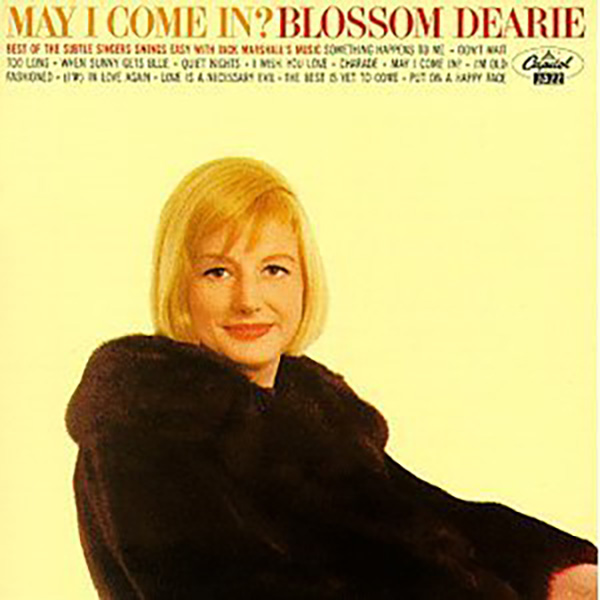 The vinyl records of vocalist/pianist Blossom Dearie are increasing in price—when you can find them. Through the 928/909, 1964's May I Come In? (Capitol T 2086) glowed. This mono disc frames her honeyed, sly vocals in swaying bossa nova rhythms, tart reeds and brass, a halo of romance and release. The 928/909 struck an ideal balance. Portrayed in a large mono spot, Dearie's vocals dominated the mix, but instruments surrounded her with gentle but insistent pacing, with subtlety and shading. The EMT performed as a clean conduit, a time traveler largely free of affectation. Apart from that characteristic propulsiveness, the personality of each disc was allowed to lead.
Through all this listening, the rocker switch was still in the On position, so I was still exposed to wall AC. I was itching to hear the EMT with only its internal battery supplying juice. A simply recorded LP seemed the perfect crucible for this test.
I chose an original mono pressing of jazz pianist Ahmad Jamal's popular trio recording, At The Blackhawk (Argo LP 703), and switched off that back-panel rocker. The change was not subtle. With battery only, piano and drums became cleaner and somehow lighter while bass became weightier and better defined. The most surprising thing was that the music sounded louder, more upfront.4 I didn't expect this level of difference. As they say in the UK, done and dusted.
The vinyl records of vocalist/pianist Blossom Dearie are increasing in price—when you can find them. Through the 928/909, 1964's May I Come In? (Capitol T 2086) glowed. This mono disc frames her honeyed, sly vocals in swaying bossa nova rhythms, tart reeds and brass, a halo of romance and release. The 928/909 struck an ideal balance. Portrayed in a large mono spot, Dearie's vocals dominated the mix, but instruments surrounded her with gentle but insistent pacing, with subtlety and shading. The EMT performed as a clean conduit, a time traveler largely free of affectation. Apart from that characteristic propulsiveness, the personality of each disc was allowed to lead.
Through all this listening, the rocker switch was still in the On position, so I was still exposed to wall AC. I was itching to hear the EMT with only its internal battery supplying juice. A simply recorded LP seemed the perfect crucible for this test.
I chose an original mono pressing of jazz pianist Ahmad Jamal's popular trio recording, At The Blackhawk (Argo LP 703), and switched off that back-panel rocker. The change was not subtle. With battery only, piano and drums became cleaner and somehow lighter while bass became weightier and better defined. The most surprising thing was that the music sounded louder, more upfront.4 I didn't expect this level of difference. As they say in the UK, done and dusted.
 For a comparison, I played the same Ahmad Jamal album on the three-times-as-expensive reference system, a VPI Avenger Direct with its VPI Fatboy tonearm and Hana Umami Blue MC cartridge. The VPI presented the record as more of a live event, with a deeper, broader soundstage. Acoustic bass had more weight and presence, and dynamics became more graduated, less abrupt. But the VPI sounded slightly recessed compared to the EMT, and it lacked the EMT's intense drive. The EMT wore its bold personality on its sleeve, while the VPI sounded more relaxed, with an obviously superior soundstage.
Conclusion
For a comparison, I played the same Ahmad Jamal album on the three-times-as-expensive reference system, a VPI Avenger Direct with its VPI Fatboy tonearm and Hana Umami Blue MC cartridge. The VPI presented the record as more of a live event, with a deeper, broader soundstage. Acoustic bass had more weight and presence, and dynamics became more graduated, less abrupt. But the VPI sounded slightly recessed compared to the EMT, and it lacked the EMT's intense drive. The EMT wore its bold personality on its sleeve, while the VPI sounded more relaxed, with an obviously superior soundstage.
ConclusionAudiophiles with a taste for sleek design and propulsive music and $15,000 or so to invest in a record player should prioritize an audition of the EMT 928 II. It delivers exceptional resolution, a dynamic and engaging listening experience, battleship-worthy build (just don't try to get it to float), and, like certain submarines and spaceships, is nearly silent running. Battery operation elevates its already fine sound quality, making it a benchmark for clean design in more than one sense of the word. Highly recommended.
Footnote 3: This would be difficult due to the plinth's weight except for the fact that the adjustment screws are close to the front edge of the plinth. The 'table can easily be pulled forward so that it overlaps the edge of the shelf. Then those screws are easy to adjust.