Sidebar 3: Measurements
I measured the Ayre Acoustics VX-8 with my Audio Precision SYS2722 system. Before performing the measurements, I preconditioned the VX-8 following the CEA's recommendation, operating it at one-eighth the specified power into 8 ohms for 30 minutes. At the end of that time, the top panel was hot, with a temperature of 113.4°F (45.3°C). Unusually, the bottom panel was even hotter, at 144.5°F (63.1°C). To reduce the possibility of overheating, I continued the testing with the amplifier raised off the test bench with inverted ceramic cones.
The Ayre VX-8 preserved absolute polarity and offered a voltage gain at 1kHz of 26.3dB with both its balanced and single-ended inputs. The specified input impedance is an extremely high 2M ohms, balanced, and 1M ohms, single-ended. The voltage-drop method I use to estimate a product's input impedance loses accuracy with values above 300k ohms—the VX-8's input impedance appeared to be close to the specified values at 20Hz and 1kHz for both input types but dropped to a still-very-high 550k ohms, balanced, and 135k ohms, unbalanced, at 20kHz.
The subwoofer outputs were also noninverting and operated full-range, meaning that they need to be used with a stand-alone crossover. The gain was –5.12dB at the single-ended outputs, +0.94dB at the balanced outputs, and the source impedance was 26 ohms, single-ended, and 52 ohms, balanced.
The Ayre Acoustics VX-8 offers respectable measured performance, not dissimilar, other than lower maximum power and a higher noisefloor, to that of Ayre's flagship MX-R Twenty monoblock amplifier. However, the VX-8's heatsinks' thermal capacity is only just sufficient for its power capability. This amplifier needs to be ventilated well.—John Atkinson
Footnote 1: Stereophile specifies clipping power as when the THD+noise reaches 1%.
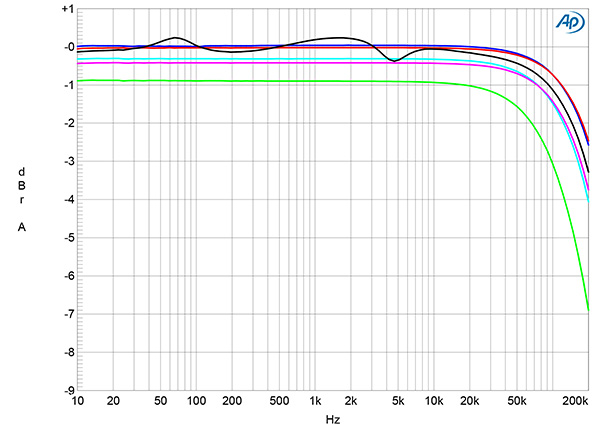
Fig.1 Ayre VX-8, frequency response at 2.83V into: simulated loudspeaker load (gray), 8 ohms (left channel blue, right red), 4 ohms (left cyan, right magenta), and 2 ohms (green) (1dB/vertical div.).
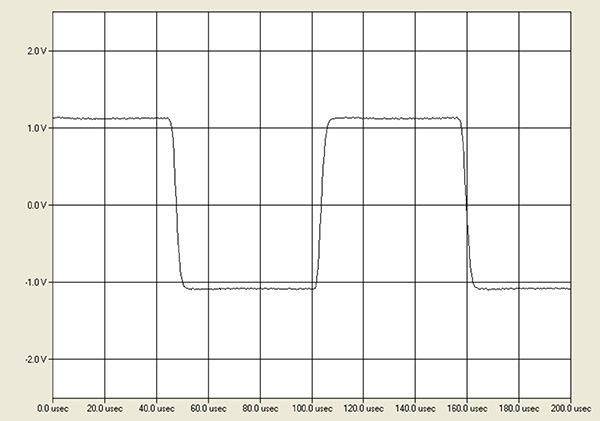
Fig.2 Ayre VX-8, small-signal 10kHz squarewave into 8 ohms.
The loudspeaker output impedance, including the series impedance of 6' of spaced-pair cable, was 0.38 ohms at 20Hz and 1kHz, rising slightly to 0.41 ohms at 20kHz. The resulting variation in the small-signal frequency response with our standard simulated loudspeaker (fig.1, gray trace) was ±0.2dB. The response into resistive loads was flat up to 20kHz and didn't start gently to roll off until an octave above the audioband. The output into 8 ohms (blue and red traces) was down by 2.3dB at 200kHz. The Ayre's reproduction of a 10kHz squarewave into 8 ohms featured very short risetimes (fig.2) with no overshoot or ringing.
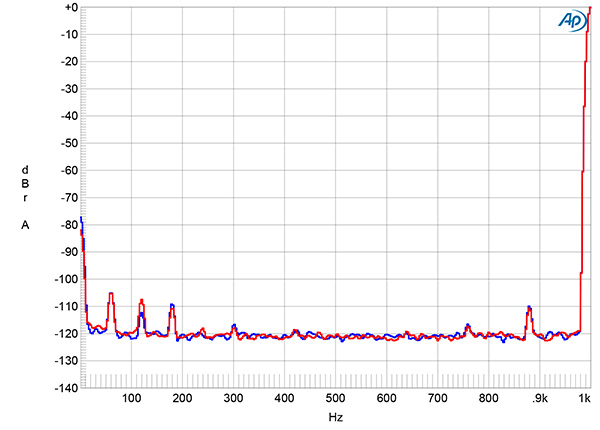
Fig.3 Ayre VX-8, spectrum of 1kHz sinewave, DC–1kHz, at 1Wpc into 8 ohms (linear frequency scale).
Channel separation (not shown) was superb, at >100dB in both directions below 1kHz and still 80dB at the top of the audioband. The unweighted, wideband signal/noise ratio (ref. 1W into 8 ohms), taken with the unbalanced input shorted to ground, was a good 75.5dB in both channels. This ratio improved to 86dB when the measurement bandwidth was restricted to 22Hz–22kHz, and to 88.6dB when A-weighted. While there were some power supply–related spuriae at 60Hz, 120Hz, and 180Hz present in the spectrum of the low-frequency noisefloor while the Ayre drove 1kHz at 1Wpc into 8 ohms, these all lay at or below –110dB (fig.3).
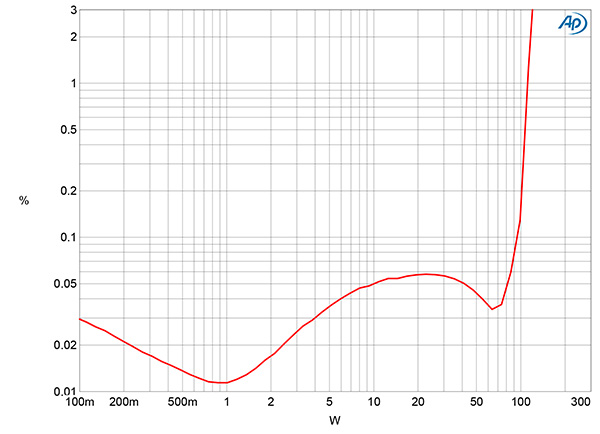
Fig.4 Ayre VX-8, distortion (%) vs 1kHz continuous output power into 8 ohms.
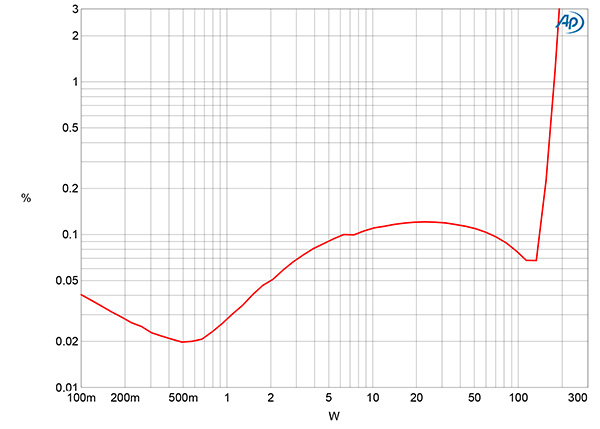
Fig.5 Ayre VX-8, distortion (%) vs 1kHz continuous output power into 4 ohms.
The VX-8 slightly exceeded its specified maximum power of 100Wpc into 8 ohms (20dBW) and 170Wpc into 4 ohms (19.3dBW), clipping (footnote 1) with both channels driven at 110Wpc into 8 ohms (20.42dBW, fig.4) and 176Wpc into 4 ohms (19.44dBW, fig.5). The shape of the traces in these two graphs suggests that the VX-8 uses a limited amount of loop negative feedback. I didn't examine the maximum power into 2 ohms as this isn't specified, though the manual does say that the VX-8 is "stable" into 2 ohms.
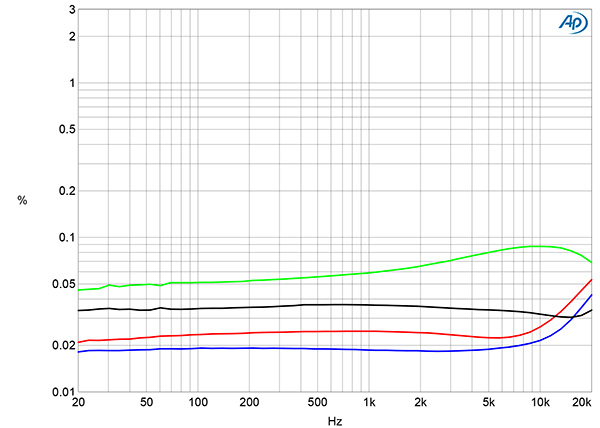
Fig.6 Ayre VX-8, THD+N (%) vs frequency at 12.67V into: 8 ohms (left channel blue, right red) and 4 ohms (left green, right gray).
I ran into problems when I examined how the percentage of THD+N varied with frequency at 12.67V, equivalent to 20W into 8 ohms or 40W into 4 ohms. Into 8 ohms, the amplifier muted its outputs after a couple of minutes at this power, and the front-panel LED flashed red and green. It appeared that the amplifier had overheated, so I powered it down for 20 minutes. I was then able to turn it back on and continue testing. The THD+N percentage at 12.67V was higher in the left channel into both 8 ohms (fig.6, blue trace) and 4 ohms (green trace) than it was in the right channel (red and gray traces). Commendably, there is only a small increase in THD+N in the top audio octaves, which suggests that the Ayre's circuit has a relatively wide open-loop bandwidth. I did note a history effect in that the THD+N percentage, particularly in the left channel into 4 ohms, rose somewhat across the audioband as the amplifier heated up.
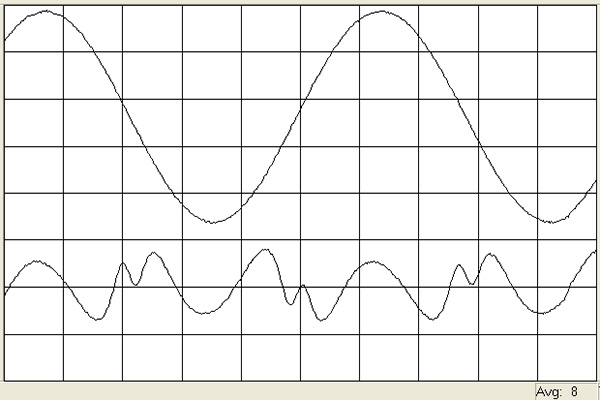
Fig.7 Ayre VX-8, 1kHz waveform at 20W into 8 ohms, 0.05% THD+N (top); distortion and noise waveform with fundamental notched out (bottom, not to scale).
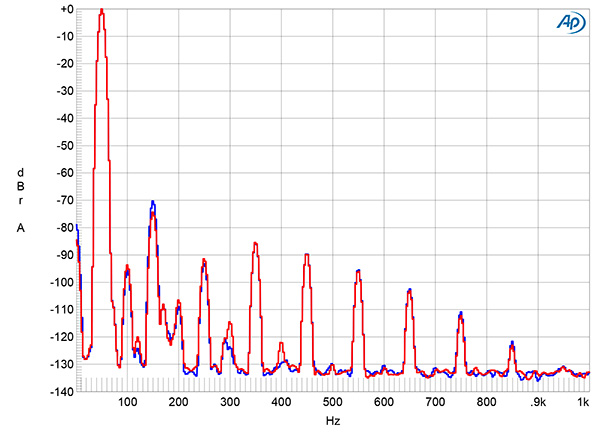
Fig.8 Ayre VX-8, spectrum of 50Hz sinewave, DC–10kHz, at 20Wpc into 8 ohms (left channel blue, right red; linear frequency scale).
The distortion waveform was predominantly the third harmonic (fig.7), at close to –70dB (0.03%) into 8 ohms (fig.8). While some higher-order harmonics can be seen in this graph, these all lie at least 15dB below the level of the third harmonic. The levels of these harmonics did increase by 10dB or so at the same voltage into 4 ohms (not shown).
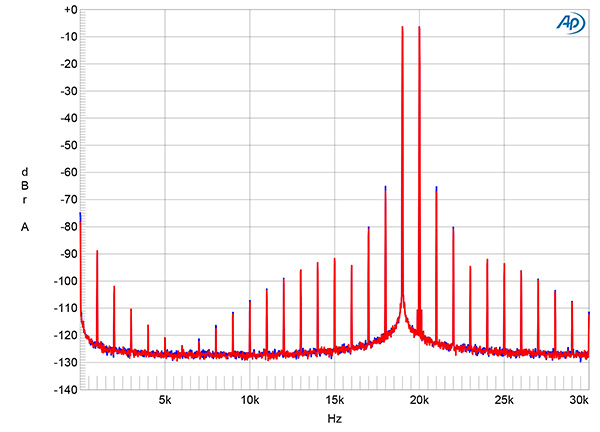
Fig.9 Ayre VX-8, HF intermodulation spectrum, DC–30kHz, 19+20kHz at 40Wpc peak into 4 ohms (linear frequency scale).
The 1kHz difference product resulting from an equal mix of 19 and 20kHz tones at 40W peak into 4 ohms lay at –90dB (0.003%, fig.9). Higher-order intermodulation products are present, bur the highest in level of these lay at –66dB (0.05%).
Footnote 1: Stereophile specifies clipping power as when the THD+noise reaches 1%.