Floor Loudspeaker Reviews

Sort By: Post DateTitle Publish Date

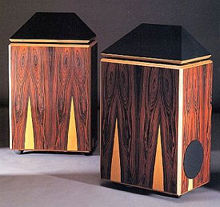
Shahinian Diapason loudspeaker system

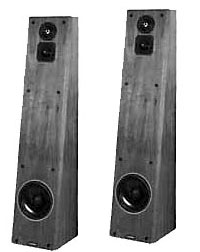
Richard Shahinian has been offering loudspeakers to music lovers for more than 15 years. I use the word "offering" here in its strictest sense, because Dick has never "sold" his products—by pushing them. Indeed, he is probably one of the worst self-promoters in the business. If we think of "soft sell" in the usual context of laid-back and low-pressure, then Shahinian's approach would have to be called "mushy sell."


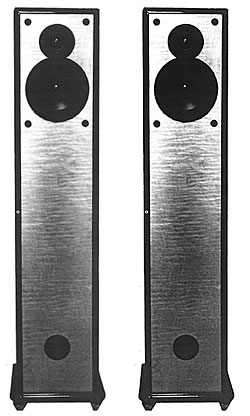
Unity Audio Signature 1 loudspeaker

90unity.promo250.jpgFor anyone who wants to be up to date on all the audio products available in North America, Audio's Annual Equipment Directory is an indispensable source of information. (So is the publication you're reading now, of course.) The 1992 Directory (aka Audio's October issue) arrived when I was finishing up the review of the Acarian Alón IV (see February 1993, Vol.16 No.2) and about to start seriously listening to the Unity Audio Signature 1s. As I leafed through the issue, I wondered how fledgling loudspeaker manufacturers feel reading the section on loudspeakers. According to the Directory, there are 329 makers of speakers (17 more than in 1991) producing no fewer than 2286 different models. How can a new loudspeaker manufacturer compete with the established makes and their marketing clout, brandname recognition, and economics of scale? You'd better have a really good product—or be a genius at promotion.

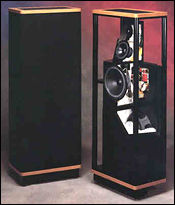
Vandersteen Audio 2Ce loudspeaker

Eighty thousand pairs. According to Vandersteen Audio, that's the number of Vandersteen 2s of various generations which have been sold since the loudspeaker—and company—first saw the light of day in 1977. The 2 has been continually refined along the way—a new driver here, a new crossover change there, heavy-duty stands—more changes, in fact, than the occasional changes in model designation would indicate. The 2's main calling card has always been a high perceived value for money. If anything, this calling card has only been enhanced over the years as its price remained remarkably stable while the cost of high-end audio in general was perceived—rightly or wrongly—as being on a dizzying upward spiral.


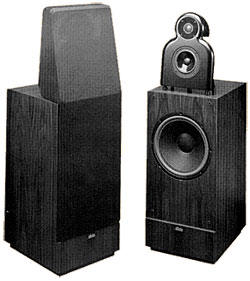
Acarian Alón IV loudspeaker

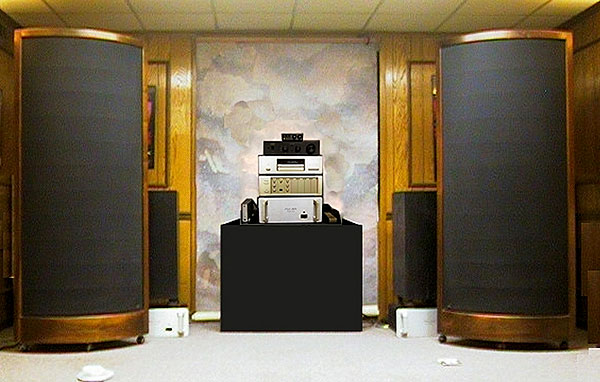
My first encounter with the Acarian Alón IV was at the 1992 Las Vegas WCES. I was doing the show report dealing with speakers, and there was already enough advance buzz about the Alón IV that I put it on my "Speakers I Must Listen To" list. And listen I did, at some length, and came away impressed with their open quality and well-defined soundstage. In discussing reviewing assignments with John Atkinson, I told him that the Alón IV was one of the speakers I wouldn't mind spending some time with. (The list also includes the WAMM, the MartinLogan Statement, and the Apogee Grand, but I'm not holding my breath.)


New England Audio Resource NEAR-50M loudspeaker

666near50m.jpgNew England Audio Resource's NEAR-50M is a cyborg: metal innards in a wooden body. It represents NEAR's top statement in the firm's Metal Diaphragm Technology speaker line, which features the "NEAR-Perfect" driver cone. Metal—in this case an anodized aluminum alloy—is much more rigid than paper or plastic. Hence, a driver with a metal cone acts more nearly as a true piston. When it comes to loudspeaker cones, breaking up is not hard to do. When that happens, the cone flexes in a complex pattern, generating harmonic distortion. A typical plastic or paper 8" woofer may experience its first breakup mode at a frequency as low as 500Hz. The NEAR 8" metal-cone woofer's first breakup mode is said to be well above 2kHz, and their 4" metal-cone midrange does much better than that.

Mirage M-3si loudspeaker

What's 1/16" narrower, over 1/2" shallower, and 3/16" higher than the Mirage">http://www.stereophile.com/floorloudspeakers/1190mirage">Mirage M-3 loudspeaker? The new Mirage M-3si, that's what. Though the published dimensions for the old and new speakers are the same, my eyes told me there was a difference between them when I had them side-by-side in my listening room in Santa Fe. Being the compulsive type, I got out my trusty tape measure. No, my eyes had not deceived me—the M-3si is skinnier and taller. As I waltzed them into position, I sensed they weighed about the same as their predecessors; close enough that setting them on Arcici Super Spikes is a two-man operation. Though either speaker makes a definite presence in a room, I still find their high-gloss, black finish (the only finish available) unassuming, attractive, and elegant.


Sound-Lab A-1 electrostatic loudspeaker

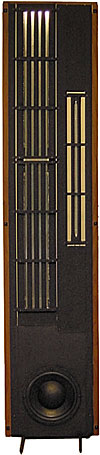
Designer Dr. Roger West got his first taste of electrostatic transducers many years ago during a stint with Janszen (remember the Janszen tweeter?). To realize the potential of the full-range electrostatic loudspeaker (ESL), he and Dr. Dale Ream formed a new company dedicated to ESL research and development. West describes this company, Sound-Lab Corp., as "the electrostatic speaker specialists."

KEF Reference Series 103/4 loudspeaker

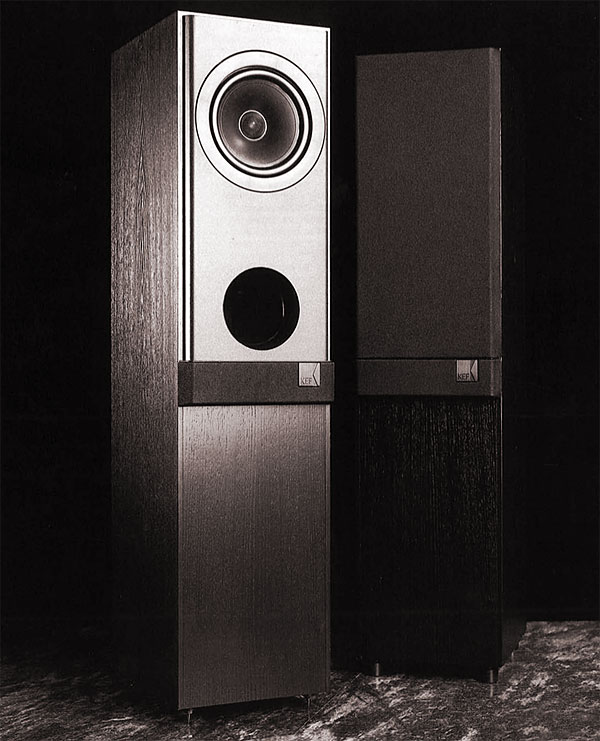
By now most readers will be familiar with the relatively new tuned-cavity method of low-frequency loading. Such designs have popped up all over the place of late, especially in those little satellite/woofer systems, but KEF can rightly lay claim to generating the design's theoretical basis, as JA described in his review of the KEF R107/2 loudspeaker in Vol.14 No.5 (May 1991). Essentially, the technique consists of loading the rear of a woofer in a conventional fashion—usually a sealed box—but also loading the front of the driver into another enclosure, ducted to the outside. Basically, the design acts as a bandpass filter with its response centered on the port-tuning frequency. The rolloff is smooth and rapid on either side of this frequency, providing a natural low-pass characteristic but thereby virtually mandating a three-way system. If properly designed, this configuration offers a number of theoretical advantages. The radiating element is actually the air in the port, which is low in mass. Low distortion is possible, as is relatively high sensitivity.

Paradigm Studio Monitor loudspeaker

692.parapromo.jpgParadigm is not a new name to US audiophiles, but the Canadian loudspeaker company hopes to increase awareness of its products with their Monitor series, all members of which incorporate a similar design philosophy and drive-units. Heavy and apparently massively constructed, the top-of-the-line Paradigm Studio Monitors ($1899/pair) are the first commercial loudspeakers to pass my way with provision for tri-wiring: three sets of terminals on the back of the enclosures provide direct links to the crossover segments feeding each separate driver (or drivers, in the case of the low end).


Those crossovers use quasi-Butterworth filters, but there is, by design, little attempt to correct for driver aberrations in the crossover, a technique which Paradigm does not believe produces the best results. The wood-veneered cabinet is solidly constructed, making use of a combination of high-density composite hardboard and MDF—a technique claimed to reduce uncontrolled resonances. MDF cross-bracing is provided, and four heavy-duty spikes are furnished per speaker. (I used Tonecones in my listening for the simple reason that three spikes are self-leveling, four are not.)

Advertisement
Advertisement
Advertisement