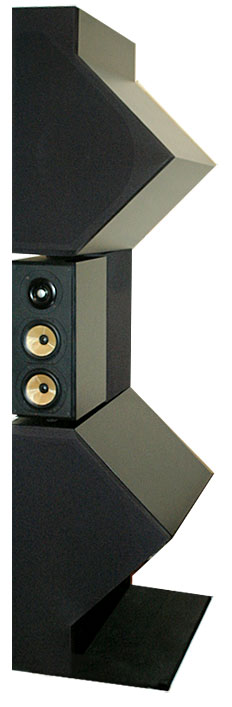
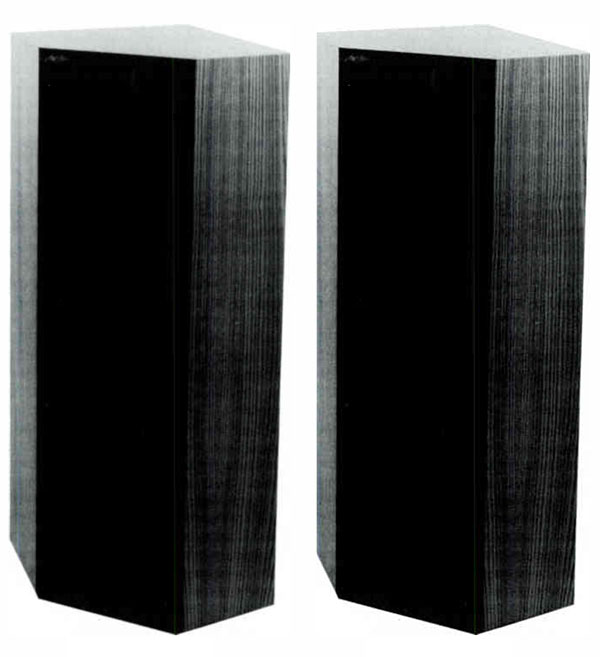
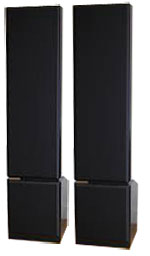
Fried R/4 loudspeaker
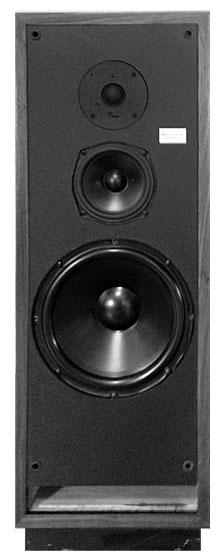 If anyone can be said to be the guru of the transmission line, that would have to be Irving M. "Bud" Fried. He has been promoting the design for years now, first with the made-in-England IMF designs, later with the designs of Fried Products, made right here in the US of A. He has long been convinced of the basic superiority of the design, and still uses it in his top-of-the-line systems. But true transmission lines are invariably big, heavy, hard to build, and, for all of those reasons, expensive. Essentially, they involve a long, convoluted, heavily damped tunnel behind the bass driver which channels the back wave to the outside world. The length and cross-sectional area of the tunnel are of some importance, although the technical basis for the transmission line, as applied to a loudspeaker enclosure, has never been firmly nailed down. Certainly there is no mathematical model for the transmission line as complete as that developed over the past two decades for the sealed or ported box (footnote 1).
But Bud Fried has clung to the transmission line, for all of its complexities. In order to bring at least some of its touted advantages to a lower price point, he had to come up with a variation which would work in a smaller enclosure. That variation was the "line tunnel," which, according to Fried, originated in an early-1970s Ferrograph (a British company specializing in tape recorders) monitor which was later adapted by IMF. Basically it consists of a short (compared with a transmission line) duct from the inside to the outside of the heavily damped enclosure. The duct is designed with approximately the same cross-sectional area as the loudspeaker cone.
 Ask anyone in the street what they think of when they hear the word "loudspeaker" and odds are they'll describe a wooden box with moving-coil drivers sitting in its front. But ask a Stereophile reader and it's quite possible that he or she'll describe a large, flat panel reminiscent of a room divider: in our
 Acoustat Model Twos have been my reference loudspeakers for almost five years. I remember, on first hearing them in a high-end store in Illinois, how they let the music through in a way new and important to me. I knew I must own them! They seemed, despite their imposing appearance, to step aside when the music came on. The effect was akin to having a door opened onto the performance. One became privy to intimate details captured in recordings which are rarely heard outside the concert hall. Not veils, but flannel sheets were lifted from the sound! If one fussed around enough with placement, the Twos truly disappeared into the soundfieldmusic came from in front of, to the sides of, between, and behind them as if they weren't there. Focusing them like a fine camera lens on the listening chair created a "sweet spot" which, when I sat therein, raised within me a sense of awe usually associated with things magical. You knew when you entered this space, for it was different from that surrounding it. The musical presentation assumed an almost holographic palpability.