

Benchmark DAC2 HGC D/A processor/headphone amplifier
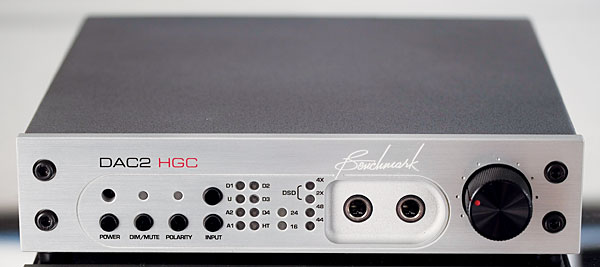
I totally called this one.
In 2007, I spent time with Bel Canto Design's e.One DAC3 D/A processor. In his review of the DAC3 in the November 2007 issue, John Atkinson quoted my comparison of it with the Benchmark DAC1, which I called "the Swiss army knife of audio" and "one of the only future-proof source components you can buy these days."
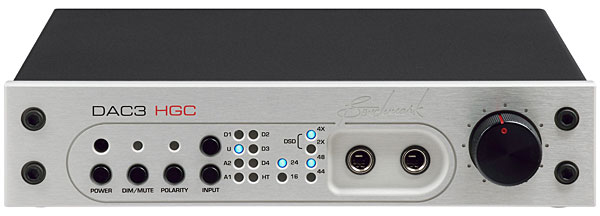
Benchmark DAC3 HGC D/A preamplifier-headphone amplifier
Much has been written about the divide in high-end audio between subjectivists, who trust their ears, and objectivists, who believe that anything not scientifically proven is fake news. I respect both sides and am skeptical of both extremes, and I like to think that's how most audiophiles feel. High-end audio is about experiencing musicthat's the whole pointbut scientific and technological rigor lie behind every real advance, past and future. I regret the cynical snake-oil salesmanship, bad thinking, and clumsy engineering that pervade certain parts of our hobby.
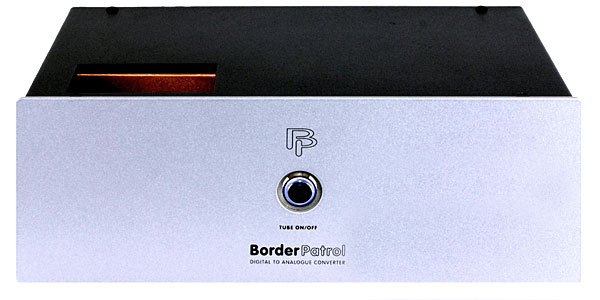
BorderPatrol Digital to Analogue Converter SE
The trouble with a classicist he looks at the sky
He doesn't ask why, he just paints a skyJohn Cale and Lou Reed, "Trouble with Classicists," from Songs for Drella Left brain/right brain, yin/yang, male/female, Apollonian/Dionysian, classical/romantic, painterly/linear, dark/light, hard/soft, warm/cool...I use these contrasting adjectives in my reviews because I feel some confidence in their ability to convey the nature of what I experience while listening to recordings with whatever new audio box sits before me in the listening studio. I also use: accurate (I hate that word), neutral (what's that?), colored, clean, transparent, open, musical. Sadly, I have little confidence in their ability to describe my experiences.
He doesn't ask why, he just paints a skyJohn Cale and Lou Reed, "Trouble with Classicists," from Songs for Drella Left brain/right brain, yin/yang, male/female, Apollonian/Dionysian, classical/romantic, painterly/linear, dark/light, hard/soft, warm/cool...I use these contrasting adjectives in my reviews because I feel some confidence in their ability to convey the nature of what I experience while listening to recordings with whatever new audio box sits before me in the listening studio. I also use: accurate (I hate that word), neutral (what's that?), colored, clean, transparent, open, musical. Sadly, I have little confidence in their ability to describe my experiences.
Boulder 1012 D/A preamplifier
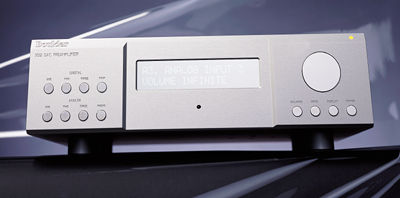
The Boulder 1012's is a line-level preamplifier and DAC in one box. Its design and build qualities are icons to elegant engineering know-how. No screws show on the rectangular box of large but not massive proportions, for example, which is all done up in matte aluminum and set off with a few highly polished stainless-steel buttons. The chassis construction uses tongue-and-groove techniques. The sides of the 1012 benefit from styling cues found on Boulder's newer amplifiers. As you can see from the photograph, the look is both elegant and hi-tech in a way very few other manufacturers manage.
Bricasti Design M1 D/A converter
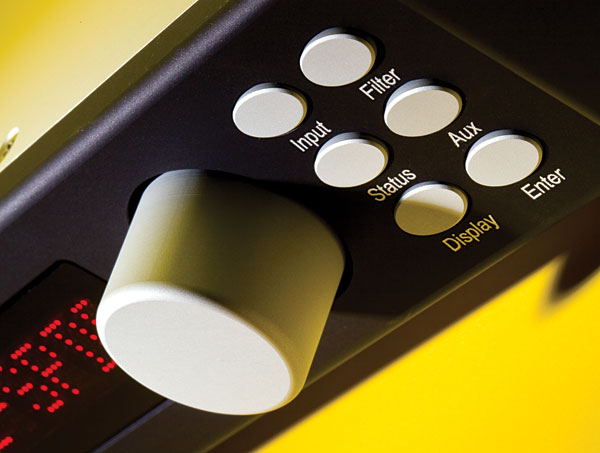
Back in the late 1980s, it seemed a good idea: Separate a CD player's transport section from its D/A circuitry so that each could be optimally designed, and, as D/A technology improved, the sound of your CD player could be upgraded by replacing the outboard D/A processor. The catch was that the transport and D/A chassis needed to be connected with a serial data link: S/PDIF in optical or electrical flavors, or balanced AES/EBU. To minimize the number of cables required, the format of that link embedded the clock data within the audio data, which rendered the link sensitive to interface timing uncertainty, or jitter. (See "Bits Is Bits?," by Malcolm Hawksford and Chris Dunn.)
Bricasti Design M1SE MDX D/A processor
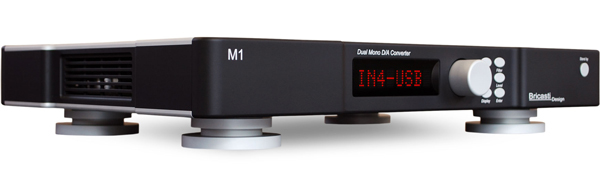
I have owned the SE version of the Bricasti M1 D/A converter for several years. It's my reference DAC. When, recently, I became aware of the availability of the factory-installed MDx Processor Board upgrade, I packed up the M1SE and sent it off to the Bricasti factory, which is in Shirley, Massachusetts, northwest of Boston. The factory-installed MDx upgrade costs $1000a lot less than the $10,000 it costs today to buy a new M1SE with the MDx board.
Bricasti Design M21 D/A processor
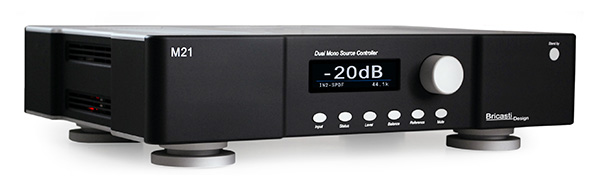
Those of us who review audio equipment, and even audiophiles who don't, often talk about our reference systems. The term implies a certain level of consistency. If you are changing components every week, your system probably lacks the stability to be a true reference. In the case of reviewers, this presents an irony . . .
Brinkmann Audio Nyquist D/A processor
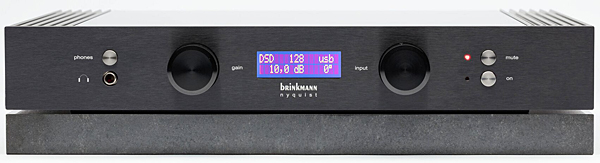
What? Johnny-come-lately turntable manufacturer Brinkmann Audio now makes a DAC? Are they desperate? What sampling rates does it support162/3, 331/3, 45, and 78? I guess the vinyl resurgence is over! Why else would Brinkmann make a DAC?
If that's what you're thinking, consider that Helmut Brinkmann began designing, manufacturing, and marketing electronics well before he made the first of the turntables for which his company is best known in the US.
Bryston BDA-1 D/A converter
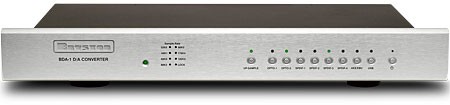
In February 2009, I reviewed Bryston Ltd.'s first CD player, the $2695 BCD-1, and was very impressed by what I heard. The BDA-1 ($1995) is the Canadian company's first standalone DAC. It's slim, only 2.75" high, with the engraved company name, model number, and infrared sensor grouped at the extreme left of a front panel of polished aluminum. Farther to the right are two columns of four LEDs each that comprise the sample-rate indicator, which identifies the selected input's signal frequency and whether the BDA-1 has locked to it. Closer to the center is the Upsample control, which governs the conversion of the incoming digital signal synchronously to 192kHz or 176.4kHz. The Upsample LED turns green for 192kHz, red for 176.4kHz. Digital sources are selected by pressing one of eight pushbuttons just right of center: two TosLink, four S/PDIF (coaxial), one AES/EBU XLR, and one USB 1.1, the last accepting only signals with sample rates at or below 48kHz. An LED above each pushbutton lights green for an incoming PCM datastreams and red for other types, including multichannel Dolby Digital streams.
Bryston BDA-3 D/A processor
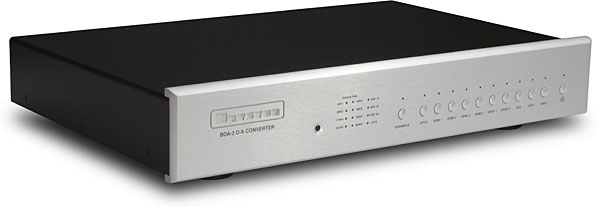
In the February 2010 issue of Stereophile, I reviewed Bryston's first standalone digital-to-analog converter, the BDA-1 ($1995). Five years later, Bryston released the BDA-2, which replaced the BDA-1's 24-bit/192kHz Crystal CS-4398 DAC with a pair of AKM DAC chips in balanced mode. In a February 2016 Follow-Up (footnote 1) I reported that the BDA-2 deepened and widened the BDA-1's soundstage, among other performance gains.