

The Price Event Horizon

Last July and September I made two loudspeaker-related road trips: first to Rockport Technologies, in Maine, to audition their new Lyra; and then to high-end dealer-distributor GTT Audio, in deepest, darkest New Jersey, to audition YG Acoustics' new Sonja XV. Both speakers offer innovative, proprietary drive-units and heroic audio engineering, especially regarding their enclosures, which are constructed from aluminum. Both experiences took place in superbly well-designed and optimized listening rooms with front-end and amplification components that were beyond reproach. The sound quality offered by the Rockport and YGA speakers was simply superb, both stepping entirely out of the way to offer maximum communion with the music.
The Price is Right
In recent months, Stereophile's "Letters" column has been filled with complaints about the equipment we choose to review. "Too rich for my pocketbook" is the universal sentiment. This puzzles me, considering that Stereophile does review many "affordable" components. In part, I think this reaction is due to the high profile invariably associated with very expensive gear. Although we did put both speakers on our cover, one review of a Wilson Grand SLAMM or a JMlab Grand Utopia seems to outweigh 10 reviews of more realistically priced products. Our writers love to cover the cutting edge of audio—witness Martin Colloms's report from HI-FI '96 in this issue—because progress is more easily made when a designer is freed from budget constraints. But without the Grand SLAMM or Utopia, would Wilson have been able to produce the $9000/pair WITT, or JMlab the $900/pair Micron">http://www.stereophile.com/">Micron Carat, to name two high-value, high-performance designs recently reviewed in the magazine?
The Purpose of Music?

Way back when, I met this maenad woman at Caffe Reggio in Greenwich Village and told her I was an artist. She told me she was an art collector and invited me to her loft to see her collection. While she was showing me an impressive assortment of African and contemporary art, she was dropping names: William Burroughs, Bob Marley, John Cage, etc. Hmmm . . . really? I spoke up. "Oh, I love John Cage. What was he like?"
The Pursuit of Audio Excellence
At the time of my August 2011 "As We See It," I was using a Wilson-McIntosh system. That system is still with me and still gets quite a bit of use. Its location, however, has changed. In its place is a system that I can't see switching out or needing to replace: Wilson Alexandria XLF speakers with VTL Siegfried Series II Reference monoblock power amps, TL-7.5 Series III Reference preamplifier, and TP-6.5 Signature phono stage. It might take a small army of people to move it, but beyond that, I think I'm good to go.
The Puzzle of Perception
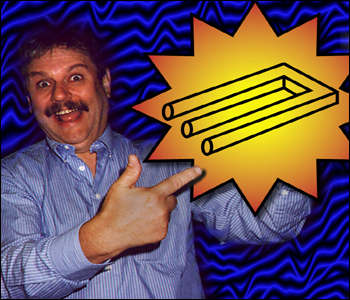
"Nothing is real, and nothing to get hung about."---John Lennon
The Quality Deficit

I grew up with a healthy disrespectalmost a dislikefor rich people. Though my home town, Winchester, Mass., is one of Boston's wealthier suburbs, and my father and grandfather were officers in a Boston-area company, my father grew up on a farm and I seemed to inherit his farm-grown distrust for those who have money.
The Real Thing
At a CES press breakfast in Las Vegas last January, a member of the "all amplifiers (and digital sources!) sound the same" school of audio journalism made an interesting assertion. He argued that if our society were studied by extraterrestrials, they would find an unhealthy obsession with the re-creation of experience at the expense of experience itself. This speculation was a vehicle to support his position that buying good hi-fi is a waste of money; for the same financial outlay, one can attend hundreds, even thousands of live performances. Moreover, this anti-high-end writer suggested that ETs would consider our quest for better music reproduction a bizarre folly when the real thing is so readily available (footnote 1).
The Recording Angel
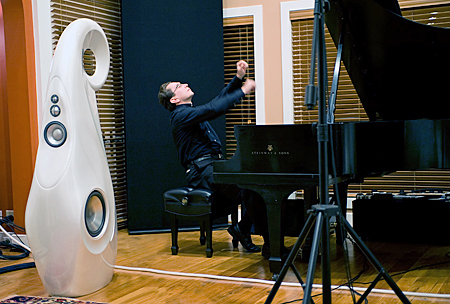
Back in the last century, I mused in this space about the essential difference between recorded sound and the real thing. I had been walking to dinner with friends when I heard the unmistakable sound of live music coming from a window. But here was the kicker: rather than the instruments being of the audiophile-approved acoustic variety, they were two amplified electric guitars. Their sounds were being reproduced by loudspeakers, yet it was unambiguously obvious that it was not a recording being played through those loudspeakers, but real instruments.
The Restorative Power of Music

It was an unusually fine day for a New York September. The W train crept from the subway tunnel into the sunlight of the Manhattan Bridge—"My God, the World Trade Center's on fire!" came the voice of the woman driving the train. I vividly remember what I did the rest of that day—the day the world terribly changed.
The Reviewer's Art

How many times have I asked myself what the purpose of music is? And what music really is, and what exactly I am trying to convey. What feelings? What ideas? How can I explain something that I myself cannot fathom?Gabriel Fauré, letter to his wife, August 31, 1903
In writing reviews for Stereophile, I face a challenge. Whether I'm evaluating an audio component, a recording, or a live performance, I'm confronted by the fact that, when all is said and done, no one fully understands why or how the sound of a particular component, composition, or artist can affect us as powerfully as so many of them do. How and why music and sound moves us remains, fundamentally, a mystery.