

The Collectible Stereophile
Stereophile is finally collectible. Either that, or I'm the biggest audiophile sucker out there. A few weeks back, I finally caved into temptation and signed up for an account on eBay, the website via which millions of folks buy and sell stuff in an online auction, and on which someone once tried to sell a human kidney. (It was not allowed.)
The Colossus of Audio
About 2200 years ago, a Greek writer named Antipater of Sidon compiled a list of the seven wonders of the world, which included a 100'-high statue of the Sun god Helios, erected next to the harbor of Rhodes on the Aegean sea. A of S called it the Colossus of Rhodes, for an obvious reason. Now there's a new Colossus, the derivation of whose name is a little less obvious, but which could justifiably be included in any contemporary listing of the seven wonders of the audio world.
The Commercial Impact of Tariffs (and of Vinyl)

As I write this, the current US president recently put into effect large import tariffs on almost every country except (oddly) Russia and North Korea, then paused for most countries (including EU countries) for 90 days (except for 10%, and then another 10%). The 145% tariff on Chinese exports wasn't paused (except for computers and smartphones).
Tariffs are the dominant force in our industry right now, due partly to the added cost but also to the uncertainty they create. New products, especially those made in China, have been delayed because prices can't be set. Companies in Europe and elsewhere are waiting and seeing; some have implemented or are contemplating price increases; others have decided (for now) to keep prices the same.
The Comparable Cassette
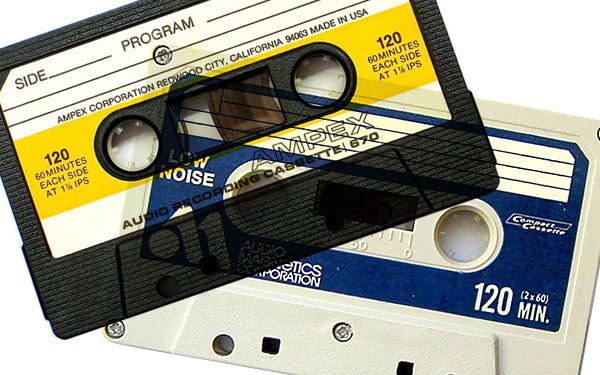
Thanks to two developments and a promise, the compact cassette has finally become, as they say, a force to be reckoned with.
Development one, perhaps the most significant factor in the changing picture, is the ready availability of B-type Dolby devices (which are single-band Dolbys, acting only on hiss frequencies). Advent makes two that can be used with any tape machine, cassette or otherwise, while Fisher, Advent, and Harman-Kardon (as of this moment) are producing cassette recorders with built-in Dolby-B. No doubt there will be others by the time this gets in print.
The Crazy You Get From So Much Choice
I don't know how many of you buy disposable diapers, but while Harry (now 6) and Emily (now 5) were still toddlers, diapers played a large role in my life. I can still remember my panic when I first saw the miles of drugstore shelves devoted to Pampers and Huggies—not just large, medium, and small, but such a variety that it could almost have been possible that each child had a diaper tailored for him or her. I'm sure that even the weirdly shaped backside of Tommy Pickles could have been securely wrapped.
The Day the Music Died
"Phonograph, n. An irritating toy that restores life to dead noises."—Ambrose Bierce (in The Devils's Dictionary, Dover, 1958)
The Day the Music Died

If you're a music fanand if you're reading this, you probably areyou've heard this already: On June 11, the New York Times Magazine published an investigative report about a 2008 fire that destroyed a vault at Universal Studios in Los Angeles.
Workers were repairing a roof on an oft-reused movie set, heating asphalt tiles with a blowtorch. Protocol required the repairmen to stick around for one hour until the asphalt had cooled, to guard against fire. But shortly after they left, a fire broke out. Hundreds of firefighters fought it, pulling water from the lake once inhabited by The Creature from the Black Lagoon.
The Death of an Audiophile
Thanksgiving will mark two years since Charles died. I still miss him.
I first met Charles in the 1990s, around the time I began to review recordings and audio equipment. I had just left my apartment and was driving slowly down the street when I spied a somewhat bent-over, wizened-looking man carrying a copy of Stereophile under his arm. My astonishment at discovering another Stereophile reader whom, it turned out, living just two buildings away, brought my car to a sudden halt.
The Deflavorizing Machine

There's an old Woody Allen bit about his mother running the family's food through a "deflavorizing machine" a couple of times, just to make sure dinner was completely tasteless. Well, that's what a lot of contemporary music sounds like to me. Booker T. Jones's recent album The Road from Memphis has some great tunes, but the sound of the album pales in comparison with his seriously funky work with Booker T. & the MG's in the 1960s. It's not just that the new CD is maximally compressed and processed to a fare-thee-wellit's a totally lifeless recording. But this isn't just another analog vs digital diatribe. The problems have little to do with the recording format; it's the way recordings are now made. Too many are assembled out of bits and pieces of sound to create technically perfect, Auto-Tuned, Pro Tooled music. It's not that great music can't be made that way, but it's sure as hell less likely to get my mojo workin'.
The Digital Genie's Out of the Bottle
In early 2000, the British magazine The Economist published a lead editorial addressing America Online's acquisition of media giant Time Warner. In the editors' view, TW was a clunky, old-style media company that needed a fresh injection of dot-com blood to help them reach a more narrowly targeted audience. "Sex, shopping and violence," the editors wrote, echoing Internet visionary George Gilder, "...are what people have in common. What differentiates them is their enthusiasm for folk music, tropical fish, or Viennese waltzes."