

The High End, Mid-Fi, & Pretend High End
If there's a phrase that increasingly gets my dander up, it's "mid-fi." I'm even starting to lose patience with the term "High End."
The High-End Review
"To be an influence in any society...one can be a little different, but only a little; a little above one's neighbours, but not too much."---C.P. Snow, The Masters, 1951
The Holy Trinity
In an e-mail exchange with Stephen Mejias about why the mere mention of cassette decks on www.stereophile.com can so easily inflame our readers (and John Atkinson), I began to develop the idea that the brains of audiophiles and music lovers are governed by three complementary needs, or desires, that define who we are. I joked to SM that these desires, which apparently shift over time, constitute the Holy Trinity of Audiophiledom. They are, respectively, the love, desire, and need for:
The Importance of the Small Difference
During a recent visit to Canada's National Research Council, I noticed stuck to the wall of the prototype IEC listening room a page of results from one of Floyd Toole's seminal papers on the blind testing of loudspeakers. The scoring system was the one that Floyd developed, and that we adopted for Stereophile's continuing series of blind tests. "0" represents the worst sound that could possibly exist, "10" the perfection of live sound—a telephone, for example, rates a "2." The speakers in Floyd's test pretty much covered the range of possible performance, yet their normalized scoring spread, from the worst to the best, was just 1.9 points.
The Joy of Music
"The whole band was in the hot tub. As water frothed over my bare breasts in the moonlight..."
The Kids Are Alright

It's one of audiophiledom's eternal questions: What can we do to draw more music lovers into the audiophile fold?
Of the proposals bandied about on audio forums, two seem predominant: a) sell stuff more people can afford, and b) sit your neighbor or the cable guy in front of your stereo, cross your fingers, and let 'er ripthe theory behind b) being that the experience will be so epic as to transform the reluctant participant into an audiophile butterfly. As if.
The Last Word on Fidelity
Last October, in Vol.11 No.10, Stereophile's Founder and Chief Tester J">http://www.stereophile.com/interviews/66">J. Gordon Holt stated, in his acerbic editorial "The">http://www.stereophile.com/asweseeit/111">The Acoustical Standard," that, in his opinion, only recordings for which there is an original acoustic reference—ie, typically those of classical music—should be used to evaluate hi-fi components. And that in the absence of a consensus over such a policy, high-end component manufacturers were losing their way over what does and does not represent good sound quality.
The Law and the Prophets: Stereophile's Review Policies
I began writing this essay on New Year's Day 2007. The passing of the old year reminded me that I am now in the 21st year of editing Stereophile, my 25th of being the editor-in-chief of a mainstream audio magazine, and my 31st of working full-time as an audio journalist. (Prior to joining Stereophile in 1986, I had worked for 10 years at British magazine Hi-Fi News & Record Review, the final four as its editor.) Back in the innocent 1970s, reviewers and editors generally picked and chose what products to review based on their own interest and what they felt appropriate for their readers to know about. Back then, there was only a tiny fraction of the audio brands now available to the audiophile, and even with fewer review pages than we now have, it was possible each year to cover a representative sample of the products being offered our readers. But such was the explosion in high-end audio throughout the 1980s that, by 1989, I felt it necessary to impose some restrictions on what products we choose for full review coverage in Stereophile.
The Listening Room: the Forgotten Factor
Question: What is it that almost every audiophile takes for granted, yet has more effect on the sound of his system than does any single component in that system? Answer: His listening room.
The Missing Specification
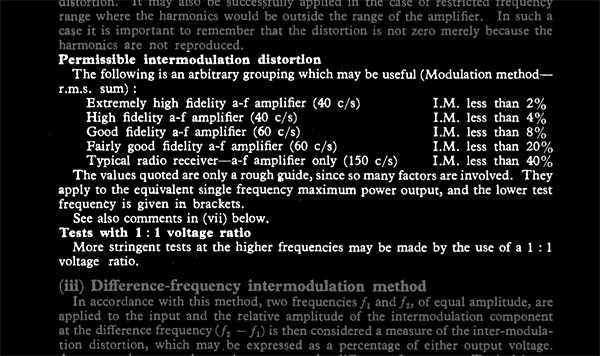
In the 1952 edition of the Radiotron Designer's Handbook, long recognized as the "bible" of the industry, the permissible level of IM distortion for a high-fidelity amplifier was given as 3%, with the alternate figure of 2% being cited as a "rather extreme" specification. We wonder what the author of that statement would think of today's solid-state amplifiers with their measured IM of 0.01% and less. And we wonder what he would think about the fact that these super-amplifiers still have audible distortion.