

Mono, Stereo, Digital: The Three Ages of Man
Caveat: This article is written by a non-audiophile. I own and listen to several thousand recordings through about $2500 worth of a rather motley assortment of audio components. Though very well informed musically, and a disciplined listener, Audiophilia remains for me a storied land. Various desultory discussions with Larry Archibald and John Atkinson, some going back almost two years, about the possibly refreshing, certainly outré (for these pages) outlook of a certified Audio Ignoramus, have finally borne astringent fruit in this diversion of an article.
Morale Will Continue Until The Beatings Improve
If home-gallows prices keep coming down, people won't go to public executions anymore. The home brothel has reduced the amount of cash American men spend each year on banging strangers. And thanks to the home sweatshop, the CEOs of all the major clothing manufacturers have been forced to take pay cuts. (I mean, come on: It was either that or something totally unimaginable, like shipping American jobs overseas, or cutting healthcare benefits for the rank and file.)
More on MQA

An economy of information transmitted . . . what was encoded was only what was needed, nothing more. (footnote 1)
As I wrote in the January issue's "As We See It," Master Quality Authenticated (MQA), the encoding/decoding system developed by J. Robert (Bob) Stuart and Peter Craven, has been widely criticized, despite reports in this magazine and others that MQA-encoded files tend to sound better than the PCM originals from which they were derived. Also in last month's issue, Jim Austin investigated the time-domain performance of the MQA reconstruction filter and I examined some of the more general aspects, ending with: "Other criticisms of MQA involve its implications for the recording industry, for manufacturers of audio products, and for consumers. I will examine those in next month's 'As We See It.'"
Mozart, Editing, & HI-FI '99
"Damned Mozart!"
MP3 & the Marginalization of High End Audio
It was the weirdest orchestral balance I'd ever heard. The gentle woodwind chords that begin Mendelssohn's incidental music to A Midsummer Night's Dream were as loud as the climactic "Wedding March" that ends the piece. The radio broadcast was obviously being compressed to hell. Yet, sitting at the wheel of the rented Vauxhall Vectra I was driving down to Cornwall for an old friend's surprise 50th birthday party, I was actually glad for the compression. Had Classic FM broadcast the Mendelssohn with its true dynamic range intact, the quiet passages would have been irretrievably buried in the road noise and the loud passages would have had me lunging for the volume control, to the possible danger of those sharing England's congested A303 trunk road with me.
MQA again
MQA has once again floated to the surface of the perfectionist-audio pondnot belly-up as some have hoped but forced there by relentless pursuit by anti-MQA predators posing as impartial jellyfish.
MQA: Benefits and Costs

Enough has been said by now about the technical details of how Master Quality Authenticated (MQA) works to fill several books. But the technical details are only part of the story, and probably not the most interesting partand they're certainly not what provokes the extreme emotional responses of many to the format. So let's jump into the business and practical aspects of MQA to which so many audiophiles are reacting.
MQA: Some Claims Examined
"The fundamental problem of communication is that of reproducing at one point either exactly or approximately a message selected at another point."Claude Shannon
Since its announcement at the end of 2014, Master Quality Authenticated, the MQA encoding/decoding system, has spawned outspoken criticism. Some of the more thoughtful negative reactions have come from engineers such as Dan Lavry, Bruno Putzeys, and Daniel Weiss. Others have been expressed by manufacturers of digital products: the late Charley Hansen at Ayre Acoustics, for example, along with Jason Stoddard and Mike Moffat at Schiit Audio, John Siau at Benchmark Media Systems, and Jim Collinson at Linn Products. Some have been audio writers: Doug Schneider, at SoundStage!, and Paul Miller and Jim Lesurf, at Hi-Fi News. Most vociferous have been anonymous website posters. As Jim Austin remarks in his examination of MQA's decoding of impulse-response data elsewhere in this issue, "the nastiness online is unprecedented."
Munich!
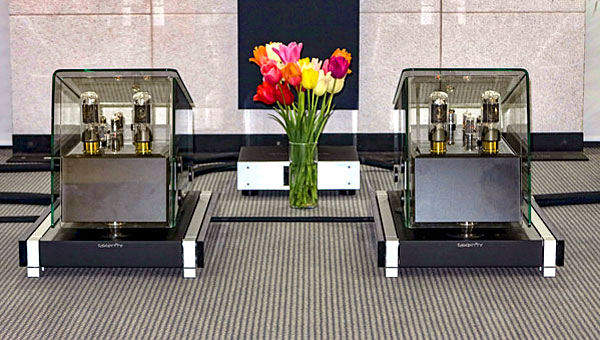
By the time you read this, Munich's High End 2019 will be a distant memory. Yet as I write this, having just returned from Munich, the experience is fresh in my mind. It's the most compelling audio topic I can think of, crying out for commentary.
Munich is to audiophilesto this one at leastwhat New York's 5th Avenue is to Black Friday shoppers. It's the audiophile version of flying through a canyon with a wing suit on. It's a giant rush, audio cocaine.
Music & Fractals
"Why do rhythms and melodies, which are composed of sound, resemble the feelings; while this is not the case for tastes, colors, or smells?"---Aristotle