Note: We now share Rogier van Bakel's final, extensive coverage of the most recent occurrence of Europe's second most important audio show, Audio Video Warsaw. Audio Video Warsaw 2026 will take place this fall, October 23-25, 2026. For Jason Victor Serinus and Rogier's previous Warsaw show coverage, go here.
Author's addendum: Show reports don't always travel at the speed of sound. This one took the scenic route. Some of the products mentioned have since appeared at other shows. The rooms, the conversations, and the sounds heard in Warsaw haven't changed.
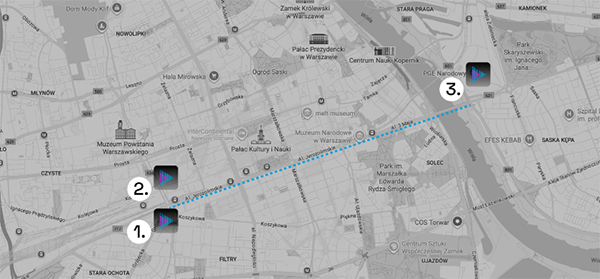
During the 10 days before the most recent high-end show in Warsaw last fall, I got to visit the capitals of Estonia, Latvia, and Lithuania—medieval, cobblestoned cities that invite walking. Poland's capital city, Warsaw, greets you differently: with asphalt and office towers. The Radisson Blu Sobieski and the Golden Tulip, neighboring show venues, are separated by a dozen lanes of criss-crossing traffic. What should be a short walk becomes a high-stakes game of Frogger. Pedestrians are an afterthought. Good luck finding a secondhand bookstore or a bohemian coffee shop—at least in this part of town, which is less than a mile from the gleaming central train station. I learned later that Warsaw does have a quarter that looks centuries old, but it was finished in the 1950s. The Nazis leveled it in World War II, and stoic Varsovians rebuilt it chiefly by using 18th-century paintings, old photographs, and architectural records as their guide. A city that's been through all that has earned the right to believe in its own future.
And in fact, there's something endearing about Warsaw's relentless faith in its own ambition. With its proud skyscrapers, tech startups, and the appreciable sense that the future involves a lot of glass and tech, Warsaw is less a city than a comeback album with great production values. Silicon Valley with worse weather and better vodka.
I'd never visited the Polish audio show before, and there were plenty of surprises. Chief among them was that the audiophiles I met weren't the silver-haired cohort that dominates US shows. I saw couples in their 20s and 30s, and parents with young children in tow.
Good luck finding a secondhand bookstore or a bohemian coffee shop—at least in this part of town, which is less than a mile from the gleaming central train station. I learned later that Warsaw does have a quarter that looks centuries old, but it was finished in the 1950s. The Nazis leveled it in World War II, and stoic Varsovians rebuilt it chiefly by using 18th-century paintings, old photographs, and architectural records as their guide. A city that's been through all that has earned the right to believe in its own future.
And in fact, there's something endearing about Warsaw's relentless faith in its own ambition. With its proud skyscrapers, tech startups, and the appreciable sense that the future involves a lot of glass and tech, Warsaw is less a city than a comeback album with great production values. Silicon Valley with worse weather and better vodka.
I'd never visited the Polish audio show before, and there were plenty of surprises. Chief among them was that the audiophiles I met weren't the silver-haired cohort that dominates US shows. I saw couples in their 20s and 30s, and parents with young children in tow.
 On Friday at the Blu Sobieski, I got to talking with Lukas, an audiophile from Vilnius with a bowl cut à la Javier Bardem in No Country for Old Men. Reassuringly, he carried a bag of vinyl albums instead of a cattle gun.
In near-perfect English, Lukas theorized that Europeans approach hi-fi as part of a broader cultural engagement with music, pursued even on middle-class incomes, while American audiophilia can tip into conspicuous consumption, the gear becoming the point. A broad brush, but worth considering. He attributed the younger European audience partly to stronger social safety nets: less financial anxiety about healthcare and retirement means less guilty second-guessing about spending thousands of Euros (or złoty) on speakers. I nodded. "Or maybe," I offered, "it's that people in apartments invest more in what happens between their four walls." Lukas agreed. "We have only a few rooms to outfit, not half a dozen."
On Friday at the Blu Sobieski, I got to talking with Lukas, an audiophile from Vilnius with a bowl cut à la Javier Bardem in No Country for Old Men. Reassuringly, he carried a bag of vinyl albums instead of a cattle gun.
In near-perfect English, Lukas theorized that Europeans approach hi-fi as part of a broader cultural engagement with music, pursued even on middle-class incomes, while American audiophilia can tip into conspicuous consumption, the gear becoming the point. A broad brush, but worth considering. He attributed the younger European audience partly to stronger social safety nets: less financial anxiety about healthcare and retirement means less guilty second-guessing about spending thousands of Euros (or złoty) on speakers. I nodded. "Or maybe," I offered, "it's that people in apartments invest more in what happens between their four walls." Lukas agreed. "We have only a few rooms to outfit, not half a dozen."
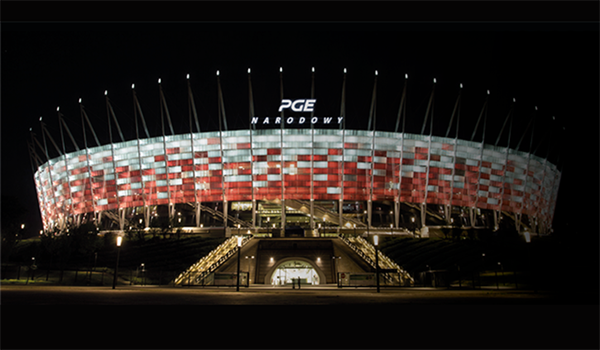 It was time for a taxi to the hulking PGE Narodowy sports stadium that anchors the show. Five miles east of the Sobieski, across the Vistula River, it sits on the site of the old 10th-Anniversary Stadium, a structure literally built from the wartime rubble of the city. There's a jarring wryness to it: $500,000 speakers sitting on a foundation of broken bricks and human calamity. All the same, it's a manifestation of Warsaw's refusal to stay down.
I arrived and took in the slightly bizarre scene. Glass-paneled skyboxes for moneyed soccer fans suddenly housed hundreds of hi-fi systems. Before the application of acoustic treatments, reflections had surely ping-ponged like demented ghosts, but exhibitors knew what to do. They'd gaffer-taped foam wedges to the windows, outfitted corners with bass traps, and hung absorber panels that went mano a mano with parallel surfaces and concrete brutality. Many of the teams achieved a minor miracle. You found yourself in what amounted to an acoustic triage unit and yet somehow, improbably, Billie Holiday or Post Malone sounded like they were actually in the heavily modded space, rather than singing inside a tiled bathroom.
It was time for a taxi to the hulking PGE Narodowy sports stadium that anchors the show. Five miles east of the Sobieski, across the Vistula River, it sits on the site of the old 10th-Anniversary Stadium, a structure literally built from the wartime rubble of the city. There's a jarring wryness to it: $500,000 speakers sitting on a foundation of broken bricks and human calamity. All the same, it's a manifestation of Warsaw's refusal to stay down.
I arrived and took in the slightly bizarre scene. Glass-paneled skyboxes for moneyed soccer fans suddenly housed hundreds of hi-fi systems. Before the application of acoustic treatments, reflections had surely ping-ponged like demented ghosts, but exhibitors knew what to do. They'd gaffer-taped foam wedges to the windows, outfitted corners with bass traps, and hung absorber panels that went mano a mano with parallel surfaces and concrete brutality. Many of the teams achieved a minor miracle. You found yourself in what amounted to an acoustic triage unit and yet somehow, improbably, Billie Holiday or Post Malone sounded like they were actually in the heavily modded space, rather than singing inside a tiled bathroom.
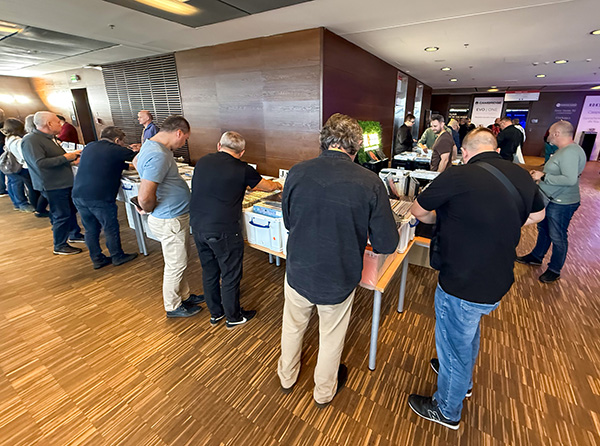
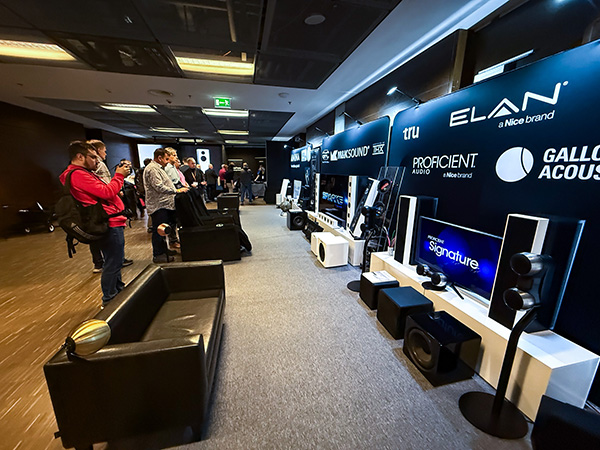 Meanwhile, the visitors were chasing something just as elusive. Everywhere—elevator, stadium, shuttle bus—people had the same question. “What's the best room you've heard today? What shouldn't I miss?” asked Lukas in the lobby. Asked my Stereophile colleague JVS over a hurried cup of tea. Asked journalists Jamie (Belgium) and Sven (Sweden) at the press dinner thrown by Audio Video Show organizer Adam Mokrzycki, who was pulling off the most successful show of his career, with 230 exhibitors and almost 15,000 visitors. And I asked all of them the same thing, because as jaded as some of us are, we all have FOMO and long to be privy to something extraordinary.
Who was the champion, the victor, the uber-alpha? Who knows? In three days, scurrying from room to room as if I were in a double-speed YouTube video, I could only see and hear a fraction of what was on offer. But these 10 rooms are the ones that earned the foot blisters.
Meanwhile, the visitors were chasing something just as elusive. Everywhere—elevator, stadium, shuttle bus—people had the same question. “What's the best room you've heard today? What shouldn't I miss?” asked Lukas in the lobby. Asked my Stereophile colleague JVS over a hurried cup of tea. Asked journalists Jamie (Belgium) and Sven (Sweden) at the press dinner thrown by Audio Video Show organizer Adam Mokrzycki, who was pulling off the most successful show of his career, with 230 exhibitors and almost 15,000 visitors. And I asked all of them the same thing, because as jaded as some of us are, we all have FOMO and long to be privy to something extraordinary.
Who was the champion, the victor, the uber-alpha? Who knows? In three days, scurrying from room to room as if I were in a double-speed YouTube video, I could only see and hear a fraction of what was on offer. But these 10 rooms are the ones that earned the foot blisters.
 VIVID AUDIO
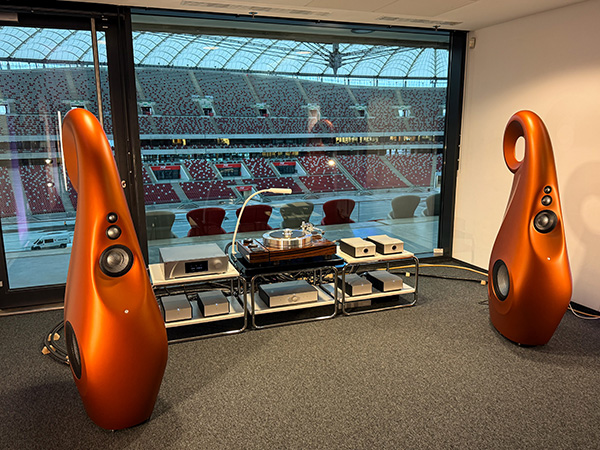
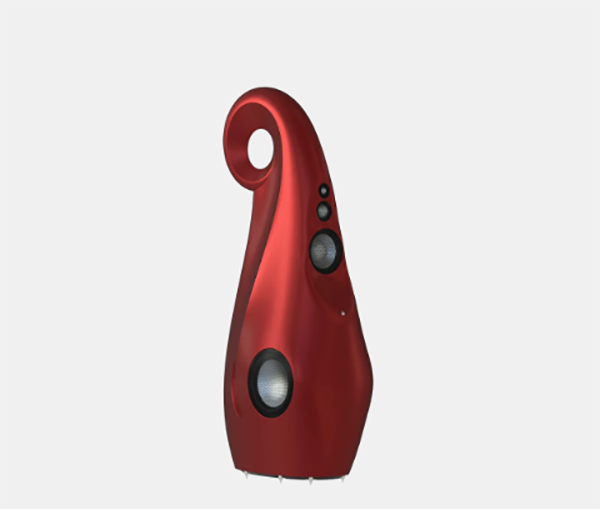
The soccer stadium felt a bit surreal for an audio show—but then, so does the Vivid Audio Giya G1 Spirit Cu speaker. The Spirit has one of the most distinctive silhouettes in audio. The cabinet is a tall, asymmetrical form with no flat surfaces or hard edges anywhere. It tapers and curves in multiple directions, the result being something between a cresting wave and a female figure with a pronounced hip. For whatever reason, the Giyas always remind me of the space-creature soprano in The Fifth Element. Others see a treble clef.
Laurence Dickie, the designer and engineer who'd previously helped birth Bowers & Wilkins' equally futuristic-looking Nautilus speakers, is used to answering questions about the look of his products. "People often mistake Vivid Audio for a design-led company," he told me. "They think that we make our speakers this funny shape for purely cosmetic reasons, but we are in fact purely led by engineering. The Giyas look like the way they do for sonic purposes—first of all, to eliminate diffraction."
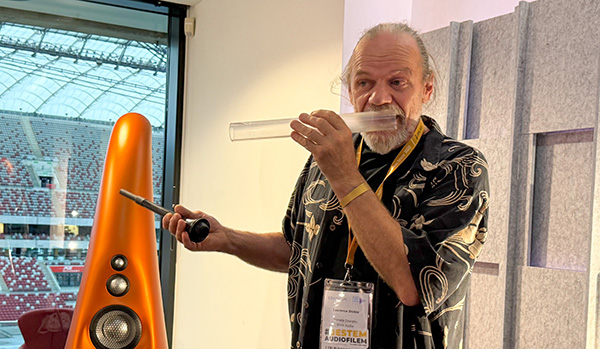 In one of the most engaging presentations I've seen at an audio show, Dickie first blew into a thin metal tube and then turned the crank of a five-dollar pocket-sized music box to demonstrate certain acoustic properties he'd engineered into the Giyas. His rundown is beyond the scope of this report, so I'll just say that you ought to a) find a way to catch Dickie's talk if you can, and b) go listen to the Giyas while you're at it, because they're outstanding.
Team Vivid had brought the Giya G1 Spirit Cu (starting around $100,000/pair) to Warsaw in a pearlescent orange finish that drew visitors to the room before a note was played. The "Cu" (copper) suffix signifies the addition of copper caps to the pole pieces of the upper and lower midrange drivers—sophisticated motor-refinement technology that trickled down from Vivid's statement Moya M1. The G1 Spirit Cu's were powered by two Mola Mola Ossetra monoblock amplifiers ($25,000/pair) making their production debut at the show. Also in the chain: a European Audio Team Forte turntable ($21,000) and a Mola Mola Lupe phono stage ($11,000).
In one of the most engaging presentations I've seen at an audio show, Dickie first blew into a thin metal tube and then turned the crank of a five-dollar pocket-sized music box to demonstrate certain acoustic properties he'd engineered into the Giyas. His rundown is beyond the scope of this report, so I'll just say that you ought to a) find a way to catch Dickie's talk if you can, and b) go listen to the Giyas while you're at it, because they're outstanding.
Team Vivid had brought the Giya G1 Spirit Cu (starting around $100,000/pair) to Warsaw in a pearlescent orange finish that drew visitors to the room before a note was played. The "Cu" (copper) suffix signifies the addition of copper caps to the pole pieces of the upper and lower midrange drivers—sophisticated motor-refinement technology that trickled down from Vivid's statement Moya M1. The G1 Spirit Cu's were powered by two Mola Mola Ossetra monoblock amplifiers ($25,000/pair) making their production debut at the show. Also in the chain: a European Audio Team Forte turntable ($21,000) and a Mola Mola Lupe phono stage ($11,000).
 The system played loudly and effortlessly. Bass was exuberant but at ease, the midrange seductive, the upper register detailed but composed. I can think of few speakers that intrigue me more. Perhaps the audio gods will dispatch a pair of the Giya G1 Spirit Cu's to my listening room in the near future.
Note: The Vivid Audio Giya G1 Spirit Cu speakers will be reviewed by Ola Björling in an upcoming issue of Stereophile. Ola also conducted an interview with Vivid Audio founder and owner Philip Guttentag and Vivid representative Ewald Verkerk to go along with his review, so stay tuned for both postings to come.
The system played loudly and effortlessly. Bass was exuberant but at ease, the midrange seductive, the upper register detailed but composed. I can think of few speakers that intrigue me more. Perhaps the audio gods will dispatch a pair of the Giya G1 Spirit Cu's to my listening room in the near future.
Note: The Vivid Audio Giya G1 Spirit Cu speakers will be reviewed by Ola Björling in an upcoming issue of Stereophile. Ola also conducted an interview with Vivid Audio founder and owner Philip Guttentag and Vivid representative Ewald Verkerk to go along with his review, so stay tuned for both postings to come.
 DUTCH & DUTCH
Next to the cost-no-object systems that were thick on the ground in Warsaw, what seemed like a bargain? It was a then-brand-new contender that scratched just about all my high-end itches—and at a little over $10,000, it's relatively kind to buyers' wallets.
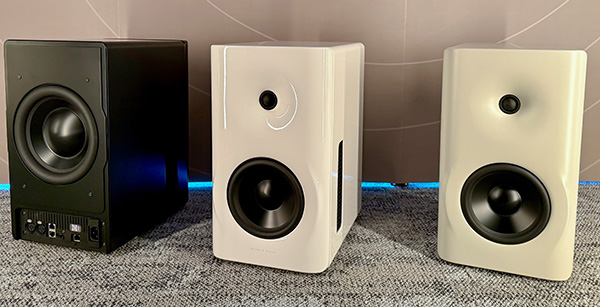
The Dutch & Dutch 6c speakers are the considerably smaller siblings (15 × 8.7 × 12") of the company's signature product, the acclaimed 8c (approx. $18,000/pair). Both speakers are DSP-equipped active systems meant to be used with a networked source like a laptop or tablet. Nothing else is needed.
The measured performance of the 8c's prompted John Atkinson to exclaim, "All I can say is, 'Wow'!" I loved them when I auditioned them back at AXPONA 2023. Based on what I heard in Warsaw, the 6c's aren't a comedown. They're even engineered to outperform the 8c's, once you add bass modules that turn them into floorstanders; Dutch & Dutch calls that the Statement 6, which is expected to cost $33,500 for the full setup. Co-founder and designer Martijn Mensink told me he's trying to kill two birds with one stone: "Some people say they love the 8c, but would like it to be smaller. Others, particularly in the US, would prefer a floorstander."
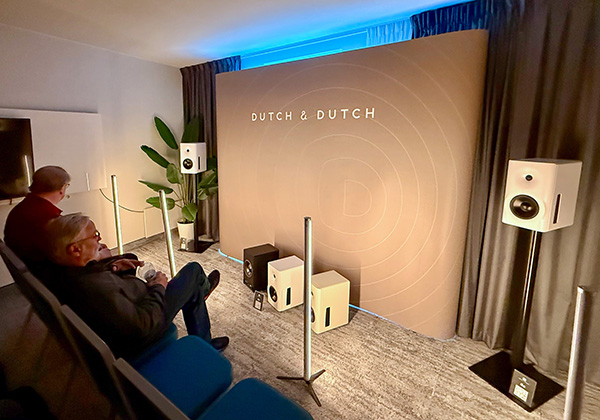 On the show's first day, I popped in for a quick listen, out of curiosity, not intending to write a report. Even without the extension modules, the bass seemed impossibly low and tight. Visitors were told that the 6c's go down to 30Hz on the test bench, but room gain seemed to be delivering 20–25Hz in the standard hotel room.
When JVS and I compared notes, he was less enthused, finding the treble too hot on classical tracks. Doubt crept in. The two pieces I'd heard featured deep, pretty spectacular bass. Had that drawn my attention away from the top end?
I went back the next day with my own playlist: Sinéad O'Connor, Till Brönner, Yinon Muallem. All sounded revealing and right. Then Gordon Goodwin's Big Phat Band burst forth with its rendition of "The Incredibles" (from 2019's The Gordian Knot)—and yes, there was some distracting stridency in the brass. I kept schtumm, but Mensink apparently heard it too. The next day, he texted me: "I decided to decrease the highs by 1.5dB, and that actually did improve the sound. Jason was right."
Kudos to my golden-eared colleague—and to Dutch & Dutch, whose built-in room correction lets users tweak the sound in great detail.
On the show's first day, I popped in for a quick listen, out of curiosity, not intending to write a report. Even without the extension modules, the bass seemed impossibly low and tight. Visitors were told that the 6c's go down to 30Hz on the test bench, but room gain seemed to be delivering 20–25Hz in the standard hotel room.
When JVS and I compared notes, he was less enthused, finding the treble too hot on classical tracks. Doubt crept in. The two pieces I'd heard featured deep, pretty spectacular bass. Had that drawn my attention away from the top end?
I went back the next day with my own playlist: Sinéad O'Connor, Till Brönner, Yinon Muallem. All sounded revealing and right. Then Gordon Goodwin's Big Phat Band burst forth with its rendition of "The Incredibles" (from 2019's The Gordian Knot)—and yes, there was some distracting stridency in the brass. I kept schtumm, but Mensink apparently heard it too. The next day, he texted me: "I decided to decrease the highs by 1.5dB, and that actually did improve the sound. Jason was right."
Kudos to my golden-eared colleague—and to Dutch & Dutch, whose built-in room correction lets users tweak the sound in great detail.
 UNITRA
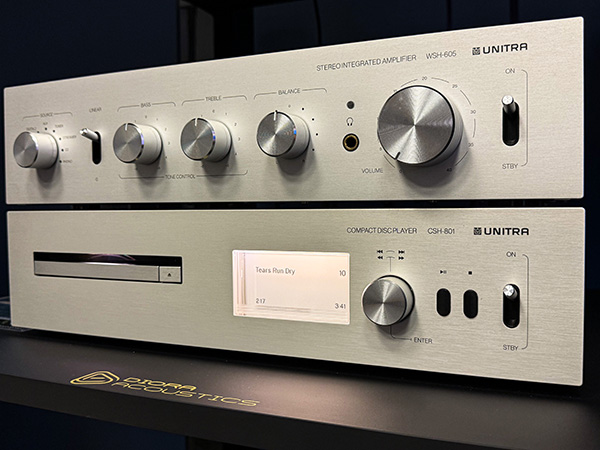
Walking into the Unitra room at the Audio Video Show's soccer stadium locale meant that, depending on your age and your passport, you'd find either a stranger or an old friend. Unitra products were once centerpieces in most Polish homes. Between 1961 and 1989, the brand was an umbrella for a state-directed association of Polish electronics manufacturers (at its peak, 28 companies and 100,000 workers), all turning out radios, amplifiers, and turntables. Then, in 1989, the Soviet Union disintegrated, the market opened, and Unitra was gone within a year, unable to compete with Western brands that flooded the Polish market. Before that wipeout, Unitra had been a source of national pride. Some of its products were good enough that they were manufactured almost entirely for export. Case in point: in the 1970s, the WSH-205 integrated amplifier was well-regarded enough that most of its production run was earmarked for other European countries, leaving Poles largely unable to buy one of their own country's best amps. Six years ago came the comeback: Unitra was revived with a serious cash infusion from Michał Kiciński of CD Projekt, the Polish studio behind The Witcher franchise, a series of role-playing e-games that sold 85 million copies worldwide and spawned a Netflix series. Now, Unitra offers a product line that spans amplifiers, turntables, a CD player, loudspeakers, and cables, all designed and manufactured locally.
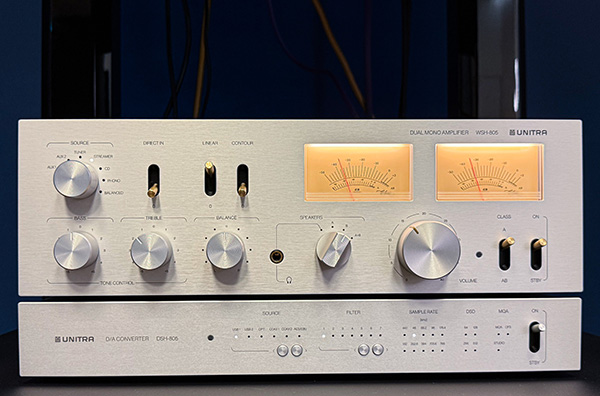 The WSH-805 Classic Edition (about $7,000) is the brand's flagship amp. Designed to evoke the WSH-205 from half a century earlier, it's a dual-mono, fully analog design with American walnut side panels and brass accents that push the 1970s reference hard. Its innards boast 80Wpc into 8 ohms in class-AB, switchable to 8W in pure class-A, with THD of less than 0.0008% at 40W; plus five stereo RCA inputs, one pair of balanced XLRs, a MM/MC phono stage, and headphone jack. The WSH-805, which seems to have borrowed the best of Yamaha's and Onkyo's visual design language, won both a Red Dot Award in 2023 and an iF Design Award in 2025.
The rest of the system drew on Unitra's complete line, which includes two direct-drive turntables, the GSH-630 Fryderyk (roughly $3200, fitted with an Ortofon 2M Red) and the GSH-801 Edmund Classic ($5100, with a 2M Black and an outboard linear power supply). There's also the CSH-801 CD player ($2900) with a TEAC transport, 32-bit ESS Sabre DAC, and e-ink display, and two loudspeaker models: the ZGB-401 standmount ($2400/pair) and the ZGZ-801 three-way floorstander ($6900/pair; shown below).
The WSH-805 Classic Edition (about $7,000) is the brand's flagship amp. Designed to evoke the WSH-205 from half a century earlier, it's a dual-mono, fully analog design with American walnut side panels and brass accents that push the 1970s reference hard. Its innards boast 80Wpc into 8 ohms in class-AB, switchable to 8W in pure class-A, with THD of less than 0.0008% at 40W; plus five stereo RCA inputs, one pair of balanced XLRs, a MM/MC phono stage, and headphone jack. The WSH-805, which seems to have borrowed the best of Yamaha's and Onkyo's visual design language, won both a Red Dot Award in 2023 and an iF Design Award in 2025.
The rest of the system drew on Unitra's complete line, which includes two direct-drive turntables, the GSH-630 Fryderyk (roughly $3200, fitted with an Ortofon 2M Red) and the GSH-801 Edmund Classic ($5100, with a 2M Black and an outboard linear power supply). There's also the CSH-801 CD player ($2900) with a TEAC transport, 32-bit ESS Sabre DAC, and e-ink display, and two loudspeaker models: the ZGB-401 standmount ($2400/pair) and the ZGZ-801 three-way floorstander ($6900/pair; shown below).
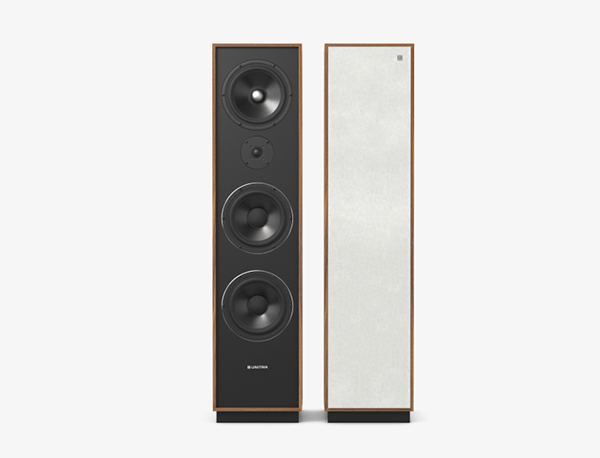 I listened to the latter, driven by Unitra's WSH-805 amp, and found the sound slightly sweet—in a good way. Chris Jones's "No Sanctuary Here" (from the 2016 2LP version of 2003's Roadhouses & Automobiles) and Malia and Boris Blank's "Celestial Echo" (the opening track on 2014's Convergence) were like a good kielbasa: meaty, snappy, and satisfying.
Can Unitra succeed internationally? The UK launch back in July 2025, through distributor The Audio Business, was the first serious (and ongoing) test. Audionation in Ottawa has inked the brand for a Canadian distribution deal. US distribution is said to be in the works, so I'm keeping my eyes and ears open.
I listened to the latter, driven by Unitra's WSH-805 amp, and found the sound slightly sweet—in a good way. Chris Jones's "No Sanctuary Here" (from the 2016 2LP version of 2003's Roadhouses & Automobiles) and Malia and Boris Blank's "Celestial Echo" (the opening track on 2014's Convergence) were like a good kielbasa: meaty, snappy, and satisfying.
Can Unitra succeed internationally? The UK launch back in July 2025, through distributor The Audio Business, was the first serious (and ongoing) test. Audionation in Ottawa has inked the brand for a Canadian distribution deal. US distribution is said to be in the works, so I'm keeping my eyes and ears open.
 FOCAL AND NAIM
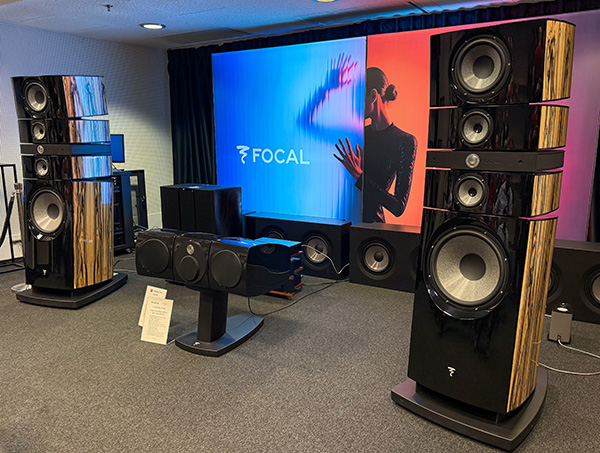
In Warsaw, Focal and Naim had put together what they billed as the world's first 7.4.4 Dolby Atmos setup built with speakers in the flagship Utopia range. A pair of top-of-the-line Grande Utopia EM Evo towers (one is shown below) appeared at the front, nearly 2m tall and 584lb apiece. The Naim Statement amplification driving them—746 watts per monoblock into 8 ohms—was a perfect match, and an always-humorous one considering that 746 watts equals 1 horsepower. Score one for British engineering wit. But of course, the system, which by my count carried at least an $820,000 price tag, was no laughing matter. It further consisted of a Viva Center Utopia Evo for the center channel; four Utopia 1000 IW LCR speakers with 1000 IW SUB subwoofers handling surround duties; 1000 IC LCR 5 in-ceiling speakers forming the Atmos height layer; and four Focal Cinema Utopia Sub subwoofers, each powered by its own Naim CI-NAP-101 amplifier. The stereo source was a Naim ND 555 streamer supported by two external 555 DR power supplies. Atmos processing fell to a Marantz AV 10, with a Marantz AMP 10 driving the surround channels.
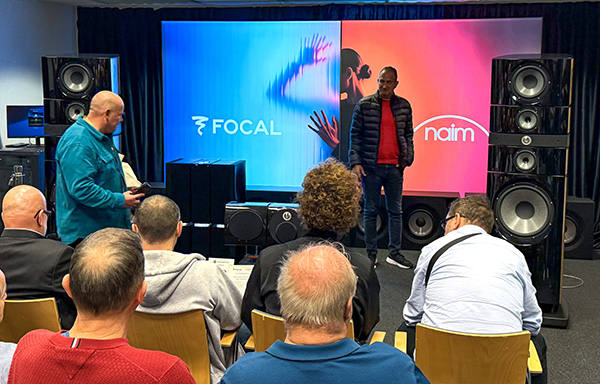 The demonstration was accompanied by a panel that included Grammy-winning mixing engineer Jacek Gawłowski, who has over 500 Atmos mixes to his credit. I got the impression that only the Polish contingent in the room felt buoyed by the local pop music we were subjected to; some of the non-Poles began shifting in their seats and eyeing the exits.
I'd heard the Grande Utopias and the Naim hardware at several other shows, and it was a pulse-quickening experience every time. In Warsaw, the magic wasn't quite there, though I had to suspend sonic judgments under the barrage of overly happy-clappy and gimmicky source material. (On the other hand, I appreciate every day I don't have sit through another playback of the Eagles' "Hotel California.")
Coda: Belgian cinema projection company Barco recently announced that it had agreed to acquire VerVent Audio, Focal and Naim's parent, for $155 million. It wouldn't surprise me if the deal had already been in the works before the Polish show. That Warsaw Atmos extravaganza foreshadowed the kind of integrated audiovisual future that I reckon VerVent's new owner often dreams about.
The demonstration was accompanied by a panel that included Grammy-winning mixing engineer Jacek Gawłowski, who has over 500 Atmos mixes to his credit. I got the impression that only the Polish contingent in the room felt buoyed by the local pop music we were subjected to; some of the non-Poles began shifting in their seats and eyeing the exits.
I'd heard the Grande Utopias and the Naim hardware at several other shows, and it was a pulse-quickening experience every time. In Warsaw, the magic wasn't quite there, though I had to suspend sonic judgments under the barrage of overly happy-clappy and gimmicky source material. (On the other hand, I appreciate every day I don't have sit through another playback of the Eagles' "Hotel California.")
Coda: Belgian cinema projection company Barco recently announced that it had agreed to acquire VerVent Audio, Focal and Naim's parent, for $155 million. It wouldn't surprise me if the deal had already been in the works before the Polish show. That Warsaw Atmos extravaganza foreshadowed the kind of integrated audiovisual future that I reckon VerVent's new owner often dreams about.
 DYNAUDIO, CIRCLE LABS, AND SILENT ANGEL
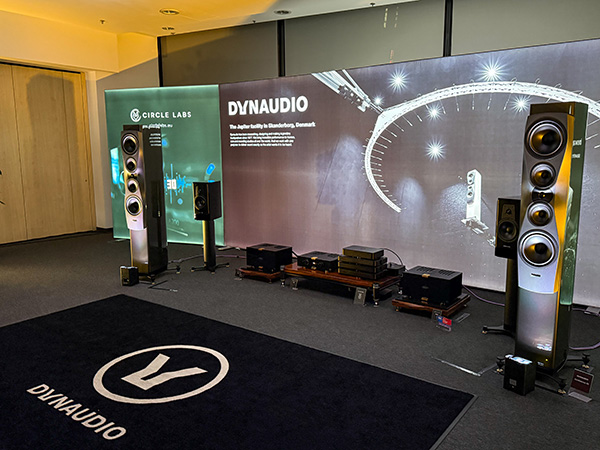
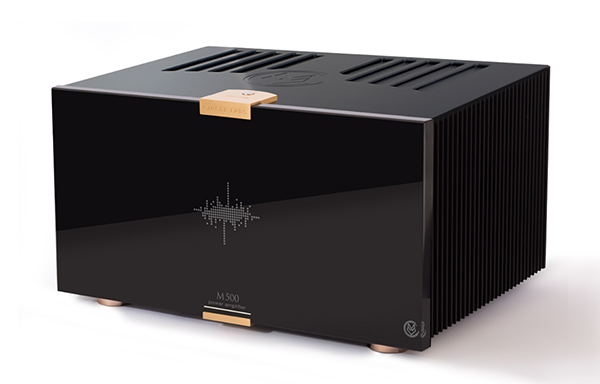
Nautilus Poland, Dynaudio's local distributor, had booked the London A room, one of the largest in the stadium. There, two different Dynaudio loudspeaker models did a yeoman's work. The Confidence 60 ($50,000/pair; one is shown below), Dynaudio's flagship floorstander, was the anchor. Alongside it, on stands, sat the Contour 20 Black Edition ($8,000/pair), an all-black two-way introduced in 2025, featuring Dynaudio's top-shelf Esotar 3 tweeter and a newly designed woofer carried over from the Confidence line. The digital front end was from Silent Angel, a brand with R&D roots in Taiwan and Hong Kong that has earned a following in Europe for its audio-grade networking products. The stack comprised five components, all bargains as far as I could tell: the Munich streamer ($799), the Rhein music server ($1999), the Forester linear power supply ($649), the Genesis 10MHz word clock ($1899), and the Bonn N8 network switch ($599). Amplification was handled by Polish brand Circle Labs, a Kraków-based company whose hybrid approach combines a tube input stage with a solid-state output design. The P300 preamplifier (about $6000, converted from Euros) uses JFET and BJT transistors in a fully balanced, shortest-possible-signal-path topology. Driving the Confidence 60s was the M500 (roughly $16,000; shown below), a hybrid stereo amplifier making its world premiere in Warsaw. In monoblock configuration, as demo'ed, each M500 delivers 600Wpc into 8 ohms. The input stage is built around a single ECC88/6922 triode, coupled through a Mundorf Silver Gold Oil capacitor into a solid-state output stage.
 After I settled into my seat, I was struck by how well the Confidence 60s filled the outsized space. My surprise doubled when I realized my error: I was in fact listening to the modest-looking speakers right next to them, the Contour 20 Black Editions, which sounded perfectly self-assured, imparting LF extension like nobody's business. On Eva Cassidy's "Stormy Monday," recorded live at Washington, DC’s Blues Alley, the speakers easily conveyed the venue's spatial cues. Not too shabby for a two-channel recording. Even "Dimestore Diamond" by Gossip (from 2009's Music for Men), featuring a brutal snare and kickdrum part, sounded convincing, though now a bit of strain showed up around the notes' edges.
Next, via the Confidence 60s, we listened to "I Can't Outrun You" by Trace Adkins (originally from 2008's X (Ten)). His burnished baritone sounded lifelike and present, while the quiet piano chords were beautifully rounded. "Like you could reach out and touch the keys," I scribbled.
After I settled into my seat, I was struck by how well the Confidence 60s filled the outsized space. My surprise doubled when I realized my error: I was in fact listening to the modest-looking speakers right next to them, the Contour 20 Black Editions, which sounded perfectly self-assured, imparting LF extension like nobody's business. On Eva Cassidy's "Stormy Monday," recorded live at Washington, DC’s Blues Alley, the speakers easily conveyed the venue's spatial cues. Not too shabby for a two-channel recording. Even "Dimestore Diamond" by Gossip (from 2009's Music for Men), featuring a brutal snare and kickdrum part, sounded convincing, though now a bit of strain showed up around the notes' edges.
Next, via the Confidence 60s, we listened to "I Can't Outrun You" by Trace Adkins (originally from 2008's X (Ten)). His burnished baritone sounded lifelike and present, while the quiet piano chords were beautifully rounded. "Like you could reach out and touch the keys," I scribbled.
 KROMA, TAIKO, AND YPSILON
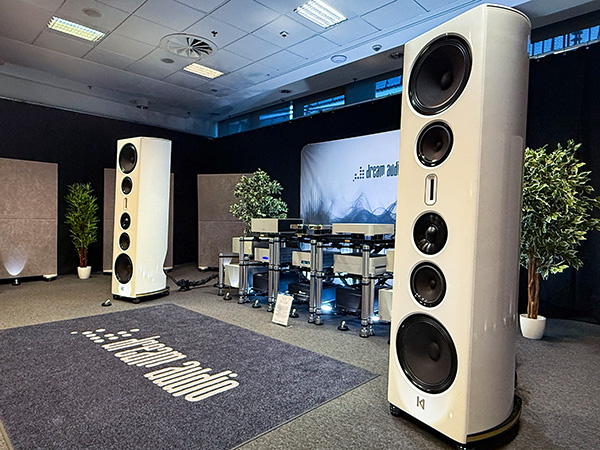
Among the most eye- and ear-catching speakers I encountered in Warsaw were a pair of Kroma Atelier Maribels (shown below) making their world premiere, towering at 6'7" and weighing 485lb apiece. Kroma Atelier is a Spanish company led by Javier Millán Sr., who has been designing and building loudspeakers since he was 14 years old. His son, Javier Millán Jr., grew up in the workshop. The Maribels are their joint statement, built without budget constraints or compromise.
The cabinet is constructed entirely from Krion, a dense composite chosen for its rigidity and non-magnetic properties. Internally, the "Silent Cavity" system employs a complex labyrinth of expansion chambers, ducts, and resonators, combined with "Phase-Lock" open-cell foam panels—a proprietary acoustic treatment designed to manage driver back-waves and internal pressure without the need for electronic correction.
The Maribels' driver complement spans dual AMT tweeters (one mounted horizontally in the back), a 3" dome midrange, two 8" paper-cone mid-woofers, and two 15" paper-cone woofers—all modified Scan-Speak units. Internal wiring consists of high-purity copper, silver, and gold.
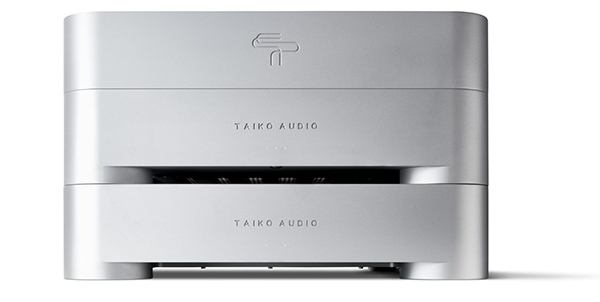 Dream Audio—a Warsaw-based high-end distributor that represents Kroma in Poland—had pulled together a Taiko Olympus server from the Netherlands ($95,000; shown above), Ypsilon Silver Edition amplifiers from Greece (price TBD), Stage III Concepts cables and Carbide Audio isolators from the US, and Telos Audio Design power products from Taiwan.
The Maribels' MSRP is $440,000/pair. I found them terrific in almost every way, my only reservation being that they didn't play as big as they looked at lower volumes. But turning up the music meant increasing the scale. Versatility was great: One moment, with Chantal Chamberland's "Beautiful Life" (from 2019's Temptation), the Kromas took on a smoky and intimate persona; next, they unleashed holy hell and furious foot-tapping via Metallica's "Enter Sandman" (originally from 1991's Metallica, a.k.a. The Black Album).
Dream Audio—a Warsaw-based high-end distributor that represents Kroma in Poland—had pulled together a Taiko Olympus server from the Netherlands ($95,000; shown above), Ypsilon Silver Edition amplifiers from Greece (price TBD), Stage III Concepts cables and Carbide Audio isolators from the US, and Telos Audio Design power products from Taiwan.
The Maribels' MSRP is $440,000/pair. I found them terrific in almost every way, my only reservation being that they didn't play as big as they looked at lower volumes. But turning up the music meant increasing the scale. Versatility was great: One moment, with Chantal Chamberland's "Beautiful Life" (from 2019's Temptation), the Kromas took on a smoky and intimate persona; next, they unleashed holy hell and furious foot-tapping via Metallica's "Enter Sandman" (originally from 1991's Metallica, a.k.a. The Black Album).
 ELECTROCOMPANIET AND ROCKPORT
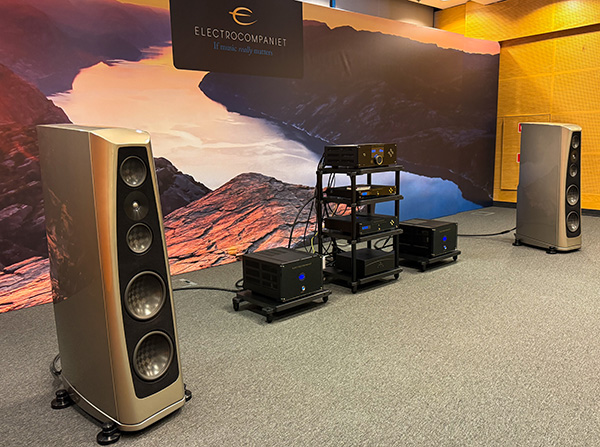
Like Dynaudio, Rockport and Electrocompaniet occupied one of the larger demo spaces in the soccer stadium, with about the square footage of a tennis court. (Borscht Belt comedian: "And what a racket it was!" Badum tish.) That really big room notwithstanding, the system was one of the more impressive and coherent of the show. Before I heard it, I already had chills, but that was because Electrocompaniet’s sales and marketing director Lasse Danielsen talked about the photo mural of Preikestolen (Pulpit Rock), a famous cliff near Stavanger that yours truly, vertigo notwithstanding, hiked to about a decade ago.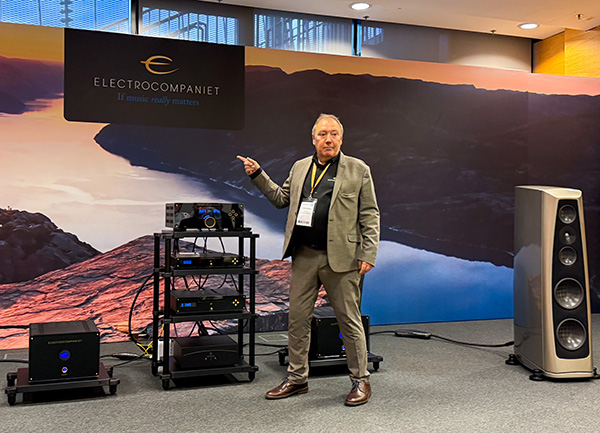 Danielsen told his audience matter-of-factly that Preikestolen will eventually break off and plunge into the Lysefjord 2000 feet below. Could be tomorrow, could be 500 years from now. When it does, he said, "it will wipe out Stavanger," Norway's fourth-largest city. The message appeared to be that we live on borrowed time, and we might as well spoil ourselves with audio baubles while we still can.
The speakers in the room were Rockport Technologies' Lyras ($215,000/pair), the Maine company's flagship product. They're not the most imposing loudspeakers physically, which made their command of the vast room all the more notable. Driving them were Electrocompaniet AW 800 M monoblock amplifiers ($45,000/pair), the company's current top-of-the-line power amps, delivering 800 watts into 8 ohms and weighing 122 pounds each. The new EC 5 Reference preamplifier (expected to cost around $17,000) was fed by two sources: an EMC 1 MkV SE CD player ($6,800) and an ECM 1 MKII streaming DAC ($6,000). Cables from Transparent did the rest.
Danielsen told his audience matter-of-factly that Preikestolen will eventually break off and plunge into the Lysefjord 2000 feet below. Could be tomorrow, could be 500 years from now. When it does, he said, "it will wipe out Stavanger," Norway's fourth-largest city. The message appeared to be that we live on borrowed time, and we might as well spoil ourselves with audio baubles while we still can.
The speakers in the room were Rockport Technologies' Lyras ($215,000/pair), the Maine company's flagship product. They're not the most imposing loudspeakers physically, which made their command of the vast room all the more notable. Driving them were Electrocompaniet AW 800 M monoblock amplifiers ($45,000/pair), the company's current top-of-the-line power amps, delivering 800 watts into 8 ohms and weighing 122 pounds each. The new EC 5 Reference preamplifier (expected to cost around $17,000) was fed by two sources: an EMC 1 MkV SE CD player ($6,800) and an ECM 1 MKII streaming DAC ($6,000). Cables from Transparent did the rest.
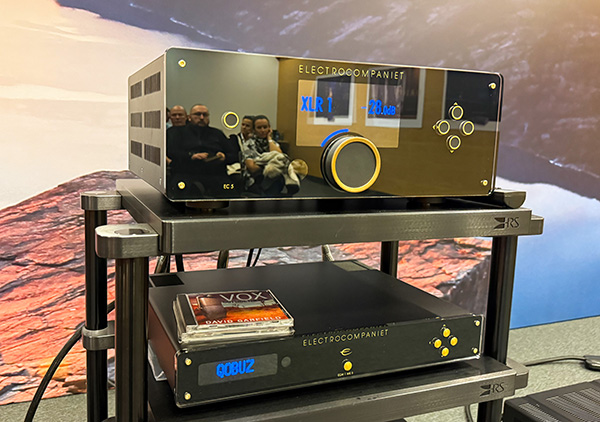 The Lyras' bass was deep and textured; also, fast and unhurried at the same time. The midrange had the bloom and presence Electrocompaniet is known for. The company calls it its "Nordic Sound"—warm but not soft, detailed without edge. I loved Dominique Fils-Aimé's "Birds" (from 2018's Nameless) via the Rockport-Electrocompaniet combo, each plosive and unselfconscious lip smack exquisitely reproduced. Though I had other rooms to visit, it was hard to find a compelling enough reason to leave.
 ONEIROS AUDIO
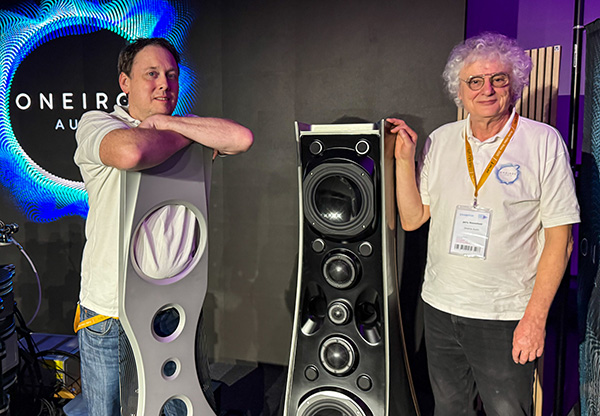
I'm not exactly given to excessive flattery or chummy asides, but I'll say this: Though I'd never met Jerry Bloomfield before, I felt like I'd known him for ages by the time I left the Oneiros Audio room. That was unexpected, because I admit that when introduced to speakers that cost well over half a million dollars, I brace for a presentation with bombastic marketing-speak and shrewd razzle-dazzle.
There was to be none of that. Bloomfield's slightly manic demeanor and his unruly white hair call to mind a dippy Albert Einstein working on a flux capacitor. He played the vinyl version of John Martyn's 1977 release One World on the room's megabuck rig (it sounded beguiling). I smiled with recognition and pleasure, he noticed a kindred spirit, and 15 minutes later, the Brit and I were conversing intensely about everything from our favorite music to our spouses and children.
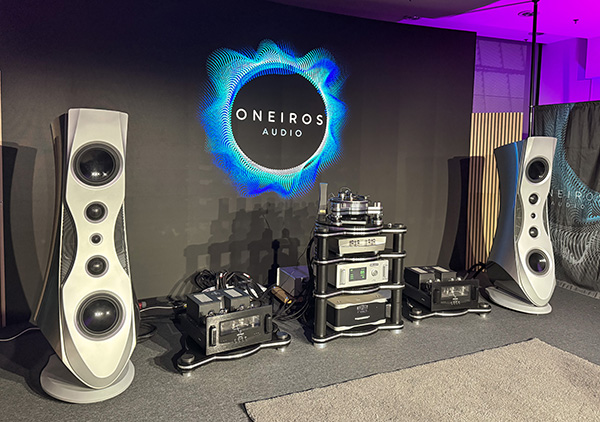 The speaker at the center of the room was the Oneiros (Greek for dream), making its European continental debut in Warsaw after earlier launches in New York and London. The design comes from Bloomfield and his business partner Graeme Bridge. Together, they've run Falcon Acoustics since 2009. Falcon is best known for its faithful recreation of the BBC LS3/5a's. A pair of those classic speakers can be had for a couple of grand.
That kind of money would barely buy you the binding posts on the Oneiros. The price-no-object towers will set you back at least $549,500/pair. Each Oneiros stands about 5'6" tall, weighs 264lb, and is built from a monocoque carbon-fiber cabinet built up in layers and fused under heat and pressure. That's the same construction method used to make Formula 1 car bodies. Not coincidentally, Oneiros Audio is headquartered in "Motorsport Valley," the area around the Silverstone motor racing circuit where many F1 cars have seen the light. Bloomfield said that gives his company access to a high concentration of advanced engineering and materials skills.
Speaking of: The front baffle is a single billet of aluminum, CNC-machined down from over 1200lb to 48lb. It can't be done any other way, I was told: A complex shape like the Oneiros baffle requires curves, undercuts, and contours from a single piece with no seams or joins, so you need an aluminum block large enough for the machine to reach into it from multiple angles and excavate the full geometry.
The speaker at the center of the room was the Oneiros (Greek for dream), making its European continental debut in Warsaw after earlier launches in New York and London. The design comes from Bloomfield and his business partner Graeme Bridge. Together, they've run Falcon Acoustics since 2009. Falcon is best known for its faithful recreation of the BBC LS3/5a's. A pair of those classic speakers can be had for a couple of grand.
That kind of money would barely buy you the binding posts on the Oneiros. The price-no-object towers will set you back at least $549,500/pair. Each Oneiros stands about 5'6" tall, weighs 264lb, and is built from a monocoque carbon-fiber cabinet built up in layers and fused under heat and pressure. That's the same construction method used to make Formula 1 car bodies. Not coincidentally, Oneiros Audio is headquartered in "Motorsport Valley," the area around the Silverstone motor racing circuit where many F1 cars have seen the light. Bloomfield said that gives his company access to a high concentration of advanced engineering and materials skills.
Speaking of: The front baffle is a single billet of aluminum, CNC-machined down from over 1200lb to 48lb. It can't be done any other way, I was told: A complex shape like the Oneiros baffle requires curves, undercuts, and contours from a single piece with no seams or joins, so you need an aluminum block large enough for the machine to reach into it from multiple angles and excavate the full geometry.
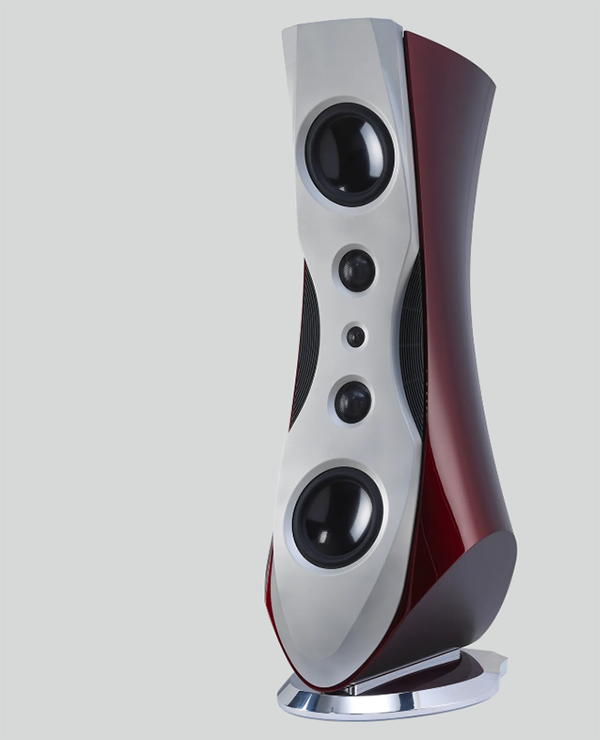 I like the speakers' carbon-fiber skin, but if you prefer natural wood veneer, prepare to spend just a leetle more. Graeme Bridge told me that due to the complex shape of the cabinet, the wood skin can only be applied by one facility in the world, in Germany, at a surcharge from $40,000/pair for standard veneers to $170,000/pair for certain rare and "complicated" ones.
The Oneiros drivers are two 10" Twaron graphene nano-composite woofers, two 3" Dyneema graphene composite dome midranges, and a 1" CVD diamond dome tweeter. Crossover components include Mundorf MCap Supreme EVO Silver/Gold/Oil capacitors and WBT Platinum binding posts.
The source in the Oneiros room was a six-figure VPI Vanquish magnetic direct-drive turntable setup with a Fatboy tonearm sporting a DS Audio Grand Master optical cartridge feeding a DS Audio TB-100 tube equalizer. Amplification was by Audio Research: the Reference 10 line-stage preamplifier ($30,000) and Reference 330M monoblock amplifiers ($90,000/pair). AudioQuest supplied its flagship Dragon cables.
The Oneiros was, for me, one of the real highlights of the Warsaw show. Poise and power, composure and scale, subtlety and precision: it was all there, and deliciously so. At least that insane price is matched by insane performance.
I like the speakers' carbon-fiber skin, but if you prefer natural wood veneer, prepare to spend just a leetle more. Graeme Bridge told me that due to the complex shape of the cabinet, the wood skin can only be applied by one facility in the world, in Germany, at a surcharge from $40,000/pair for standard veneers to $170,000/pair for certain rare and "complicated" ones.
The Oneiros drivers are two 10" Twaron graphene nano-composite woofers, two 3" Dyneema graphene composite dome midranges, and a 1" CVD diamond dome tweeter. Crossover components include Mundorf MCap Supreme EVO Silver/Gold/Oil capacitors and WBT Platinum binding posts.
The source in the Oneiros room was a six-figure VPI Vanquish magnetic direct-drive turntable setup with a Fatboy tonearm sporting a DS Audio Grand Master optical cartridge feeding a DS Audio TB-100 tube equalizer. Amplification was by Audio Research: the Reference 10 line-stage preamplifier ($30,000) and Reference 330M monoblock amplifiers ($90,000/pair). AudioQuest supplied its flagship Dragon cables.
The Oneiros was, for me, one of the real highlights of the Warsaw show. Poise and power, composure and scale, subtlety and precision: it was all there, and deliciously so. At least that insane price is matched by insane performance.
 ESTELON AND KONDO
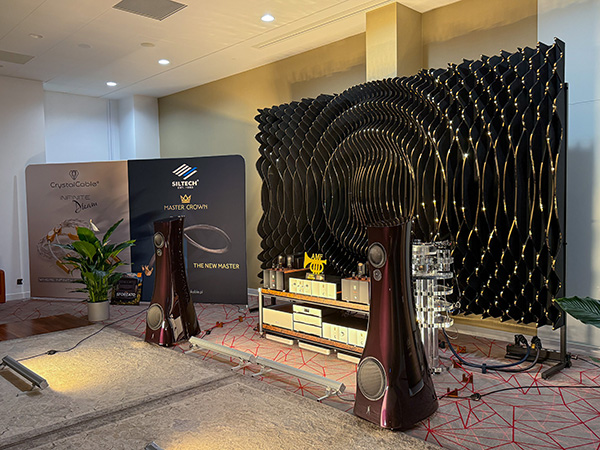
The first thing visitors encountered in the Golden 1 room at the Golden Tulip Hotel was a pair of eggplant-colored Estelon X Diamond Mk II's ($116,400/pair). The dazzling Estonian floorstanders have a poured marble-composite cabinet with flowing organic curves, polished to a depth of gloss that seems to have no bottom. Nautilus, their Polish distributor, has been bringing Estelon to Warsaw for several years and knows how to let the speakers make their own introduction.
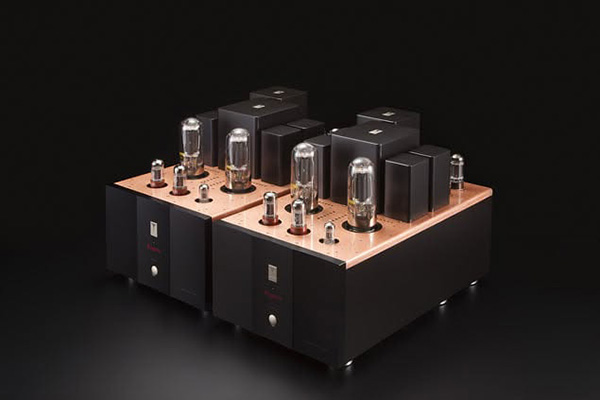
The Estelons are built around Accuton drivers: an 11" woofer, a 7" midrange, and a 1" inverted diamond dome tweeter. Driving them was a full Kondo stack from Japan. The Kagura 2i monoblock amplifiers ($180,000/pair; shown below) are parallel single-ended designs built around a pair of 211 transmitting triodes per chassis, rated at 50Wpc. Before them in the signal chain sat the G-1000i line-stage preamplifier ($96,000) and the GE-10i phono stage ($60,000).
 The source was a Transrotor Orion Reference FMD turntable fitted with a ZYX moving-coil cartridge (about $50,000 for the setup, including the tonearm). The German-built product uses the company's Free Magnetic Drive (FMD) bearing system, which magnetically couples the motor to the platter. By eliminating any physical connection between the belt and the platter assembly, the system acts as a sophisticated mechanical filter, effectively isolating the platter from motor cogging and reducing wow and flutter to vanishingly low levels. Cabling throughout was Siltech, with the full loom priced at a hair-raising $200,000.
The Kondo-Estelon pairing is one that Nautilus had shown before, which is easy to understand: the Estelon's high efficiency and smooth impedance curve suits single-ended triode amplification well, and Kondo's house sound—warm and resolved, sumptuous yet truthful—suits the analytical precision of Accuton drivers without the rig tipping into clinical territory.
The source was a Transrotor Orion Reference FMD turntable fitted with a ZYX moving-coil cartridge (about $50,000 for the setup, including the tonearm). The German-built product uses the company's Free Magnetic Drive (FMD) bearing system, which magnetically couples the motor to the platter. By eliminating any physical connection between the belt and the platter assembly, the system acts as a sophisticated mechanical filter, effectively isolating the platter from motor cogging and reducing wow and flutter to vanishingly low levels. Cabling throughout was Siltech, with the full loom priced at a hair-raising $200,000.
The Kondo-Estelon pairing is one that Nautilus had shown before, which is easy to understand: the Estelon's high efficiency and smooth impedance curve suits single-ended triode amplification well, and Kondo's house sound—warm and resolved, sumptuous yet truthful—suits the analytical precision of Accuton drivers without the rig tipping into clinical territory.
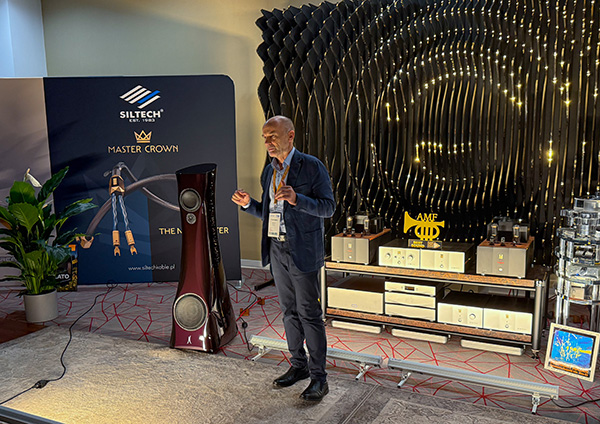 A dozen times at the show, I had to wait for a chance to move up from the third or fourth row to the first, heedful that the broadnecked Poles sitting in front of me were doing God knows what to the stereo image. So it went in the Estelon room, where my game of musical chairs was eventually rewarded with gobs of resolution when, from a prime spot, I listened to Giovanni Bottesini's "Rêverie," a classical piece for piano and double bass. The woody resonance of the bass was rendered as convincingly as the texture of each bow stroke. Then, Bob Dylan's "Man in the Long Black Coat" (originally from 1989's Oh Mercy) left even this non-fan in a state of appreciation.
 CLARISYS AND LAMPIZATOR
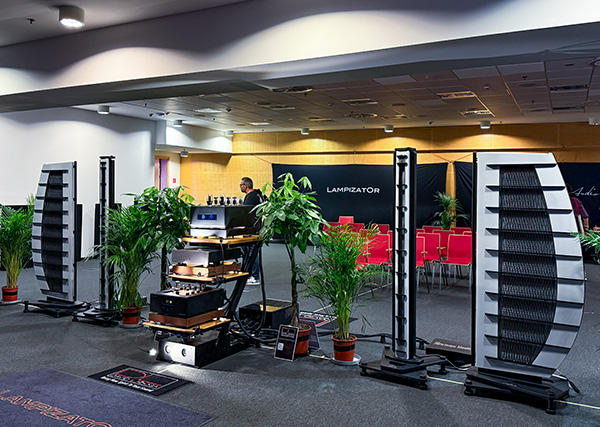
The Amsterdam room at the PGE Narodowy, roughly 3500 square feet of unobstructed concrete, is the kind of space that makes most show systems sound hollow and defeated. Clarisys had apparently decided to treat that as a challenge rather than a problem. For the 2025 edition of the Warsaw show, the Swiss speaker company partnered with Polish DAC manufacturer LampizatOr to present two world premieres at once. The speakers were the Clarisys Aria MK 2 (about $162,000/pair), a four-tower dipole planar-magnetic ribbon design consisting of two dedicated bass towers and two midrange/tweeter towers. The Arias were developed by a team split between Vietnam and Switzerland.
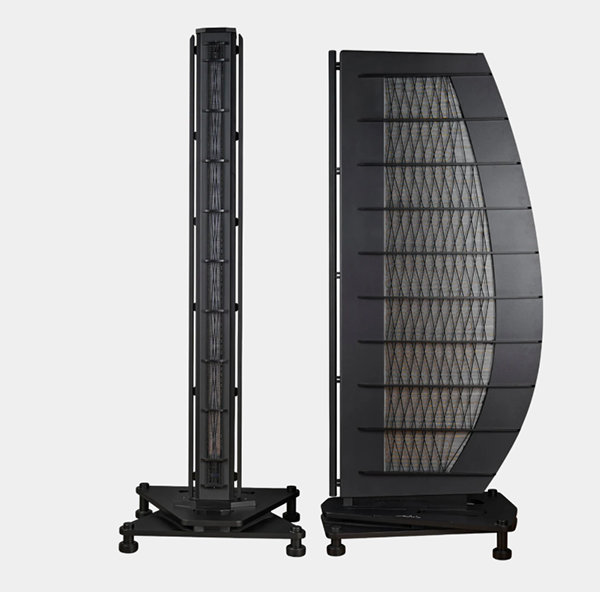 For the first time at any show, the room was not only bisected by the Arias but configured so that listeners could audition the system from in front of the speakers as well as from behind, in facing seating areas. Only dipoles can pull that off.
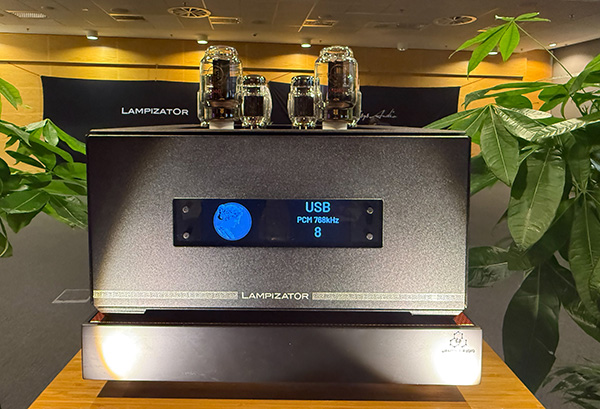
The source was the LampizatOr Aphrodite DAC ($105,000), making its world premiere after two years of intensive development. The Aphrodite sits above the Horizon360 (approx. $60,000) in the LampizatOr lineup. It dispenses with a volume control entirely, presenting itself as a pure, fixed-level DAC with a single amplification stage, four large EI transformers, a dual-mono power supply, and a complement of two rectifier tubes and eight KT88s. The six-figure price tag notwithstanding, LampizatOr claims that the first batch of 20 units sold out at the show, two months before the scheduled release date.
For the first time at any show, the room was not only bisected by the Arias but configured so that listeners could audition the system from in front of the speakers as well as from behind, in facing seating areas. Only dipoles can pull that off.
The source was the LampizatOr Aphrodite DAC ($105,000), making its world premiere after two years of intensive development. The Aphrodite sits above the Horizon360 (approx. $60,000) in the LampizatOr lineup. It dispenses with a volume control entirely, presenting itself as a pure, fixed-level DAC with a single amplification stage, four large EI transformers, a dual-mono power supply, and a complement of two rectifier tubes and eight KT88s. The six-figure price tag notwithstanding, LampizatOr claims that the first batch of 20 units sold out at the show, two months before the scheduled release date.
 I laughed when Hedegaard's 2020 track "Ratchets" exploded from the Arias. It's almost cheeky, almost a dare, to play such a deep-bass electro-track on panel speakers, a design that many audiophiles wave off for its supposed lack of LF extension. The piledriver of a track reached deep and hit all the right spots.
Others, like Rafał Trzaskowski, the mayor of Warsaw, felt equally happy. On Friday, Hizzoner dropped in carrying a just-released jazz recording of his father, Andrzej. Trzaskowski père (1933–1998) was a dominant figure in Polish jazz—a gifted pianist and composer who performed with Stan Getz and led his own quintet on the first Polish jazz tour of the United States in 1962. The recording was Wstęp wzbroniony (No Entry), which features performances of the Studio S-1 band led by the elder Trzaskowski, with the always-excellent Polish trumpeter Tomasz Stańko, an ECM alumnus, as the soloist.
The mayor, clearly affected, told the Clarisys team it was the first time he'd been able to hear his dad's work in so much detail. In a massive edifice full of wallet-busting technology, that stood out as one of the show's most human moments.
And, on that final note . . . it's a wrap on Warsaw!
I laughed when Hedegaard's 2020 track "Ratchets" exploded from the Arias. It's almost cheeky, almost a dare, to play such a deep-bass electro-track on panel speakers, a design that many audiophiles wave off for its supposed lack of LF extension. The piledriver of a track reached deep and hit all the right spots.
Others, like Rafał Trzaskowski, the mayor of Warsaw, felt equally happy. On Friday, Hizzoner dropped in carrying a just-released jazz recording of his father, Andrzej. Trzaskowski père (1933–1998) was a dominant figure in Polish jazz—a gifted pianist and composer who performed with Stan Getz and led his own quintet on the first Polish jazz tour of the United States in 1962. The recording was Wstęp wzbroniony (No Entry), which features performances of the Studio S-1 band led by the elder Trzaskowski, with the always-excellent Polish trumpeter Tomasz Stańko, an ECM alumnus, as the soloist.
The mayor, clearly affected, told the Clarisys team it was the first time he'd been able to hear his dad's work in so much detail. In a massive edifice full of wallet-busting technology, that stood out as one of the show's most human moments.
And, on that final note . . . it's a wrap on Warsaw!
During the 10 days before the most recent high-end show in Warsaw last fall, I got to visit the capitals of Estonia, Latvia, and Lithuania—medieval, cobblestoned cities that invite walking. Poland's capital city, Warsaw, greets you differently: with asphalt and office towers. The Radisson Blu Sobieski and the Golden Tulip, neighboring show venues, are separated by a dozen lanes of criss-crossing traffic. What should be a short walk becomes a high-stakes game of Frogger. Pedestrians are an afterthought.
Good luck finding a secondhand bookstore or a bohemian coffee shop—at least in this part of town, which is less than a mile from the gleaming central train station. I learned later that Warsaw does have a quarter that looks centuries old, but it was finished in the 1950s. The Nazis leveled it in World War II, and stoic Varsovians rebuilt it chiefly by using 18th-century paintings, old photographs, and architectural records as their guide. A city that's been through all that has earned the right to believe in its own future.
On Friday at the Blu Sobieski, I got to talking with Lukas, an audiophile from Vilnius with a bowl cut à la Javier Bardem in No Country for Old Men. Reassuringly, he carried a bag of vinyl albums instead of a cattle gun.
It was time for a taxi to the hulking PGE Narodowy sports stadium that anchors the show. Five miles east of the Sobieski, across the Vistula River, it sits on the site of the old 10th-Anniversary Stadium, a structure literally built from the wartime rubble of the city. There's a jarring wryness to it: $500,000 speakers sitting on a foundation of broken bricks and human calamity. All the same, it's a manifestation of Warsaw's refusal to stay down.
I arrived and took in the slightly bizarre scene. Glass-paneled skyboxes for moneyed soccer fans suddenly housed hundreds of hi-fi systems. Before the application of acoustic treatments, reflections had surely ping-ponged like demented ghosts, but exhibitors knew what to do. They'd gaffer-taped foam wedges to the windows, outfitted corners with bass traps, and hung absorber panels that went mano a mano with parallel surfaces and concrete brutality. Many of the teams achieved a minor miracle. You found yourself in what amounted to an acoustic triage unit and yet somehow, improbably, Billie Holiday or Post Malone sounded like they were actually in the heavily modded space, rather than singing inside a tiled bathroom.
Meanwhile, the visitors were chasing something just as elusive. Everywhere—elevator, stadium, shuttle bus—people had the same question. “What's the best room you've heard today? What shouldn't I miss?” asked Lukas in the lobby. Asked my Stereophile colleague JVS over a hurried cup of tea. Asked journalists Jamie (Belgium) and Sven (Sweden) at the press dinner thrown by Audio Video Show organizer Adam Mokrzycki, who was pulling off the most successful show of his career, with 230 exhibitors and almost 15,000 visitors. And I asked all of them the same thing, because as jaded as some of us are, we all have FOMO and long to be privy to something extraordinary.
Who was the champion, the victor, the uber-alpha? Who knows? In three days, scurrying from room to room as if I were in a double-speed YouTube video, I could only see and hear a fraction of what was on offer. But these 10 rooms are the ones that earned the foot blisters.
VIVID AUDIO
The soccer stadium felt a bit surreal for an audio show—but then, so does the Vivid Audio Giya G1 Spirit Cu speaker. The Spirit has one of the most distinctive silhouettes in audio. The cabinet is a tall, asymmetrical form with no flat surfaces or hard edges anywhere. It tapers and curves in multiple directions, the result being something between a cresting wave and a female figure with a pronounced hip. For whatever reason, the Giyas always remind me of the space-creature soprano in The Fifth Element. Others see a treble clef.
In one of the most engaging presentations I've seen at an audio show, Dickie first blew into a thin metal tube and then turned the crank of a five-dollar pocket-sized music box to demonstrate certain acoustic properties he'd engineered into the Giyas. His rundown is beyond the scope of this report, so I'll just say that you ought to a) find a way to catch Dickie's talk if you can, and b) go listen to the Giyas while you're at it, because they're outstanding.
Team Vivid had brought the Giya G1 Spirit Cu (starting around $100,000/pair) to Warsaw in a pearlescent orange finish that drew visitors to the room before a note was played. The "Cu" (copper) suffix signifies the addition of copper caps to the pole pieces of the upper and lower midrange drivers—sophisticated motor-refinement technology that trickled down from Vivid's statement Moya M1. The G1 Spirit Cu's were powered by two Mola Mola Ossetra monoblock amplifiers ($25,000/pair) making their production debut at the show. Also in the chain: a European Audio Team Forte turntable ($21,000) and a Mola Mola Lupe phono stage ($11,000).
The system played loudly and effortlessly. Bass was exuberant but at ease, the midrange seductive, the upper register detailed but composed. I can think of few speakers that intrigue me more. Perhaps the audio gods will dispatch a pair of the Giya G1 Spirit Cu's to my listening room in the near future.
Note: The Vivid Audio Giya G1 Spirit Cu speakers will be reviewed by Ola Björling in an upcoming issue of Stereophile. Ola also conducted an interview with Vivid Audio founder and owner Philip Guttentag and Vivid representative Ewald Verkerk to go along with his review, so stay tuned for both postings to come.
DUTCH & DUTCH
Next to the cost-no-object systems that were thick on the ground in Warsaw, what seemed like a bargain? It was a then-brand-new contender that scratched just about all my high-end itches—and at a little over $10,000, it's relatively kind to buyers' wallets.
On the show's first day, I popped in for a quick listen, out of curiosity, not intending to write a report. Even without the extension modules, the bass seemed impossibly low and tight. Visitors were told that the 6c's go down to 30Hz on the test bench, but room gain seemed to be delivering 20–25Hz in the standard hotel room.
UNITRA
Walking into the Unitra room at the Audio Video Show's soccer stadium locale meant that, depending on your age and your passport, you'd find either a stranger or an old friend. Unitra products were once centerpieces in most Polish homes. Between 1961 and 1989, the brand was an umbrella for a state-directed association of Polish electronics manufacturers (at its peak, 28 companies and 100,000 workers), all turning out radios, amplifiers, and turntables. Then, in 1989, the Soviet Union disintegrated, the market opened, and Unitra was gone within a year, unable to compete with Western brands that flooded the Polish market. Before that wipeout, Unitra had been a source of national pride. Some of its products were good enough that they were manufactured almost entirely for export. Case in point: in the 1970s, the WSH-205 integrated amplifier was well-regarded enough that most of its production run was earmarked for other European countries, leaving Poles largely unable to buy one of their own country's best amps. Six years ago came the comeback: Unitra was revived with a serious cash infusion from Michał Kiciński of CD Projekt, the Polish studio behind The Witcher franchise, a series of role-playing e-games that sold 85 million copies worldwide and spawned a Netflix series. Now, Unitra offers a product line that spans amplifiers, turntables, a CD player, loudspeakers, and cables, all designed and manufactured locally.
The WSH-805 Classic Edition (about $7,000) is the brand's flagship amp. Designed to evoke the WSH-205 from half a century earlier, it's a dual-mono, fully analog design with American walnut side panels and brass accents that push the 1970s reference hard. Its innards boast 80Wpc into 8 ohms in class-AB, switchable to 8W in pure class-A, with THD of less than 0.0008% at 40W; plus five stereo RCA inputs, one pair of balanced XLRs, a MM/MC phono stage, and headphone jack. The WSH-805, which seems to have borrowed the best of Yamaha's and Onkyo's visual design language, won both a Red Dot Award in 2023 and an iF Design Award in 2025.
The rest of the system drew on Unitra's complete line, which includes two direct-drive turntables, the GSH-630 Fryderyk (roughly $3200, fitted with an Ortofon 2M Red) and the GSH-801 Edmund Classic ($5100, with a 2M Black and an outboard linear power supply). There's also the CSH-801 CD player ($2900) with a TEAC transport, 32-bit ESS Sabre DAC, and e-ink display, and two loudspeaker models: the ZGB-401 standmount ($2400/pair) and the ZGZ-801 three-way floorstander ($6900/pair; shown below).
I listened to the latter, driven by Unitra's WSH-805 amp, and found the sound slightly sweet—in a good way. Chris Jones's "No Sanctuary Here" (from the 2016 2LP version of 2003's Roadhouses & Automobiles) and Malia and Boris Blank's "Celestial Echo" (the opening track on 2014's Convergence) were like a good kielbasa: meaty, snappy, and satisfying.
FOCAL AND NAIM
In Warsaw, Focal and Naim had put together what they billed as the world's first 7.4.4 Dolby Atmos setup built with speakers in the flagship Utopia range. A pair of top-of-the-line Grande Utopia EM Evo towers (one is shown below) appeared at the front, nearly 2m tall and 584lb apiece. The Naim Statement amplification driving them—746 watts per monoblock into 8 ohms—was a perfect match, and an always-humorous one considering that 746 watts equals 1 horsepower. Score one for British engineering wit. But of course, the system, which by my count carried at least an $820,000 price tag, was no laughing matter. It further consisted of a Viva Center Utopia Evo for the center channel; four Utopia 1000 IW LCR speakers with 1000 IW SUB subwoofers handling surround duties; 1000 IC LCR 5 in-ceiling speakers forming the Atmos height layer; and four Focal Cinema Utopia Sub subwoofers, each powered by its own Naim CI-NAP-101 amplifier. The stereo source was a Naim ND 555 streamer supported by two external 555 DR power supplies. Atmos processing fell to a Marantz AV 10, with a Marantz AMP 10 driving the surround channels.
The demonstration was accompanied by a panel that included Grammy-winning mixing engineer Jacek Gawłowski, who has over 500 Atmos mixes to his credit. I got the impression that only the Polish contingent in the room felt buoyed by the local pop music we were subjected to; some of the non-Poles began shifting in their seats and eyeing the exits.
I'd heard the Grande Utopias and the Naim hardware at several other shows, and it was a pulse-quickening experience every time. In Warsaw, the magic wasn't quite there, though I had to suspend sonic judgments under the barrage of overly happy-clappy and gimmicky source material. (On the other hand, I appreciate every day I don't have sit through another playback of the Eagles' "Hotel California.")
Coda: Belgian cinema projection company Barco recently announced that it had agreed to acquire VerVent Audio, Focal and Naim's parent, for $155 million. It wouldn't surprise me if the deal had already been in the works before the Polish show. That Warsaw Atmos extravaganza foreshadowed the kind of integrated audiovisual future that I reckon VerVent's new owner often dreams about.
DYNAUDIO, CIRCLE LABS, AND SILENT ANGEL
Nautilus Poland, Dynaudio's local distributor, had booked the London A room, one of the largest in the stadium. There, two different Dynaudio loudspeaker models did a yeoman's work. The Confidence 60 ($50,000/pair; one is shown below), Dynaudio's flagship floorstander, was the anchor. Alongside it, on stands, sat the Contour 20 Black Edition ($8,000/pair), an all-black two-way introduced in 2025, featuring Dynaudio's top-shelf Esotar 3 tweeter and a newly designed woofer carried over from the Confidence line. The digital front end was from Silent Angel, a brand with R&D roots in Taiwan and Hong Kong that has earned a following in Europe for its audio-grade networking products. The stack comprised five components, all bargains as far as I could tell: the Munich streamer ($799), the Rhein music server ($1999), the Forester linear power supply ($649), the Genesis 10MHz word clock ($1899), and the Bonn N8 network switch ($599). Amplification was handled by Polish brand Circle Labs, a Kraków-based company whose hybrid approach combines a tube input stage with a solid-state output design. The P300 preamplifier (about $6000, converted from Euros) uses JFET and BJT transistors in a fully balanced, shortest-possible-signal-path topology. Driving the Confidence 60s was the M500 (roughly $16,000; shown below), a hybrid stereo amplifier making its world premiere in Warsaw. In monoblock configuration, as demo'ed, each M500 delivers 600Wpc into 8 ohms. The input stage is built around a single ECC88/6922 triode, coupled through a Mundorf Silver Gold Oil capacitor into a solid-state output stage.
After I settled into my seat, I was struck by how well the Confidence 60s filled the outsized space. My surprise doubled when I realized my error: I was in fact listening to the modest-looking speakers right next to them, the Contour 20 Black Editions, which sounded perfectly self-assured, imparting LF extension like nobody's business. On Eva Cassidy's "Stormy Monday," recorded live at Washington, DC’s Blues Alley, the speakers easily conveyed the venue's spatial cues. Not too shabby for a two-channel recording. Even "Dimestore Diamond" by Gossip (from 2009's Music for Men), featuring a brutal snare and kickdrum part, sounded convincing, though now a bit of strain showed up around the notes' edges.
Next, via the Confidence 60s, we listened to "I Can't Outrun You" by Trace Adkins (originally from 2008's X (Ten)). His burnished baritone sounded lifelike and present, while the quiet piano chords were beautifully rounded. "Like you could reach out and touch the keys," I scribbled.
KROMA, TAIKO, AND YPSILON
Among the most eye- and ear-catching speakers I encountered in Warsaw were a pair of Kroma Atelier Maribels (shown below) making their world premiere, towering at 6'7" and weighing 485lb apiece. Kroma Atelier is a Spanish company led by Javier Millán Sr., who has been designing and building loudspeakers since he was 14 years old. His son, Javier Millán Jr., grew up in the workshop. The Maribels are their joint statement, built without budget constraints or compromise.
Dream Audio—a Warsaw-based high-end distributor that represents Kroma in Poland—had pulled together a Taiko Olympus server from the Netherlands ($95,000; shown above), Ypsilon Silver Edition amplifiers from Greece (price TBD), Stage III Concepts cables and Carbide Audio isolators from the US, and Telos Audio Design power products from Taiwan.
ELECTROCOMPANIET AND ROCKPORT
Like Dynaudio, Rockport and Electrocompaniet occupied one of the larger demo spaces in the soccer stadium, with about the square footage of a tennis court. (Borscht Belt comedian: "And what a racket it was!" Badum tish.) That really big room notwithstanding, the system was one of the more impressive and coherent of the show. Before I heard it, I already had chills, but that was because Electrocompaniet’s sales and marketing director Lasse Danielsen talked about the photo mural of Preikestolen (Pulpit Rock), a famous cliff near Stavanger that yours truly, vertigo notwithstanding, hiked to about a decade ago.
Danielsen told his audience matter-of-factly that Preikestolen will eventually break off and plunge into the Lysefjord 2000 feet below. Could be tomorrow, could be 500 years from now. When it does, he said, "it will wipe out Stavanger," Norway's fourth-largest city. The message appeared to be that we live on borrowed time, and we might as well spoil ourselves with audio baubles while we still can.
The Lyras' bass was deep and textured; also, fast and unhurried at the same time. The midrange had the bloom and presence Electrocompaniet is known for. The company calls it its "Nordic Sound"—warm but not soft, detailed without edge. I loved Dominique Fils-Aimé's "Birds" (from 2018's Nameless) via the Rockport-Electrocompaniet combo, each plosive and unselfconscious lip smack exquisitely reproduced. Though I had other rooms to visit, it was hard to find a compelling enough reason to leave.
ONEIROS AUDIO
I'm not exactly given to excessive flattery or chummy asides, but I'll say this: Though I'd never met Jerry Bloomfield before, I felt like I'd known him for ages by the time I left the Oneiros Audio room. That was unexpected, because I admit that when introduced to speakers that cost well over half a million dollars, I brace for a presentation with bombastic marketing-speak and shrewd razzle-dazzle.
The speaker at the center of the room was the Oneiros (Greek for dream), making its European continental debut in Warsaw after earlier launches in New York and London. The design comes from Bloomfield and his business partner Graeme Bridge. Together, they've run Falcon Acoustics since 2009. Falcon is best known for its faithful recreation of the BBC LS3/5a's. A pair of those classic speakers can be had for a couple of grand.
That kind of money would barely buy you the binding posts on the Oneiros. The price-no-object towers will set you back at least $549,500/pair. Each Oneiros stands about 5'6" tall, weighs 264lb, and is built from a monocoque carbon-fiber cabinet built up in layers and fused under heat and pressure. That's the same construction method used to make Formula 1 car bodies. Not coincidentally, Oneiros Audio is headquartered in "Motorsport Valley," the area around the Silverstone motor racing circuit where many F1 cars have seen the light. Bloomfield said that gives his company access to a high concentration of advanced engineering and materials skills.
I like the speakers' carbon-fiber skin, but if you prefer natural wood veneer, prepare to spend just a leetle more. Graeme Bridge told me that due to the complex shape of the cabinet, the wood skin can only be applied by one facility in the world, in Germany, at a surcharge from $40,000/pair for standard veneers to $170,000/pair for certain rare and "complicated" ones.
The Oneiros drivers are two 10" Twaron graphene nano-composite woofers, two 3" Dyneema graphene composite dome midranges, and a 1" CVD diamond dome tweeter. Crossover components include Mundorf MCap Supreme EVO Silver/Gold/Oil capacitors and WBT Platinum binding posts.
ESTELON AND KONDO
The first thing visitors encountered in the Golden 1 room at the Golden Tulip Hotel was a pair of eggplant-colored Estelon X Diamond Mk II's ($116,400/pair). The dazzling Estonian floorstanders have a poured marble-composite cabinet with flowing organic curves, polished to a depth of gloss that seems to have no bottom. Nautilus, their Polish distributor, has been bringing Estelon to Warsaw for several years and knows how to let the speakers make their own introduction.
The source was a Transrotor Orion Reference FMD turntable fitted with a ZYX moving-coil cartridge (about $50,000 for the setup, including the tonearm). The German-built product uses the company's Free Magnetic Drive (FMD) bearing system, which magnetically couples the motor to the platter. By eliminating any physical connection between the belt and the platter assembly, the system acts as a sophisticated mechanical filter, effectively isolating the platter from motor cogging and reducing wow and flutter to vanishingly low levels. Cabling throughout was Siltech, with the full loom priced at a hair-raising $200,000.
The Kondo-Estelon pairing is one that Nautilus had shown before, which is easy to understand: the Estelon's high efficiency and smooth impedance curve suits single-ended triode amplification well, and Kondo's house sound—warm and resolved, sumptuous yet truthful—suits the analytical precision of Accuton drivers without the rig tipping into clinical territory.
A dozen times at the show, I had to wait for a chance to move up from the third or fourth row to the first, heedful that the broadnecked Poles sitting in front of me were doing God knows what to the stereo image. So it went in the Estelon room, where my game of musical chairs was eventually rewarded with gobs of resolution when, from a prime spot, I listened to Giovanni Bottesini's "Rêverie," a classical piece for piano and double bass. The woody resonance of the bass was rendered as convincingly as the texture of each bow stroke. Then, Bob Dylan's "Man in the Long Black Coat" (originally from 1989's Oh Mercy) left even this non-fan in a state of appreciation.
CLARISYS AND LAMPIZATOR
The Amsterdam room at the PGE Narodowy, roughly 3500 square feet of unobstructed concrete, is the kind of space that makes most show systems sound hollow and defeated. Clarisys had apparently decided to treat that as a challenge rather than a problem. For the 2025 edition of the Warsaw show, the Swiss speaker company partnered with Polish DAC manufacturer LampizatOr to present two world premieres at once. The speakers were the Clarisys Aria MK 2 (about $162,000/pair), a four-tower dipole planar-magnetic ribbon design consisting of two dedicated bass towers and two midrange/tweeter towers. The Arias were developed by a team split between Vietnam and Switzerland.
For the first time at any show, the room was not only bisected by the Arias but configured so that listeners could audition the system from in front of the speakers as well as from behind, in facing seating areas. Only dipoles can pull that off.
The source was the LampizatOr Aphrodite DAC ($105,000), making its world premiere after two years of intensive development. The Aphrodite sits above the Horizon360 (approx. $60,000) in the LampizatOr lineup. It dispenses with a volume control entirely, presenting itself as a pure, fixed-level DAC with a single amplification stage, four large EI transformers, a dual-mono power supply, and a complement of two rectifier tubes and eight KT88s. The six-figure price tag notwithstanding, LampizatOr claims that the first batch of 20 units sold out at the show, two months before the scheduled release date.
I laughed when Hedegaard's 2020 track "Ratchets" exploded from the Arias. It's almost cheeky, almost a dare, to play such a deep-bass electro-track on panel speakers, a design that many audiophiles wave off for its supposed lack of LF extension. The piledriver of a track reached deep and hit all the right spots.