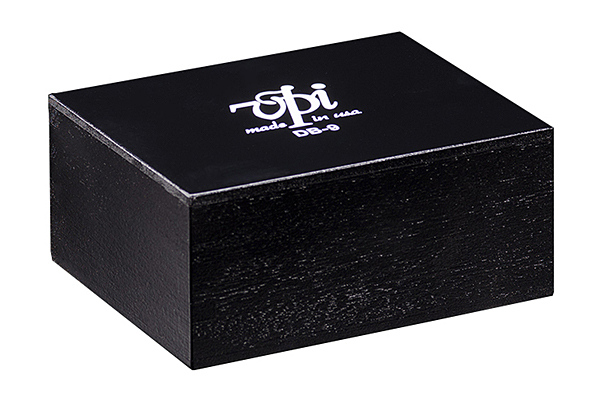
The VPI Magic Brick is an 8lb block of steel laminations, about 5" by 3" by 2", encased in a nicely-finished oak box for aesthetic appeal and for protecting whatever the brick is sitting on from scratches. Placing the Brick over the power transformer of a piece of electronic gear is supposed to improve the sound of your stereo system.
Before I tried it, I was definitely of two minds about the Brick. Because people I respected had told me that it really did work, I was inclined to believe it. But in my heart I did not really believe that an inert metal block could do anything for an audiophile except cost him money.
Currently, my own system consists of a slightly modified Hafler DH-200, an also-modified db Systems preamp, custom-made, five-way, dynamic speakers (of which we may have more to say at a later date), and a Logic DM-101 turntable (which also warrants later discussion). The arm is a Fidelity Research FR-64fx, and the cartridge a modified Grado G1+. In dollars, this is about a $5500 system; not SOTA by any means, but typical of what the majority of audiophiles own. (Although most of you will undoubtedly criticise my choices.)
So, does it or doesn't it work?
Dammit, it does. I used it on my Hafler DH-200 power amp, and there was a small but unmistakable improvement in the focus of the sound. The best analogy for what I heard is the difference between a photograph which is almost in perfect focus (and few would notice that it wasn't) and when it is in perfect, razor-sharp focus. I also tried the Brick on a much more modest system to determine whether its effect could still be heard or whether it was of value only when a system's quality was above a certain level. The more modest system consisted of a Technics SLB202 belt-drive table with an Audioref mat, a Grado GT-1+ pickup, an NAD 3020 integrated amplifier and a pair of Audiomaster LS-1 speakers. (The Audiomasters are typical British two-way boxes utilizing Audax drivers.) The retail price of this system is about $725. The Brick worked again! The sound was still more focused than without the brick. And having heard the difference, I don't feel that anyone who is concerned about sound would want to be without the Brick, even on a modest system.
I found it easiest to perceive the effect of the VPI Brick by trying to follow the line of individual instruments among many. The first Sheffield Amanda McBroom LP is perfect for the purpose. I also found it easier to hear what the Brick was doing by removing it after a while than by adding it and trying to observe what changed. This should not be surprising; all sonic improvements are more noticeable when, after one has gotten used to them, they are taken away, than they are when first installed.
How does it work?
There have been two, not mutually exclusive, theories advanced to explain it. The first has to do with the effect on the sound of otherwise inaudible amounts of hum, which are radiated by the component's power transformer and picked up by its signal-carrying circuits. According to this theory, the metal Brick acts as a "sponge" to absorb much of the stray magnetic field from the power transformer. I've discussed this idea with more knowlegeable audiophiles than I, and most concur with this explanation. They add that, if this theory is right, then the Brick should have little effect on a component whose power transformer is adequately isolated from the active circuitry, or if the power transformer is toroidal (that is, doughnut-shaped, for minimal hum radiation).
The db preamp has its power supply in a separate box, so I tried placing the Brick on the preamp chassis and then on the power supply chassis. It had no noticeable effect on either, which would seem to lend support to the magnetic-field theory.
The other explanation for the Brick's effect is that it damps mechanical vibration of the chassis beneath it. JGH touched on this in his report in the last issue on the Sony Sound Base.
Briefly, this theory (which Sony obviously supports) holds that the discrete components and signal conductors in an amp or preamp are made to vibrate by airborne and floor-borne sound waves, and that the resulting changes in inter-electrode capacitances or magnetic fields, caused by sounds which have just left the loudspeakers, modulate the signal which is currently passing through the active device, smearing the sound. If the modulations are due to magnetic fields, the effect would be greater when circuits are handling large electrical currents than when currents are small. Power amplifiers should then be more affected than preamps.
I was unable to check out this theory because high-current devices also tend to have more AC radiation from their power transformer, so there was no way I could isolate one effect from the other. Perhaps the theory will be resolved ultimately; as of now, all I can report is that, for whatever reason, the Brick works. And at only $35, I recommend it.
Dammit, it does. I used it on my Hafler DH-200 power amp, and there was a small but unmistakable improvement in the focus of the sound. The best analogy for what I heard is the difference between a photograph which is almost in perfect focus (and few would notice that it wasn't) and when it is in perfect, razor-sharp focus. I also tried the Brick on a much more modest system to determine whether its effect could still be heard or whether it was of value only when a system's quality was above a certain level. The more modest system consisted of a Technics SLB202 belt-drive table with an Audioref mat, a Grado GT-1+ pickup, an NAD 3020 integrated amplifier and a pair of Audiomaster LS-1 speakers. (The Audiomasters are typical British two-way boxes utilizing Audax drivers.) The retail price of this system is about $725. The Brick worked again! The sound was still more focused than without the brick. And having heard the difference, I don't feel that anyone who is concerned about sound would want to be without the Brick, even on a modest system.
There have been two, not mutually exclusive, theories advanced to explain it. The first has to do with the effect on the sound of otherwise inaudible amounts of hum, which are radiated by the component's power transformer and picked up by its signal-carrying circuits. According to this theory, the metal Brick acts as a "sponge" to absorb much of the stray magnetic field from the power transformer. I've discussed this idea with more knowlegeable audiophiles than I, and most concur with this explanation. They add that, if this theory is right, then the Brick should have little effect on a component whose power transformer is adequately isolated from the active circuitry, or if the power transformer is toroidal (that is, doughnut-shaped, for minimal hum radiation).