In the opinion of this hi-fi reviewer, the debate over the efficacy of audio-quality network switches should be over. As logic would dictate, when connections are made via a network switch, the quality of its inputs, outputs, oscillators (clocks), power supplies, and pathways affects the sound of everything downstream. It's clearly audible. Everything matters.
What about reclocking switches? And what if you only need to connect two units—which could be connected with just a cable? Do reclocking switches offer any advantage?
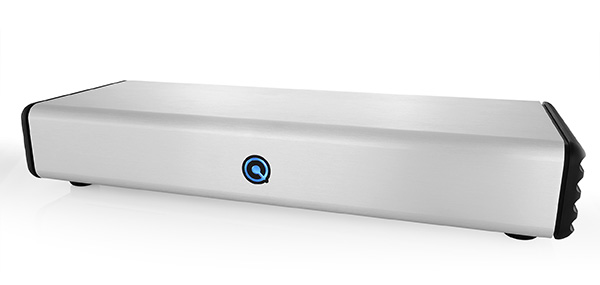
That is one of several questions I set out to answer by auditioning the Nordost QNet7 seven-port network switch ($5499.99). I auditioned it two places in my system: in front of the Innuos Nazaré music server/streamer, which fed the multibox dCS Varèse, and without the Innuos Nazaré, in front of the dCS Varèse (footnote 1). In both cases, the Nordost QNet7 replaced both a Small Green Computer/Sonore OpticalModule Deluxe and the Innuos PhoenixNet reclocking network switch.
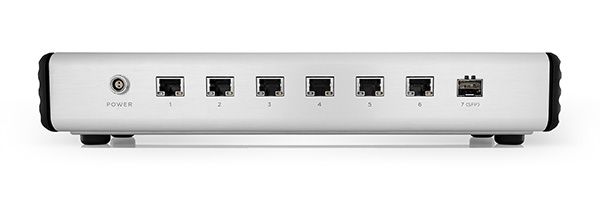
Nordost presents the QNet7 as a major upgrade to the original QNet switch ($3799.99, footnote 2), which I reviewed alongside the Nordost QSource linear power supply ($2749.99) in fall 2022. It has five auto-negotiated 1000BASE-T (1Gbps) ports, one auto-negotiated 100BASE-TX (100Mbps) port, which is optimized for audio performance, and a special SFP port that can accept either copper or optical SFP 1Gb transceiver modules. The QNet7 thus allows you the choice of inputting signal by either Ethernet or fiber.
The QNet7 has nine physically separate, "completely independent, ultra-low noise" power supplies, an eight-layer "impedance controlled" circuit board, and two "femtosecond" clocks (which Nordost sometimes calls "oscillators"). The oscillators are said to be temperature-compensated and extremely low noise, with "ultra-low jitter and exceptional stability."
As with the original QNet, you can power it with either its supplied switch-mode wall wart or with Nordost's optional QSource linear power supply. Available options, which I used, include a QRT Stand Mount ($124.99) designed to accept four Nordost Sort Kone equipment supports—the same stand works with the QSource—and a premium-grade QSource DC microfilament 18AWG cable ($390.00 for 1m).
Dennis Bonotto, whose signature title—intl. sales/eng./R&D—merely hints that he's responsible for the design and electrical development of Nordost's R&D projects as well as international sales and product training, elaborated on technical considerations via Zoom. "Quite a bit has changed from the original QNet," he said. "The difference between the QNet and the QNet7 is actually much larger than people expect. First, we changed the form factor from round to rectangular because, in part, a larger round switch would have become the size of a small pizza. Plus, some customers preferred a traditional rear connection panel, where cables could remain unseen.
"Because every single circuit in the switch demands a little voltage, we chose to be even more careful about how we distribute the power internally and increased the internal power supplies from six to nine. We also changed the power supply architecture a little bit to make the power supplies even less noisy than before. Then we added two more layers of PCBs and deeply embedded all traces and every single high-speed signal into the PCB. Emissions and crosstalk are virtually zero. The physical distance between the ports is also very, very, very large to help reduce any crosstalk between the ports even further.
"Before, we had three gigabit ports and two 100-megabit ports. In addition to the QNet7's new SFP port (port 7), it has five gigabit ports (ports 1–5) and one 100Mb port (port 6), because our customers told us they only needed one. Thanks to so many changes, we expect the QNet7's five gigabit ports to perform as well as or even better than the QNet's 100Mb port, which is inherently less noisy because it runs at a much lower data rate."
The QNet has one oscillator—one clock; the QNet7 has two. The two layers of ports 1–5 are handled by a single clock, while those of port 6 are separated into two dedicated circuits, one for each layer, and handled by two clocks. Port 7, in turn, uses a single clock.
Why does an Ethernet switch need clocks? "When the Ethernet signal arrives at the QNet7, it is undone, so to speak, and redone," Bonotto explained. "The bits (information) are transformed, encapsulated, and made into symbols so they can travel down the line in a more efficient and noise-proof way. Rather than send the packets down the cable directly, they are forwarded to the PHY unit, whose role is to take those packets and 'line code' them. Essentially, this makes the data more immune to noise. The whole process becomes more reliable. When the symbols arrive, everything must be de-encapsulated, as it were, and transformed back into bits. Then it gets routed and re-encapsulated and resent out on the other port. For this to happen, you need a clock base—a timing base. It's the oscillator that makes it possible."
 The pudding proof
I haven't eaten pudding in decades, but I have evaluated enough audio equipment to know what is and is not possible in my system configuration.
My streaming network uses two Sonore opticalModule Deluxe units, connected by a long run of fiber-optic cabling, to extend from my second-floor office to the detached street-level music room. This setup gave me the option to feed signal into the QNet7 via fiber and evaluate its SFP fiber input. That's the good news.
Because the QSource linear power supply has just one 9V output, I could not use it to simultaneously power both the music room's 5–9V opticalModule Deluxe and the 5–9V QNet7, let alone three units: the opticalModule Deluxe, QNet7, and QNet. So much for QNet switch comparisons using the QSource.
I knew from previous experience that wall warts are far noisier than the QSource, so using wall warts to power one or more of those units was out of the question; I knew it would degrade its sound. Why take a sonic step backwards to determine if a device offered a sonic step forward? Some may question my logic, but I had no interest in intentionally degrading my system's sound to test something. Life is too short.
The only way to input signal into the QNet7 was to remove the SFP module from the music room's opticalModule Deluxe and place it in the QNet7's SFP port. Lacking two QSources to power both the OpticalModule and the QNet7, I could not input signal into the QNet7 by Ethernet.
That left me two ways to audition the QNet7. The first was as a replacement for the Innuos PhoenixNET reclocking Ethernet switch, which feeds the superb Innuos Nazaré music streamer/server, and to use the proprietary InnuOS Sense for playback. The second was to use the QNet7 to feed signal directly into the state-of-the-art multibox dCS Varèse DAC-streamer's Core and use dCS's proprietary Mosaic Actus software for playback. Both options allowed copious before-and-after comparison opportunities.
As I'd discovered on previous occasions, and validated again during this review, the Innuos PhoenixNET (and presumably the forthcoming NazaréNET) is a perfect match for the Innuos Nazaré. Connecting the two units delivers a wider and airier soundstage, weightier images, more saturated colors, and stronger bass. They're a great combination. Would the QNet7 work as well with the Nazaré?
 On the familiar first movements of two period instrument recordings—Les Siècles' recording of Mahler's Symphony No.4 and Freiburger Barockorchester's Mozart Piano Concerto No.23, both streamed in 24/96 from Qobuz—the QNet7 could not top the sound of the PhoenixNET into the Nazaré. The QNet7 sounded better than streaming directly into the Nazaré—no network switch—but it could not deliver as much air, soundstage width, image weight, color spread, bass, and realistic up-close vividness as the PhoenixNET. An Innuos streamer is happiest with an Innuos switch. No surprise.
I also knew from previous experimentation, and confirmed once again, that when I used the dCS Varèse system as both streamer/server and DAC, with dCS Mosaic Actus as streaming software, Varèse sounds best without the Innuos PhoenixNET switch. I'm not sure why. Initially, I thought it might be because the PhoenixNET only outputs a 100Mb signal, which is the preferred way to input signal to the Nazaré. But the dCS folks say that the Varèse is equally happy receiving a 1Gb or 100Mb signal, which blows that explanation away.
This begged the question ... the last in a string of questions that threatened to stretch to Talmudic length and keep me in the music room forever: Might the Nordost QNet7 be a better match for the dCS Varèse than the Innuos PhoenixNET? Might the QNet7 improve the sound of music streamed through the dCS Varèse?
Short answer: yes. On the aforementioned Mahler and Mozart, Chris Jones's "No Sanctuary Here" (24/44.1 FLAC, Stockfisch Records/Qobuz), The Beatles' "Come Together (2019 Mix)" (24/96 FLAC, UMC/Qobuz), and Aretha Franklin's "Bridge Over Trouble Water (Long Version)" (24/96 FLAC, Rhino Atlantic/Qobuz), the Nordost QNet7 feeding signal to the Varèse delivered a more open, transparent, weightier sound with superb color and a gorgeous midrange. Bass was also stronger, and, on Aretha's cover, dirtier (as in snarlier) by intention.
On the familiar first movements of two period instrument recordings—Les Siècles' recording of Mahler's Symphony No.4 and Freiburger Barockorchester's Mozart Piano Concerto No.23, both streamed in 24/96 from Qobuz—the QNet7 could not top the sound of the PhoenixNET into the Nazaré. The QNet7 sounded better than streaming directly into the Nazaré—no network switch—but it could not deliver as much air, soundstage width, image weight, color spread, bass, and realistic up-close vividness as the PhoenixNET. An Innuos streamer is happiest with an Innuos switch. No surprise.
I also knew from previous experimentation, and confirmed once again, that when I used the dCS Varèse system as both streamer/server and DAC, with dCS Mosaic Actus as streaming software, Varèse sounds best without the Innuos PhoenixNET switch. I'm not sure why. Initially, I thought it might be because the PhoenixNET only outputs a 100Mb signal, which is the preferred way to input signal to the Nazaré. But the dCS folks say that the Varèse is equally happy receiving a 1Gb or 100Mb signal, which blows that explanation away.
This begged the question ... the last in a string of questions that threatened to stretch to Talmudic length and keep me in the music room forever: Might the Nordost QNet7 be a better match for the dCS Varèse than the Innuos PhoenixNET? Might the QNet7 improve the sound of music streamed through the dCS Varèse?
Short answer: yes. On the aforementioned Mahler and Mozart, Chris Jones's "No Sanctuary Here" (24/44.1 FLAC, Stockfisch Records/Qobuz), The Beatles' "Come Together (2019 Mix)" (24/96 FLAC, UMC/Qobuz), and Aretha Franklin's "Bridge Over Trouble Water (Long Version)" (24/96 FLAC, Rhino Atlantic/Qobuz), the Nordost QNet7 feeding signal to the Varèse delivered a more open, transparent, weightier sound with superb color and a gorgeous midrange. Bass was also stronger, and, on Aretha's cover, dirtier (as in snarlier) by intention.
 When the EMM Labs PREi stereo preamplifier ($28,900) arrived for review in the July 2026 issue, I repeated these tests, with identical results.
Even with a DAC-streamer as superb as the dCS Varèse, the Nordost QNet7 network switch improves sound, apparently by lowering the near-vanishing noisefloor of music streamed through a supposedly quiet fiber-based streaming network. Go figure.
If the QNet7 improves the sound of the Varèse, I expect it will also improve the sound of most streaming DACs and all-in-one solutions.
If you're looking for a simple sonic upgrade for your digital system, and it's in your budget, I urge you to try a Nordost QNet7 powered by a Nordost QSource.
When the EMM Labs PREi stereo preamplifier ($28,900) arrived for review in the July 2026 issue, I repeated these tests, with identical results.
Even with a DAC-streamer as superb as the dCS Varèse, the Nordost QNet7 network switch improves sound, apparently by lowering the near-vanishing noisefloor of music streamed through a supposedly quiet fiber-based streaming network. Go figure.
If the QNet7 improves the sound of the Varèse, I expect it will also improve the sound of most streaming DACs and all-in-one solutions.
If you're looking for a simple sonic upgrade for your digital system, and it's in your budget, I urge you to try a Nordost QNet7 powered by a Nordost QSource.
Footnote 1: The complete system is listed here. Footnote 2: See nordost.com/qrt/qnet7-network-switch.php.
The pudding proofI haven't eaten pudding in decades, but I have evaluated enough audio equipment to know what is and is not possible in my system configuration.
On the familiar first movements of two period instrument recordings—Les Siècles' recording of Mahler's Symphony No.4 and Freiburger Barockorchester's Mozart Piano Concerto No.23, both streamed in 24/96 from Qobuz—the QNet7 could not top the sound of the PhoenixNET into the Nazaré. The QNet7 sounded better than streaming directly into the Nazaré—no network switch—but it could not deliver as much air, soundstage width, image weight, color spread, bass, and realistic up-close vividness as the PhoenixNET. An Innuos streamer is happiest with an Innuos switch. No surprise.
I also knew from previous experimentation, and confirmed once again, that when I used the dCS Varèse system as both streamer/server and DAC, with dCS Mosaic Actus as streaming software, Varèse sounds best without the Innuos PhoenixNET switch. I'm not sure why. Initially, I thought it might be because the PhoenixNET only outputs a 100Mb signal, which is the preferred way to input signal to the Nazaré. But the dCS folks say that the Varèse is equally happy receiving a 1Gb or 100Mb signal, which blows that explanation away.
This begged the question ... the last in a string of questions that threatened to stretch to Talmudic length and keep me in the music room forever: Might the Nordost QNet7 be a better match for the dCS Varèse than the Innuos PhoenixNET? Might the QNet7 improve the sound of music streamed through the dCS Varèse?
When the EMM Labs PREi stereo preamplifier ($28,900) arrived for review in the July 2026 issue, I repeated these tests, with identical results.
Even with a DAC-streamer as superb as the dCS Varèse, the Nordost QNet7 network switch improves sound, apparently by lowering the near-vanishing noisefloor of music streamed through a supposedly quiet fiber-based streaming network. Go figure.
Footnote 1: The complete system is listed here. Footnote 2: See nordost.com/qrt/qnet7-network-switch.php.