Founded in 1995 by Uwe Bartel, Vincent Audio is owned by Sintron Distribution GmbH. Vincent launched its LS-1 preamplifier and D-150 hybrid stereo power amplifier the year the company was founded.
Vincent "offers two 'electrical concepts,'" states the Vincent website. "One side is solid state transistor products. The other is a hybrid technology featuring vacuum tubes on the input stages combined with solid state transistors in the output stage."
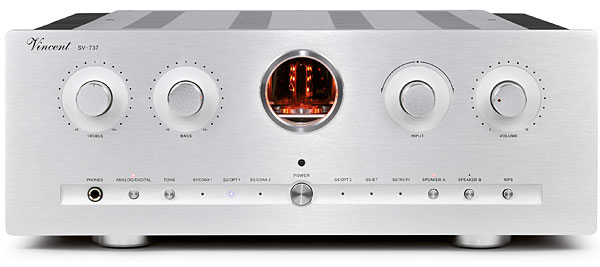
The Vincent Audio SV-737 integrated amplifier ($3499.95) is on the hybrid side. It has a "class-A/AB" output stage—biased to deliver 10W in class-A—said to be capable of 180Wpc into 8 ohms (10Wpc of that in class-A) or 300Wpc into 4 ohms. The SV-737 does digital, with a Burr-Brown PCM5102 DAC chip capable of PCM playback up to 24-bit/192kHz via TosLink or coaxial S/PDIF connections. Wi-Fi and Bluetooth are also included. There is no USB input.
"All [Vincent] products are designed and engineered in Germany," Frank Blöhbaum, engineering consultant to Vincent and a leading member of the design team, told me in an email. "Product manufacturing takes place in China, Germany, or a combination of the two. We have no unit which is 100% produced in Germany. Only the SA-T7, the SP-T700, and the new KHV-200 have final assembly in Germany." The SV-737 is manufactured in China.
The SV-737 is big. It weighs 47lb. Its casework is aluminum. The exterior is imposing, like a newly christened battleship. I found the matte black finish, thick faceplate, and hefty control knobs impressive, and I liked the little porthole that reveals a tube inside.
An Allgemeine Elektrizitäts-Gesellschaft tube
As black as coal, the SV-737's faceplate holds, left to right, four control knobs for treble, bass, input selection, and volume. All the knobs work smoothly and silently. A round, 2¼" display window appears at the center of the façade—a porthole, revealing a German-made, new old-stock (NOS) AEG (Allgemeine Elektrizitäts-Gesellschaft) 85A2 tube; more on that tube later.
Along the bottom edge of the front panel, below the knobs and glowing window, is a ¼" headphone jack followed by a row of fingertip-sized pushbuttons that are intermixed with LEDs. The headphone jack is said to support 'phones between 32 ohms and 600 ohms; when headphones are inserted, the loudspeakers are muted. The small buttons allow you to select between digital or analog sources; activate tone controls; or choose which set of speaker terminals is active. A "WPS" button facilitates setting up the 737 to work with your Wi-Fi network. The big button in the middle is for power.
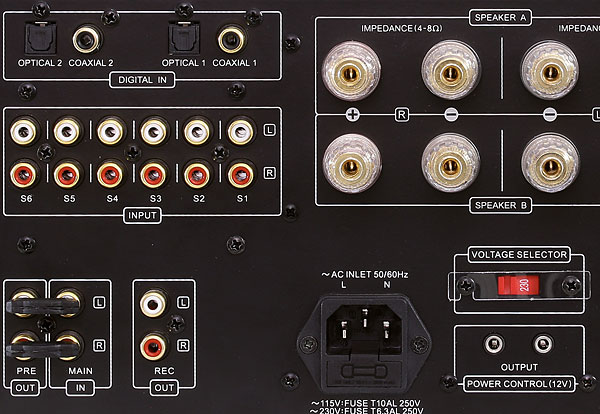
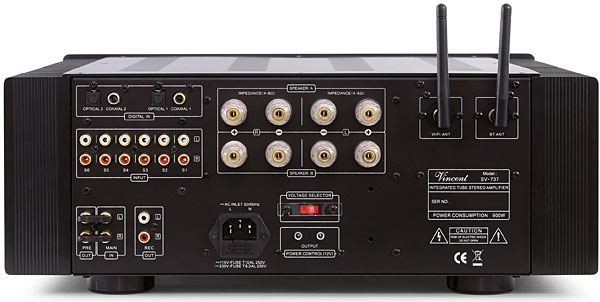 On the back panel are the four digital inputs, the six line-level inputs, pre-out and amp-in connections (jumpered by default), a set of Record analog outputs, two sets of loudspeaker binding posts, the IEC input, a voltage selector (115/230V), and a pair of DC-trigger outputs. Top-right are mounts for the Wi-Fi and Bluetooth antennas.
The thin, brushed-black aluminum remote's controls include mute, input, and volume. It was easy to choose inputs using the remote, but I found it difficult to set just the right volume level. Another button on the remote controlled illumination of the 85A2 tube; three brightness levels are available. (Apparently, it's not tube light that's visible through the window.) The chassis's two sides are heatsinks.
Under the hood, I found a Chinese-made, "DC 5kV tested," 5.6" × 4.25" power transformer that Vincent says weighs 17lb, and I believe it. Also, prominent inside are two circuit boards that contain circuitry for the mirror-image, dual-mono output stages; five tubes including the AEG tube in the middle; an Alps volume control; capacitors from Elna, Wima, and Nichicon; and several Sanken bipolar output power transistors. Everything inside seemed well-ordered and methodically situated, down to the thick "Huaming Wire Mesh Co. Ltd." soldered silver wire affixing circuit board to speaker terminals.
The 737 preamplifier-stage array of two 6N1P and two 6N2P tubes is standard stuff, but the single AEG 85A2 tube (CV449/CV4048) peering out from the faceplate window is anything but. "It's a professional gas stabilizer tube, an integral part of the high-voltage power supply regulation for the preamplifier," Blöhbaum explained. "Allgemeine Elektrizitäts-Gesellschaft [AEG] was an icon of the German electronics industry, founded 1883." AEG developed "the world's first high-quality tape recorder in the 1930s" (footnote 1). The 85A2 "has tight tolerances and was used for voltage stabilization in professional equipment. For audio devices, it was never used up to now because it was too expensive."
On the back panel are the four digital inputs, the six line-level inputs, pre-out and amp-in connections (jumpered by default), a set of Record analog outputs, two sets of loudspeaker binding posts, the IEC input, a voltage selector (115/230V), and a pair of DC-trigger outputs. Top-right are mounts for the Wi-Fi and Bluetooth antennas.
The thin, brushed-black aluminum remote's controls include mute, input, and volume. It was easy to choose inputs using the remote, but I found it difficult to set just the right volume level. Another button on the remote controlled illumination of the 85A2 tube; three brightness levels are available. (Apparently, it's not tube light that's visible through the window.) The chassis's two sides are heatsinks.
Under the hood, I found a Chinese-made, "DC 5kV tested," 5.6" × 4.25" power transformer that Vincent says weighs 17lb, and I believe it. Also, prominent inside are two circuit boards that contain circuitry for the mirror-image, dual-mono output stages; five tubes including the AEG tube in the middle; an Alps volume control; capacitors from Elna, Wima, and Nichicon; and several Sanken bipolar output power transistors. Everything inside seemed well-ordered and methodically situated, down to the thick "Huaming Wire Mesh Co. Ltd." soldered silver wire affixing circuit board to speaker terminals.
The 737 preamplifier-stage array of two 6N1P and two 6N2P tubes is standard stuff, but the single AEG 85A2 tube (CV449/CV4048) peering out from the faceplate window is anything but. "It's a professional gas stabilizer tube, an integral part of the high-voltage power supply regulation for the preamplifier," Blöhbaum explained. "Allgemeine Elektrizitäts-Gesellschaft [AEG] was an icon of the German electronics industry, founded 1883." AEG developed "the world's first high-quality tape recorder in the 1930s" (footnote 1). The 85A2 "has tight tolerances and was used for voltage stabilization in professional equipment. For audio devices, it was never used up to now because it was too expensive."
 Considerable thought seems to have gone into lowering the noise floor of the SV-737. "The transformer has extra isolation between the primary and secondary windings and can therefore withstand the elevated 5kV test procedure," Blöhbaum wrote. "This extra isolation is not only favorable for added safety. It lowers the coupling capacitance between the primary and secondary coils and therefore has a damping effect on unwanted noise, which could be picked-up from the mains supply. In these days of myriad switch-mode power supplies in every household, this is an important feature."
I asked Blöhbaum about the design concept behind the SV-737. "The power amplifier is designed [to have] a very linear characteristic, like a 'straight wire with gain'," he replied. "It ... has a large phase reserve for dealing with complex loads easily (footnote 2). While the power amplifier consists of transistors, the preamplifier uses tubes." The tubed preamplifier, though, is designed to have "a linear characteristic with a tiny flavor of the sweet second harmonics of triodes. 'Tiny' is important! It should not harm the signal integrity at all! An amplifier is not a musical instrument, but it should bring the amplified music to life. The idea was to combine a very linear and neutral power amplifier with a sweet, singing tube preamplifier. Finally, the result should be like a triode amplifier on steroids, ... capable of playing music with a well-balanced clarity."
Bass fishing
Considerable thought seems to have gone into lowering the noise floor of the SV-737. "The transformer has extra isolation between the primary and secondary windings and can therefore withstand the elevated 5kV test procedure," Blöhbaum wrote. "This extra isolation is not only favorable for added safety. It lowers the coupling capacitance between the primary and secondary coils and therefore has a damping effect on unwanted noise, which could be picked-up from the mains supply. In these days of myriad switch-mode power supplies in every household, this is an important feature."
I asked Blöhbaum about the design concept behind the SV-737. "The power amplifier is designed [to have] a very linear characteristic, like a 'straight wire with gain'," he replied. "It ... has a large phase reserve for dealing with complex loads easily (footnote 2). While the power amplifier consists of transistors, the preamplifier uses tubes." The tubed preamplifier, though, is designed to have "a linear characteristic with a tiny flavor of the sweet second harmonics of triodes. 'Tiny' is important! It should not harm the signal integrity at all! An amplifier is not a musical instrument, but it should bring the amplified music to life. The idea was to combine a very linear and neutral power amplifier with a sweet, singing tube preamplifier. Finally, the result should be like a triode amplifier on steroids, ... capable of playing music with a well-balanced clarity."
Bass fishing
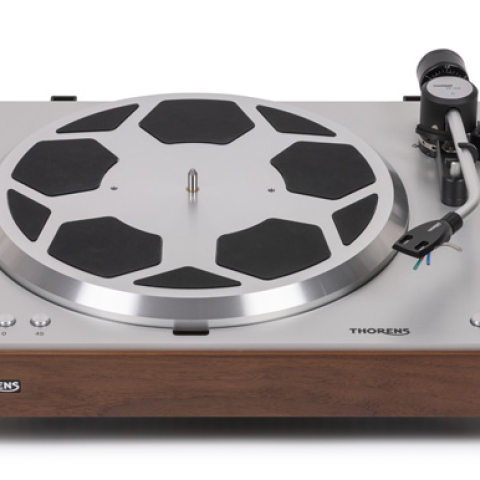
I ran my Kuzma and Thorens turntables into the Tavish Audio Design Adagio phono preamp; a pair of Triode Wire Labs Spirit II interconnects connected the phono pre to the SV-737. For files and streaming, I used my Asus Windows laptop as a digital source, but because the Vincent lacks a USB connection—a notable omission in an age when computers are often used as digital sources—I used a Wyred4Sound µLink converter to adapt the laptop's USB output to TosLink. To play CDs, I connected my Tascam 200iL CD player to one of the SV-737's analog inputs via a 1m pair of Shindo Laboratory interconnects. To compare the Vincent's onboard DAC to my Denafrips Ares II DAC, I used an AudioQuest Forest digital cable and Triode Wire Labs Spirit II interconnects. I hooked up the Klipsch Forte III floorstanding loudspeakers to the amplifier, and off I went.
Footnote 1: AEG showed the first practical audio magnetic tape recorder, the Magnetophon K1, at the Internationale Funkausstellung Berlin in 1935.—Editor
Footnote 2: "Phase reserve" refers to the ability of an amplifier to deal with complex (specifically, capacitive) loads.—Editor
As black as coal, the SV-737's faceplate holds, left to right, four control knobs for treble, bass, input selection, and volume. All the knobs work smoothly and silently. A round, 2¼" display window appears at the center of the façade—a porthole, revealing a German-made, new old-stock (NOS) AEG (Allgemeine Elektrizitäts-Gesellschaft) 85A2 tube; more on that tube later.
On the back panel are the four digital inputs, the six line-level inputs, pre-out and amp-in connections (jumpered by default), a set of Record analog outputs, two sets of loudspeaker binding posts, the IEC input, a voltage selector (115/230V), and a pair of DC-trigger outputs. Top-right are mounts for the Wi-Fi and Bluetooth antennas.
The thin, brushed-black aluminum remote's controls include mute, input, and volume. It was easy to choose inputs using the remote, but I found it difficult to set just the right volume level. Another button on the remote controlled illumination of the 85A2 tube; three brightness levels are available. (Apparently, it's not tube light that's visible through the window.) The chassis's two sides are heatsinks.
Considerable thought seems to have gone into lowering the noise floor of the SV-737. "The transformer has extra isolation between the primary and secondary windings and can therefore withstand the elevated 5kV test procedure," Blöhbaum wrote. "This extra isolation is not only favorable for added safety. It lowers the coupling capacitance between the primary and secondary coils and therefore has a damping effect on unwanted noise, which could be picked-up from the mains supply. In these days of myriad switch-mode power supplies in every household, this is an important feature."
I ran my Kuzma and Thorens turntables into the Tavish Audio Design Adagio phono preamp; a pair of Triode Wire Labs Spirit II interconnects connected the phono pre to the SV-737. For files and streaming, I used my Asus Windows laptop as a digital source, but because the Vincent lacks a USB connection—a notable omission in an age when computers are often used as digital sources—I used a Wyred4Sound µLink converter to adapt the laptop's USB output to TosLink. To play CDs, I connected my Tascam 200iL CD player to one of the SV-737's analog inputs via a 1m pair of Shindo Laboratory interconnects. To compare the Vincent's onboard DAC to my Denafrips Ares II DAC, I used an AudioQuest Forest digital cable and Triode Wire Labs Spirit II interconnects. I hooked up the Klipsch Forte III floorstanding loudspeakers to the amplifier, and off I went.
Footnote 1: AEG showed the first practical audio magnetic tape recorder, the Magnetophon K1, at the Internationale Funkausstellung Berlin in 1935.—Editor