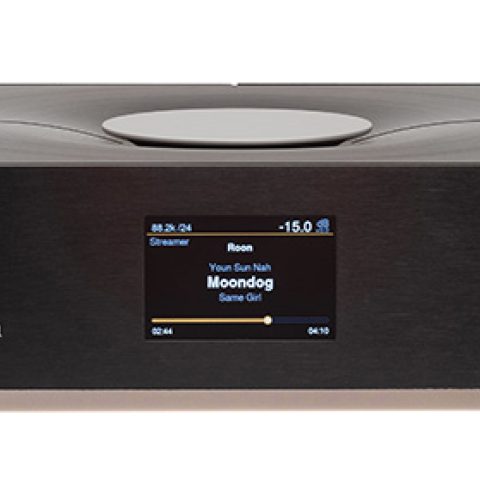
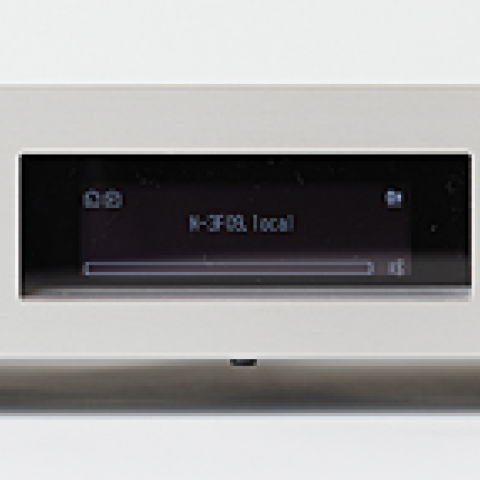
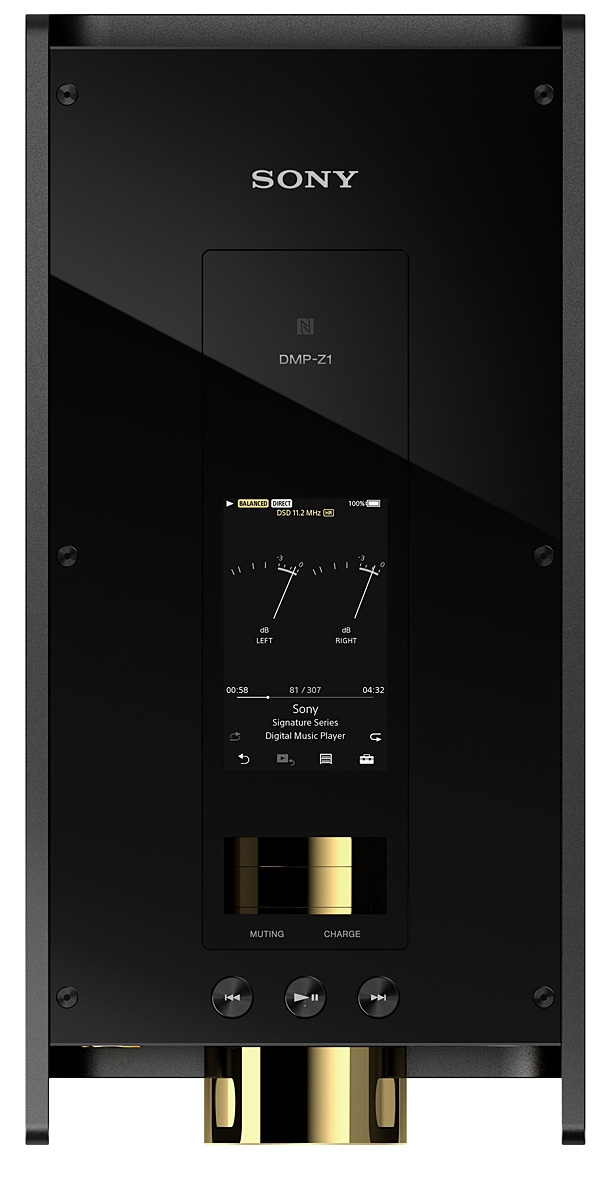
In USB DAC mode, the DMP-Z1's display shows a bar-graph level meter for each channel, as well as the sample rate of the incoming data. With Roon performing the first or both unfoldings of MQA-encoded, 192kHz-sampled data, the Sony peculiarly displayed, respectively, "PCM 96kHz" or "PCM 48kHz." The display correctly showed the sample rate with linear PCM or DSD data in USB DAC mode, however. And MQA files played from the DMP-Z1's internal storage were identified as "MQA," with the unfolded sample rate displayed. With all files that have a bit depth greater than 16 or a sample rate higher than 48kHz, including MQA-encoded files, "HR" (for "Hi-Res") appeared at the top of the Sony's screen, to the right of the sample rate.
Sony provides a "Guide to High Quality Sound," accessible from the display's Settings page. The guide indicates that the DMP-Z1 uses polymer capacitors and Panasonic POSCAP capacitors in the amplifier circuit, and that these need 200 hours of break-in with music playing before they will produce the "highest quality sound." I didn't have the DMP-Z1 long enough to get to the 200-hour point, but I noticed no changes in the player's sound during the four weeks I listened to it.
I briefly played with the DMP-Z1's DSP functions, but other than DSD Remastering and the reconstruction-filter choices, I didn't spend significant time auditioning them. They are what they are. Nor did I audition the Bluetooth mode—regardless of the convenience, I'm no fan of Bluetooth—other than to check that it worked with my iPhone 6S. It did.
Listening to filters
As with some other processors and headphone amplifiers we've recently reviewed, the DMP-Z1's filter options complicated the auditioning. I echo Herb Reichert's question in the May 2019 issue: "Have filters become the digital equivalent of analog tone controls? . . . which one am I supposed to like? Most important, why am I being forced to choose?" Nevertheless, I spent the best part of a day auditioning the Sony's six reconstruction filters, in the process draining the DMP-Z1's battery from fully charged to 19%. With CD-resolution music—eg, "Satellites," from Rickie Lee Jones's Flying Cowboys (16/44.1 AAC file, Geffen), an album produced by the late Walter Becker that has superb dynamic range but can sound a bit forward in the upper mids—the Short Delay Slow filter gave the most palpable imaging. But it was close between that filter and the Slow filter, both sounding less "shouty" than the Super Slow filter. Differences between filters were more difficult to hear at higher sample rates. With a needle drop of violinist David Abel and pianist Julie Steinberg performing Beethoven's Violin Sonata 10 in G, Op.96 (24/192 ALAC from LP, Wilson Audiophile W-8315), the Short Delay Sharp filter sounded slightly more relaxed than the Slow filter, with a somewhat better sense of soundstage depth, even through headphones. Low Dispersion Short Delay produced a somewhat lighter-sounding piano in this recording, while Sharp emphasized the percussive noise of the piano's keys.
 Robert Levine enthusiastically reviewed Japanese percussionist Kuniko's virtuosic performance of Steve Reich's Drumming (CD, Linn CKD 385) in the March 2019 issue (p.115). A fan of both Kuniko and Reich—a live performance in London of the composer's minimalist Music for 18 Musicians remains a vivid memory 35 years later—I purchased the 24/192 "Studio Master" FLAC files. The fourth and final part of Drumming features repetitive patterns on marimba and glockenspiel—the Super Slow filter emphasized the instrumental attacks, the glock sounding a touch "shiny." Short Delay Fast gave the best balance between the leading edges of notes and the body of the tone.
I used Short Delay Fast for most of my listening, checking out the other filters when I felt the sound of a familiar track wasn't quite what I'd expected. For classical orchestral music, I most often used Low Dispersion Short Delay.
What about DSD Remastering? When I streamed from Tidal Music for 18 Musicians, performed by the Steve Reich Ensemble in 1978 (16/44.1 FLAC, ECM), the complex musical threads were a little easier to unravel with the DMPZ1 transcoding the CD data to DSD128. Even a mono recording—"Please, Please, Please" from James Brown's 20 All-Time Greatest Hits! (24/192 ALAC file, Polydor/PonoMusic)—sounded a touch smoother with DSD upsampling.
Listening to music
Robert Levine enthusiastically reviewed Japanese percussionist Kuniko's virtuosic performance of Steve Reich's Drumming (CD, Linn CKD 385) in the March 2019 issue (p.115). A fan of both Kuniko and Reich—a live performance in London of the composer's minimalist Music for 18 Musicians remains a vivid memory 35 years later—I purchased the 24/192 "Studio Master" FLAC files. The fourth and final part of Drumming features repetitive patterns on marimba and glockenspiel—the Super Slow filter emphasized the instrumental attacks, the glock sounding a touch "shiny." Short Delay Fast gave the best balance between the leading edges of notes and the body of the tone.
I used Short Delay Fast for most of my listening, checking out the other filters when I felt the sound of a familiar track wasn't quite what I'd expected. For classical orchestral music, I most often used Low Dispersion Short Delay.
What about DSD Remastering? When I streamed from Tidal Music for 18 Musicians, performed by the Steve Reich Ensemble in 1978 (16/44.1 FLAC, ECM), the complex musical threads were a little easier to unravel with the DMPZ1 transcoding the CD data to DSD128. Even a mono recording—"Please, Please, Please" from James Brown's 20 All-Time Greatest Hits! (24/192 ALAC file, Polydor/PonoMusic)—sounded a touch smoother with DSD upsampling.
Listening to music
In a nostalgic mood, I began my serious listening by using Roon to bring up perhaps the best live album ever, Donny Hathaway's Live (24/192 FLAC, Atlantic/HDtracks). The version of John Lennon's "Jealous Guy" on this album, with its loping rhythm, is definitive, and the combination of the DMP-Z1 and AudioQuest NightHawks presented Hathaway's voice within the subtle club ambience to perfection. The sound was a touch too mellow—AudioQuest headphones are balanced on the dark side of neutral—so I switched to the Audeze LCD-Xes, connected with Nordost Heimdall cables, for "The Ghetto." The tremolo'd Wurlitzer electric piano in this track's intro floated even farther free of the audience's soul clapping, and the Sony propelled the song's iconic bass riff with hypnotic urgency. The Hathaway album was released in 1972, as was another album that had a huge effect on me that year: Stevie Wonder's Music of My Mind. Streaming this album's opener, "Love Having You Around," from Qobuz (24/96 FLAC, Motown), I was reminded that on this album Wonder plays every instrument other than guitar and, on this track, trombone, the latter courtesy of ace trombonist Art Baron. The last trombone player Duke Ellington hired, Baron has a connection with this magazine: He plays on the Jerome Harris Quintet's Rendezvous (CD, Stereophile STPH013-2), which I recorded in 1998. Rendezvous is out of print, but one track from it, Duke Ellington's "The Mooche," appears on our Editor's Choice CD (STPH016-2). Baron's plunger-muted soloing in "The Mooche" was optimally reproduced by the Sony-Audeze-Nordost combination, with all its wah-wah rasp intact. When I'd mixed this track, I wanted to preserve the original sound's wide dynamic range, which meant that Harris's Taylor acoustic bass guitar is relatively low in level. Its subtle sound was clearly delineated, however, with excellent low-frequency weight. But what about a track in which the low frequencies are big, bold, and magnificent? I cued up "#thatPower," by will.i.am and Justin Bieber, from will.i.am's #willpower (16/44.1 FLAC, Interscope). The Sony managed to hold on to this song's subterranean excesses without making the sound bloated or boomy.
Listening to MQA
It was time to try some MQA-encoded music. My current favorite performance of Benjamin Britten's Variations on a Theme of Frank Bridge is by the Trondheim Soloists, on their Reflections (24/44.1 MQA FLAC unfolded by the DMP-Z1 to 24/352.8, 2L 2L-125). This work for string orchestra sounded simply glorious through the Sony with all three pairs of headphones: The Audezes presented a wealth of detail in the midrange and treble; despite their lift in the lows, the AudioQuests didn't sound over-rich; and the Sennheisers sounded neutral, if a little bass-shy, compared with the other two pairs of cans. The Sony simply stepped out of the way of the music. As I write these words, I'm listening through the Sony-Sennheiser system to Radka Toneff's hauntingly beautiful performance of "Nature Boy," from the 2018 Original Master Edition reissue of her Fairytales (24/48 MQA file unfolded to 24/192, Odin CD9561), our Recording of the Month for April 2018. I have to keep lifting my fingers from the keyboard to revel in the glory of the sound and the song: musical gold to match the DMP-Z1's gold-plated volume control. An unbalanced comparison
Until I began working exclusively from home, my constant companion on my daily commute was the PonoPlayer I'd bought after reviewing it in April 2015. It may seem absurd to compare the $8500 Sony with the Pono, which cost $399 when last available, but I've racked up more hours listening through headphones with the Pono than with any other product. With the Audeze LCD-Xes, which are more revealing than the AudioQuest NightHawks, the high frequencies in "The Mooche" had more top-octave air with the DMPZ1, letting me better hear the subtle acoustic of Blue Heaven Studios, in Salina, Kansas. At the other end of the spectrum, the double bass in James Brown's "Please, Please, Please" had a weightier body tone through the Sony, though this recording's rather rough mid-treble sounded a touch smoother through the Pono. A case of Authority (Sony) vs Acceptable (Pono).
Conclusion
Two high-end products with digital inputs and headphone outputs that I enjoyed for a while in my system were Ayre Acoustics' Codex ($1795) and QX-5 Twenty ($8950), both AC-powered. Other than lacking internal storage and an integral playback app, both are broadly equivalent to Sony's DMP-Z1. Both review samples were long ago returned to Ayre, but I have fond memories of using them with my Audeze LCD-X headphones, especially the QX-5 Twenty. When it comes to headphone sound quality, the Sony DMP-Z1 joins that distinguished company — and it's a Walkman! Kind of.
As with some other processors and headphone amplifiers we've recently reviewed, the DMP-Z1's filter options complicated the auditioning. I echo Herb Reichert's question in the May 2019 issue: "Have filters become the digital equivalent of analog tone controls? . . . which one am I supposed to like? Most important, why am I being forced to choose?" Nevertheless, I spent the best part of a day auditioning the Sony's six reconstruction filters, in the process draining the DMP-Z1's battery from fully charged to 19%. With CD-resolution music—eg, "Satellites," from Rickie Lee Jones's Flying Cowboys (16/44.1 AAC file, Geffen), an album produced by the late Walter Becker that has superb dynamic range but can sound a bit forward in the upper mids—the Short Delay Slow filter gave the most palpable imaging. But it was close between that filter and the Slow filter, both sounding less "shouty" than the Super Slow filter. Differences between filters were more difficult to hear at higher sample rates. With a needle drop of violinist David Abel and pianist Julie Steinberg performing Beethoven's Violin Sonata 10 in G, Op.96 (24/192 ALAC from LP, Wilson Audiophile W-8315), the Short Delay Sharp filter sounded slightly more relaxed than the Slow filter, with a somewhat better sense of soundstage depth, even through headphones. Low Dispersion Short Delay produced a somewhat lighter-sounding piano in this recording, while Sharp emphasized the percussive noise of the piano's keys.
Robert Levine enthusiastically reviewed Japanese percussionist Kuniko's virtuosic performance of Steve Reich's Drumming (CD, Linn CKD 385) in the March 2019 issue (p.115). A fan of both Kuniko and Reich—a live performance in London of the composer's minimalist Music for 18 Musicians remains a vivid memory 35 years later—I purchased the 24/192 "Studio Master" FLAC files. The fourth and final part of Drumming features repetitive patterns on marimba and glockenspiel—the Super Slow filter emphasized the instrumental attacks, the glock sounding a touch "shiny." Short Delay Fast gave the best balance between the leading edges of notes and the body of the tone.
I used Short Delay Fast for most of my listening, checking out the other filters when I felt the sound of a familiar track wasn't quite what I'd expected. For classical orchestral music, I most often used Low Dispersion Short Delay.
What about DSD Remastering? When I streamed from Tidal Music for 18 Musicians, performed by the Steve Reich Ensemble in 1978 (16/44.1 FLAC, ECM), the complex musical threads were a little easier to unravel with the DMPZ1 transcoding the CD data to DSD128. Even a mono recording—"Please, Please, Please" from James Brown's 20 All-Time Greatest Hits! (24/192 ALAC file, Polydor/PonoMusic)—sounded a touch smoother with DSD upsampling.
In a nostalgic mood, I began my serious listening by using Roon to bring up perhaps the best live album ever, Donny Hathaway's Live (24/192 FLAC, Atlantic/HDtracks). The version of John Lennon's "Jealous Guy" on this album, with its loping rhythm, is definitive, and the combination of the DMP-Z1 and AudioQuest NightHawks presented Hathaway's voice within the subtle club ambience to perfection. The sound was a touch too mellow—AudioQuest headphones are balanced on the dark side of neutral—so I switched to the Audeze LCD-Xes, connected with Nordost Heimdall cables, for "The Ghetto." The tremolo'd Wurlitzer electric piano in this track's intro floated even farther free of the audience's soul clapping, and the Sony propelled the song's iconic bass riff with hypnotic urgency. The Hathaway album was released in 1972, as was another album that had a huge effect on me that year: Stevie Wonder's Music of My Mind. Streaming this album's opener, "Love Having You Around," from Qobuz (24/96 FLAC, Motown), I was reminded that on this album Wonder plays every instrument other than guitar and, on this track, trombone, the latter courtesy of ace trombonist Art Baron. The last trombone player Duke Ellington hired, Baron has a connection with this magazine: He plays on the Jerome Harris Quintet's Rendezvous (CD, Stereophile STPH013-2), which I recorded in 1998. Rendezvous is out of print, but one track from it, Duke Ellington's "The Mooche," appears on our Editor's Choice CD (STPH016-2). Baron's plunger-muted soloing in "The Mooche" was optimally reproduced by the Sony-Audeze-Nordost combination, with all its wah-wah rasp intact. When I'd mixed this track, I wanted to preserve the original sound's wide dynamic range, which meant that Harris's Taylor acoustic bass guitar is relatively low in level. Its subtle sound was clearly delineated, however, with excellent low-frequency weight. But what about a track in which the low frequencies are big, bold, and magnificent? I cued up "#thatPower," by will.i.am and Justin Bieber, from will.i.am's #willpower (16/44.1 FLAC, Interscope). The Sony managed to hold on to this song's subterranean excesses without making the sound bloated or boomy.
It was time to try some MQA-encoded music. My current favorite performance of Benjamin Britten's Variations on a Theme of Frank Bridge is by the Trondheim Soloists, on their Reflections (24/44.1 MQA FLAC unfolded by the DMP-Z1 to 24/352.8, 2L 2L-125). This work for string orchestra sounded simply glorious through the Sony with all three pairs of headphones: The Audezes presented a wealth of detail in the midrange and treble; despite their lift in the lows, the AudioQuests didn't sound over-rich; and the Sennheisers sounded neutral, if a little bass-shy, compared with the other two pairs of cans. The Sony simply stepped out of the way of the music. As I write these words, I'm listening through the Sony-Sennheiser system to Radka Toneff's hauntingly beautiful performance of "Nature Boy," from the 2018 Original Master Edition reissue of her Fairytales (24/48 MQA file unfolded to 24/192, Odin CD9561), our Recording of the Month for April 2018. I have to keep lifting my fingers from the keyboard to revel in the glory of the sound and the song: musical gold to match the DMP-Z1's gold-plated volume control. An unbalanced comparison
Until I began working exclusively from home, my constant companion on my daily commute was the PonoPlayer I'd bought after reviewing it in April 2015. It may seem absurd to compare the $8500 Sony with the Pono, which cost $399 when last available, but I've racked up more hours listening through headphones with the Pono than with any other product. With the Audeze LCD-Xes, which are more revealing than the AudioQuest NightHawks, the high frequencies in "The Mooche" had more top-octave air with the DMPZ1, letting me better hear the subtle acoustic of Blue Heaven Studios, in Salina, Kansas. At the other end of the spectrum, the double bass in James Brown's "Please, Please, Please" had a weightier body tone through the Sony, though this recording's rather rough mid-treble sounded a touch smoother through the Pono. A case of Authority (Sony) vs Acceptable (Pono).
Two high-end products with digital inputs and headphone outputs that I enjoyed for a while in my system were Ayre Acoustics' Codex ($1795) and QX-5 Twenty ($8950), both AC-powered. Other than lacking internal storage and an integral playback app, both are broadly equivalent to Sony's DMP-Z1. Both review samples were long ago returned to Ayre, but I have fond memories of using them with my Audeze LCD-X headphones, especially the QX-5 Twenty. When it comes to headphone sound quality, the Sony DMP-Z1 joins that distinguished company — and it's a Walkman! Kind of.