The Nucleus also has an internal bay for a 2.5" drive, either HDD or SSD, but this drive can't be more than 7mm in height. The Nucleus+ is powered by a wall wart—a linear power supply should be available later this year—and is turned on or off with a rear-panel pushbutton. With its minimal system overhead, it boots up incredibly quickly. One of Roon's goals for the Nucleus was that it dissipate heat only passively, without a cooling fan, and even after prolonged use the prominent heatsink fins on the top and sides of its dark gray case barely got warm. I measured the top panel's temperature as 92.6°F (33.7°C).
Listening
To use the Nucleus servers you'll need a subscription to Roon (free 14-day trial, $119/year, $499/lifetime, footnote 2). I began my auditioning of the Nucleus+ with v.1.4 of the Roon app running on my iPad mini, and v.1.4 of the Roon Core and v.1.0 of the Roon OS running on the Nucleus+. Toward the end of the review period, both app and Core were updated to v.1.5, which allows the unfolding of MQA-encoded files. Using the iPad app, I pointed the Roon Core to my library, initially stored on a 2TB USB drive. Roon's metadata library continues to amaze me. The Radio function, akin to iTunes' Shuffle mode, digs deep into the data to find connections. It followed Robert Silverman's Chopin's Last Waltz/ (DSD64 files, IsoMike 5606) with an MQA-encoded version of his recording of a Beethoven piano sonata. But who then would have anticipated it cueing up "Soul Intro/The Chicken," from the late bass guitarist Jaco Pastorius's Truth, Liberty & Soul (24/192 AIFF file, Resonance HCD 2027)? And Roon's ability to instantly discover a particular performance of a composition is frightening. While playing Henry Love's Das alte Lied, from pianist Stephen Hough's Dream Album (16/44.1k WAV, Hyperion CDA68176), I asked Roon what other performances there were of this work. It immediately responded that while there was just the one in my library, eight others were available from the Tidal streaming service.
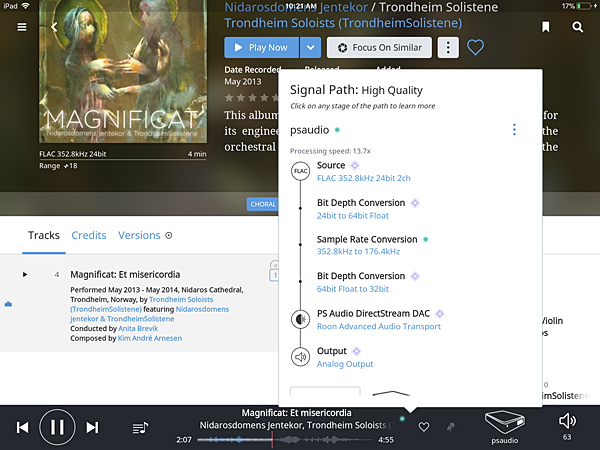
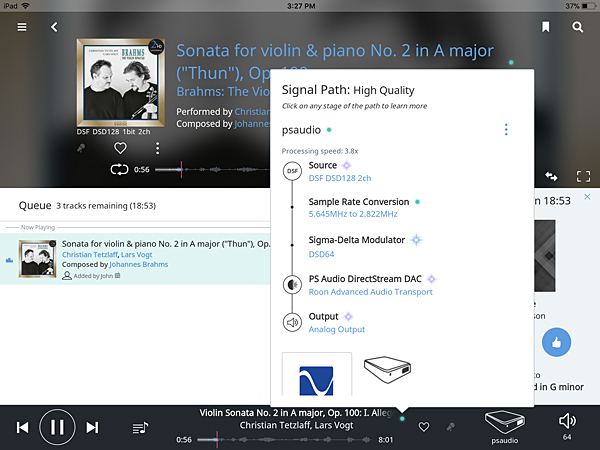
While Roon supports PCM resolutions up to 24 bits, sample rates up to 384kHz, and DSD up to DSD128, it downsamples the data to match the limitations of the D/A converter in use. For example, my PS Audio DirectStream DAC is limited to PCM sampled at 192kHz via its Bridge II network adapter. Clicking on the colored dot to the right of the track name at the bottom of the Roon app's screen displays the signal path. With the Trondheim Soloists' performance of Kim André Arnesen's Magnificat (24/352.8k FLAC, 2L), the Nucleus first converted the 24-bit integer data to 64-bit floating point, then converted the sample rate from 352.8 to 176.4kHz, then the 64-bit float data to 32-bit integer, finally sending the 32/176.4 data to the Roon Ready PS Audio over the network using the Roon Advanced Audio Transport (RAAT), which Roon says "delivers bit perfect audio to local outputs, networked outputs, and Roon Ready devices." The processing speed was listed as "13.7x"—ie, plenty of margin. Similarly with Christian Tetzlaff and Lars Vogt's performance of the Brahms Violin Sonatas (DSD128 files, Ondine ODE1284-2D/HDtracks), the Nucleus converted the sample rate from 5645 to 2822MHz, then applied a DSD64 sigma-delta modulator to the data before sending them to the PS Audio. This time, the more intensive processing cut the conversion speed to "3.8x."
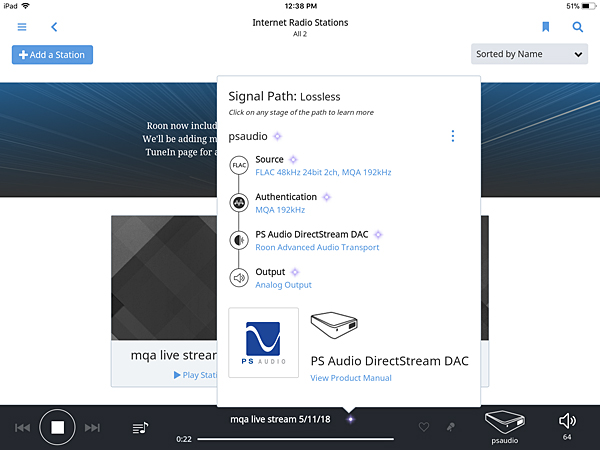
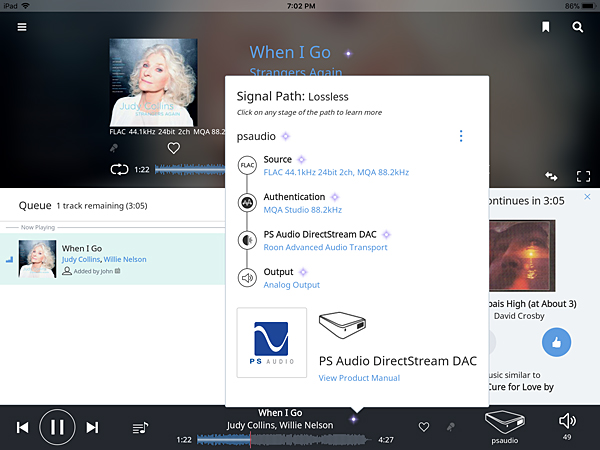
 With Roon 1.5, I used the Internet Radio Stations feature to access a live streaming event that MQA Ltd. had arranged to coincide with May's High End show, in Munich: a jazz sextet led by double bassist Misha Mullov-Abbado playing four songs in a London studio. Roon identified the stream as "FLAC 48kHz 24-bit, 2ch, MQA 192kHz," noted that Authentication was "MQA 192kHz," and used RAAT to send the data over my network to the PS Audio. The PSA's screen indicated that it was receiving data sampled at 192kHz, though the bit depth was indicated as "16 bits" rather than 24, apparently due to a bug in the PSA Bridge's firmware (since fixed).
 You'll note that I've said nothing about sound quality. Having used the Nucleus almost every day since it arrived, I have nothing specific to say about the sound other than that it was always excellent. So . . .
Comparisons
You'll note that I've said nothing about sound quality. Having used the Nucleus almost every day since it arrived, I have nothing specific to say about the sound other than that it was always excellent. So . . .
Comparisons
I've written before that I've found that a DAC fed data via USB doesn't sound as "solid" as when the DAC is fed the same data via an AES/EBU link. I didn't listen to the Nucleus+'s USB output—the server sits in a rack too far from the PS Audio DAC for a USB link to be practicable. But what about data sent from it via Ethernet, where the length of the link is immaterial? As I left Michael Fremer's place after measuring the Moon by Simaudio 888 amplifier reviewed elsewhere in this issue, he pressed on me the CD of Van Morrison and Joey DeFrancesco's You're Driving Me Crazy (Exile/Legacy 19075820041). Comparing a WAV file of "Like Young Lovers Do," sourced from the Roon over my network, with my Ayre Acoustics C-5xeMP disc player via AES/EBU, it was difficult to hear any significant difference. Perhaps the Hammond organ's bass pedals were a bit fuller with the Nucleus+; perhaps the Ayre's output sounded a little more open. Perhaps. Before introducing the Nucleus servers, Roon used to recommend Intel's NUC mini PCs. Jason Victor Serinus lent me his NUC7i7BH ($469 in kit form). This takes longer to boot—and from 3' away I could hear its cooling fan—but it was then recognized by the Roon app as "Roon Optimized Core Kit." I pointed Roon to ROCK as the music source and enabled the PS Audio DAC as the audio device.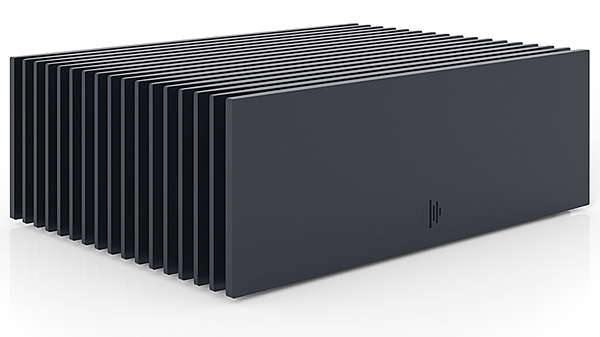 Who knew Jason would have the B-52's in his library? "Rock Lobster," sourced from Tidal and the NUC, had excellent impact, with good low-frequency extension. Streaming the same track from Tidal via the Nucleus+, perhaps there was a touch more authority in the bass. Perhaps. With "Every Day I Have the Blues," from the Morrison-DeFrancesco album, the sound through the NUC was less authoritative, less open. However, the comparison was unfair: Though both versions were 16/44.1, I was streaming from Tidal with the NUC, and playing a WAV file from local storage with the Nucleus+. Nevertheless, while changing to the Tidal stream with the Nucleus+ reduced the difference between the servers, the Nucleus+ sounded still a tad tidier.
Conclusion
Who knew Jason would have the B-52's in his library? "Rock Lobster," sourced from Tidal and the NUC, had excellent impact, with good low-frequency extension. Streaming the same track from Tidal via the Nucleus+, perhaps there was a touch more authority in the bass. Perhaps. With "Every Day I Have the Blues," from the Morrison-DeFrancesco album, the sound through the NUC was less authoritative, less open. However, the comparison was unfair: Though both versions were 16/44.1, I was streaming from Tidal with the NUC, and playing a WAV file from local storage with the Nucleus+. Nevertheless, while changing to the Tidal stream with the Nucleus+ reduced the difference between the servers, the Nucleus+ sounded still a tad tidier.
Conclusion
For those who, like me, don't want to go the hair-shirt, DIY route to networked audio, the fit'n'forget functionality and routinely excellent sound quality of Roon Labs' Nucleus+ through both of the DACs I used it with make it an easy recommendation. It's not going back!
Footnote 2: For a full description of Roon's capabilities, see here and here.
To use the Nucleus servers you'll need a subscription to Roon (free 14-day trial, $119/year, $499/lifetime, footnote 2). I began my auditioning of the Nucleus+ with v.1.4 of the Roon app running on my iPad mini, and v.1.4 of the Roon Core and v.1.0 of the Roon OS running on the Nucleus+. Toward the end of the review period, both app and Core were updated to v.1.5, which allows the unfolding of MQA-encoded files. Using the iPad app, I pointed the Roon Core to my library, initially stored on a 2TB USB drive. Roon's metadata library continues to amaze me. The Radio function, akin to iTunes' Shuffle mode, digs deep into the data to find connections. It followed Robert Silverman's Chopin's Last Waltz/ (DSD64 files, IsoMike 5606) with an MQA-encoded version of his recording of a Beethoven piano sonata. But who then would have anticipated it cueing up "Soul Intro/The Chicken," from the late bass guitarist Jaco Pastorius's Truth, Liberty & Soul (24/192 AIFF file, Resonance HCD 2027)? And Roon's ability to instantly discover a particular performance of a composition is frightening. While playing Henry Love's Das alte Lied, from pianist Stephen Hough's Dream Album (16/44.1k WAV, Hyperion CDA68176), I asked Roon what other performances there were of this work. It immediately responded that while there was just the one in my library, eight others were available from the Tidal streaming service.
With Roon 1.5, I used the Internet Radio Stations feature to access a live streaming event that MQA Ltd. had arranged to coincide with May's High End show, in Munich: a jazz sextet led by double bassist Misha Mullov-Abbado playing four songs in a London studio. Roon identified the stream as "FLAC 48kHz 24-bit, 2ch, MQA 192kHz," noted that Authentication was "MQA 192kHz," and used RAAT to send the data over my network to the PS Audio. The PSA's screen indicated that it was receiving data sampled at 192kHz, though the bit depth was indicated as "16 bits" rather than 24, apparently due to a bug in the PSA Bridge's firmware (since fixed).
You'll note that I've said nothing about sound quality. Having used the Nucleus almost every day since it arrived, I have nothing specific to say about the sound other than that it was always excellent. So . . .
I've written before that I've found that a DAC fed data via USB doesn't sound as "solid" as when the DAC is fed the same data via an AES/EBU link. I didn't listen to the Nucleus+'s USB output—the server sits in a rack too far from the PS Audio DAC for a USB link to be practicable. But what about data sent from it via Ethernet, where the length of the link is immaterial? As I left Michael Fremer's place after measuring the Moon by Simaudio 888 amplifier reviewed elsewhere in this issue, he pressed on me the CD of Van Morrison and Joey DeFrancesco's You're Driving Me Crazy (Exile/Legacy 19075820041). Comparing a WAV file of "Like Young Lovers Do," sourced from the Roon over my network, with my Ayre Acoustics C-5xeMP disc player via AES/EBU, it was difficult to hear any significant difference. Perhaps the Hammond organ's bass pedals were a bit fuller with the Nucleus+; perhaps the Ayre's output sounded a little more open. Perhaps. Before introducing the Nucleus servers, Roon used to recommend Intel's NUC mini PCs. Jason Victor Serinus lent me his NUC7i7BH ($469 in kit form). This takes longer to boot—and from 3' away I could hear its cooling fan—but it was then recognized by the Roon app as "Roon Optimized Core Kit." I pointed Roon to ROCK as the music source and enabled the PS Audio DAC as the audio device.
Who knew Jason would have the B-52's in his library? "Rock Lobster," sourced from Tidal and the NUC, had excellent impact, with good low-frequency extension. Streaming the same track from Tidal via the Nucleus+, perhaps there was a touch more authority in the bass. Perhaps. With "Every Day I Have the Blues," from the Morrison-DeFrancesco album, the sound through the NUC was less authoritative, less open. However, the comparison was unfair: Though both versions were 16/44.1, I was streaming from Tidal with the NUC, and playing a WAV file from local storage with the Nucleus+. Nevertheless, while changing to the Tidal stream with the Nucleus+ reduced the difference between the servers, the Nucleus+ sounded still a tad tidier.
For those who, like me, don't want to go the hair-shirt, DIY route to networked audio, the fit'n'forget functionality and routinely excellent sound quality of Roon Labs' Nucleus+ through both of the DACs I used it with make it an easy recommendation. It's not going back!
Footnote 2: For a full description of Roon's capabilities, see here and here.