In either mode, the Harbeth M30.2s were obviously well-tempered and well-nourished, power-wise. Both modes delivered detailed sound that was neither warm nor cool, just well balanced. The bass was tight and clean, maybe slightly lean, with no overhang or fuzzy harmonic additives.
Ultralinear mode was more sharply focused than Triode. In UL, music's empty spaces seemed too empty, in a slightly unnatural way. I felt I was receiving less information, that those empty spaces had once been occupied by texture, color, light, and shade. UL seemed higher in contrast. In Triode, voices and instruments felt denser, more tactile, more a part of their surroundings. UL was more forceful and immediate, but occasionally peaky or hard. UL maximized bass punch and string plucks, emphasized keystrokes and Manoff's left hand; Triode favored the upper octaves, emphasizing decays, sustains, and harmonics. Manoff's pedaling was more obvious in Triode. UL drew my attention to the tempo; Triode showed me more mélodie Française.
I preferred Triode mode because the most obvious difference between it and UL was an important one: Triode delivered bigger, deeper, more CinemaScope soundstages populated with denser, more vivid three-dimensional aural images.
The differences just described were actually subtle, and both modes of tube operation were enjoyable, but for different reasons. More obviously, in both modes, the Stereo 100's sound was unsubtly not tube-like. In a blind test, I doubt I could identify it as a tubed amplifier.
Comparison: Pass Laboratories XA25
The sound of the Rogue Stereo 100 was not as strikingly transparent as that of Pass Laboratories' XA25 25Wpc amplifier ($4900), nor did it feel more powerful. Nor was it as alive, open, or dynamic. That doesn't mean I found it inferior. Watt for watt, the XA25 stands tall and truthful next to any amplifier putting out less than 100W. So will the Stereo 100. Both played diverse music with the authority of excellent design. To my taste, driving my speakers in my room, the triode-connected Stereo 100 seemed nigh on perfect. It had a way of disappearing, leaving vital, living music hanging in the air between the Harbeth M30.2s. The XA25 may be more transparent in the sense of the air between performers being freshly oxygenated and free of haze, but I can always tell when the Pass is driving my speakers—I can feel its hyperdynamic presence. The Rogue was more unobtrusive, readily disappearing from my awareness. Driving the Harbeth M30.2s, both were true reference-quality amps.
Comparison: PrimaLuna ProLogue Premium
The Rogue Stereo 100 also proved more "invisible" than my long-beloved PrimaLuna ProLogue Premium 35Wpc amplifier ($2195). The Rogue added less of the friendly magic of the PrimaLuna's kinder, gentler, more romantic EL34 tube sound—which I love. To me, the ProLogue Premium, which operates only in UL, is exceedingly tactile in its reproduction of music: It enhances soprano voices in a way that makes singer and song more beautiful and physically tangible. It can also add an occasional hard bite to a high note, or a moment of blur to a bass line. Meanwhile, the Rogue Stereo 100 sailed smoothly and elegantly through even the most highly modulated bass and treble passages. Bass was consistently tight and detailed, and treble always relaxed, big-sky open, and finely rendered. (Forget bandwidth specs—solid-state amps are never as elegant or as transparent in the highs as a properly designed tube amp.) Driving the Harbeths in Triode mode, the Stereo 100 delivered a greater sense of easy-flowing, unrestricted power than the UL-connected PrimaLuna. This easy-flowing power reproduced sopranos' high notes with zero compression or strain. Triode mode delivered pianos that were more full-size and solid, more anchored in the recording venue than through the PrimaLuna.
 Overall, the Rogue Stereo 100 plus Harbeth M30.2s reproduced sopranos, pianos, and big orchestras with relaxed precision, realistic timbres, and understated beauty. It put reference quantities of bang, fire, and a subtle little glow into the Harbeth monitors. Rogue Audio Stereo 100 + Harbeth M30.2 = my new reference amp-speaker pairing.
With: KEF LS50 speakers
Overall, the Rogue Stereo 100 plus Harbeth M30.2s reproduced sopranos, pianos, and big orchestras with relaxed precision, realistic timbres, and understated beauty. It put reference quantities of bang, fire, and a subtle little glow into the Harbeth monitors. Rogue Audio Stereo 100 + Harbeth M30.2 = my new reference amp-speaker pairing.
With: KEF LS50 speakers
The first time I heard KEF's LS50 minimonitors ($1499/pair), I was with friends. When they asked me what I thought, I laughed: "I'm glad I'm not in the business of making $5000/pair speakers!" The LS50's agile bass, focused imaging, and conspicuous eight-octave coherence seemed as tight and right as anything I'd ever heard from a pair of speakers with 5" woofers. Now, as I listened via the LS50s to Morphine's Cure for Pain (24/96, Ryko/Qobuz), Mark Sandman's saxophone was displaying such a beguiling low-frequency textural growl that I had zero urge to replace the 35Wpc PrimaLuna ProLogue Premium with the 100Wpc Rogue Stereo 100. But I forced myself, and discovered a new level of clarity that let Sandman's voice step forward and reach out of the fog. The Stereo 100 reduced the saxophone's growl, but instead showed me the air coming out of its bell. The articulation of Sandman's voice improved. Microphone positions were easier to pinpoint.
Lately, I've been deeply appreciating Jimmy Smith—I can't get enough of his fast-moving grooves or the rich harmonics of his Hammond organ. I'm especially entranced by his 1972 album Bluesmith (16/44.1 FLAC, Verve/Tidal), which showcases Smith at his purest and freewheeling best. Eric Miller's production perfectly frames Smith's dreamy keyboard blues with Ray Crawford's guitar and Leroy Vinnegar's double bass. "Absolutely Funky"—a demo-quality recording—opens slowly and quietly, Vinnegar methodically walking the strings of his double bass for a long 40 seconds; then, out of this vibrating bass-filled darkness, Smith's electric organ hits like lightning. Sparks fly! The Stereo 100 gave Smith's keyboard sparks every bit of electric fire they needed—and none extra—and made the LS50s sound newly vivid and impressively solid.
The Rogue-KEF combo did an outstanding job of recovering the basic pleasures of every musical genre. LS50 + Stereo 100 = a powerful good marriage.
With: Magnepan .7 speakers
Still streaming Bluesmith, I connected Magnepan's .7 quasi-ribbon panel speakers ($1395/pair) to the Rogue Stereo 100. This time with "Absolutely Funky," I felt Vinnegar's double bass physically against my chest and face. Smith's Hammond was huge in the space in front of me. When I tell you that plucked double-bass strings sounded visceral through one of my minimonitors, I mean lower-case visceral. Now, suddenly, through the 5'-tall Magnepans, bass was VISCERAL. Smith's band was big and tall. The Stereo 100 (in Triode!) was driving my beloved Maggies, making all of Bluesmith feel like an extended dream of head-nodding beat, high tactility, and scrumptious instrumental tones.
In both Triode and UL, and at the modest SPLs of 75–85dB/2m I listen at, the Rogue easily adapted to the Maggies' current-hungry load, with no hint of clipping or compression. In UL, there was no odd-order harmonic bite. The Rogue-Magnepan sound was hypertextural, superspacious, luxurious. I'd forgotten how much I like speakers that move lots of air, that deliver instruments and voices in something close to actual size.
Except for some fluffiness in the bass and some roundness on the edges of transients, the Rogue-Maggie mashup made recordings sound surprisingly real and completely engaging.
Conclusions
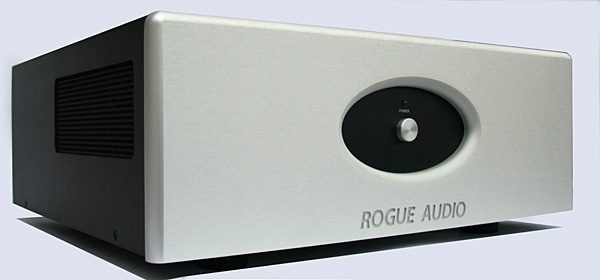
Remember those McIntosh MC30 tube amps that were left turned on for 30 years and still sounded wonderful? Well, I doubt the new KT120 tubes in Rogue Audio's new power amplifier will last over 262,980 hours, as the G.E. GT6L6GCs in those ancient beauties did, but I'm certain that the Stereo 100's tank-like build quality, vividly neutral dynamic sound, and timeless styling make it a worthy successor to McIntosh's most adored classic. In my view, the Stereo 100 is everything—sonically, mechanically, aesthetically—that we could hope for in a 21st-century tube amp. Everything about it screams "End-game tube amp, long-term keeper!"
The sound of the Rogue Stereo 100 was not as strikingly transparent as that of Pass Laboratories' XA25 25Wpc amplifier ($4900), nor did it feel more powerful. Nor was it as alive, open, or dynamic. That doesn't mean I found it inferior. Watt for watt, the XA25 stands tall and truthful next to any amplifier putting out less than 100W. So will the Stereo 100. Both played diverse music with the authority of excellent design. To my taste, driving my speakers in my room, the triode-connected Stereo 100 seemed nigh on perfect. It had a way of disappearing, leaving vital, living music hanging in the air between the Harbeth M30.2s. The XA25 may be more transparent in the sense of the air between performers being freshly oxygenated and free of haze, but I can always tell when the Pass is driving my speakers—I can feel its hyperdynamic presence. The Rogue was more unobtrusive, readily disappearing from my awareness. Driving the Harbeth M30.2s, both were true reference-quality amps.
The Rogue Stereo 100 also proved more "invisible" than my long-beloved PrimaLuna ProLogue Premium 35Wpc amplifier ($2195). The Rogue added less of the friendly magic of the PrimaLuna's kinder, gentler, more romantic EL34 tube sound—which I love. To me, the ProLogue Premium, which operates only in UL, is exceedingly tactile in its reproduction of music: It enhances soprano voices in a way that makes singer and song more beautiful and physically tangible. It can also add an occasional hard bite to a high note, or a moment of blur to a bass line. Meanwhile, the Rogue Stereo 100 sailed smoothly and elegantly through even the most highly modulated bass and treble passages. Bass was consistently tight and detailed, and treble always relaxed, big-sky open, and finely rendered. (Forget bandwidth specs—solid-state amps are never as elegant or as transparent in the highs as a properly designed tube amp.) Driving the Harbeths in Triode mode, the Stereo 100 delivered a greater sense of easy-flowing, unrestricted power than the UL-connected PrimaLuna. This easy-flowing power reproduced sopranos' high notes with zero compression or strain. Triode mode delivered pianos that were more full-size and solid, more anchored in the recording venue than through the PrimaLuna.
Overall, the Rogue Stereo 100 plus Harbeth M30.2s reproduced sopranos, pianos, and big orchestras with relaxed precision, realistic timbres, and understated beauty. It put reference quantities of bang, fire, and a subtle little glow into the Harbeth monitors. Rogue Audio Stereo 100 + Harbeth M30.2 = my new reference amp-speaker pairing.
With: KEF LS50 speakersThe first time I heard KEF's LS50 minimonitors ($1499/pair), I was with friends. When they asked me what I thought, I laughed: "I'm glad I'm not in the business of making $5000/pair speakers!" The LS50's agile bass, focused imaging, and conspicuous eight-octave coherence seemed as tight and right as anything I'd ever heard from a pair of speakers with 5" woofers. Now, as I listened via the LS50s to Morphine's Cure for Pain (24/96, Ryko/Qobuz), Mark Sandman's saxophone was displaying such a beguiling low-frequency textural growl that I had zero urge to replace the 35Wpc PrimaLuna ProLogue Premium with the 100Wpc Rogue Stereo 100. But I forced myself, and discovered a new level of clarity that let Sandman's voice step forward and reach out of the fog. The Stereo 100 reduced the saxophone's growl, but instead showed me the air coming out of its bell. The articulation of Sandman's voice improved. Microphone positions were easier to pinpoint.
Still streaming Bluesmith, I connected Magnepan's .7 quasi-ribbon panel speakers ($1395/pair) to the Rogue Stereo 100. This time with "Absolutely Funky," I felt Vinnegar's double bass physically against my chest and face. Smith's Hammond was huge in the space in front of me. When I tell you that plucked double-bass strings sounded visceral through one of my minimonitors, I mean lower-case visceral. Now, suddenly, through the 5'-tall Magnepans, bass was VISCERAL. Smith's band was big and tall. The Stereo 100 (in Triode!) was driving my beloved Maggies, making all of Bluesmith feel like an extended dream of head-nodding beat, high tactility, and scrumptious instrumental tones.
Remember those McIntosh MC30 tube amps that were left turned on for 30 years and still sounded wonderful? Well, I doubt the new KT120 tubes in Rogue Audio's new power amplifier will last over 262,980 hours, as the G.E. GT6L6GCs in those ancient beauties did, but I'm certain that the Stereo 100's tank-like build quality, vividly neutral dynamic sound, and timeless styling make it a worthy successor to McIntosh's most adored classic. In my view, the Stereo 100 is everything—sonically, mechanically, aesthetically—that we could hope for in a 21st-century tube amp. Everything about it screams "End-game tube amp, long-term keeper!"