Sidebar 3: Measurements
I measured the Rogue Stereo 100 amplifier using my Audio Precision SYS2722 system (see the January 2008 "As We See It"). Before doing so, I installed the KT120 output tubes and, following the instructions in the manual, checked each tube's bias current. These were all around 50mA rather than the recommended 40mA, so, using the supplied tool, I adjusted the four trim pots. I checked the bias currents several times while performing the measurements, but none of the tubes had drifted from the recommended 40mA. The Stereo 100 has both balanced and single-ended inputs, 4 ohm and 8 ohm output-transformer taps, and its output tubes can be operated in Ultralinear or Triode mode. I took complete sets of measurements in both output modes from both sets of output taps, using the balanced inputs. I then repeated some tests using the single-ended inputs, which I understand are taken to the same input transformers as the balanced inputs.
The Stereo 100 is specified as having an input sensitivity of 1V for full power; ie, a voltage gain of 29dB. In Ultralinear mode the gain into 8 ohms from the 8 ohm tap measured 29.2dB with both the balanced and unbalanced inputs. In Triode mode from the 8 ohm tap, the gain with both inputs measured 28.8dB. As expected, the gain was lower from the 4 ohm tap, at 26.5dB Ultralinear and 26.1dB Triode. (These figures were all for the left channel; the right channel was 0.4dB less sensitive.) Both sets of inputs and output taps preserved absolute polarity (ie, were non-inverting). The input impedances varied with both frequency and input type. For the single-ended inputs I measured a high 77k ohms at 20Hz and 62k ohms at 1kHz, but 11k ohms at 20kHz. The corresponding impedances for the balanced inputs were 80k, 94k, and 16k ohms.
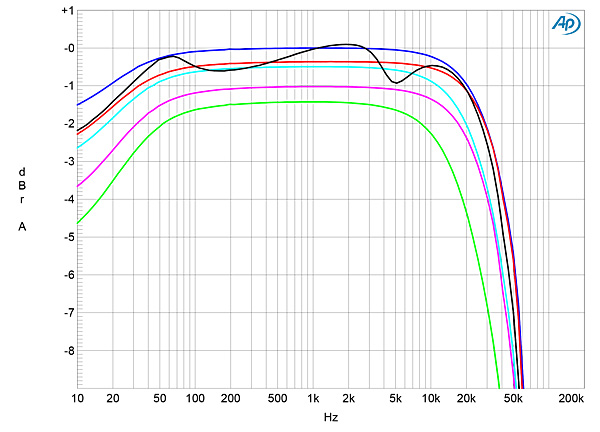
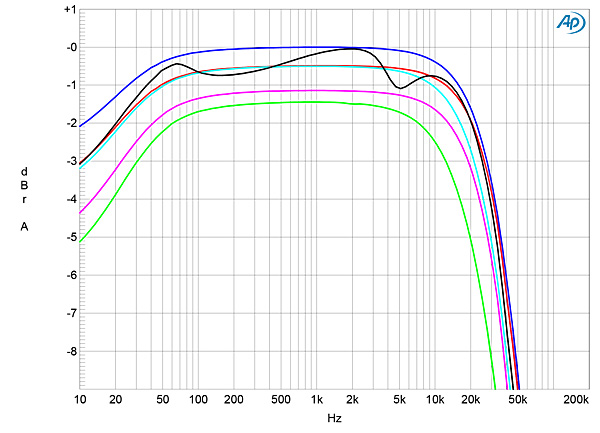
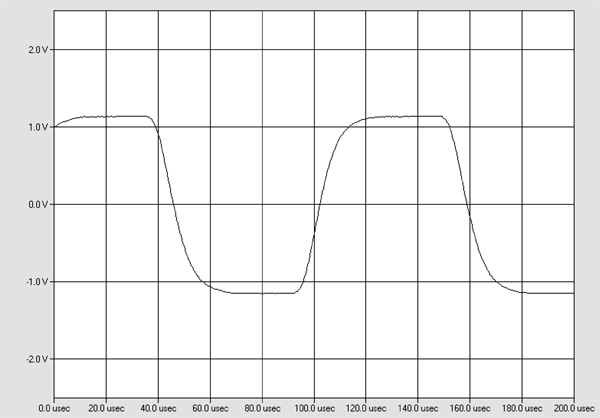
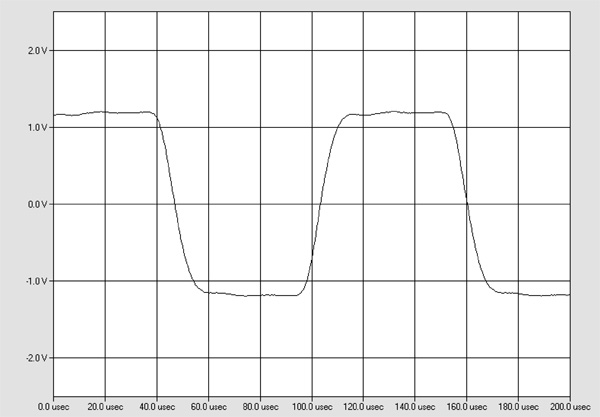
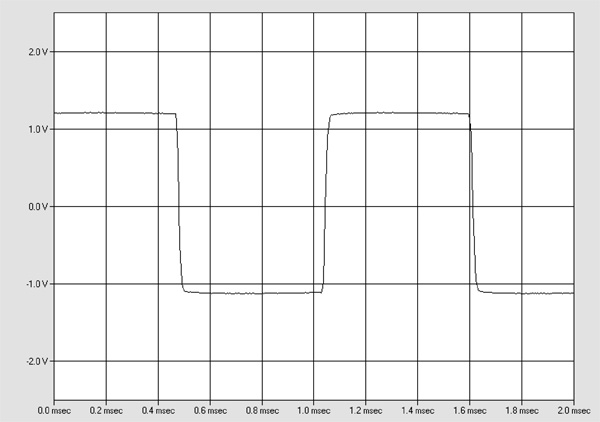
The output impedance varied with transformer tap and frequency, but not with output-stage mode. In both Ultralinear and Triode modes, the output impedance from the 8 ohm tap was 0.96 ohm at 20Hz, dropping to 0.48 ohm at 1kHz, and rising again to 0.85 ohm at 20kHz. As a result, the modulation of the Stereo 100's frequency response with the 8 ohm tap driving our standard simulated loudspeaker was ±0.5dB, before rapidly rolling off above 25kHz (fig.1, gray trace). Fig.1 was taken in Ultralinear mode; in Triode mode (fig.2) the ultrasonic rolloff was more extreme, the output into 8 ohms (blue and red traces) being down by 2dB at 20kHz, and was even further depressed into 2 ohms (green). This increased the risetimes with a 10kHz squarewave (fig.3), though Ultralinear mode gave a squarer waveform, with just the slightest hint of ringing on the tops and bottoms (fig.4). The 1kHz squarewave was superbly square in both modes (fig.5), a tribute to the Stereo 100's output transformers.
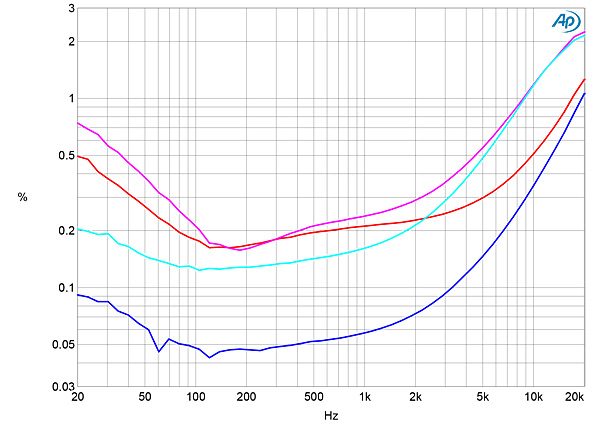
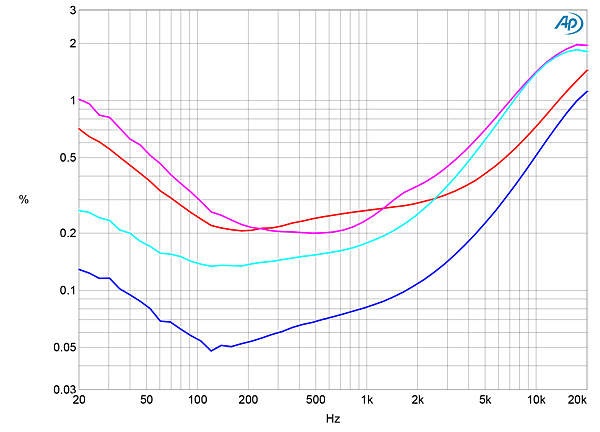
 I examined how the Stereo 100's percentage of THD+N varied with frequency at 6.35V (equivalent to 5W into 8 ohms and 10W into 4 ohms) and found that the left channel, which I'd used to measure the clipping powers, was considerably more linear than the right. From the 4 ohm taps in Ultralinear mode (fig.11), the THD+N in the left channel (blue trace) was below 0.1% from 20Hz to 3kHz, but the THD+N in the right channel (red) was three times higher. The two channels matched more closely into 4 ohms (cyan, magenta traces), but this behavior suggests that a tube in the right channel might need replacing. (While performing these tests, I again checked the bias currents to ensure that they were set correctly. They were.) The Stereo 100 behaved similarly in Triode mode (fig.12), but offered higher levels of THD+N at high frequencies than in Ultralinear mode.
 Fortunately, the Stereo 100's distortion signature is predominantly the second and third harmonics (fig.13). However, spectral analysis of the amplifier's output while it drove 50Hz at 5Wpc into 8 ohms (4 ohm tap, Ultralinear) confirmed that the right channel (fig.14, red trace) was less linear than the left (blue). While the second and third harmonics were equal in level in both channels, those in the right channel were 12dB higher, with considerably more higher-order harmonics present. Tested with an equal mix of 19 and 20kHz tones with the signal peaking at 5Wpc into 8 ohms (4 ohm tap, Triode), the difference product at 1kHz lay at –46dB (0.2%) in both channels (fig.15), but many more higher-order products were present in the Rogue's right channel (red trace) than the left (blue).
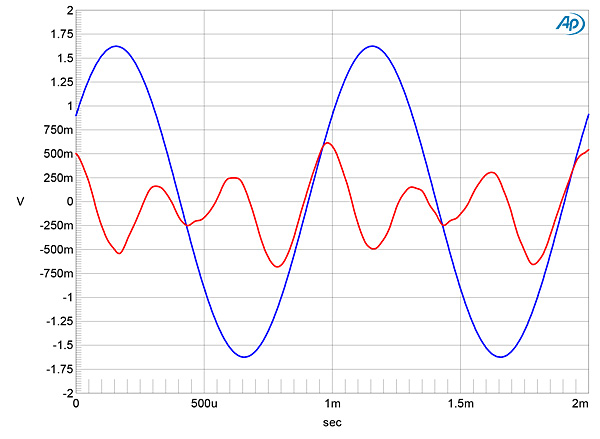
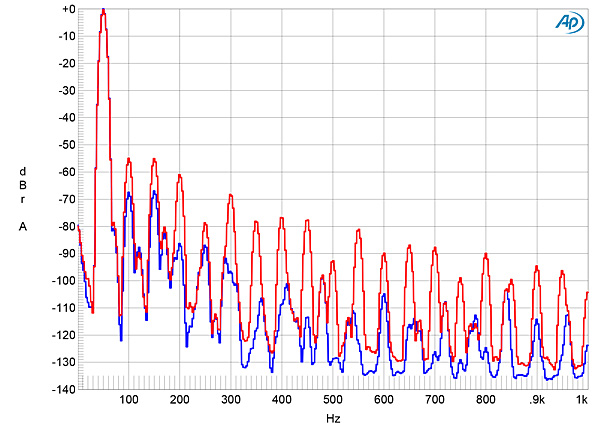
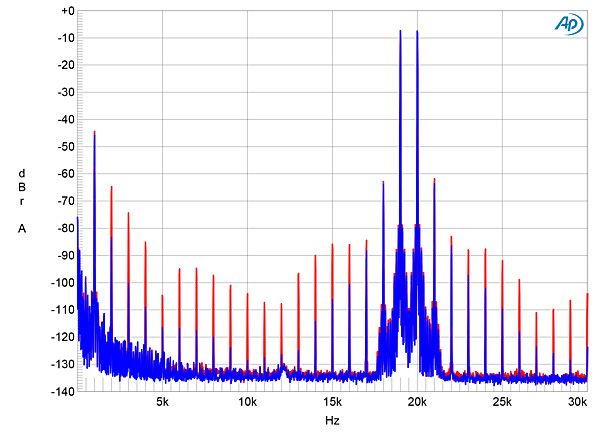
Fig.1 Rogue Stereo 100, Ultralinear mode, frequency response from 8 ohm tap at 2.83V into: simulated loudspeaker load (gray), 8 ohms (left channel blue, right red), 4 ohms (left cyan, right magenta), 2 ohms (green) (1dB/vertical div.).
Fig.2 Rogue Stereo 100, Triode mode, frequency response from 8 ohm tap at 2.83V into: simulated loudspeaker load (gray), 8 ohms (left channel blue, right red), 4 ohms (left cyan, right magenta), 2 ohms (green) (1dB/vertical div.).
Fig.3 Rogue Stereo 100, Triode mode, small-signal 10kHz squarewave into 8 ohms.
Fig.4 Rogue Stereo 100, Ultralinear mode, small-signal 10kHz squarewave into 8 ohms.
Fig.5 Rogue Stereo 100, Triode mode, small-signal 1kHz squarewave into 8 ohms.
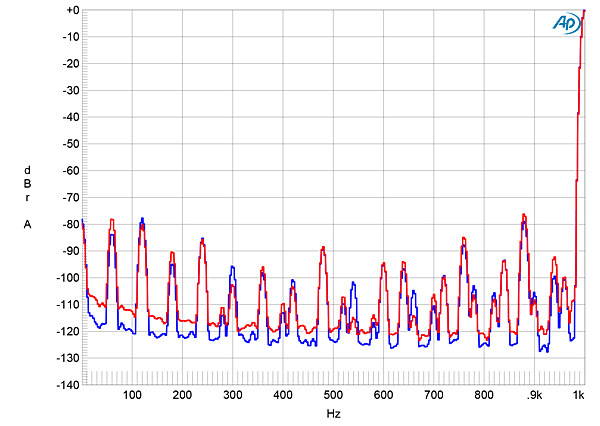
Channel separation was good, at close to 80dB in both directions from 100Hz to 4kHz, decreasing to 64dB at the top of the audioband. In Triode mode, the unweighted, wideband signal/noise ratio, taken with the inputs shorted to ground, was a high 74.2dB (left channel) and 72.4dB (right), ref. 1W into 8 ohms. These S/N ratios improved to 84.8dB with an A-weighting filter in circuit. In Ultralinear mode, the ratios were all 0.5dB lower. Spectral analysis of the low-frequency noise floor (fig.6) revealed a large number of AC-supply–related harmonics at both 60Hz and its odd-order harmonics, due to magnetic interference from the power transformer, as well as at the full-wave–rectified frequency of 120Hz and the other even-number harmonics of 60Hz, due to non-zero impedances to ground somewhere in the circuit. It's fair to note, however, that all of these spuriae lie at or below –80dB (0.01%) and thus won't be audible.
Fig.6 Rogue Stereo 100, Ultralinear mode, spectrum of 1kHz sinewave, DC–1kHz, at 1W into 8 ohms (left channel blue, right red; linear frequency scale).
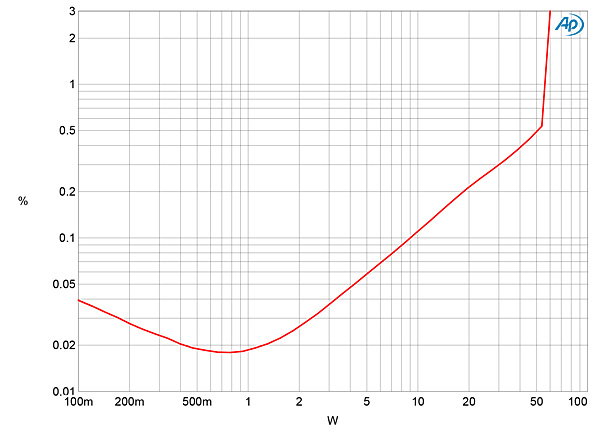
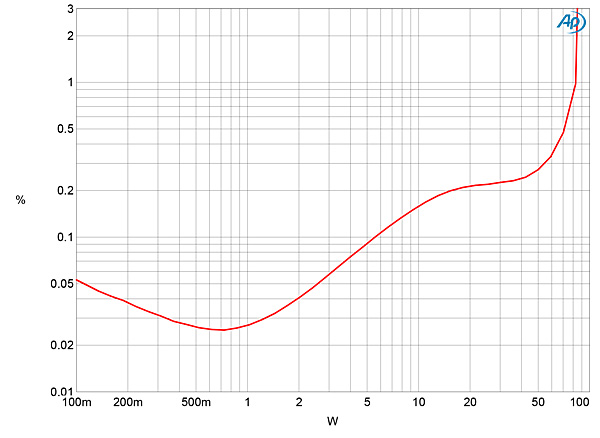
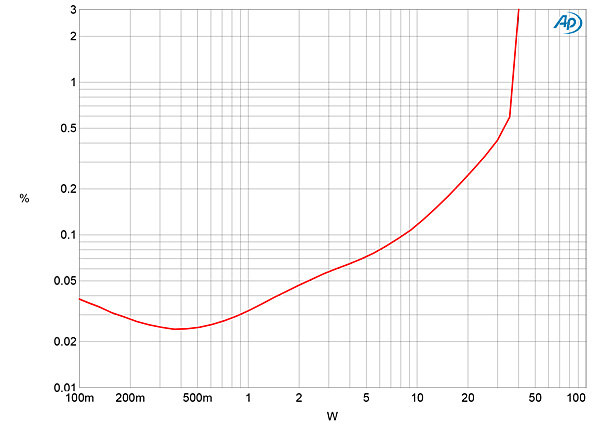
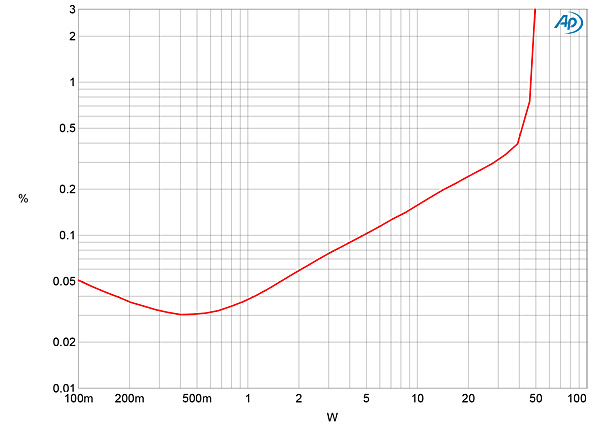
Rogue specifies the Stereo 100 as offering 100Wpc (20dBW into 8 ohms) in Ultralinear mode. Defining clipping as when the THD+noise in the output reaches 1%, my measurements of the Rogue's clipping power were lower than this. Into 8 ohms from the 4 ohm tap in Ultralinear mode (fig.7), the Stereo 100 clipped at 56Wpc (17.5dBW) and 83Wpc into 4 ohms (16.2dBW, fig.8), both with both channels driven. The clipping power from the 8 ohm tap was 80Wpc into 8 ohms (19dBW) and 85Wpc into 4 ohms (16.3dBW). As anticipated, less power was available in Triode mode. The Rogue clipped at 37Wpc with the 4 ohm tap driving 8 ohms (15.7dBW, fig.9), and at 47Wpc into 4 ohms (13.7dBW, fig.10). The maximum output from the 8 ohm tap into 8 ohms in Triode mode was 40Wpc (16dBW). Figs.7–10, which were taken with the left channel, reveal that the Stereo 100 has respectably low distortion at low powers.
Fig.7 Rogue Stereo 100, Ultralinear mode, distortion (%) vs 1kHz continuous output power from the 4 ohm tap into 8 ohms.
Fig.8 Rogue Stereo 100, Ultralinear mode, distortion (%) vs 1kHz continuous output power from the 4 ohm tap into 4 ohms.
Fig.9 Rogue Stereo 100, Triode mode, distortion (%) vs 1kHz continuous output power from the 4 ohm tap into 8 ohms.
Fig.10 Rogue Stereo 100, Triode mode, distortion (%) vs 1kHz continuous output power from the 4 ohm tap into 4 ohms.
Fig.11 Rogue Stereo 100, Ultralinear mode, THD+N (%) vs frequency at 6.3V from 4 ohm tap into: 8 ohms (left channel blue, right red), 4 ohms (left cyan, right magenta).
Fig.12 Rogue Stereo 100, Triode mode, THD+N (%) vs frequency at 6.3V from 4 ohm tap into: 8 ohms (left channel blue, right red), 4 ohms (left cyan, right magenta).
Fig.13 Rogue Stereo 100, Ultralinear mode, 1kHz waveform at 5W into 8 ohms, 0.089% THD+N (blue); distortion and noise waveform with fundamental notched out (red, not to scale).
Fig.14 Rogue Stereo 100, Ultralinear mode, spectrum of 50Hz sinewave, DC–1kHz, at 5W from the 4 ohm tap into 8 ohms (left channel blue, right red; linear frequency scale).
Fig.15 Rogue Stereo 100, Triode mode, HF intermodulation spectrum, DC–30kHz, 19+20kHz at 5W peak from the 4 ohm tap into 4 ohms (left channel blue, right red; linear frequency scale).
Assuming the right channel's measured performance stems from an out-of-spec output tube, Rogue Audio's Stereo 100 offers respectable measured performance typical of a classic tube design. I don't think the 1dB shortfall in maximum power is a significant failing.—John Atkinson