Hi-fi dealerships need to find creative new ways to get customers into their stores—to stoke their interest and to help new people feel welcome. Special events are the obvious way to get them through the door and keep them coming back.
In last month's column, I wrote about Audio Concepts, the Dallas dealership under new ownership, and their Community Vinyl Nights where anyone can come, bring a record, and share a track via one of the showroom's setups. In the December 2025 column, I discussed Denver-adjacent Wheat Ridge, Colorado–based Crescendo Fine Audio's expansion to a new location in Boulder and owner Matt Alterman's plans to incorporate live-music events with hi-fi. Boutique Audio Gallery outside Toronto held an event a while back combining hi-fi with rare whiskeys. There are countless other examples.
Not long ago, I attended some events at Common Wave Hi-Fi in downtown Los Angeles, a dealership I covered in this column previously. Only in hindsight did I realize and come to appreciate the broader significance of those Common Wave events.
The first of two events over as many evenings was one in their series they call Night School, held from 7–9pm on selected Thursdays. Presented by various audio and music industry folks, "Night School" is Common Wave's listening and learning event. Night School events are open to the public, though an RSVP is necessary and it's not completely free; the token admission fees benefit music programs at the local L.A. Unified Schools.
Night School is an homage to David Mancuso's weekly Loft parties, held in a New York City loft—on Broadway starting in 1970 and moving to Prince Street in 1975—where people would be invited to come and dance. Mancuso's Loft parties were seminal. They were a sort of hybrid of deejay/party culture and audiophile culture. They presaged NYC nightclubbing in the decades to come, from Studio 54 and Paradise Garage, to Limelight, Tunnel, and beyond, but with audiophile aspirations: Mancuso's said, "you don't want to hear the system. You want to hear the music."
The setup and selection of tracks at the Common Wave Night School were intended to celebrate those events 50-or-so years ago, with similar aspirations. That Common Wave event was partly a soft launch for the Cometa M2 rotary mixing preamplifier. The Cometa M2 is an audio device, but not of the typical audiophile variety. It's essentially a pair of preamplifiers and phono stages in a box. It's aimed at deejays but designed for crossover appeal to people who enjoy spinning vinyl, particularly in a social context. The M2 makes it easy to play and mix records back-to-back, deejay-style.
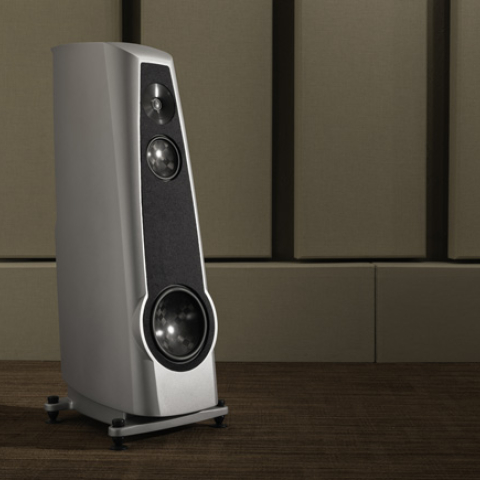
That's what Jason Jackson, aka J. Rocc, did that Thursday night. J. Rocc is a pioneering deejay, founder of World Famous Beat Junkies and Madlib's live disc spinner. J. Rocc spun records on a pair of Technics SL-1200GR2 turntables tethered to a Cometa M2 rotary mixer. Also in the chain were an Accuphase E-4000 integrated amplifier and a pair of Accuphase A-300 monoblock amplifiers. The speakers were a pair of Klipsch Heritage Klipschorn AK7 speakers with active outboard crossovers and DSP (below). Those speakers are an updated version of the six (sometimes eight) classic Klipschorns seen and heard in Mancuso's New York Lofts.
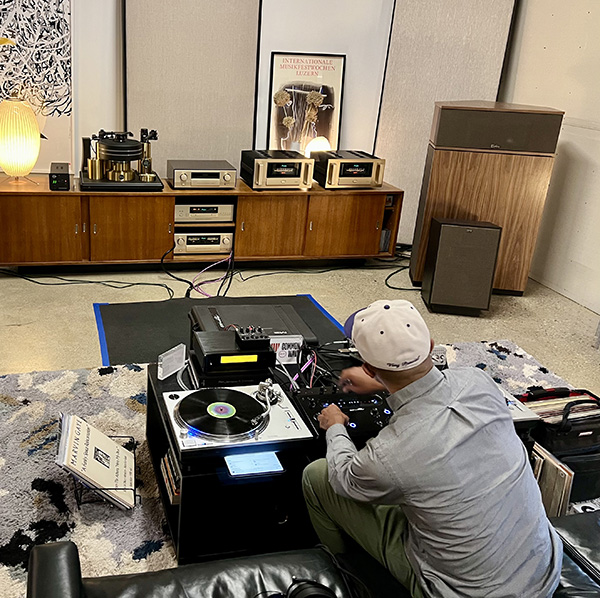 Every time J. Rocc put on a new album, he held the cover high for all to see. This event was about music and paying homage to the practice of communal listening. There wasn't much dancing, though a few people in the back boogied about a bit. People were fixated on the music, listening. Conversation was minimal. Attendees spanned a range of ages, though this event skewed Gen X and up.
A second event (or group of events) took place the following evening: a listening event for Blood Orange's latest album release, Essex Honey. Blood Orange is the current musical alias of one Devonté "Dev" Hynes, a British-born, New York–based producer, multi-instrumentalist, and songwriter. Released last August and debuting at #4 on the Billboard 200, Essex Honey is in a genre some critics call "art R&B." Caroline Polachek and Lorde collaborated on the album, but no celebrities were in attendance. T-shirts, however, were sold.
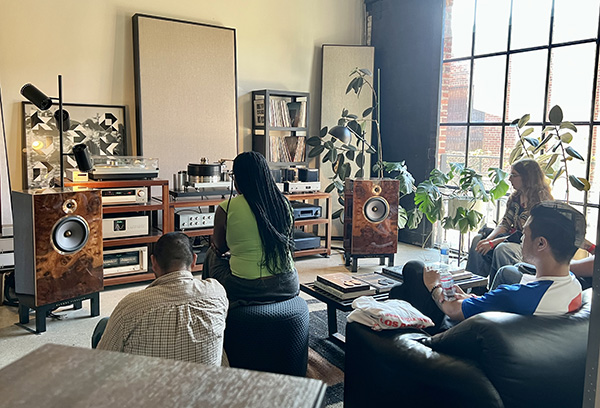
There were three back-to-back sessions, preregistration required. Young fans snapped up all the slots in half an hour. Not only were they eager to hear the latest album from one of their favorite artists, but they also looked forward to hearing it in high fidelity, as it was meant to be heard.
For these events, the sources were all digital. It was multiroom sound in a sense: Common Wave founder/owner Wesley Katzir played hi-rez files back across several different systems in various listening areas.
This was a young crowd. Contradicting stereotypes, there was hardly a phone in sight. Everyone was listening. I saw curiosity, about the equipment and the sound. The event seemed to open eyes and ears to what a hi-fi could do.
Hi-fi dealerships must continue to find new ways to draw new (read: younger) people into the hobby. Traditional hi-fi events featuring new equipment and reps from manufacturers surely serve a purpose. But thinking outside the box to find ways to attract new blood has never been more crucial than it is now.
Especially now, people seem to be longing to be a part of something, to feel connected, part of a broader community. Music has long held that power.
Every time J. Rocc put on a new album, he held the cover high for all to see. This event was about music and paying homage to the practice of communal listening. There wasn't much dancing, though a few people in the back boogied about a bit. People were fixated on the music, listening. Conversation was minimal. Attendees spanned a range of ages, though this event skewed Gen X and up.
A second event (or group of events) took place the following evening: a listening event for Blood Orange's latest album release, Essex Honey. Blood Orange is the current musical alias of one Devonté "Dev" Hynes, a British-born, New York–based producer, multi-instrumentalist, and songwriter. Released last August and debuting at #4 on the Billboard 200, Essex Honey is in a genre some critics call "art R&B." Caroline Polachek and Lorde collaborated on the album, but no celebrities were in attendance. T-shirts, however, were sold.
There were three back-to-back sessions, preregistration required. Young fans snapped up all the slots in half an hour. Not only were they eager to hear the latest album from one of their favorite artists, but they also looked forward to hearing it in high fidelity, as it was meant to be heard.
For these events, the sources were all digital. It was multiroom sound in a sense: Common Wave founder/owner Wesley Katzir played hi-rez files back across several different systems in various listening areas.
This was a young crowd. Contradicting stereotypes, there was hardly a phone in sight. Everyone was listening. I saw curiosity, about the equipment and the sound. The event seemed to open eyes and ears to what a hi-fi could do.
Hi-fi dealerships must continue to find new ways to draw new (read: younger) people into the hobby. Traditional hi-fi events featuring new equipment and reps from manufacturers surely serve a purpose. But thinking outside the box to find ways to attract new blood has never been more crucial than it is now.
Especially now, people seem to be longing to be a part of something, to feel connected, part of a broader community. Music has long held that power.
Every time J. Rocc put on a new album, he held the cover high for all to see. This event was about music and paying homage to the practice of communal listening. There wasn't much dancing, though a few people in the back boogied about a bit. People were fixated on the music, listening. Conversation was minimal. Attendees spanned a range of ages, though this event skewed Gen X and up.
A second event (or group of events) took place the following evening: a listening event for Blood Orange's latest album release, Essex Honey. Blood Orange is the current musical alias of one Devonté "Dev" Hynes, a British-born, New York–based producer, multi-instrumentalist, and songwriter. Released last August and debuting at #4 on the Billboard 200, Essex Honey is in a genre some critics call "art R&B." Caroline Polachek and Lorde collaborated on the album, but no celebrities were in attendance. T-shirts, however, were sold.