David and Alma Wilson must be doing something right. They've been married for 50 years, and for 36 years, they've owned and operated Accent on Music on Main Street in Mount Kisco, New York, about an hour north of New York City. In a recent, lively Zoom conversation with the Wilsons, it became apparent that staying the course is a viable approach, for marriage and for business.
Ever since Accent opened in 1989, David and Alma have stayed true to their values and preferences. They sell vinyl records. They never stopped, even when cassettes and then CDs took over, and it seemed as if vinyl had no future. They still carry many of the brands they took on when they started out: Linn, Rega, Naim. Equipment from the UK—England and Scotland in particular—is especially close to David's heritage and heart. They have since added Fyne Audio, from Scotland.
David was born in Scotland, in Glasgow. He was living in Edinburgh in the early 1970s when he met Alma, a native New Yorker. They've been a couple since 1973 and married since 1975. In 1979, David took a job at the legendary Lyric Hi-Fi, working for the legendary Michael Kay (footnote 1). "I took roots because he gave me a great job," David said. "He was a genuinely cool guy. I ended up being 'that damned, son-of-a-bitch Scotsman who only liked the good stuff.'"
Fast forward a decade. David decided he would be happier selling equipment he would want to take home himself. Alma encouraged him. Accent on Music was born.
Simple as it is, there are some things to unpack in the store's name. First, it's a statement of values: The focus is on music and its proper reproduction. "Accent," of course, is a musical term. Finally, David still has his Scottish accent.
David says Accent's focus is and always was on products that offer "performance, reliability, and user appeal for the money." Does that mean budget? It does not. The store carries equipment ranging from entry-level up to, as Alma put it, "quite ridiculous prices." Both Wilsons favor gear that's well-made, repairable, and provides excellent sonic performance. Quality over quantity. "We're not a supermarket," David said.
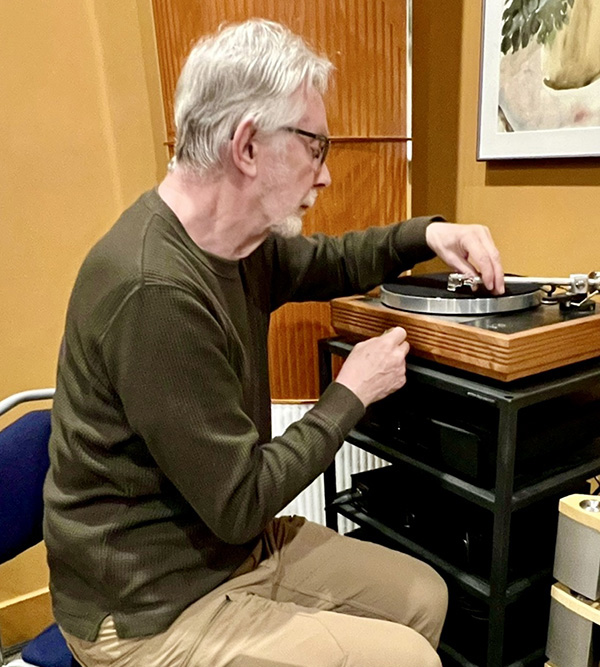
Accent on Music handles some repairs, just not electronics. David fixes turntables. He does lots of Linn Sondek upgrades (see heading photo). He repairs speakers. Amplifiers go back to the manufacturer for repair or to a trusted local shop.
What Accent on Music mostly focuses on is what most shops focus on: selling. That and customer satisfaction. Step one is to figure out what a customer likes. First and foremost, the system must involve a person musically. If a system is musically involving and in-budget, it practically sells itself.
Their clientele seems to be especially interested in analog front-ends. David estimates that their average customer spends 25% on electronics, 25% on speakers—and 50% on a turntable. That ratio, surely, is a reflection of the store's hi-fi values.
Though some of the equipment they sell is, as Alma suggested, quite expensive, price is a consideration. The store's focus on products from the British Isles helps to keep things reasonable, because "most British hi-fi, at least until recently, has been not quite so exotically priced," David said. "It's never really been in the über class." There's an obvious exception: dCS. "I'm always very much aware of the fact that a young man not through or just through college doesn't have a lot of spare dollars to play with, but he needs to play something that is true to the music and doesn't disappoint."
As you'd assume about a couple married for 50 years, David and Alma are no longer young. Yet they remain open to new music and enjoy exposure via their younger customers. When one of those younger customers brings music in, it's often on vinyl. David and Alma reciprocate, exposing younger listeners to unfamiliar genres and music from previous generations. Often customers are blown away by the jazz he plays: Bill Evans, say, or Thelonious Monk. "Young people who don't even know we exist become enthusiasts of the music, and we become facilitators of enjoying that music." That's not a bad way of defining the ideal role of a hi-fi dealership: facilitators of enjoying the music.
Accent on Music carries some expensive equipment, but its customers are not all wealthy. Many are tradespeople. Accent on Music sees doctors, lawyers, academics, schoolteachers. Curiously, more than one customer is an elevator tech. The elevator techs are, David said, "mad, crazy, really keen customers."
Some customers are empty nesters who are "ready to replace their mass-produced stuff. I meet older or middleaged people who have finally figured out that the el cheapo stereo they put together isn't giving them much nourishment," David said.
David's favorite customers are women. He says they have the best taste, and they use their ears better than men do. "They hear better because their forebrain is not blocked up with all that technical stereo crap. They can just listen and see if that violinist sounds like she's playing properly or not, and that's what we encourage people to do. The ladies ... are a joy to work with because they simply respond to something that sounds like music."
Although Accent on Music keeps to tradition, the store has added a few new lines recently, and they're close to committing to a few more. Alma said they hold the same standards of musical performance and build quality for new brands as for the ones they've worked with forever. "Do they have a record of being around for a while?" Alma asks, rhetorically.
"We have a tradition here going back 36 years of finding something good, understanding why people can and should appreciate it in their home, and sticking with it," he said. "Like during the dominance of CDs, we still stuck with record players, because people with ears still needed them. We live and die by making people happy—or not," he said. "Make them happy, stay in business."
Footnote 1: See here, here, and here.
Footnote 1: See here, here, and here.