Sidebar 3: Measurements
I used my Audio Precision SYS2722 system to examine the Octave Jubilee Mono SE's measured performance. (For logistical reasons, the sample I measured was not one of those auditioned by JVS but was borrowed from a Boston dealer.) I followed the instructions in the manual to check the bias of the eight output tubes after running the amplifier for 30 minutes to allow the operating conditions to stabilize. The pots that allow the bias for each tube to be optimized have a somewhat coarse action. The best I could arrange was for the bias for the tubes to lie between "1005" and "1025" as indicated by the digital meter on the amplifier's top panel.
The Octave Jubilee Mono SE preserved absolute polarity, ie, was noninverting, with both the balanced and single-ended inputs. The voltage gain at 1kHz was 29dB into 8 ohms for both inputs, this inconsequentially lower than the specified 30dB. The balanced input impedance was a high 51k ohms at all audio frequencies. The single-ended input impedance was even higher, at 74k ohms at 20Hz, 71k ohms at 1kHz, and 52k ohms at 20kHz.
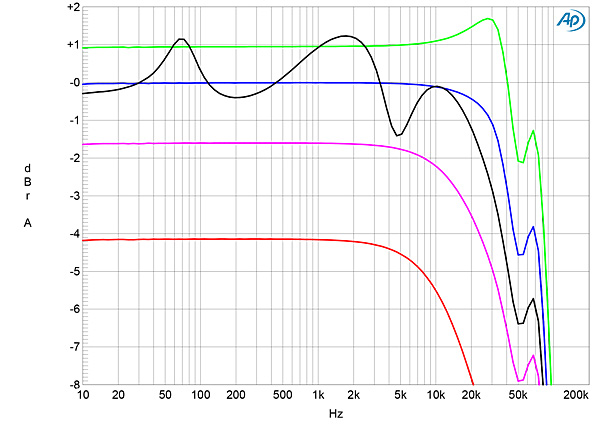
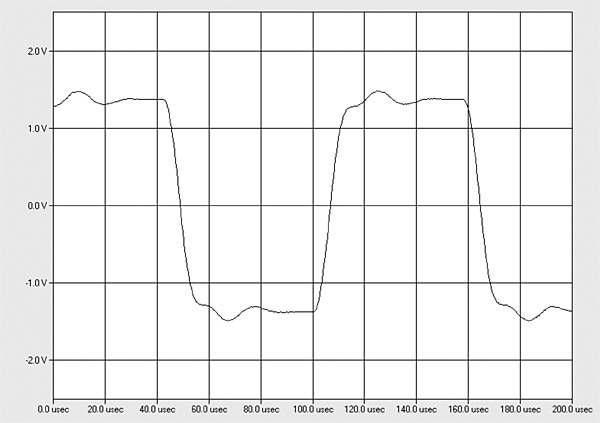
Octave doesn't specify the output impedance of the Jubilee Mono SE's single output transformer tap. I measured 2 ohms (including the series resistance of 6' of speaker cable) at low and middle frequencies, rising to 4.5 ohms at the top of the audioband. The variation in the small-signal frequency response of the Jubilee Mono into our standard simulated loudspeaker (fig.1, gray trace) was ±1.2dB, which will be audible. The amplifier's response into 16 ohms (fig.1, green trace) gently rose above 10kHz, before rolling off above 39kHz. The increase in output impedance in the top octave meant that the response increasingly rolled off as the load impedance was reduced. Into 2 ohms, for example, the output was down by 4dB at 20kHz (fig.1, red trace). A slight peak at 70kHz can be seen in the response traces; this correlated with a small amount of well-damped ringing in the Jubilee Mono's reproduction of a 10kHz squarewave into 8 ohms (fig.2).
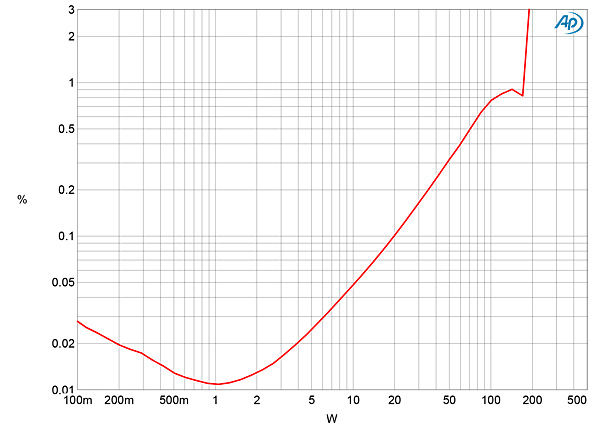
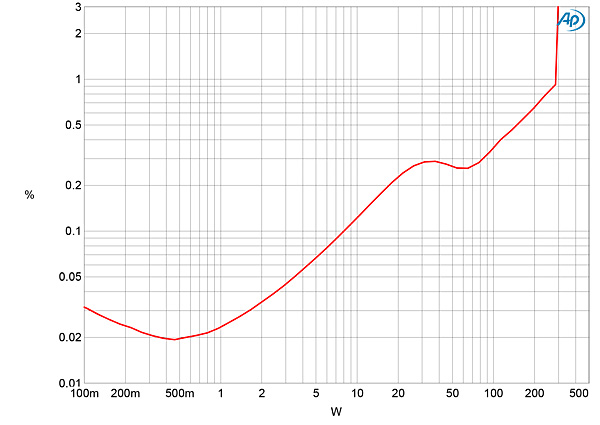
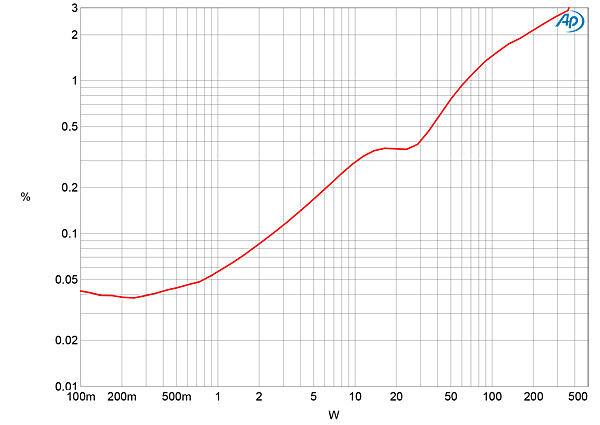
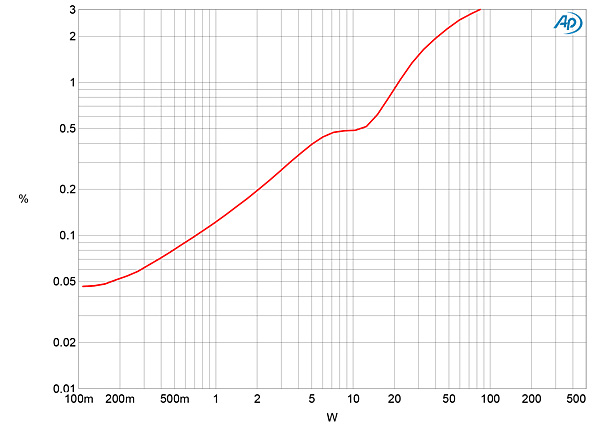
 The Octave Jubilee Mono SE's maximum power is specified as 400W into 4 ohms (21dBW). With our usual definition of clipping—when the THD+noise reaches 1%—I measured a clipping power of 175W into 16 ohms (25.4dBW, fig.4), 295W into 8 ohms (24.7dBW, fig.5), and 68W into 4 ohms (15.3dBW, fig.6). Relaxing the definition of clipping to 3% THD+N, the Jubilee Mono clipped at 380W into 4 ohms (22.3dBW), just shy of its full rated power. In the Jubilee Mono's manual, Octave says that the minimum recommended load impedance is 2 ohms. I examined the maximum power into that load; the amplifier reached 3% THD+N at 88W (13.4dBW, fig.7). I also examined how the power delivery changed if I switched the amplifier into the low-bias mode, which is indicated by the bias LED on the top panel turning from blue to green. However, the THD+N was very much higher than the very low distortion at low powers that can be seen in figs.5 and 6.
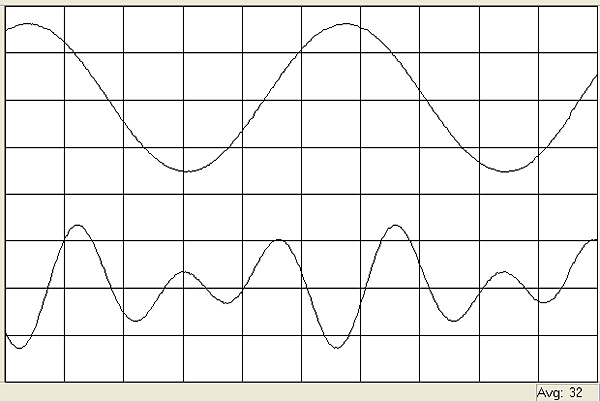
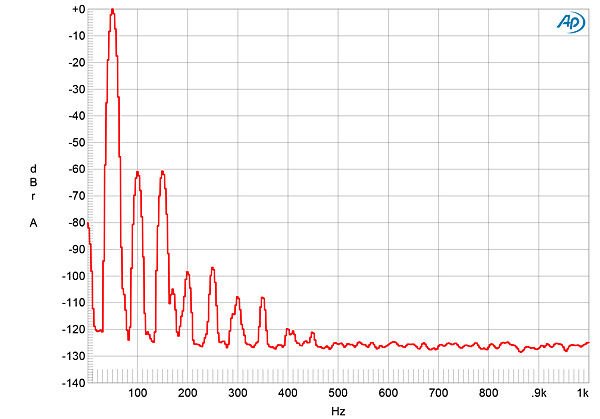
 The Octave's distortion signature into 8 ohms predominantly comprised the second and third harmonics (fig.9). I recently received an email from veteran English engineer Ben Duncan (footnote 1) in which he told me that he had found a correlation between the smoothness of an amplifier's THD+N waveform and its sound quality. The spikier the waveform, the less its sound quality was preferred by listeners. By that criterion, even though the second and third harmonics in the Jubilee Mono SE's output each lie close to –60dB (0.1%, fig.10), the relative absence of higher-order harmonics should result in good sound quality. (As I write this, I haven't yet seen JVS's review findings.)
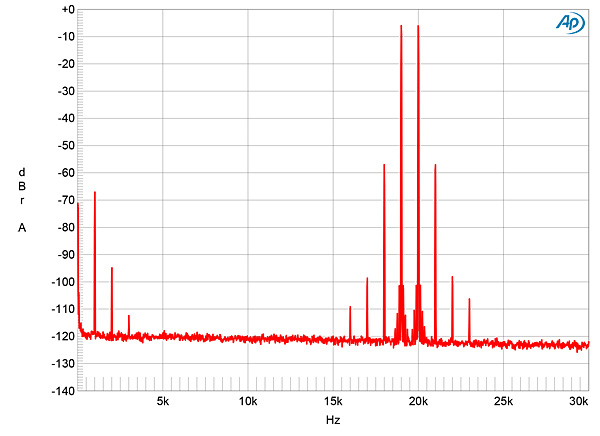
 Duncan's finding depends on an amplifier's harmonic distortion not being accompanied by excessive levels of intermodulation distortion. The Jubilee Mono SE did okay when I looked at the spectrum of its output while it drove an equal mix of 19 and 20kHz tones at 10Wpc into 4 ohms (fig.11). The 1kHz difference product lay 70dB below the peak signal level (0.03%), while the higher-order products at 18 and 21kHz lay at –60dB (0.1%).
Footnote 1: Ben Duncan has contributed several technical articles to Stereophile.
Fig.1 Octave Jubilee Mono SE, frequency response at 2.83V into: simulated loudspeaker load (gray), 16 ohms (green), 8 ohms (blue), 4 ohms (magenta), and 2 ohms (red) (1dB/vertical div.).
Fig.2 Octave Jubilee Mono SE, small-signal 10kHz squarewave into 8 ohms.
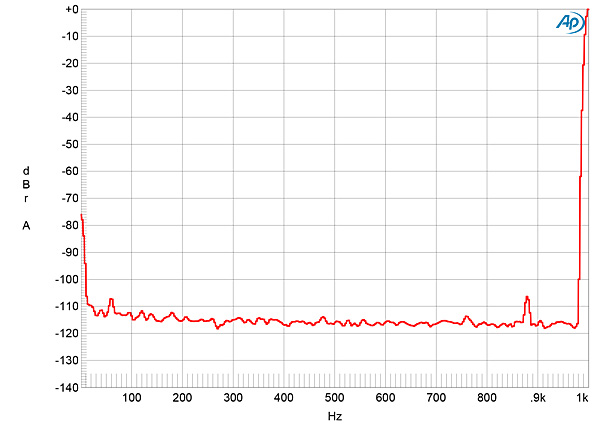
The unweighted, wideband signal/noise ratio (ref.1W into 8 ohms and measured with the unbalanced input shorted to ground) was very good, measuring 73.2dB. This ratio improved to an excellent 90.5dB when the measurement bandwidth was restricted to 22Hz–22kHz and to 96.7dB when A-weighted. Spectral analysis of the low-frequency noisefloor with the Octave amplifier driving a 1kHz tone at 1Wpc into 8 ohms (fig.3) revealed that AC-related spuriae were very low in level.
Fig.3 Octave Jubilee Mono SE, spectrum of 1kHz sinewave, DC–1kHz, at 1W into 8 ohms (linear frequency scale).
Fig.4 Octave Jubilee Mono SE, distortion (%) vs 1kHz continuous output power into 16 ohms.
Fig.5 Octave Jubilee Mono SE, distortion (%) vs 1kHz continuous output power into 8 ohms.
Fig.6 Octave Jubilee Mono SE, distortion (%) vs 1kHz continuous output power into 4 ohms.
Fig.7 Octave Jubilee Mono SE, distortion (%) vs 1kHz continuous output power into 2 ohms.
Fig.8 shows how the percentage of THD+N varies with frequency into 16, 8, 4, and 2 ohms at 5V (equivalent to 1.56W into 16 ohms, 3.125W into 8 ohms, 6.25W into 4 ohms, and 12.5W into 2 ohms). Other than the usual rise in the top audio octave, which will be due to the limited open-loop bandwidth, the THD+N was impressively low into 16 ohms (green). However, it rose with each halving of the load impedance and was close to 1% into 2 ohms (red trace).
Fig.8 Octave Jubilee Mono SE, THD+N (%) vs frequency at 5V into: 16 ohms (gray), 8 ohms (blue), 4 ohms (magenta), and 2 ohms (red).
Fig.9 Octave Jubilee Mono SE, 1kHz waveform at 10W into 8 ohms, 0.122% THD+N (top); distortion and noise waveform with fundamental notched out (bottom, not to scale).
Fig.10 Octave Jubilee Mono SE, spectrum of 50Hz sinewave, DC–1kHz, at 10W into 8 ohms (linear frequency scale).
Fig.11 Octave Jubilee Mono SE, HF intermodulation spectrum, DC–30kHz, 19+20kHz at 10W peak into 4 ohms (linear frequency scale).
The Octave Jubilee Mono SE offers massive power, albeit at relatively high levels of distortion, most likely due to a design decision only to use a modest amount of loop negative feedback. I commend the amplifier for its low levels of distortion at moderate powers into higher impedances, coupled with its benign distortion signature and its low levels of noise. I wouldn't recommend the Jubilee Mono's use with loudspeakers whose impedance drops below 4 ohms, however.—John Atkinson
Footnote 1: Ben Duncan has contributed several technical articles to Stereophile.