Zesto’s George Counnas gets excited about his tubed phono and line preamps
It was a first-time venture for Elite Audio Systems, San Francisco’s newest and unique fine-audio emporium. On June 29, 2013, proprietor Michael Woods opened his doors to an event, co-organized with Peter Truce of the Bay Area Audiophile Society’s Analog Committee, that drew close to 60 folks to two mainly analog listening sessions.
The event gave me another opportunity to visit what is likely America’s most innovative fine-audio/video emporium. At the entrance to Elite Audio Systems resides the Elite Coffee Bar. Outfitted with four Kharma Matrix One speakers mounted over its barista area, as well as various small audio items (headphones, DAC, and iPod docking music systems) in the seating area, the coffee bar is designed to both keep the high-tech sector stoked on coffee and sugar, and to entice a young, hip, and intellectually sophisticated clientele from San Francisco’s South of Market high-tech zone with high-quality sound.
Those whose curiosity leads them beyond the bar itself discover, behind a door whose hideous squeaks suggest a previous lifetime in the Cabinet of Dr. Caligari, a one-of-a-kind emporium. Elite Audio Systems isn’t just about music and java. In addition to a large downstairs space that offers up to eight audio and A/V systems in various configurations, and a mezzanine hosting two to three additional systems with more brand names than you can shake a vinyl platter at, the store showcases furnishings and art from Cardenio Petrucci’s high-end design emporium, Dsegnare.
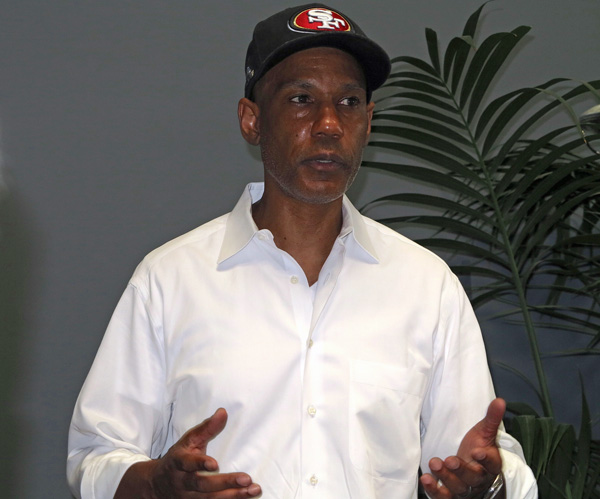
Elite Audio Systems’ Michael Woods
The SystemsWith the assistance of Allen Perkins of Spiral Groove and George Counnas of Zesto Audio, both of whom addressed attendees, Michael and Peter assembled three vastly different systems. For lower-price-point analog, Michael placed, atop an older Reference rack, a Clearaudio Emotion turntable with Verify tonearm ($1995 total) and Dynavector 20X2L moving-coil cartridge ($850). A solid-state Lehmann Black Cube SE ($399) served as phono preamplifier.
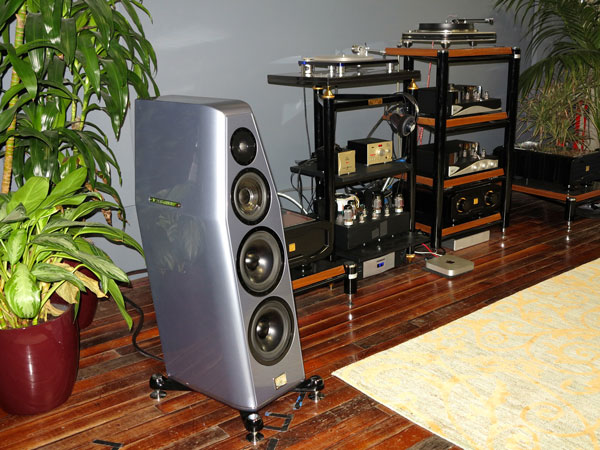
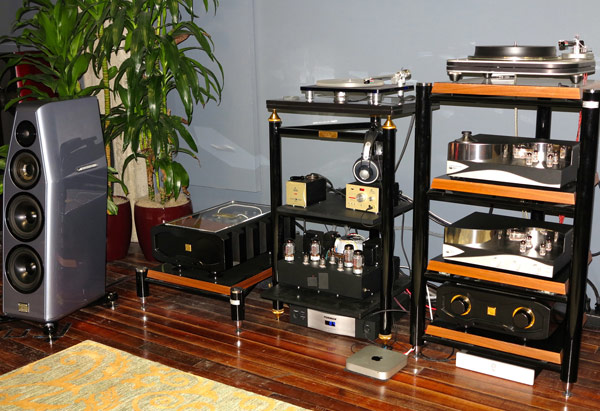 At a much higher price point, on Michael’s commercially unavailable, custom-designed German Copulare rack, sat the excellent Spiral Groove SG-1.1 table ($25,000), whose Centroid tonearm ($6000) was outfitted with another Dynavector 20X2L cartridge. The tube phono preamp was the fine Zesto Audio Andros PS1 ($4300).
Both systems fed Zesto’s Audio Zeto tube preamp ($7500) and prototype 50Wpc stereo tube amplifier (hopefully debuting at October’s Rocky Mountain Audio Fest). Using Spiral Groove phono cables, and Claris Crimson interconnects (approx. $1000/each) and speaker cables ($1200/10 ft. pair), the system terminated with the handsome Kharma DB9 Signature Edition loudspeakers ($33,000/pair).
At a much higher price point, on Michael’s commercially unavailable, custom-designed German Copulare rack, sat the excellent Spiral Groove SG-1.1 table ($25,000), whose Centroid tonearm ($6000) was outfitted with another Dynavector 20X2L cartridge. The tube phono preamp was the fine Zesto Audio Andros PS1 ($4300).
Both systems fed Zesto’s Audio Zeto tube preamp ($7500) and prototype 50Wpc stereo tube amplifier (hopefully debuting at October’s Rocky Mountain Audio Fest). Using Spiral Groove phono cables, and Claris Crimson interconnects (approx. $1000/each) and speaker cables ($1200/10 ft. pair), the system terminated with the handsome Kharma DB9 Signature Edition loudspeakers ($33,000/pair).
 BAAS also set up a somewhat lame digital vs analog comparison in which a Mac mini, outfitted with Amarra 4.5 and loaded with hi-rez files of the same music played on LP, used an MIT StyleLink Plus USB cable ($149) to feed the excellent Antelope Audio Zodiac Gold 348kHz DAC with optional Voltikus power supply ($4495 combined). I say “lame,” not only because the provenance of at least one of the digital files was unknown, but also because the cost of the digital set-up was also one sixth that of the finer analog rig. Hence, any conclusions about the sound of analog vs digital were speculative at best.
“We have two very different turntables here,” said Michael Woods before the music began. “If your system is not very high-resolving, this $1995 machine can give you a glimpse of audio heaven.”
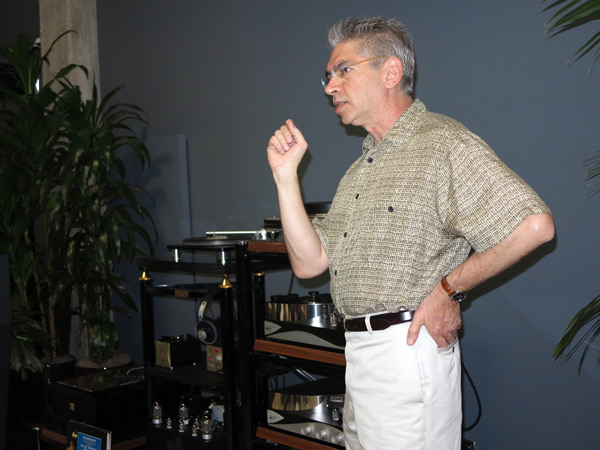
Spiral Groove’s Allen Perkins
Allen, who introduced himself as a “tinkerer,” noted that the Spiral Groove SG-1.1 has the same fundamental design as the RPM 'table he designed 20 years ago. But one crucial difference, not visible from the outside, is the SG’s far more stable bearing. “If you execute this design at a lower price point, you can’t achieve the same quality of playback,” he explained. “This bearing was manufactured by a computerized machine with a three-point laser system. You can hear the difference because of its significantly tighter tolerances. Another difference is a 70 lb platter, whose mass loading helps keep noise out.”
Noise was also one of the George Counnas’s big concerns. When he initially worked for Decca Navigator (now Raytheon) in the UK, he learned how to build tube equipment that remained quiet even when he turned the preamp’s volume all the way up.
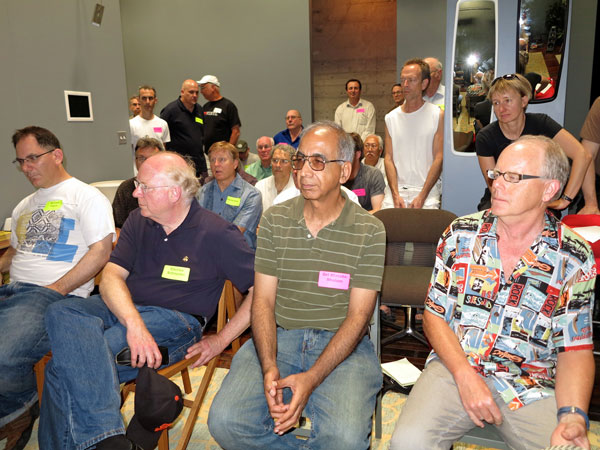
Some attendees had to sit against a dividing wall
Here is a video of my first tour of the store, in November 2012, less than a week after the official opening. I had never shot video before, and naively thought that when I turned the camera 90°, from horizontal to vertical, the video would remain upright. While some of the footage thus offers rare opportunities to view the showroom from the vantage point of a high-end ant crawling up the wall, it does show the vastness of the store, with its many nooks and crannies, and allows Michael to cogently expound upon his intentions. You also get an opportunity to hear JVS in ultra-intellectual, “oh wow” mode as I discover one more impressive system after the other.